
Prepare for the NREMT Paramedic exam by studying to the July 2024 test plan: weight your effort toward Clinical Judgment (34-38%) and Medical, Obstetrics & Gynecology (24-28%), practice the six-step processing information cycle on scenario items, learn the six item types from the official sample items, and confirm your eligibility and Authorization to Test before paying.
Which exam this is and which version applies
You are preparing for the National Registry Paramedic Certification Examination, administered by the National Registry of Emergency Medical Technicians, under the specifications in effect since July 1, 2024.
The exam determines whether EMS professionals at the paramedic level can demonstrate entry-level knowledge, skills, and abilities for competent practice. The National Registry built the current content from its 2019 National EMS Practice Analysis and a 2021 addendum.
One important change in this generation of the exam: the previous psychomotor examination was discontinued, and skills such as communication, leadership, and clinical judgment are now measured inside the cognitive exam as a dedicated Clinical Judgment domain.
Pediatric patient care is not a standalone domain. The test plan states that pediatric items are integrated throughout the exam content, so pediatric questions can appear under any domain.
Tested domains and how they are weighted
The exam samples five cognitive domains plus Clinical Judgment. Clinical Judgment and Medical, Obstetrics & Gynecology together account for roughly 58 to 66 percent of your items.
Each clinical domain samples assessment, pathophysiology, and management. EMS Operations covers vehicle and equipment operation, leadership and professionalism, communication and documentation, medical and legal standards, and the environment of care.
Clinical Judgment draws on communication and leadership in an EMS response and on each step of a six-step processing information cycle described below. The weights below come directly from the 2024 test plan.
| Content domain | Percent of examination |
|---|---|
| Airway, Respiration & Ventilation | 8% – 12% |
| Cardiology & Resuscitation | 10% – 14% |
| Trauma | 6% – 10% |
| Medical, Obstetrics & Gynecology | 24% – 28% |
| EMS Operations | 8% – 12% |
| Clinical Judgment | 34% – 38% |
Explore in 3D: Trachea and Main Bronchi
This model shows the trachea and its division into the right and left main bronchi. Only these three airway structures are present: there are no lobar branches, alveoli, or other respiratory structures, and the model shows normal anatomy with no pathology or devices.
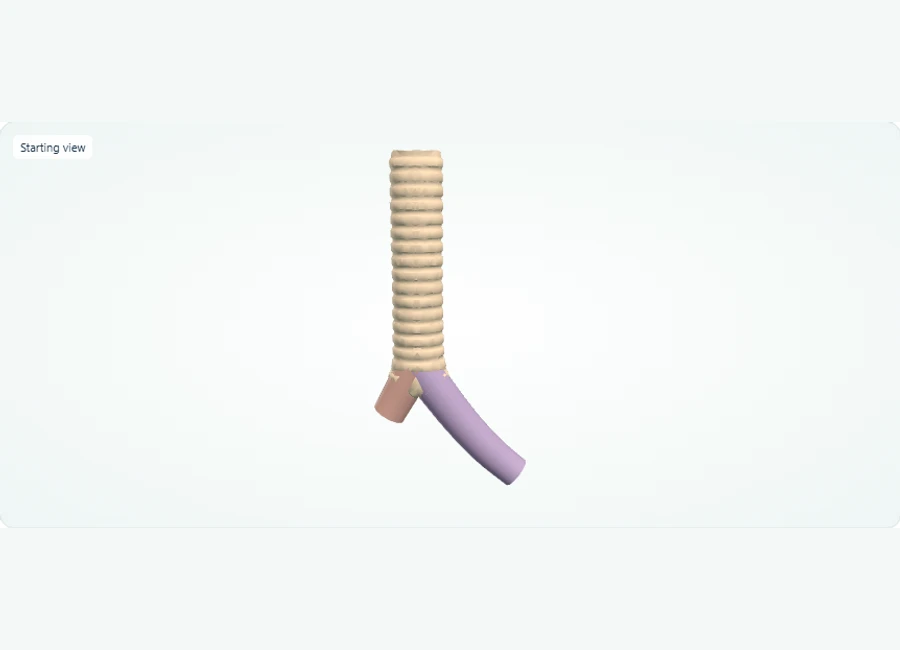
Rotate, isolate structures, and test your recall.
Set the view to front and zoom to see the whole model: the trachea is the single central tube, with the right main bronchus and left main bronchus branching from its lower end.
Select each of the three structures in turn (Trachea, Right main bronchus, Left main bronchus), using isolate to view one at a time and show all to restore the full model.
Use Test recall to hide the labels; when a structure is highlighted, name it before pressing Reveal name, then use Return to study to continue.
Practice exercise
Test recall highlights the structure branching from the lower end of the trachea toward the body's left side. Which structure is it?
Show answer
Left main bronchus
In the front view, the trachea runs down the midline and splits into two main bronchi. The branch passing to the viewer's right (the body's left side) is the left main bronchus, while the branch to the body's right side is the right main bronchus.
- The trachea is the central airway that divides into two main bronchi, one for each lung side.
- The right main bronchus and left main bronchus are the first branches off the trachea; this model contains no smaller (lobar) branches or alveoli beyond them.
- Because only three structures are selectable, identification practice here means telling the trachea from the right versus left main bronchus.
Explore in 3D: Heart chambers and great vessels
A four-chambered heart viewed from the front. The right ventricle supplies the pulmonary circulation via the pulmonary trunk; the left ventricle supplies the systemic circulation via the ascending aorta. This model shows external chamber surfaces and the visible great vessels only — no internal valves or conduction system.
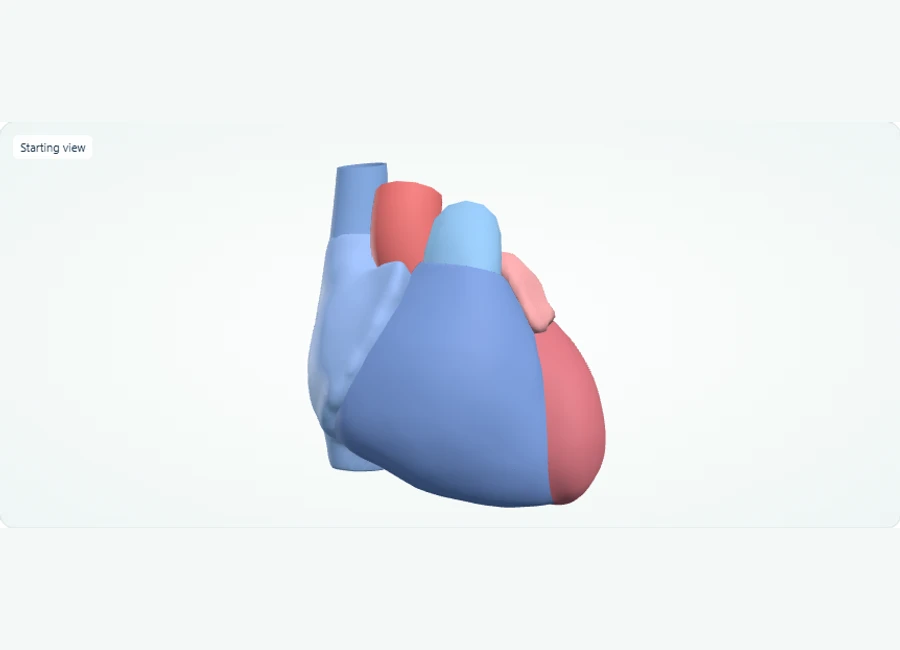
Rotate, isolate structures, and test your recall.
Choose Front and compare the four chambers. The right ventricle forms most of the anterior surface; the left ventricle contributes to the apex.
Select and isolate each chamber in turn, then use Show all to restore its relationship to the surrounding structures.
Select the pulmonary trunk and ascending aorta in turn. Name the circulation supplied by each, then use Test recall to practise identifying the listed structures.
Practice exercise
Which ventricle supplies the pulmonary trunk, and which supplies the ascending aorta?
Show answer
The right ventricle; it serves the pulmonary circulation.
On the front view, the right ventricle is the anterior-most chamber, and its outflow tract continues as the pulmonary trunk carrying blood to the lungs. The left ventricle instead empties into the ascending aorta for the systemic circulation.
- The right ventricle pumps blood into the pulmonary trunk toward the lungs; the left ventricle pumps into the ascending aorta to the body.
- The superior vena cava returns blood to the right atrium from above the heart.
- The two atria sit superior to the two ventricles; atria receive blood, ventricles eject it.
Adaptive format, length, and item types
The exam is a computer adaptive test of 110 to 150 items, including 20 unscored pilot items, with 3.5 hours allowed at a Pearson testing center.
Computer adaptive testing (CAT) means the computer selects items targeted at your estimated ability level. If it can determine pass or fail with 95 percent confidence at the minimum item count, the exam ends early; otherwise it continues until the maximum items or time is reached. The passing standard is the same for every candidate even though item difficulty varies.
All items are scored dichotomously: full credit for a correct response, no credit for a partially correct one. The exam includes six item types, and graphics such as charts and ECG rhythm strips can appear in any of them. Scenario-based items link several questions to one reading passage.
Twenty of the items are unscored pilots used to vet future questions. You cannot tell which items count, so the handbook's advice is to answer each one as if it counts.
- Multiple-choice: one correct answer out of four options
- Multiple-response: two or three correct answers out of five or six options
- Build List: place options into the order the item specifies
- Drag-and-Drop: sort options into categories the item specifies
- Options Box: classify table entries against given criteria
- Graphical and scenario-based items can use any of the formats above
Sources: National Registry Paramedic examination test plan effective July 1, 2024 — Examination specifications, content outline, administration, and sample items; Paramedic Candidate Handbook · About The Examination | National Registry of Emergency Medical Technicians — Format, ATT, scheduling, security, scoring, and retest policies
Eligibility, application, and your Authorization to Test
You need a current EMT-level license or certification, enrollment in a CAAHEP-accredited Paramedic program (or one with a CoAEMSP Letter of Review), a completed application with payment, and Program Director verification before an Authorization to Test posts to your account.
Eligibility rests on three pillars: an existing EMT or higher-level certification, and a Paramedic education program that is CAAHEP-accredited or holds a CoAEMSP Letter of Review. The National Registry accepts candidates only from these accredited programs.
The recommended sequence is to create your National Registry account once enrolled, submit your application about four weeks before you finish the program, and have your Program Director approve it when you complete course requirements. Payment is due before you can be authorized to test. If you need testing accommodations, submit that request at least four weeks before you finish your program.
Once your application, payment, and verification are complete, your Authorization to Test (ATT) typically posts within one to two business days. The ATT is valid for up to 90 days; if it expires, you must pay the application fee again for a new one. Schedule directly from your National Registry account, which redirects you to Pearson.
Sources: Paramedic Candidate Handbook · Introduction | National Registry of Emergency Medical Technicians — Certification vs. licensure and the four application steps; Paramedic Candidate Handbook · About The Examination | National Registry of Emergency Medical Technicians — Format, ATT, scheduling, security, scoring, and retest policies
Scoring, results, and retakes
Scores are reported on a 100 to 1500 scale with a passing point of 950. Results post to your National Registry account, and failed candidates may retest after 15 days, with remedial education required after three failed attempts.
Pearson staff cannot give you results; your score is posted to your National Registry account, generally within three business days. The report shows your score on the 100-1500 scale and how far it fell from the 950 passing point, which helps you plan further preparation. Passing candidates receive no item-level detail.
If you do not pass, you can reapply and pay the fee as soon as results post, but you must wait 15 days from your last exam date before testing again. You have six attempts in total.
After three failed attempts, you must complete remedial education before your fourth attempt. Options include the Paramedic 30-credit National Competency Component from the NCCP model or a CAPCE-approved or state-approved Paramedic refresher course. Upload the completed education with your fourth-attempt application.
Building your study order around the weights
The National Registry recommends your own program materials, the current AHA CPR and emergency cardiovascular care guidelines, the National EMS Education Standards, and the official sample items. Beyond that, the domain weights give you a rational study order.
Start with the issuer's own suggestions, which carry real weight because the exam items are referenced to industry-standard sources. Review the sample items in the test plan appendix so the build-list, drag-and-drop, and options-box formats hold no surprises on test day. Note that the National Registry does not recommend any particular commercial preparation materials.
As editorial study advice: because Clinical Judgment and Medical, Obstetrics & Gynecology dominate the blueprint, schedule them first and revisit them weekly. The clinical domains of Airway, Cardiology, and Trauma each carry roughly comparable single-digit weights, so cover them fully but do not let any one of them crowd out the two heavyweights. Because pediatric items appear across all domains, weave pediatric variations into each domain's review rather than treating them as a separate block.
For EMS Operations, the knowledge areas listed in the test plan, from documentation to vehicle and equipment maintenance, are a useful checklist. For Clinical Judgment, the next section shows you exactly what the exam is sampling.
Sources: Paramedic Candidate Handbook · About The Examination | National Registry of Emergency Medical Technicians — Format, ATT, scheduling, security, scoring, and retest policies; National Registry Paramedic examination test plan effective July 1, 2024 — Examination specifications, content outline, administration, and sample items
Practice the processing information cycle the exam samples
Clinical judgment items move through six steps: recognize cues, analyze cues, define hypothesis, generate solutions, take action, and evaluation. You re-enter the cycle each time the scenario setting changes.
The test plan defines this cycle explicitly, so it is fair game to practice it directly. The exercise below walks one exam-style reasoning sequence through all six steps. Do it once now, then use the same mapping when you review any scenario item: identify which step each answer option represents before choosing one.
Practice exercise
A scenario item describes a patient with sudden difficulty breathing and then asks several questions. Match each reasoning step below to its place in the six-step processing information cycle: (a) You read the respiratory rate, breathing effort, and breath sound findings given in the stem. (b) You connect those findings to the explanations the answer options imply. (c) You settle on the explanation the findings best support at this point. (d) You identify what action each answer option represents. (e) You select the option that best addresses the patient as the scenario now stands. (f) The next question reports what happened after your action, and you judge whether your choice worked.
Show answer
(a) recognize cues; (b) analyze cues; (d) generate solutions; (c) define hypothesis; (e) take action; (f) evaluation.
The test plan lists the cycle in this order: recognize cues, analyze cues, define hypothesis, generate solutions, take action, evaluation. Reading the stem's findings is cue recognition; linking findings to possible explanations is analysis; committing to the best-supported explanation defines the hypothesis; naming what each option would do generates solutions; selecting one takes action; and judging the outcome is evaluation. The plan also notes that as the clinician moves to a new setting within the EMS response, the cycle restarts, which is why a follow-up question in the same scenario often begins again at cue recognition with newly reported findings.
Mistakes that cost points on this exam
Three format facts and one reasoning habit account for most avoidable errors: no partial credit, adaptive difficulty that is not a verdict on you, unscored items you must still answer seriously, and scenarios that reward re-entering the cycle instead of holding your first impression.
Every item is scored dichotomously, so a multiple-response item with two right selections out of three earns nothing. Treat partially-correct answering as a full miss and practice the item types until selecting exactly the required number feels routine.
When the CAT serves harder items, that reflects its estimate of your ability, not a signal that you are failing. The passing standard is fixed; your job is only to demonstrate entry-level competency. Do not let rising difficulty push you into second-guessing correct reasoning.
Twenty items are unscored pilots and are indistinguishable from scored ones. Answering carelessly because a question seems odd is how candidates throw away points on items that do count.
As editorial advice tied to the test plan: when a scenario item presents new findings, treat them as a cue-recognition event and re-enter the cycle rather than defending the hypothesis you formed earlier. The Clinical Judgment domain explicitly samples the full cycle, including evaluation, so the exam is designed to reward candidates who update.
Sources: National Registry Paramedic examination test plan effective July 1, 2024 — Examination specifications, content outline, administration, and sample items; Paramedic Candidate Handbook · About The Examination | National Registry of Emergency Medical Technicians — Format, ATT, scheduling, security, scoring, and retest policies
Test-day and scheduling checklist
Verify your ATT, match your ID, respect the non-disclosure and tutorial time limits, and know the reschedule and no-show rules before appointment day.
Most avoidable losses on this exam are administrative. Run this checklist in the week before your appointment, and contact the National Registry for policy questions and Pearson for test-center questions.
- Confirm your ATT is posted, note your Registry Candidate ID and Deadline to Test, and schedule within the 90-day window
- Check that the name on your ATT matches your unexpired, government-issued ID
- Rescheduling or cancelling through Pearson costs $30; cancel at least one business day (24 hours) ahead or you risk a no-show mark and forfeited fee
- Complete the non-disclosure agreement within its 5-minute limit; if you do not, you will not be allowed to begin, it counts as an attempt, and you forfeit your fee. You then have 10 minutes for the item-type tutorial before the exam starts.
- Expect to show ID, provide a legal signature, have your photo taken, store belongings, and possibly be recorded
- Do not copy, record, discuss, or reconstruct exam content; violations can void your results and certification
- Access results only through your National Registry account, generally within three business days
Sources: Paramedic Candidate Handbook · About The Examination | National Registry of Emergency Medical Technicians — Format, ATT, scheduling, security, scoring, and retest policies; Paramedic Candidate Handbook · Introduction | National Registry of Emergency Medical Technicians — Certification vs. licensure and the four application steps
Sources
Facts checked against official National Registry documents retrieved September 2026: