
Study the NREMT AEMT exam around one organizing question: for each advanced intervention, is this in my scope, and does this patient need it now? Map the AEMT formulary and procedures against EMT and Paramedic levels, then rehearse use, defer, and decline decisions with written scenarios and self-scored documentation exercises.
Where the AEMT Scope Ends and the Paramedic Scope Begins
The AEMT credential covers basic emergency care plus limited advanced procedures and basic medications, deliberately positioned between the EMT and Paramedic levels. Studying it means mapping which interventions belong to your level and which do not.
The National Registry describes the AEMT as providing intermediate emergency care, including basic medications and limited advanced procedures, bridging EMTs and Paramedics. Turn that description into a working tool: build a three-column scope map with one row per intervention. EMT-level rows include basic airway management, bleeding control, CPR and AED use. AEMT-level additions center on vascular access for fluid administration and a short medication list. Broad medication formularies, cardiac monitoring and rhythm interpretation, and extensive advanced airway work belong to the Paramedic column.
This map matters because scenario items reward discrimination. A well-built case will offer an attractive, plausible intervention that sits outside AEMT practice, and the correct response is the best in-scope action instead: supportive care, reassessment, and timely transport. For every skill you drill, practice naming the level that owns it. When you catch yourself studying a paramedic-level drug infusion or a rhythm algorithm, stop and redirect that time to the AEMT formulary and to the judgment questions the limited scope actually creates.
| Domain | EMT | AEMT | Paramedic |
|---|---|---|---|
| Airway | Basic maneuvers, suction, bag-valve mask | Basic skills plus limited adjuncts defined by the education standards | Advanced airway management and broader airway pharmacology |
| Medications | Small set of basic, often assist-administered drugs | Basic medications plus a limited added formulary and IV fluids | Broad formulary across many routes, including IV push |
| Vascular access | Not in scope | Peripheral IV access and fluid administration within protocols | IV and IO access with broader fluid and drug administration |
| Cardiac care | CPR and AED | CPR, AED, and supportive care within protocols | Cardiac monitoring, rhythm interpretation, and advanced interventions |
Matching the Limited Formulary to Route, Patient, and Contraindication
AEMT medications form a short list, so the learnable skill is pairing each drug with its route, indication, contraindications, and reassessment plan rather than memorizing a large pharmacy.
Write one card per medication commonly taught at this level, such as IM epinephrine for anaphylaxis, naloxone, oral glucose, assisted nitroglycerin and aspirin per protocol, inhaled bronchodilators, and IV crystalloid. On each card record four things: what problem it treats, the route used at the AEMT level, the findings that must be present before you give it, and what you reassess afterward. Route and patient matching is where the limited scope gets tested: a drug you can give one way at one level may belong to a different route or a different credential entirely in another situation.
The clearest example is epinephrine. The IM dose drawn from a 1:1,000 vial for anaphylaxis is a standard medication at this level in a labeled teaching example; IV push epinephrine during cardiac arrest is paramedic practice. If your mental model links epinephrine only to a dose and not to a route paired with a patient presentation, these two items blur together. Drill the pairing, not just the number: anaphylaxis with signs of shock or airway compromise calls for the IM route at your level, and your course formulary supplies the exact adult dose to memorize once.
Illustrated practice: Bronchial Wall Inflammation and Airway Narrowing in COPD Exacerbation
Show the airway-level anatomy (narrowed, mucus-filled bronchial lumen with surrounding smooth muscle) that underlies expiratory wheezing and is the target of nebulized bronchodilator therapy.
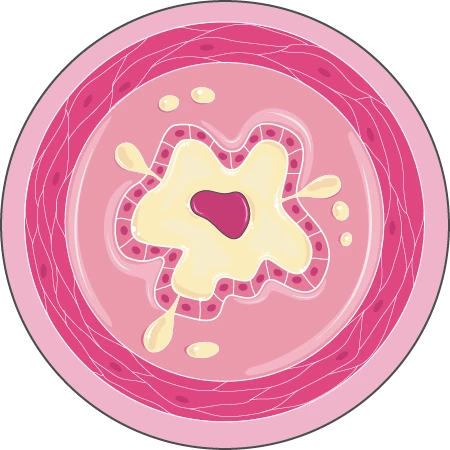
Anatomical study exhibit for the worked question below. Open the full-size view to inspect the structures.
Use the anatomical exhibit to work through the example. Choose an answer before opening the explanation.
Try it yourself
A 58-year-old man with a long smoking history reports worsening dyspnea and a productive cough over three days. He sits upright with pursed-lip breathing, a barrel-shaped chest, bilateral expiratory wheezes, and SpO2 of 88% on room air; mild ankle swelling is noted. The anatomy exhibit is an educational pathophysiology schematic of a bronchus with a thickened wall, mucus in the lumen, and surrounding smooth muscle; it is NOT this patient's imaging or evidence of his specific disease. What is the best next action? A. Position him supine and administer an isotonic crystalloid fluid bolus for suspected hypovolemia B. Perform bilateral needle chest decompression for suspected tension pneumothorax C. Administer intramuscular epinephrine immediately for suspected anaphylaxis D. Administer supplemental oxygen titrated to target saturation and nebulized bronchodilator therapy per protocol
Show answer and explanation
D. Administer supplemental oxygen titrated to target saturation and nebulized bronchodilator therapy per protocol
Gradual onset, chronic smoking history, pursed-lip breathing, and expiratory wheezing indicate a COPD exacerbation, best managed with titrated oxygen and nebulized bronchodilators per protocol. The exhibit's narrowed bronchial lumen, mucus, and thickened wall correspond anatomically to the sounds of wheezing and represent the level of the airway on which inhaled bronchodilators act via the surrounding smooth muscle. Pulmonary edema would present with crackles and orthopnea rather than a barrel chest, and anaphylaxis requires an acute allergic trigger, which is absent here.
IV Fluid Decisions: When Access Helps and When It Delays Transport
Vascular access is a tool, not a destination. The decision rule is whether establishing access and giving fluid will change this patient's condition before definitive care, and what that costs in scene time.
Worked scenario one: a stable-sounding but hypotensive adult after a motor vehicle collision, alert with abdominal tenderness, has a delay before the receiving facility. The plausible mistake is committing to the scene for repeated IV attempts, treating the cannula as the intervention. The better decision is to begin transport, perform basic shock care such as keeping the patient warm and splinting injuries, and attempt access en route where a failed attempt costs seconds of travel rather than minutes at the scene. In trauma, fluid is supportive and time to definitive care is the intervention that changes outcomes.
Contrast that with a medical patient, such as suspected dehydration with vomiting, where access during assessment is appropriate and fluid is a primary AEMT-level therapy. Practice articulating the difference in one sentence per case: this patient needs access now because fluid will change the prehospital course, or this patient needs transport now because fluid will not. That single sentence is the decision skill. In written scenarios, an option that describes repeated on-scene vascular attempts in an unstable trauma patient should read as a delay, not as thoroughness.
Reading Respiratory Distress: Bronchodilator, Epinephrine, or Neither
Before choosing a respiratory medication, classify the breathing problem: isolated bronchospasm, anaphylaxis with airway involvement, or a cause neither drug addresses, such as heart failure.
Worked scenario two: an adult with widespread hives, lip swelling, and audible wheezing after a bee sting, with a rising pulse and falling blood pressure. The tempting error is selecting the inhaled bronchodilator because wheezing dominates the picture, treating the audible symptom instead of the process. The better decision is IM epinephrine from your formulary as the anaphylaxis intervention, with the bronchodilator as an adjunct afterward if protocol allows. Epinephrine acts on the underlying allergic response affecting airway, circulation, and bronchi together; the nebulized drug only widens bronchi.
The interpretive habit to build is a two-axis check on every dyspneic patient: is this airway-circulation involvement suggesting anaphylaxis, and is this fluid overload where bronchodilators and extra fluid both work against you. Crackles, orthopnea, and a history of heart failure point away from bronchospasm and away from aggressive crystalloid. In exam stems, skin findings are the discriminating clue: hives or swelling pushes you toward epinephrine, isolated wheeze with asthma history toward the bronchodilator, and wet crackles toward positioning, oxygen, and cautious transport.
Documenting Advanced Interventions So the Handoff Holds Up
Advanced interventions create documentation duties that basic care does not: access site, fluid volume, drug, dose, route, time, and the patient's response, each recorded close to the moment it happens.
Once you start an IV or give a medication, your record must let a receiving clinician reconstruct what was done without asking you. Practice writing an intervention note in a fixed order: the assessment finding that justified the intervention, what you did including site and gauge or drug with dose and route, the time, and the reassessment that followed, including any change in the finding that prompted treatment. Times matter most for interventions because the receiving team will make decisions based on what entered the patient and when.
Documentation also closes the loop on your own clinical reasoning. A note that records wheezing before treatment and its character afterward demonstrates reassessment; a note that records only the drug given does not. Build this into practice by writing one complete note after every paper scenario you complete, not just answering the multiple-choice items. If your note would not let a paramedic or emergency nurse continue care seamlessly, revise it. This habit converts scenario practice into documentation practice and covers two content areas at once.
Consent and Refusal After an IV or Medication Is Already On Board
Refusals become more demanding once advanced care has begun. You must reassess decision-making capacity, explain what was given and what risks follow, involve medical direction per protocol, and document the informed refusal in detail.
A patient who received IV fluid or a medication and then wants to stop transport presents a different problem from a refusal before any care. Assess capacity against the specific decision: can the patient state the situation, the risks of not continuing, and a coherent alternative plan. Explain in plain language what was administered and what could still change, such as a medication wearing off. Altered mental status, significant intoxication, or an injury pattern suggesting impaired judgment can remove the option to refuse, and local protocol defines who you contact, typically medical direction.
Document the refusal as thoroughly as you would document the intervention itself: capacity findings, the specific risks you explained, the patient's stated reasoning, who was consulted, and your advice to call back if symptoms change. Offer a safe alternative such as a family member or another responsible adult remaining with the patient, when appropriate and permitted. In study terms, drill refusal items the same way you drill medication items: as condition-action pairs, here with the condition being post-intervention refusal and the actions being reassessment, explanation, consultation, and documentation.
A Two-Week Sequence with a Self-Check Rubric and Readiness Checks
Spend week one building the scope map and medication cards; spend week two drilling written cases, IV decisions, and full documentation notes, finishing with a scored self-check you can interpret honestly.
Days one to four: complete the three-column scope map from section one and write a medication card for every drug in your AEMT course formulary, including route, indication, contraindication, and reassessment. Days five to seven: work ten written respiratory and shock cases, writing the one-sentence access-and-transport decision for each before looking at answer explanations. Days eight to eleven: add trauma and anaphylaxis cases, forcing yourself to justify any advanced intervention or its deliberate omission. Days twelve to fourteen: run the chart audit exercise below and score yourself against the rubric.
Chart audit exercise: take any practice case, write the full call as you would chart it, then check for five elements: a justification sentence before each intervention, complete intervention details including site, drug, dose, and route, at least one documented reassessment, a patient response to each treatment, and a coherent handoff summary. Expected observations on a first attempt: reassessment and handoff details are usually the missing elements, which tells you exactly what to redrill. Treat the rubric score as a learning milestone, not a pass prediction.
- Self-check rubric, score one point each: scope map complete for every drilled skill; medication cards cover the full formulary with routes; access-and-transport decision sentence written for ten cases; two full intervention notes pass the five-element audit; you can state three examples of interventions outside AEMT scope and the in-scope alternative for each
- Readiness checks before test day: you can teach the epinephrine route-and-patient pairing from memory; you can explain why on-scene IV attempts in unstable trauma cost more than they buy; you can produce a complete advanced-intervention note in under ten minutes without a template
- One administrative note: scheduling, eligibility, and handbook details live with the issuer, so confirm current requirements directly on the National Registry site rather than relying on secondhand summaries
References and further reading
Use these references to explore the concepts and check the latest information from the relevant organizations.