
Treat EMR study as decision training, not fact collection. For every topic you review, write one sentence answering: what does this finding change about what I do next, in what order, and within my scope? Then test that sentence against written scenarios before worrying about recall speed.
Separating the primary assessment from the secondary assessment
The primary assessment answers 'is there an immediate life threat and what do I do about it right now?' The secondary assessment answers 'what else is going on?' Confusing the two produces either missed life threats or dangerously slow care of stable patients.
The primary assessment is a fixed, rapid sweep: general impression, level of consciousness, airway, breathing, circulation, and a decision about whether the patient is critical. Its defining feature is that each step can generate an immediate intervention. You find snoring respirations, you open the airway; you find spurting bleeding, you control it — before moving to the next step. Nothing in the primary assessment is scheduled for later if it is fixable now.
The secondary assessment is the systematic history and physical exam: vital signs, SAMPLE history, OPQRST questioning on medical complaints, and a head-to-toe or focused exam. It only proceeds after you have decided the patient has no unmanaged life threat. A practical check when studying: if you cannot say why the next exam step could not wait for an ambulance, you are probably doing secondary-assessment work on a critical patient. Drill both assessments separately, then drill switching between them when a patient deteriorates mid-scenario.
When the sequence bends: two findings that interrupt your order
Two findings legitimately reorder the primary assessment: catastrophic external bleeding and a blocked airway in an unresponsive patient. Knowing when to interrupt the standard order is the sequencing judgment that EMR practice scenarios should drill.
Consider this paper scenario: you arrive at a single vehicle with one patient, responsive only to painful stimuli, loud snoring respirations, and a forearm laceration soaking through a towel. A tempting error is working strictly 'top to bottom' on the arm because it is visible and dramatic. The better decision: address the airway first — manual opening, positioning, suction if available — because an unmanaged airway can kill within minutes, then apply direct pressure to the bleeding, then reassess. The visible wound feels urgent; the airway is the faster killer.
Now invert it: the same unresponsive patient has a thigh wound with arterial-appearing hemorrhage but a clear airway and adequate breathing. Here the sequence bends the other way. Massive external bleeding is controlled immediately, even though the airway appears intact, because circulating volume is the immediate threat. The reason this matters for study is that good practice scenarios should push you to match the intervention to the actual threat rather than recite a memorized order. Practice saying aloud, for each finding: does this threaten the airway, the pump, or the plumbing, and how fast?
Explore in 3D: Trachea and Main Bronchi
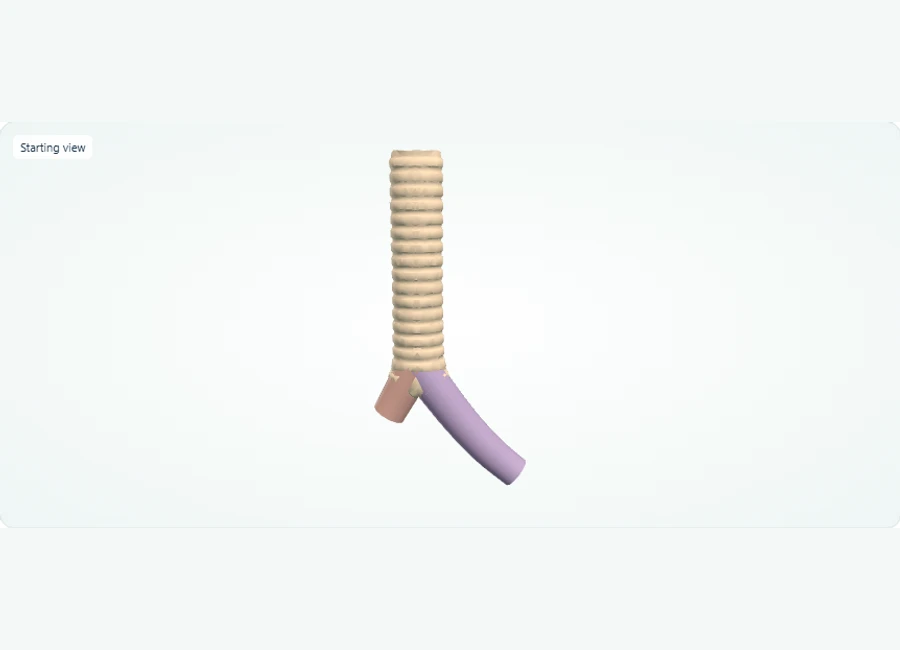
This model shows the trachea and its division into the right and left main bronchi. Only these three airway structures are present: there are no lobar branches, alveoli, or other respiratory structures, and the model shows normal anatomy with no pathology or devices.
Rotate, isolate structures, and test your recall.
Set the view to front and zoom to see the whole model: the trachea is the single central tube, with the right main bronchus and left main bronchus branching from its lower end.
Select each of the three structures in turn (Trachea, Right main bronchus, Left main bronchus), using isolate to view one at a time and show all to restore the full model.
Use Test recall to hide the labels; when a structure is highlighted, name it before pressing Reveal name, then use Return to study to continue.
Try it yourself
Test recall highlights the structure branching from the lower end of the trachea toward the body's left side. Which structure is it?
Show answer and explanation
Left main bronchus
In the front view, the trachea runs down the midline and splits into two main bronchi. The branch passing to the viewer's right (the body's left side) is the left main bronchus, while the branch to the body's right side is the right main bronchus.
- The trachea is the central airway that divides into two main bronchi, one for each lung side.
- The right main bronchus and left main bronchus are the first branches off the trachea; this model contains no smaller (lobar) branches or alveoli beyond them.
- Because only three structures are selectable, identification practice here means telling the trachea from the right versus left main bronchus.
The scope line: what an EMR performs versus supports
The EMR role, as the National Registry describes it, centers on immediate lifesaving care — patient assessment, CPR, bleeding control, and stabilization until EMTs or paramedics take over. Every scenario decision should be tested against that boundary.
Scenario: an unresponsive adult in cardiac arrest at a workplace. You start compressions, apply the AED, and it advises a shock, which you deliver, then resume compressions. Colleagues mention the patient takes a prescription medication for a heart condition. The plausible mistake is leaving the arrest to search for the pill bottle or the medication list. The better decision is continuing high-quality CPR and defibrillation — the interventions the EMR performs — and letting the arriving crew gather the medication history from family or containers. Your value in this scenario is uninterrupted resuscitation, not information collection.
The mirror-image mistake is performing beyond your level when a higher level is minutes away. Suppose a patient with a suspected spinal injury needs airway management. The EMR decision is manual in-line stabilization and opening the airway with positioning techniques that protect the spine — not improvised advanced maneuvers, and not an extended attempt at interventions you were never trained to perform. Recognizing 'this is where my scope ends and my job becomes stabilization, monitoring, and a good handoff' is itself a core EMR competency worth rehearsing. When studying any intervention, label it: perform, assist, or defer. The table below turns that labeling into a reusable decision aid.
| Intervention situation | EMR action level | Why it matters |
|---|---|---|
| Adult in cardiac arrest; AED advises a shock | Perform | Compressions and defibrillation are core EMR interventions; uninterrupted resuscitation is your contribution until handoff. |
| Unresponsive patient with an obstructed or noisy airway | Perform | Manual opening, positioning, and suction if trained and equipped address the fastest-killing threat. |
| Catastrophic external bleeding | Perform | Direct pressure and hemorrhage control are within the immediate lifesaving scope the EMR credential describes. |
| Suspected spinal injury that still needs an open airway | Modify within scope | In-line stabilization and spine-safe positioning — not improvised advanced airway maneuvers. |
| Collecting a medication history during an ongoing arrest | Defer | Higher-trained crews arriving on scene can gather it; leaving resuscitation to search costs compressions. |
| Ambulance crew arriving on scene | Hand off | Deliver a structured report of findings, interventions, and patient response; the EMR role ends at transfer. |
SAMPLE and OPQRST as decision tools, not forms to fill
SAMPLE organizes what you know about the patient's background and event; OPQRST structures the questioning of a patient with a medical complaint. Their study purpose is to change your next action, not to complete a checklist.
SAMPLE stands for signs and symptoms, allergies, medications, pertinent past history, last oral intake, and events leading to the emergency. The mistake to avoid in scenarios is collecting all six letters robotically before doing anything. On a responsive, breathing patient with no life threat, that is reasonable. On a patient whose condition is visibly changing, you take the letters that alter your care now — for example, confirming a severe allergy with a known trigger — and return for the rest while monitoring.
OPQRST applies to symptom interviews: onset, provocation, quality, radiation, severity, and time. Its study value is teaching you which answer changes urgency. Chest discomfort that began an hour ago, radiates, and is unrelieved by rest tells a different story than a sharp pain reproduced by pressing on a rib. Practice pairing each question with the decision it informs: if you cannot articulate what you would do differently based on a given answer, you are collecting data without a purpose. Write three sample patients where a single OPQRST answer should change your level of concern.
Handoff and documentation: what the next crew needs from you
Because the EMR role explicitly ends at transfer to EMTs or paramedics, your handoff is a clinical skill in its own right: a structured, concise report of findings, interventions, and patient response.
A workable handoff structure to rehearse: patient identity and age, chief problem, level of consciousness and its trend, life threats found, interventions performed, the patient's response to each intervention, and anything you were unable to assess. The common error to catch in your own practice is reporting in the order you discovered things — 'first I saw the arm, then I asked about allergies' — instead of in the order the receiving crew can use. Trend information matters most: 'was alert, now responds only to voice' changes the receiving crew's thinking more than any single reading.
Documentation follows the same logic. Record what you assessed, what you found, what you did, and how the patient responded, with times where you know them. Avoid two habits: recording opinions you cannot support ('patient is faking'), and leaving gaps where an intervention has no documented response. When studying, practice writing a five-sentence handoff for each practice scenario you complete, then check it against the question: could a crew arriving cold reconstruct what happened and why? That discipline transfers directly to scenario practice that asks what you should report.
A practice exercise: run a scene with a self-check rubric
Build one written scene, respond to it aloud as if on scene, then score yourself against five observable checks. The point is to make your decision sequence visible so gaps are diagnosable.
Exercise: write a one-paragraph scene — for example, a responsive elderly patient on the floor of a kitchen, complaining of dizziness, with a cut on the head, slurred speech, and an anxious spouse offering information. Then, speaking aloud with a timer, walk through your general impression, primary assessment, immediate interventions, the SAMPLE and OPQRST questions you would ask, and your first three handoff sentences. Speaking aloud matters because hesitations and skipped steps are silent on paper but obvious in speech.
Score yourself against this rubric: (1) Did you state a general impression before touching the patient? (2) Did every primary-assessment finding trigger either an action or an explicit 'no intervention needed'? (3) Did you touch the secondary assessment only after declaring the patient non-critical — or correctly declare the patient critical and shift to rapid intervention and handoff? (4) Did at least one history question change a decision? (5) Did your handoff include a trend, not just a snapshot? Five of five suggests you are sequencing well; three or fewer tells you which section above to re-drill. Then rewrite the scene with one changed finding — slurred speech becoming unresponsiveness — and run it again to see how your sequence adapts.
An adaptable preparation sequence from course material to scenario fluency
A practical sequence: master one clinical topic at a time through its decision points, then convert everything into timed paper scenarios, then rehearse handoffs and documentation. Repeat the loop per topic rather than saving scenarios for the end.
Week-shape the loop around your course calendar. For each clinical topic — airway, circulation and bleeding, cardiac arrest, medical complaints, trauma basics, special populations as your course covers them — first write the topic's decision list: for airway, it would include patent versus obstructed, unresponsive versus responsive, and what changes when vomiting or spine injury is suspected. Then complete several written scenarios on that single topic, then one mixed scenario that combines it with an earlier topic. This interleaving is what makes the sequencing skills above stick, because mixed scenarios force you to compare competing threats.
In your final stretch, shift emphasis from acquisition to fluency: run scenarios under time pressure, score them with the rubric from the exercise section, and rewrite every imperfect handoff. Close the loop by re-testing any topic where a rubric check failed twice. One administrative note: certification logistics such as eligibility, scheduling, and recertification requirements are set by the National Registry of Emergency Medical Technicians, so confirm current details directly with the issuer rather than relying on third-party summaries.
Readiness checks before you sit the exam: you can state the EMR scope boundary and classify any intervention as perform, assist, or defer using the scope table above; you can run a primary assessment aloud in under two minutes with an intervention named for each abnormal finding; you can explain, for two different patients, why the assessment order changed; and you can deliver a five-sentence handoff that a peer can accurately summarize. If those four checks hold across mixed scenarios, your decision-making foundation matches what this credential trains.
- Per topic, write its decision list before memorizing its fact list.
- Interleave one older topic into each new topic's scenario set.
- Re-drill any topic that fails the same rubric check twice.
- Verify all scheduling and eligibility details with the National Registry directly.
References and further reading
Use these references to explore the concepts and check the latest information from the relevant organizations.