
Study the NREMT-EMT exam by turning every practice question into a simulated patient contact: identify the life threat, complete the assessment step the stem implies, and select the action an EMT can lawfully perform right now. Audit each answer against a three-question rubric instead of only checking right or wrong.
Why chapter-by-chapter recall breaks down on scenario items
Scenario items offer several defensible actions. The difficulty is sequencing: what must happen first for this specific patient, right now. Train yourself to answer as if you walked onto the scene, not as if you are recalling a chapter.
When you study a textbook section such as airway management in isolation, your brain stores it as a topic. The exam presents the same knowledge inside a stem with a mechanism of injury, bystander comments, distracting injuries, and four answer choices that each contain a true statement. Under those conditions, topic-level memory gives you no tiebreaker between two correct-sounding actions.
The fix is a repeatable contact framework you apply to every item. Read the stem twice: once for the patient's status, once for what the question actually asks. Place the patient in your mental sequence: scene safe, general impression, life threats, intervention, priority. If two answer choices both look correct, the earlier step in the sequence usually wins, because assessment and life-threat control come before comfort care and detailed examination.
- Scene size-up: mechanism, hazards, number of patients, and needed resources before touching the patient.
- Primary assessment: level of consciousness, airway, breathing, circulation, and visible uncontrolled problems.
- History taking: SAMPLE for medical patients and OPQRST for pain when the patient can respond.
- Secondary assessment and vitals: after life threats are addressed, not before.
- Ongoing management and priority: does this patient need rapid transport or can care continue on scene per your protocols.
The EMT, AEMT, and Paramedic boundary that distractor answers exploit
Answer choices often describe valid EMS care performed at the wrong certification level. Before selecting an action, filter it through EMT-level scope: basic airway support, CPR, bleeding control, splinting, and assisting the patient with their own prescribed medications where protocols allow.
The National Registry describes the EMT as a frontline responder providing basic emergency care, including CPR, bleeding control, airway management, and patient assessment, while AEMTs add basic medications and limited advanced procedures and Paramedics add advanced medication administration and procedures. Distractor choices are frequently Paramedic-level actions wrapped around your patient's exact presentation. An intervention that is textbook-correct for the condition can still be the wrong exam answer if an EMT would not perform it.
Build the filter into your practice: after choosing an answer, name the certification level that action belongs to and say why. If you catch yourself selecting a choice that involves a full medication calculation, advanced airway placement, or cardiac drug administration for an EMT-level question, treat that as a scope error in your own reasoning and re-read the choice set. Scope filtering also matters clinically, because it keeps you practicing the decision points an EMT actually owns on a call.
| Credential | General role | Illustrative actions within scope |
|---|---|---|
| EMR | Immediate life-saving care until more trained responders arrive | Patient assessment basics, CPR, bleeding control |
| EMT | Basic emergency care and preparation for transport | CPR, bleeding control, basic airway management, patient assessment |
| AEMT | Intermediate care bridging EMT and Paramedic | EMT-level care plus basic medications and limited advanced procedures |
| Paramedic | Advanced prehospital care | Medication administration, advanced procedures, management of critical patients |
Explore in 3D: Trachea and Main Bronchi
This model shows the trachea and its division into the right and left main bronchi. Only these three airway structures are present: there are no lobar branches, alveoli, or other respiratory structures, and the model shows normal anatomy with no pathology or devices.
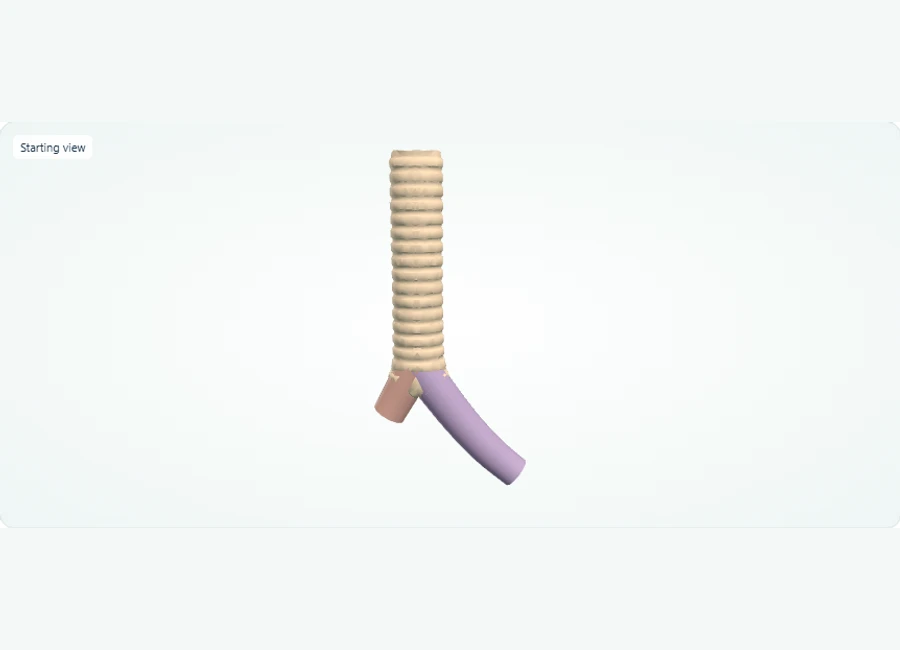
Rotate, isolate structures, and test your recall.
Set the view to front and zoom to see the whole model: the trachea is the single central tube, with the right main bronchus and left main bronchus branching from its lower end.
Select each of the three structures in turn (Trachea, Right main bronchus, Left main bronchus), using isolate to view one at a time and show all to restore the full model.
Use Test recall to hide the labels; when a structure is highlighted, name it before pressing Reveal name, then use Return to study to continue.
Try it yourself
Test recall highlights the structure branching from the lower end of the trachea toward the body's left side. Which structure is it?
Show answer and explanation
Left main bronchus
In the front view, the trachea runs down the midline and splits into two main bronchi. The branch passing to the viewer's right (the body's left side) is the left main bronchus, while the branch to the body's right side is the right main bronchus.
- The trachea is the central airway that divides into two main bronchi, one for each lung side.
- The right main bronchus and left main bronchus are the first branches off the trachea; this model contains no smaller (lobar) branches or alveoli beyond them.
- Because only three structures are selectable, identification practice here means telling the trachea from the right versus left main bronchus.
Explore in 3D: Lung lobes
This model shows the five lung lobes: three on the right (superior, middle, inferior) and two on the left (superior, inferior). The left lung has no middle lobe. Each colored lobe is a distinct selectable structure, separate from segments and bronchial branches. As a normal surface model, it shows healthy anatomy only.
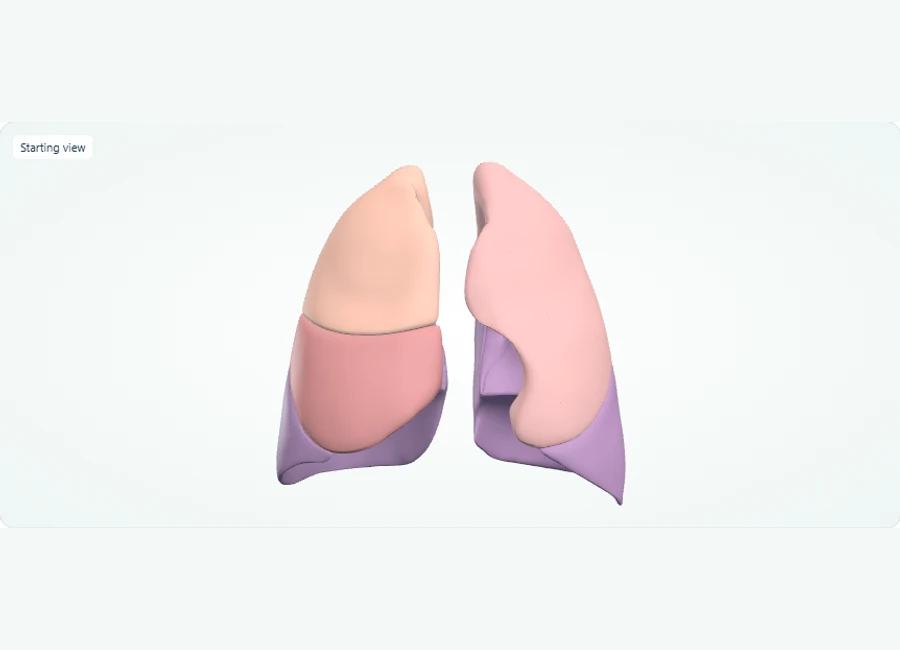
Rotate, isolate structures, and test your recall.
Choose Front. Use the Structure list to select each lobe and count three on the anatomical right and two on the left.
Select and isolate the right middle lobe, then use Show all and Back to inspect how it relates to the other right lung lobes.
Start Test recall, name the highlighted lobe, then select Reveal name to check your answer.
Try it yourself
How many lobes does each lung have, and which lobe name occurs only on the right?
Show answer and explanation
The right lung has superior, middle and inferior lobes. The left lung has superior and inferior lobes, with no middle lobe.
A lobe is a gross anatomical division of a lung. The right lung has three lobes and the left has two. These surface models show lobes, not individual bronchopulmonary segments or surgical margins.
- The right lung has three lobes: superior, middle, and inferior.
- The left lung has only two lobes: superior and inferior; there is no left middle lobe.
- Lobes are distinct from segments and bronchial branches, and a normal model shows no tumors or surgical margins.
Trauma scenario: the loud injury that hides the quiet patient problem
Trauma stems often pair a dramatic, noisy injury with quieter systemic findings. A screaming patient can still be deteriorating. Practice completing your primary assessment and circulatory checks before committing to splinting or other limb-focused care.
Scenario: an unrestrained driver of a low-speed collision is alert, screaming about a visibly deformed ankle, with pale cool skin, a delayed capillary refill, and a rapid weak radial pulse. The tempting answer is to splint the ankle first because it is the obvious complaint. The better decision is to control any external bleeding, address circulation and shock concerns, keep the patient warm, and prioritize packaging and transport decisions before detailed splinting, recognizing the systemic findings as the more urgent problem.
Why it matters: the deformed ankle is a peripheral problem, while pale, cool skin with delayed refill and a weak rapid pulse points toward compromised perfusion that can worsen. Exam items reward the candidate who notices that the presenting complaint and the most urgent problem are not always the same thing. Build the habit in practice: whenever a stem shows a dramatic local injury, deliberately scan the vitals and skin signs for systemic findings before selecting an intervention.
Medical scenario: altered mental status and the airway before the intervention
Medical stems test whether you match an intervention to the patient's current ability to protect the airway. A classic trap is giving an oral intervention to a patient with a decreased level of consciousness who cannot swallow safely.
Scenario: a family reports that a drowsy, confused relative with diabetes may have taken too much insulin. The tempting answer is to administer oral glucose immediately because hypoglycemia explains the picture. The better decision is to assess the patient's airway and ability to swallow first: if the patient cannot protect the airway, manage it with basic airway techniques, position appropriately, suction as needed, and move toward transport, with any glucose administration reserved for a patient who is awake enough to swallow safely under your protocols.
Why it matters: an intervention that is correct for the underlying condition becomes harmful when applied to a patient at risk of aspiration, and the exam encodes that conditional logic. When you study medical conditions, write each basic-level intervention with its precondition attached, for example an oral intervention requires an intact swallow. In drills, pause on every altered-mental-status stem and state the patient's swallow and airway status aloud before you touch the answer choices.
A rubric drill that audits how you chose, not just what you chose
Score practice items on process, not outcome. For each of ten scenario questions, record your chosen action, its certification level, and whether you sequenced assessment before treatment. A repeatable audit shows exactly which reasoning step needs work.
Run the drill in one sitting: pick ten scenario-style questions on your weakest content area, answer them timed, then reopen each one and complete the rubric below before revealing the answer key. This converts a passive answer check into a decision audit, and it surfaces patterns that a raw score hides, such as consistently skipping a circulatory check or drifting toward out-of-scope interventions.
Expected observations after one full run: most process errors cluster in one or two rubric rows rather than spreading evenly, and your accuracy usually improves on the second set before your score does. Repeat the drill weekly with fresh items and compare which row your errors moved to. If a row stays red for two sessions, that row, not the topic overall, is your next focused study target.
- Sequencing: Did I identify the life threat before considering any treatment choice? Yes or no.
- Assessment first: Did I confirm the primary assessment step the stem implies before acting? Yes or no.
- Scope check: Is my chosen action within EMT-level practice as I understand it? Name the level.
- Precondition check: Does my intervention require a precondition (such as a safe swallow or an open airway) that the patient does not meet? Flag any mismatch.
- Priority call: Could I state in one sentence whether this patient needs rapid transport priorities or continued on-scene care?
An adaptable four-week preparation sequence for scenario reasoning
Sequence your preparation so framework building comes first, scope filtering second, mixed timed practice third, and error-pattern review last. Adjust the duration to fit your schedule; the order matters more than the calendar.
Week one: rebuild your content around the contact framework, mapping each disease and injury topic to its assessment findings, basic-level interventions, and intervention preconditions rather than as isolated facts. Week two: run the scope filter, drilling item sets where you label every answer choice as EMT, AEMT, or Paramedic level and justify the label in one sentence.
Week three: mixed timed sets, applying the rubric drill from the previous section across all content areas so your sequencing habit holds under time pressure. Week four: error-pattern review only. Re-run the ten items you scored worst on the rubric, rewrite the one decision step you got wrong in your own words, and finish with a small fresh mixed set to confirm the pattern moved. Candidates preparing alongside work or coursework can stretch each week across two; keep the phases in order.
Readiness checks to run before you schedule the exam
You are ready to schedule when your process audit is clean, not when your raw score plateaus. Use these concrete self-checks as learning milestones; they measure your decision habits and are not a prediction of any score.
Run these checks on a fresh twenty-item mixed set you have never seen. First, sequencing check: on every item, you can name the life threat before selecting an answer, and you never chose a treatment option before an assessment option when both were correct. Second, scope check: you labeled every selected action correctly as EMT-level or flagged it as beyond EMT scope.
Third, rubric check: your ten-item drill produces at most one process error across all rows, and no single row has failed in two consecutive sessions. Fourth, explanation check: for any item you answered correctly, you can explain why the two nearest distractors were wrong in one sentence each. If you cannot do the fourth check, your correct answers may still be pattern-matching, so return to the rubric drill before booking. For administrative details such as scheduling and eligibility, rely on the National Registry's own site.
- Sequencing milestone: life threat named first on every item in a fresh set, with zero assessment-after-treatment errors.
- Scope milestone: every selected action correctly labeled EMT-level across a full mixed set.
- Rubric milestone: ten-item drill with one or fewer process errors and no repeat failure in any single rubric row.
- Explanation milestone: for every correct answer, the nearest distractors can be ruled out in one sentence each.
References and further reading
Use these references to explore the concepts and check the latest information from the relevant organizations.