
Preparing for the BCETMB calls for a different study method than entry-level review: the credential is designed to demonstrate advanced assessment and critical thinking, so your practice should mirror that. Instead of drilling isolated facts, build your sessions around decision points—screening a client history, interpreting an assessment finding, choosing whether to proceed, modify, or refer, and writing the reasoning down. Work through one full case scenario per study session, state your decision out loud, and then grade your reasoning against a rubric. Start with the screening scenario in Section 2 and the four-week sequence in Section 7.
Why BCETMB Preparation Should Center on Clinical Judgment
NCBTMB describes Board Certification as a credential demonstrating advanced assessment and critical thinking abilities. That framing means your study time is best spent practicing decisions, not re-reading definitions you likely already know.
Consider the difference with a single example. Recall-level knowledge says anticoagulant medication increases bleeding risk; that is a definition. Judgment-level knowledge decides what to do when a client on such medication requests deep pressure on a recently bruised thigh. The second version requires you to weigh the finding, choose an action, and explain why—three steps a flashcard never asks you to take.
To convert your existing knowledge into judgment practice, take every fact you review and attach a decision to it. For contraindications, write the modification, not just the warning. For assessment findings, write what each finding changes about your plan. For ethics standards, write the exact words you would say to a client. A fact without a decision attached is passive; a fact paired with a decision is exam-ready and practice-ready.
- Recall question shape: 'Which condition contraindicates deep work?'
- Judgment question shape: 'Given this intake, what do you do next, and why?'
- Conversion habit: after every review topic, write one client situation it changes
Screening Red Flags Before You Plan Any Treatment
Worked scenario: a new client on anticoagulant medication reports easy bruising and asks for deep tissue work on a bruised thigh. The correct decision sequence is screen, modify, communicate—not comply with the request.
The plausible mistake is treating the client's stated preference as the treatment plan: applying deep pressure because 'deep tissue was requested.' A better decision is to recognize the combination—anticoagulation plus visible bruising plus reported easy bruising—as a finding that changes the plan. Appropriate responses include reducing pressure, avoiding the bruised area entirely, checking whether a physician has cleared massage, and documenting both the finding and the adjustment. The decision matters because tissue damage from aggressive work on compromised tissue is a safety outcome, not a comfort preference.
Train this with a rule you can apply under pressure: name the finding, state the risk, choose the modification, record it. Practice by writing three intake summaries of your own construction—one straightforward, one with a medication flag, one with a symptom flag—and script your first three sentences to each client. The exam scenario rewards the candidate who adjusts the plan visibly; the practicing therapist protects the client the same way.
Explore in 3D: Right Arm and Forearm Bones
Identify the three long bones of the right upper limb: the humerus in the arm, and the radius and ulna in the forearm. Learn their left-right relationship in anatomical position, which is a common exam question.
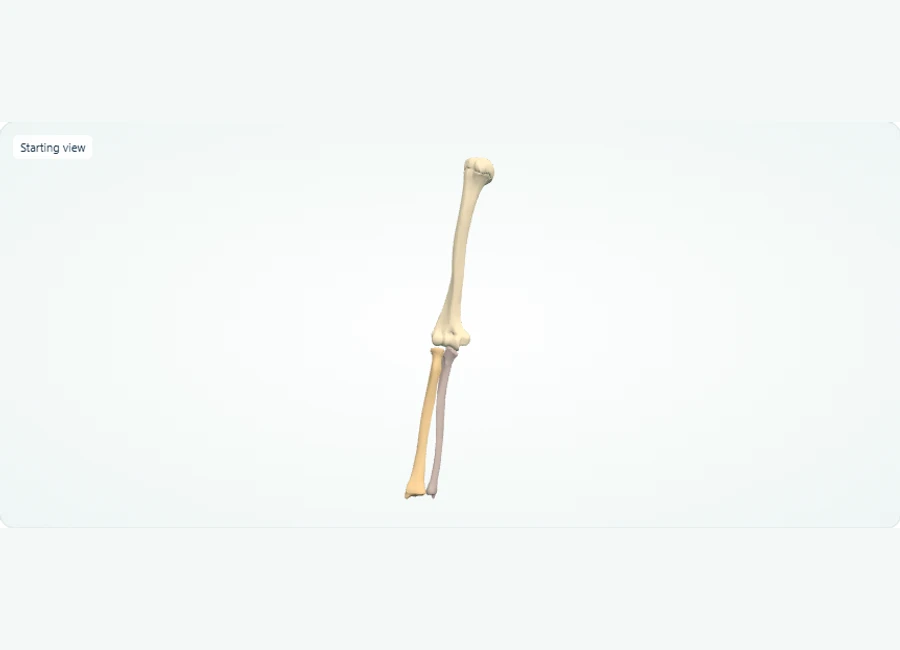
Rotate, isolate structures, and test your recall.
Drag to rotate the model to the front view and zoom in so all three bones are visible. Select the Right humerus to highlight the single arm bone; note it is the only bone between shoulder and elbow.
Isolate the Right radius, then show all and hide the radius to compare it with the Right ulna. In anatomical position, confirm the radius lies lateral (thumb side) and the ulna medial.
Use Test recall to hide the names and highlight a random bone. Guess its name, then Reveal name to check yourself, and Return to study to continue.
Try it yourself
In anatomical position, which forearm bone lies on the lateral (thumb) side of the right forearm?
Show answer and explanation
The radius
With palms facing forward in anatomical position, the radius sits laterally on the thumb side, while the ulna is medial on the little-finger side. Reversing this relationship is a common mistake, so test it on the model before your exam.
- The humerus is the single bone of the arm, spanning shoulder to elbow.
- The forearm has two bones: the radius and the ulna.
- In anatomical position the radius is lateral (thumb side) and the ulna is medial.
Explore in 3D: Right knee: bony relationships
A right knee shown as four whole bones — femur, tibia, fibula and patella — in anatomical position. This model teaches which bone sits where around the knee, not soft-tissue joint anatomy: no menisci, cartilage, cruciate ligaments or tendons are included.
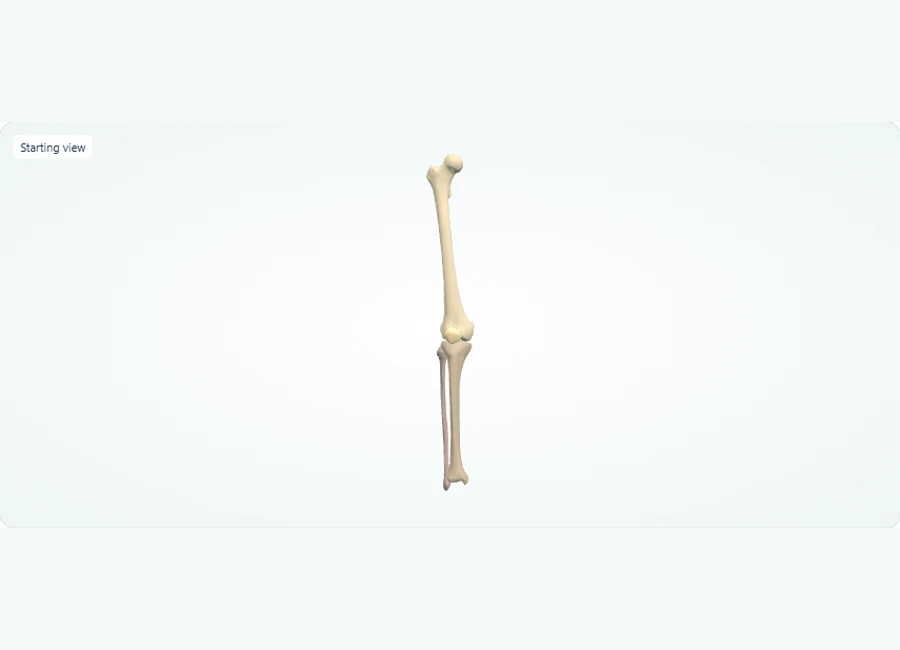
Rotate, isolate structures, and test your recall.
Compare Front, Back and Side views. Whole bones are included, so zoom and pan toward the knee region.
Select and isolate the patella to inspect it. Use Show all, then select and hide the patella to inspect the femur and tibia near the knee.
Use Show all and Test recall. Identify the highlighted bone, using the fibula’s lateral position and patella’s anterior position as clues.
Try it yourself
Which leg bone lies lateral to the tibia, and where is the patella relative to the knee?
Show answer and explanation
The fibula lies lateral to the tibia. The patella lies anterior to the knee.
In anatomical position, the fibula is the slender lateral leg bone, beside the larger tibia. The patella lies in front of the distal femur. These are bony relationships; the model does not include joint cartilage, menisci or ligaments.
- In anatomical position the fibula is the lateral bone of the leg, so it is your orientation landmark for left/right.
- The patella lies anterior to the femur–tibia articulation, so it appears at the front in a front view and overlaps the distal femur in profile.
- The knee region contains four bones here: femur above, tibia and fibula below, patella in front; joint soft tissues are not part of this model.
Interpreting Assessment Findings: Local Pain Versus Referral Patterns
Worked scenario: a desk worker presents with shoulder pain plus tingling into the forearm and fingers. Treating only the local shoulder muscles misses the pattern; the tingling changes your interpretation and your plan.
The plausible mistake is anchoring on the client's words—'my shoulder hurts'—and building the entire session around the deltoid and trapezius. The better decision is to notice that symptoms crossing into the extremity, especially with numbness or tingling, suggest the pattern may not be purely local muscular. That observation should prompt gentle assessment of neck movement and symptom behavior, a more conservative session, and a recommendation to seek medical evaluation if the neurological symptoms persist or worsen. It matters because working aggressively on a local hypothesis when the pattern points elsewhere can aggravate the underlying issue and delay appropriate care.
Use a comparison table to sharpen this distinction during review. For each practice case you write, classify the presentation into one row, then justify the classification in one sentence. If you cannot justify it, your knowledge is still at the recall stage. This same classification habit transfers directly to case-analysis questions, where the scenario details—symptom location, quality, and behavior—are the evidence you argue from.
| Feature | Likely local muscular presentation | Referral or red-flag pattern |
|---|---|---|
| Symptom spread | Stays near the treated region | Extends into a limb or follows a distribution away from the site |
| Sensory changes | Aching, soreness, stiffness | Numbness, tingling, or burning in a defined pathway |
| Response to positioning | Eases or worsens predictably with local movement | Reproduced by positions affecting the spine or nerve pathways |
| Reasonable session response | Targeted local work, moderate pressure | Conservative work, avoid aggravating positions, recommend medical evaluation |
Adapting Technique Parameters for Special Populations
For pregnancy, older adults, and clients with chronic illness, the teachable pattern is the same: adjust pressure, positioning, and session structure rather than defaulting to either routine technique or refusing treatment outright.
Contrast the two failure modes directly. One failure is running a standard deep-pressure session unchanged for a client in later pregnancy or a frail older adult, ignoring positioning needs and tissue tolerance. The opposite failure is treating the population label as a blanket contraindication. The trained middle path is parameter thinking: ask what pressure level, what positioning support, what session length, and what positioning or draping changes this specific client's situation requires, then justify each parameter in your plan.
Practice this by building a modification grid from your review materials. For each special population, list at least three parameter adjustments and one indication to obtain provider clearance or decline specific work. Grade yourself with a rubric: a complete answer names the population, the parameter changed, the reason tied to that population's physiology or circumstances, and the documentation line recording it. If your answer only says 'be gentler,' you have not yet demonstrated the applied reasoning the credential is meant to certify.
- Parameter 1 — pressure and depth: what tissue or condition limits it here?
- Parameter 2 — positioning and support: what props or positions does this client need?
- Parameter 3 — session structure: duration, pacing, and post-session monitoring
- Parameter 4 — communication: what must be confirmed with the client or their provider first?
Writing Documentation That Shows Your Reasoning
A SOAP note is a record of decisions, not a diary. The common writing habit that weakens notes is mixing observations with opinions; the fix is keeping subjective, objective, assessment, and plan clearly separated.
Compare two note fragments. 'Client seemed tense, gave a good massage, will continue next week' mixes categories and proves nothing. 'Client reports neck tightness rated 6/10 (S); forward head posture observed, left rotation limited (O); plan: 30 minutes focused cervical and upper thoracic work, moderate pressure, reassess rotation post-session (P)' allows any reader—exam grader or covering therapist—to reconstruct your thinking. Notice the plan includes parameters and a follow-up check, which is where reasoning becomes visible.
Build the habit with a timing drill: after each practice scenario, write the note in five minutes without looking back at the scenario text, then check which category each sentence belongs to. Sentences that mix categories get rewritten. Then audit for the three elements that make a note defensible: a specific baseline observation, a stated rationale linking observation to technique choice, and a measurable recheck. If your recheck says only 'reassessed,' redo it—'reassessed' must mean the same measurement you took at baseline.
Resolving Ethics Conflicts: Boundaries, Gifts, and Scope
Worked scenario: a long-term client invites you to a family celebration and offers a substantial gift. The decision framework is role clarity: separate the therapeutic relationship from personal roles, and address it openly.
The plausible mistake is deciding purely on feelings—accepting because the relationship feels friendly, or refusing coldly and damaging rapport. The better decision applies a framework: identify the dual-role issue, consult your professional standards of ethics, and respond with a clear, kind boundary statement, such as appreciating the invitation while explaining that you keep professional and personal roles separate. A modest token may be handled differently under your standards than a significant gift; the point is that your answer comes from an articulated standard, not improvisation. It matters because undefined boundaries erode the trust the professional relationship depends on.
A second scope scenario sharpens the same skill: a client asks you to diagnose persistent numbness or to advise them to stop a prescribed medication. The correct move is to stay within your role—describe what you observed, decline to diagnose or modify medical treatment, and recommend they consult their physician. Rehearse your boundary language aloud until it is automatic. In case-style questions, the option that names the standard being applied and preserves the client's dignity is the choice that demonstrates professional judgment.
A Four-Week Preparation Sequence with Readiness Checks
A realistic adaptable sequence: week one, screening and red flags; week two, assessment interpretation and adaptation; week three, documentation and ethics; week four, full case integration and self-assessment against a rubric.
Practical exercise for weeks one through three: write three original case scenarios per week from your review materials, each with an intake summary and one decision point. For each, record your decision, your stated rationale, and a self-grade on this rubric—0 points if you named no relevant finding, 1 point if you named the finding but no modification, 2 points if you named both, 3 points if you also stated the reason and the documentation line. Expected observation: your week-one scores cluster at 1 to 2, and by week three most scenarios score 3. If a topic stays at 1, that is your signal to re-study it before integration week.
In week four, combine everything: one complete case per day covering screening, assessment interpretation, parameter choices, a SOAP note, and one ethics element, completed in a single sitting. Readiness checks before you finish: (1) you can classify any practice presentation as local, referral-pattern, or clear-red-flag within a minute and justify it; (2) your written notes consistently contain baseline, rationale, and measurable recheck; (3) your rubric scores hold at 3 across three consecutive integrated cases; (4) you can state your boundary response to a gift or scope challenge verbatim. These are learning milestones showing your reasoning is complete—not a prediction of any score. For current eligibility requirements, application steps, and administrative details, consult NCBTMB directly at ncbtmb.org.
References and further reading
Use these references to explore the concepts and check the latest information from the relevant organizations.