
Prepare for the ABA pathway by treating BASIC, ADVANCED, and APPLIED as three depth levels over the same clinical material rather than three separate syllabi. For each major topic, practice stating the underlying mechanism, justifying management choices, and sequencing decisions inside a timed case, then verify administrative details directly with the ABA.
Why one study method fails across the ABA's three exam stages
The ABA structures initial certification as three sequential exams — BASIC, ADVANCED, and APPLIED — and each stage rewards a different kind of answer, so a single passive-review method mismatches at least two of the three.
The ABA describes its initial exams as a series of three: BASIC, ADVANCED, and APPLIED, taken on the way to certification. That structure gives you a planning tool. A mechanism you memorized for BASIC reappears at ADVANCED as a justification for a clinical choice, and again at APPLIED as one decision inside a longer case with competing priorities and a communication element.
Build your notes around that progression from the start. For each topic, keep three labeled layers: the mechanism or science, the rationale connecting that mechanism to a management decision, and the sequence in which decisions unfold under time pressure. When you review, cycle through all three layers rather than rereading a single summary. This converts one set of source material into preparation for the whole pathway instead of three separate campaigns.
- BASIC orientation: state mechanisms, definitions, and science precisely.
- ADVANCED orientation: connect mechanisms to why a clinical choice is correct.
- APPLIED orientation: order interventions, manage competing priorities, and communicate reasoning.
| Stage | What your review should produce | Practice format that fits | Mismatch to avoid |
|---|---|---|---|
| BASIC | Accurate mechanism statements and definitions you can reproduce cold | Short-answer self-testing on science and pharmacology | Reading long clinical vignettes before mechanisms are solid |
| ADVANCED | Causal chains from mechanism to management rationale | Explaining why an intervention fits a described physiology | Memorizing intervention lists without the linking rationale |
| APPLIED | Ordered decision sequences with contingencies and communication | Timed case stems and station-style spoken responses | Re-reading notes instead of performing decisions aloud |
Staging one topic in three depths: hypoxemia during one-lung ventilation
Take a single topic, such as hypoxemia during one-lung ventilation, and deliberately rewrite it at BASIC, ADVANCED, and APPLIED depth. The plausible mistake is answering every depth with the same reflexive intervention.
Scenario one. A paper stem describes a patient under general anesthesia for thoracic surgery in the lateral position; after initiation of one-lung ventilation, arterial oxygen saturation drifts downward. At BASIC depth, your answer is mechanistic: describe hypoxic pulmonary vasoconstriction, how it redirects blood away from non-ventilated lung, and which anesthetic and physiologic conditions blunt it. A plausible mistake here is jumping straight to a ventilator adjustment, because the question is asking for science, not management.
The better decision is to match the answer to the depth. At ADVANCED depth, the same stem asks why a particular intervention helps: you justify raising inspired oxygen or applying positive airway pressure to the operative lung by tracing the effect through shunt fraction and vasoconstrictor tone. At APPLIED depth, the stem adds time pressure, prior steps, and a distractor — say, a tempting but context-poor option — and you must order your actions and state what you would reassess. Why it matters: a candidate who only owns the reflexive intervention produces a strong BASIC answer and a weak APPLIED answer from identical knowledge.
Visual anatomy review: Trace the airway branches
Trace the main bronchi when reviewing the one-lung ventilation scenario.
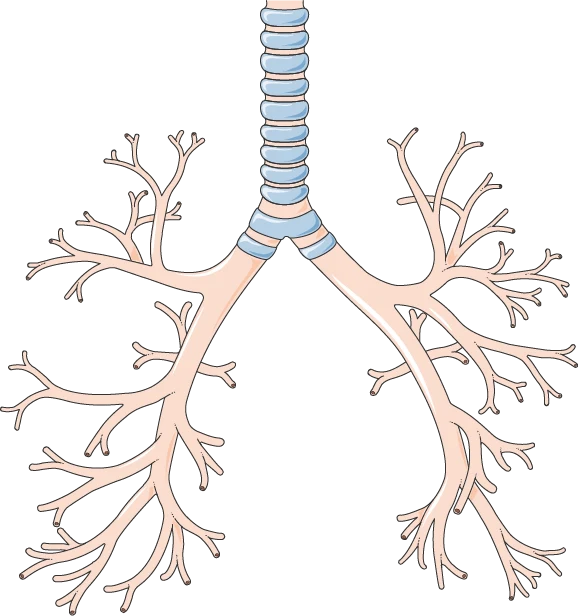
A normal bronchial tree schematic. It shows branching airways, not a chest radiograph, a tumor, or the external boundaries of the lung lobes.
The trachea divides into the main bronchi, which branch within the lungs. Distinguish the airway being entered from the lung tissue being examined or removed. A schematic cannot establish a patient’s lesion location or laterality.
In Z-Anatomy, locate the trachea and main bronchi, then compare them with the right and left lungs. Rotate the model and describe the airway route separately from the external lung surface.
Try it yourself
What structures immediately follow the trachea on the route into the lungs? Does a normal airway diagram establish which side has a lesion?
Show answer and explanation
The right and left main bronchi. No: lesion location must come from the patient’s findings and documentation.
The airway map helps organize anatomy, while the scenario supplies the evidence about disease, intervention and side.
Sequencing decisions in case stems: the intraoperative anaphylaxis pattern
Case-analysis questions reward ordered reasoning, not isolated facts. Practice with a scenario such as intraoperative anaphylaxis, where the plausible mistake is selecting correct drugs in a wrong or unweighted order.
Scenario two. A paper stem describes hypotension and bronchospasm shortly after induction of anesthesia, with a rash noted by the surgeon. The facts are individually familiar, which is exactly why this stem is hard: every option looks defensible. The plausible mistake is answering with a memorized drug and dose while skipping the ordering logic — stopping the likely trigger, calling for help, and prioritizing epinephrine titration while managing ventilation — so the response reads as fragmented rather than as a coherent resuscitation.
The better decision is to practice writing or speaking a numbered sequence, then attach each factual detail you know to the step where it belongs: the mediator and mechanism knowledge to the recognition step, the pharmacology to the treatment step, and follow-up considerations to the disposition step. Why it matters: case stems evaluate whether your knowledge is organized for use under pressure. A fact filed in the wrong step is functionally absent during the case, no matter how well you can recite it in isolation.
- Read the stem once for the problem, once for the constraints already fixed by the scenario.
- Draft an ordered plan before looking at options, so distractors compete with your sequence, not with each other.
- Name your reassessment point: what finding would change your next step.
Getting ready for OSCE-style stations on the APPLIED exam
The APPLIED exam includes station-based assessment, and the ABA has publicly announced work on an additional OSCE station pilot for its 2027 APPLIED exams, so spoken, structured performance deserves its own preparation track.
A station differs from a written stem in that you are producing structured spoken responses in a defined block of time, often to a standardized colleague or scripted prompt. Knowledge you would recognize on paper can stall when you must generate it aloud in order. Treat communication as a testable skill: opening with your read of the situation, stating an ordered plan, and closing with a check-back question or a stated follow-up.
Train this with a partner using ordinary clinical scenarios — an abnormal laboratory value to explain to a surgeon, a postoperative complication to hand off, a family question about risk. The partner's job is not to test knowledge but to interrupt and add new information mid-response, forcing you to update your plan verbally. Record yourself once per week and listen for hesitations, unordered lists, and jargon used without explanation. This is the layer of APPLIED preparation that note-based review cannot reach.
Sequencing your preparation across the pathway without wasting early effort
A realistic sequence front-loads mechanism work for BASIC, converts it into rationale chains for ADVANCED, and reserves timed case and station practice for the APPLIED stage, while keeping one living error log.
An adaptable sequence: first, build a topic list from your training curriculum and a core anesthesiology text, not from guesses about question content. Second, work each topic to BASIC depth with closed-book self-explanation of mechanisms. Third, for the ADVANCED stage, rewrite those topics as if/then rationale chains — if this physiology is present, this intervention follows because. Fourth, at the APPLIED stage, convert chains into timed case stems you write yourself or draw from practice material, and rehearse them aloud with contingencies.
Keep a single error log across all stages with three columns: the fact or step I missed, the depth it belongs to, and the fix I will rehearse. Reviewing the log weekly is more valuable than expanding your notes, because repeated misses cluster around depth mismatches — a BASIC fact dragged into an APPLIED answer, or a sequence performed as a list of unrelated facts. The log makes that pattern visible before the exam does.
- Phase one: topic list plus mechanism mastery for the BASIC stage.
- Phase two: rationale chains and comparison of competing interventions for ADVANCED.
- Phase three: timed cases, spoken station rehearsal, and contingency drills for APPLIED.
- Throughout: weekly error-log review instead of passive rereading.
A practical exercise: the three-depth rewrite with a self-check rubric
Once a week, take one clinical topic and write it at all three depths yourself, then score it against a rubric. Expected observations are depth mismatches and sequencing gaps, not knowledge gaps.
The exercise: choose one topic — for example, acid-base interpretation, neuromuscular blockade reversal, or postoperative delirium. Write a five-line BASIC summary of the science, a three-step ADVANCED rationale chain linking that science to a management choice, and a short APPLIED case with two contingencies and a closing communication element. Budget under an hour. As you work, check your own output against the expected observations: a chain step you cannot justify without notes is a depth mismatch, and an APPLIED case with no reassessment point is a sequencing gap.
Score each layer against this rubric: two points if you reproduced it closed-book, one point if you needed notes, zero if you could not complete it. A self-check total below four out of six on any layer marks that topic for the following week's review. These scores are learning milestones for your own tracking, not predictions about exam performance. Repeat on a rotating topic list so that within several weeks every major rotation area has passed through all three depths at least once.
- Closed-book completion of all three layers: 2 points per layer.
- Completion with notes: 1 point; unable to complete: 0 points.
- Any layer under 2 points becomes next week's review topic.
Concrete readiness checks before you schedule each stage
You are ready to move between stages when you can pass specific behavioral checks: explain the pathway, produce rationales on demand, run a timed case aloud, and show a shrinking error log.
Use these checks rather than a feeling of familiarity. First, you can describe in your own words what the BASIC, ADVANCED, and APPLIED exams each demand and how MOCA Minute continuing certification differs from initial certification — if you cannot, review the ABA's own materials. Second, given any topic from your list, you can produce a mechanism, a rationale chain, and an ordered case sequence within a few minutes without notes. Third, you have completed timed practice cases and at least one recorded spoken station rehearsal with a partner.
Fourth, your error log shows repeat categories declining across consecutive weeks — the fix entries referencing old misses are getting shorter because the same gaps are not recurring. If any check fails, that check tells you which phase of the preparation sequence to re-enter, which is the practical value of organizing your study by depth from the beginning. For scheduling, eligibility, fees, and format details, rely on the ABA directly rather than on secondary summaries, since administrative specifics change.
- Can explain all three exam stages and continuing certification in your own words.
- Can generate mechanism, rationale, and case sequence for any listed topic without notes.
- Has a recorded spoken rehearsal and a declining repeat-error count in the log.
- Administrative details such as scheduling and eligibility confirmed on theaba.org.
References and further reading
Use these references to explore the concepts and check the latest information from the relevant organizations.