
The FSMTB describes the MBLEx as a measure of entry-level standards for safe and competent massage practice. Build readiness by practicing one repeated decision on exam-style drills: given a client presentation, decide whether to adapt the treatment, avoid a region or technique, or refer out, and justify it with anatomy, contraindication classification, and scope of practice.
Turning condition lists into adapt, avoid, or refer decisions
Study each condition as a decision about a treatment choice, not a definition. Practice turning every condition you review into an adaptation, avoidance, or referral answer with a stated reason.
When you study a condition such as varicose veins, diabetes, or a healing fracture, the memorized definition is only half the work. For each condition in your notes, force three answers: what can be adapted (pressure, position, duration, technique), what must be locally avoided (a region or tissue state), and what requires physician clearance or referral. This drill converts passive familiarity into the applied judgment that entry-level safe practice standards describe, and it exposes gaps that definition cards hide.
The FSMTB describes the MBLEx as a measure of entry-level standards for safe and competent practice, scored on a criterion-referenced, pass/fail basis and delivered by computer-adaptive testing. Practically, that means your preparation target is a defined standard of safe judgment, not a ranking against other candidates. Build your flashcards around action verbs: compress, elevate, avoid, shorten, reposition, refer. A card that says 'varicose veins: avoid direct deep pressure over the vessels; light work proximal may support venous return' rehearses a decision; a definition card does not.
Classifying contraindications: systemic versus local changes your whole answer
A systemic contraindication affects whether you treat at all or need clearance; a local one affects where and how you work. Classify first, then choose the response. Mixing the two categories produces wrong answers in both directions.
Systemic or globally significant presentations include things like an acute infectious illness with fever, unstable or unmanaged cardiovascular disease, or an acute phase of a condition where circulatory demand matters. Local presentations include a healing scar, a bruised area, a recently sprained joint, or irritated skin. The classification drives the response: systemic issues push you toward postponement, medical clearance, or wholesale modification of the session, while local issues usually support treatment with a regional or technique adjustment.
Build the classification habit with a two-column drill. Take twenty conditions from your coursework and sort each into 'decide about the whole session' versus 'decide about a region or technique.' Expect to argue with yourself on edge cases, and write down your reasoning rather than just a label. For example, hypertension is systemic in nature, but a case describing a client whose blood pressure is well managed with medication points toward modified, monitoring-aware treatment rather than automatic refusal. The lesson of the drill is that the same named condition can map to different actions depending on the details a scenario supplies, so read the modifiers carefully before you classify.
| Scenario detail | Key question to ask | Exam-style response direction |
|---|---|---|
| Fever, acute infection, feeling unwell | Is the whole body under systemic stress right now? | Postpone the session; circulatory work is inappropriate during acute illness |
| Healing sprain, first days after injury | Is the tissue in an acute inflammatory stage? | Avoid local work on the injury; support uninvolved structures and follow acute-care positioning |
| Well-managed chronic condition with medication | Does the medication change tissue response or pressure tolerance? | Adapt pressure and monitor; document; seek clearance if the case indicates unmanaged status |
| Client reports new neurological symptoms | Is this within massage scope to assess or treat? | Refer to a qualified provider; do not diagnose or treat the symptom as a massage problem |
Explore in 3D: Heart chambers and great vessels
A four-chambered heart viewed from the front. The right ventricle supplies the pulmonary circulation via the pulmonary trunk; the left ventricle supplies the systemic circulation via the ascending aorta. This model shows external chamber surfaces and the visible great vessels only — no internal valves or conduction system.
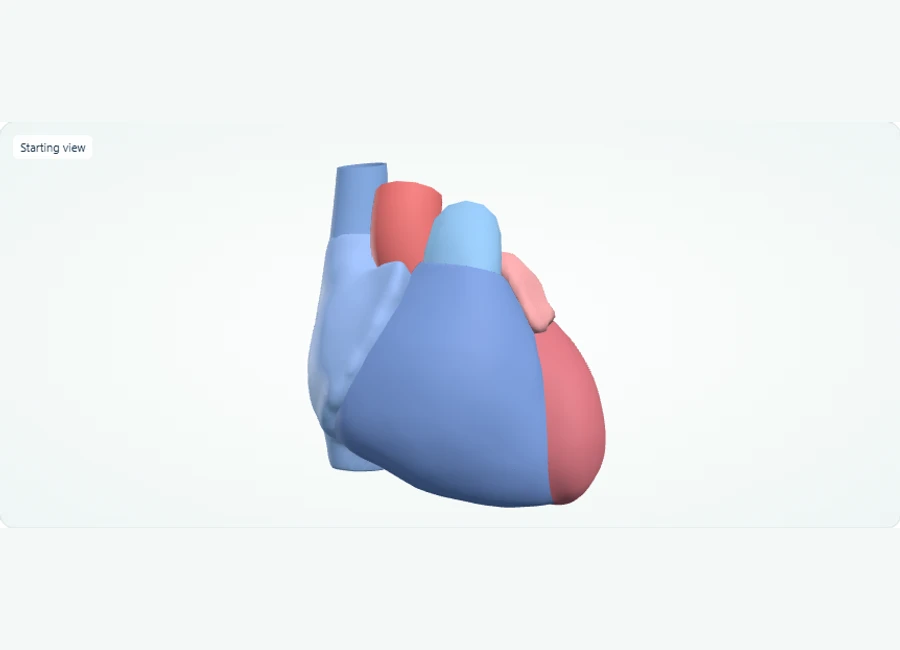
Rotate, isolate structures, and test your recall.
Choose Front and compare the four chambers. The right ventricle forms most of the anterior surface; the left ventricle contributes to the apex.
Select and isolate each chamber in turn, then use Show all to restore its relationship to the surrounding structures.
Select the pulmonary trunk and ascending aorta in turn. Name the circulation supplied by each, then use Test recall to practise identifying the listed structures.
Try it yourself
Which ventricle supplies the pulmonary trunk, and which supplies the ascending aorta?
Show answer and explanation
The right ventricle; it serves the pulmonary circulation.
On the front view, the right ventricle is the anterior-most chamber, and its outflow tract continues as the pulmonary trunk carrying blood to the lungs. The left ventricle instead empties into the ascending aorta for the systemic circulation.
- The right ventricle pumps blood into the pulmonary trunk toward the lungs; the left ventricle pumps into the ascending aorta to the body.
- The superior vena cava returns blood to the right atrium from above the heart.
- The two atria sit superior to the two ventricles; atria receive blood, ventricles eject it.
Explore in 3D: Right Arm and Forearm Bones
Identify the three long bones of the right upper limb: the humerus in the arm, and the radius and ulna in the forearm. Learn their left-right relationship in anatomical position, which is a common exam question.
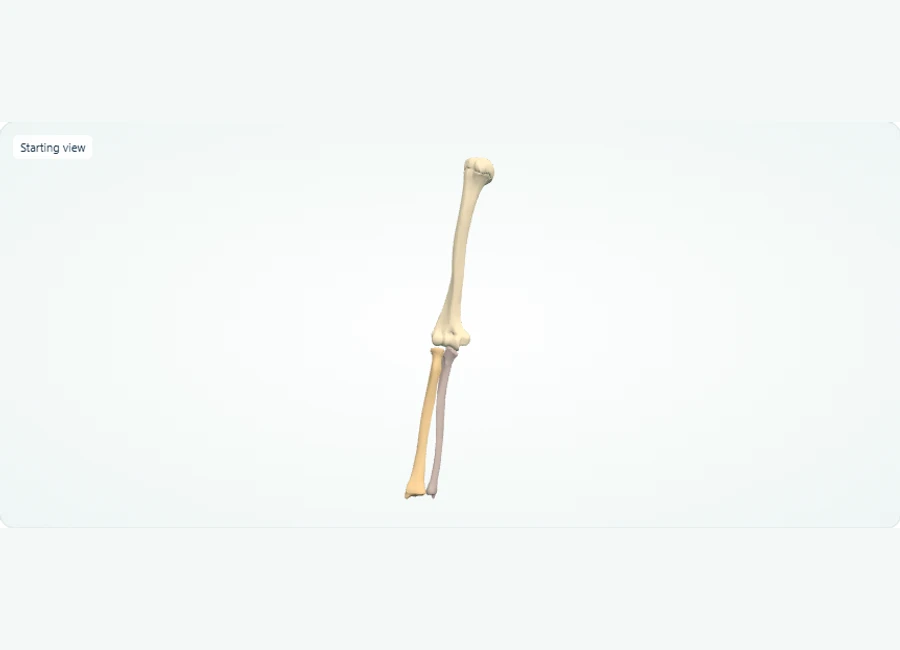
Rotate, isolate structures, and test your recall.
Drag to rotate the model to the front view and zoom in so all three bones are visible. Select the Right humerus to highlight the single arm bone; note it is the only bone between shoulder and elbow.
Isolate the Right radius, then show all and hide the radius to compare it with the Right ulna. In anatomical position, confirm the radius lies lateral (thumb side) and the ulna medial.
Use Test recall to hide the names and highlight a random bone. Guess its name, then Reveal name to check yourself, and Return to study to continue.
Try it yourself
In anatomical position, which forearm bone lies on the lateral (thumb) side of the right forearm?
Show answer and explanation
The radius
With palms facing forward in anatomical position, the radius sits laterally on the thumb side, while the ulna is medial on the little-finger side. Reversing this relationship is a common mistake, so test it on the model before your exam.
- The humerus is the single bone of the arm, spanning shoulder to elbow.
- The forearm has two bones: the radius and the ulna.
- In anatomical position the radius is lateral (thumb side) and the ulna is medial.
Endangerment sites: pairing each location with its at-risk structure
Endangerment sites are regions where nerves, vessels, or other vulnerable structures lie close to the surface. For each site, learn the structure at risk and the technique that would threaten it, not just the location name.
The posterior triangle of the neck, the anterior triangle, the axilla, the cubital area around the brachial structures, the popliteal fossa, the femoral triangle, the umbilical region, and the area around the kidneys are standard endangerment-site examples. Rote lists fade quickly; anchor each site to its at-risk structure and its mechanism. The popliteal fossa matters because the popliteal vessels and tibial nerve are superficial there; deep sustained compression behind the knee threatens them. The anterior neck matters because the carotid structures and trachea are compressible.
Then practice the application format on exam-style drills: give yourself a technique and a location, such as deep sustained pressure, a joint levered, or compression combined with a stretch position. Your check is: what structure is superficial here, and does this technique load it? If yes, the reasoning supports modifying the contact, redirecting pressure, or choosing a different approach at that spot rather than abandoning the session. Make flashcards with the site on the front and 'structure at risk + safe substitution' on the back. When you can state the substitution, you have studied the site the way a scenario asks about it.
Worked practice scenario 1: the acute ankle sprain two days old
Acute-stage injuries call for avoiding local circulatory work, supporting the client's comfort and uninvolved areas, and recognizing signs that need referral. This is a local contraindication with acute-stage reasoning, not a whole-session refusal.
Scenario drill: a client books a sports massage and mentions rolling their ankle two days ago; the lateral ankle is swollen and warm, bruising is spreading, and they are limping but want you to 'work the swelling out.' A plausible mistake in this drill is choosing effleurage directed vigorously at the ankle to mobilize the swelling. In the acute inflammatory stage, aggressive local circulatory work is the wrong call: the tissue is actively inflamed, and the reasoning is that heat, swelling, and recent injury signal avoid local work, not flush it.
The better decision treats the presentation as a local avoidance with adaptation elsewhere. Work uninvolved regions: the opposite leg, hips, low back, and shoulders, which are compensating for the altered gait. Keep the ankle neutral and supported, note in your documentation that the client declined and that you advised appropriate care, and watch for referral signals: inability to bear weight, severe pain, or suspicion of fracture all point to advising evaluation by a qualified provider before any future local work. This exercise trains you to distinguish an acute-stage local avoidance from a blanket rule that no massage is possible; the compensating regions are exactly where safe, useful treatment remains.
Worked practice scenario 2: anticoagulant medication and unexplained bruising
Medication cases change pressure and technique choices, and unexplained bruising is a referral signal. The safe pattern is lighter adapted work plus advising medical follow-up, not deep tissue as requested.
Scenario drill: a new client reports taking a blood-thinning medication for a cardiovascular condition and you observe several bruises of different ages on the forearms. They request deep tissue work on the back. The plausible mistake is proceeding with the requested deep stripping because 'the medication is managing their condition.' The reasoning is that anticoagulation increases bleeding and bruising risk, so deep pressure and vigorous techniques carry a heightened risk even without an acute injury, and unexplained or excessive bruising is itself a finding that warrants medical evaluation.
The better decision adapts rather than refuses outright when the condition is managed: lighter overall pressure, avoidance of deep stripping and harsh friction, gentle broad contact, and a check-in about comfort during the session. Simultaneously, mention the bruising observation, suggest they discuss it with their physician, and document the observation, the modification, and the discussion. This drill stacks two decision layers: the managed systemic condition justifying adaptation, and the unexplained sign pushing toward referral advice. When a practice case includes both a managed condition and an unexplained finding, train yourself to combine modification with advising the client to seek evaluation.
Scope-of-practice wording: the referral answers are hidden in the verbs
Case drills signal referral through diagnosis, treatment, prescription, or unexplained symptom language. Your safe entry-level role is observe, describe, modify, document, and refer; learn which verbs belong to which role.
Practice labeling verbs. Assess, observe, palpate for tone and temperature, document, modify, position, drape, advise within scope, and refer belong to the massage therapist. Diagnose, prescribe, treat a disease, interpret imaging, prognosis, and adjust a medication belong to other licensed providers. When a drill says a client asks you whether their shoulder pain means a rotator cuff tear, or asks you to recommend they stop a medication, the exercise tests whether you recognize the boundary: you can describe what you observe, share general information, and refer, but naming a diagnosis or altering a medical plan is outside entry-level massage scope.
The FSMTB content outline includes professional standards, ethics, and boundaries alongside clinical content, which reflects that scope judgment is a first-class exam topic, not an afterthought. Build a sentence-completion drill: 'The client reports numbness and tingling down the arm that began last week. I should ___.' Trained answers include documenting the report, avoiding techniques that could aggravate it, and advising evaluation by a qualified provider. Untrained answers attempt a musculoskeletal explanation or promise that massage will resolve it. Run this drill until the referral instinct fires before the explanation instinct.
A five-week practice sequence with self-check rubric and readiness checks
Spend weeks one to two building the classification and endangerment-decision drills, weeks three to four on timed case drills, and week five on documentation, ethics, and full mixed sets. Score yourself against a rubric, not against feelings.
Weeks one and two: build the condition-to-decision drill and the endangerment-substitution flashcards described above, plus a terminology pass through kinesiology and assessment vocabulary. Weeks three and four: write or collect ten case drills, one new variable each (acute versus chronic, managed versus unmanaged, local versus systemic), and answer them under a light time limit, writing your justification in two sentences. Week five: mix in ethics, boundaries, and documentation items, then run full mixed sets and review every item you answered by guessing. For administrative matters such as fees, scheduling, eligibility, and accommodations, rely on the FSMTB directly; this guide deliberately excludes those details.
Use this rubric after each case set: (1) Did I classify systemic versus local before choosing an action? (2) Did my answer name the adaptation or avoidance specifically, in technique and region terms? (3) Did I catch any referral signal, such as an unexplained sign or a scope-boundary request? (4) Could I justify the answer with anatomy or physiology in one sentence? (5) Did I complete the item without second-guessing into an unsupported refusal? Score each case 0 or 1 per criterion. A learning milestone to aim for before exam day: consistently scoring 4 or 5 out of 5 across a set of ten mixed cases, with no repeated category of error across two consecutive sets. These are self-check milestones for your study, not predictions of your exam result.
- Readiness check 1: you can sort a list of 20 unfamiliar conditions into systemic-decision versus local-decision columns and state a reason for each
- Readiness check 2: for any endangerment site you can name the at-risk structure and a safe technique substitution without notes
- Readiness check 3: given a two-sentence drill case, you can produce an adapt, avoid, or refer answer plus a one-sentence justification in under a minute
- Readiness check 4: you can state three referral-signal phrases and three scope-boundary verbs on demand
References and further reading
Use these references to explore the concepts and check the latest information from the relevant organizations.