
Approach CEN preparation as decision training. Convert every condition into an if-then action card, practice triage and survey sequencing with two-patient comparisons, and track time-critical pathways as ordered steps. Use the readiness checks at the end to gauge progress; they are study milestones, not pass predictions.
Studying CEN Topics as Decisions Rather Than Definitions
This guide treats every CEN topic as a decision: what comes first, what you reassess, what you escalate. A decision-based review leaves you with actions instead of bare facts, turning system review into scenario practice rather than list memorization.
A list-based review leaves you with facts; a decision-based review leaves you with actions. This guide deliberately frames each topic around three questions: what you assess first, what finding would change your plan, and what you would escalate and to whom. A chapter on respiratory emergencies is not finished under this method until you can answer those questions for several presentations without opening the book. Note that the topic groupings used here are this guide's own study organization, not a claim about BCEN's published content outline.
A concrete conversion method: rewrite facts as if-then cards. Instead of noting that adrenal insufficiency can present with hypotension, write 'patient on chronic steroids with vomiting and hypotension — suspect adrenal crisis; expect steroids plus fluids.' Every card carries a trigger and an action, which mirrors the shape of the worked scenarios and self-check exercises used throughout this guide.
Sorting Two Patients with Triage Acuity Logic Instead of Gut Feeling
Triage acuity frameworks rank patients by immediate threat to life, limb, or function, and by time-sensitivity — not by how loudly distress is expressed. Practice separating pain intensity from physiologic risk, because the two frequently point to different patients first.
A useful named distinction here is between acuity (how fast deterioration could happen) and resource needs (how much care the visit will consume). A stable patient needing many interventions can be lower acuity than a patient needing almost nothing except immediate treatment. When you review any presentation, ask two separate questions: could this person crash within minutes, and is there a time window that treatment must beat? Both answers feed the triage decision, and neither depends on the volume of the complaint.
Worked scenario 1: two patients arrive together. A 22-year-old with an ankle injury calls out in pain, rating it 10/10. A 55-year-old reports the sudden 'worst headache of my life,' has vomited once, and appears drowsy. The plausible mistake is sending the nurse to the ankle first because the pain is dramatic. The better decision: the drowsy patient with sudden severe headache signals possible intracranial bleeding — an immediate-threat, time-critical presentation — and gets the highest acuity; the ankle injury gets analgesia promptly but after. It matters because minutes, not volume, define risk here.
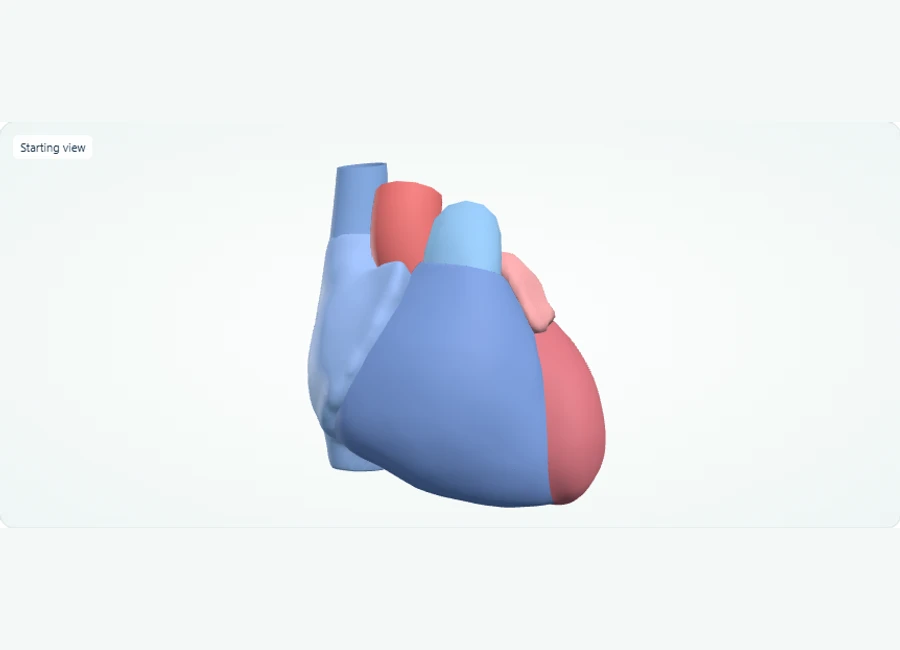
Explore in 3D: Heart chambers and great vessels
A four-chambered heart viewed from the front. The right ventricle supplies the pulmonary circulation via the pulmonary trunk; the left ventricle supplies the systemic circulation via the ascending aorta. This model shows external chamber surfaces and the visible great vessels only — no internal valves or conduction system.
Rotate, isolate structures, and test your recall.
Choose Front and compare the four chambers. The right ventricle forms most of the anterior surface; the left ventricle contributes to the apex.
Select and isolate each chamber in turn, then use Show all to restore its relationship to the surrounding structures.
Select the pulmonary trunk and ascending aorta in turn. Name the circulation supplied by each, then use Test recall to practise identifying the listed structures.
Try it yourself
Which ventricle supplies the pulmonary trunk, and which supplies the ascending aorta?
Show answer and explanation
The right ventricle; it serves the pulmonary circulation.
On the front view, the right ventricle is the anterior-most chamber, and its outflow tract continues as the pulmonary trunk carrying blood to the lungs. The left ventricle instead empties into the ascending aorta for the systemic circulation.
- The right ventricle pumps blood into the pulmonary trunk toward the lungs; the left ventricle pumps into the ascending aorta to the body.
- The superior vena cava returns blood to the right atrium from above the heart.
- The two atria sit superior to the two ventricles; atria receive blood, ventricles eject it.
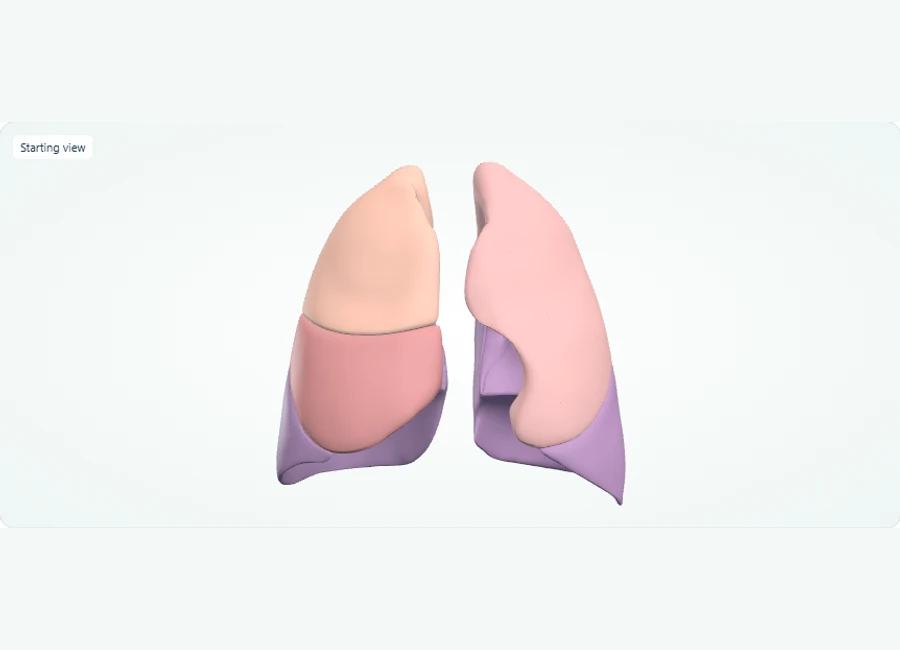
Explore in 3D: Lung lobes
This model shows the five lung lobes: three on the right (superior, middle, inferior) and two on the left (superior, inferior). The left lung has no middle lobe. Each colored lobe is a distinct selectable structure, separate from segments and bronchial branches. As a normal surface model, it shows healthy anatomy only.
Rotate, isolate structures, and test your recall.
Choose Front. Use the Structure list to select each lobe and count three on the anatomical right and two on the left.
Select and isolate the right middle lobe, then use Show all and Back to inspect how it relates to the other right lung lobes.
Start Test recall, name the highlighted lobe, then select Reveal name to check your answer.
Try it yourself
How many lobes does each lung have, and which lobe name occurs only on the right?
Show answer and explanation
The right lung has superior, middle and inferior lobes. The left lung has superior and inferior lobes, with no middle lobe.
A lobe is a gross anatomical division of a lung. The right lung has three lobes and the left has two. These surface models show lobes, not individual bronchopulmonary segments or surgical margins.
- The right lung has three lobes: superior, middle, and inferior.
- The left lung has only two lobes: superior and inferior; there is no left middle lobe.
- Lobes are distinct from segments and bronchial branches, and a normal model shows no tumors or surgical margins.
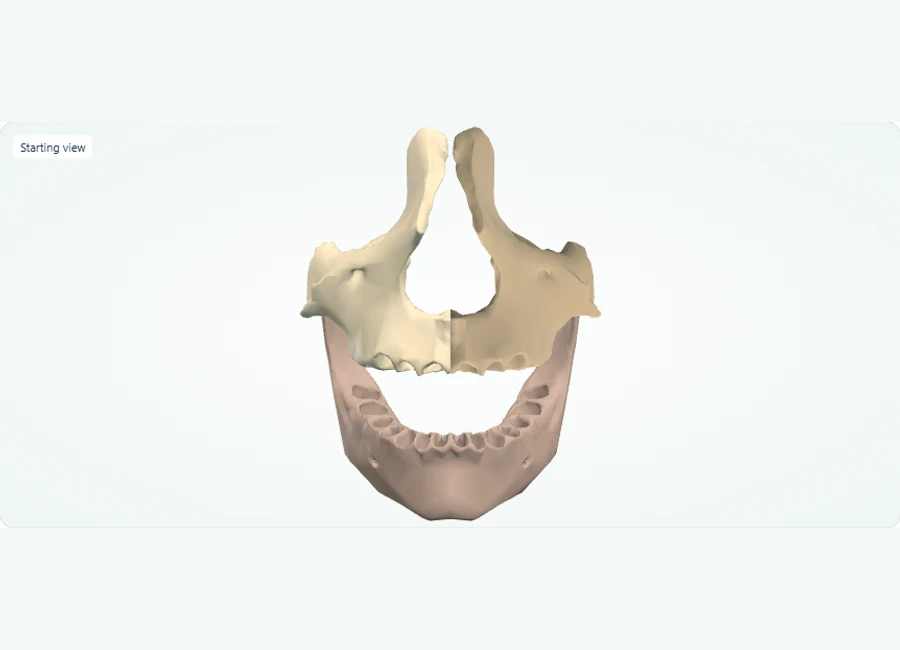
Explore in 3D: Maxilla and Mandible: Upper and Lower Jaws
This model shows the skeletal framework of the jaws: paired maxillae forming the upper jaw and the single mandible forming the lower jaw. Bones only, no teeth.
Rotate, isolate structures, and test your recall.
Choose Front and rotate to compare the paired maxillae above with the mandible below.
Select and isolate the right maxilla to inspect it. Use Show all before comparing it with the left maxilla.
Start Test recall, identify the highlighted bone, then use Reveal name to check.
Try it yourself
Which bones form the upper jaw, and which bone forms the lower jaw?
Show answer and explanation
The paired right and left maxillae form the upper jaw. The mandible forms the lower jaw.
The maxillae are paired upper-jaw bones, whereas the adult mandible is a single lower-jaw bone. This model shows those bones without teeth.
- The maxillae are paired bones that together form the upper jaw; the mandible is a single bone forming the lower jaw.
- The model contains only three selectable structures: right maxilla, left maxilla, and mandible, so recall answers come from that set.
- Teeth are not present in this bones-only model, so focus on the bones themselves rather than dental features.
Running a Primary Survey When a Trauma Scene Pulls Your Attention Elsewhere
The primary survey — airway, breathing, circulation, disability, exposure, with catastrophic hemorrhage handled immediately — exists precisely because dramatic injuries distract. Train the order until it overrides your instinct to treat what is most visible or most vocal.
Distinguish the primary survey from the secondary survey in your notes: the primary survey finds and fixes immediate threats in a fixed order; the secondary survey is the head-to-toe detailed examination that comes after stability. Studying trauma only by injury type blurs this. Keep the sequence as the spine of every trauma note, and attach injuries to the letter where they are discovered — tension pneumothorax under breathing, for example — so the framework, not the injury list, drives your answers in practice.
Worked scenario 2: after a vehicle collision, one patient shouts about an obviously deformed, open lower-leg injury; a second patient is quiet, pale, and speaking only short phrases. The plausible mistake is treating the leg first because it is the visible emergency. The better decision: assess the quiet patient's airway and breathing immediately — short phrases and pallor suggest a breathing or circulation threat — while the leg injury receives covering dressing and splinting afterward. The lesson: the silent patient can be the sickest, and the fixed survey order protects against attention being captured by the loudest problem.
Treating Sepsis, Stroke, and STEMI as Pathways Rather Than Disease Lists
Time-critical conditions share a structure: recognition triggers, a first-window of priority actions, and ongoing tracking duties. Building each pathway as an ordered sequence beats memorizing scattered drug facts, because mid-pathway practice then tells you the next step at any pause point.
For each pathway, write three things on one card: the trigger findings that should make you think of it, the actions that belong to the earliest treatment window, and what must be monitored or reassessed afterward. Then compare the pathways against each other — the differences in recognition anchors and in what you track are exactly where adjacent-condition confusion happens. This table is a study scaffold for the concept structure; verify current clinical protocols against your facility's policies and current evidence before applying them in practice.
The reason pathway study pays off in case-analysis practice: a well-built pathway card tells you what to do when a scenario stops mid-stream. If a practice stem gives you a recognized stroke trigger but the treatment window question is unresolved, pathway knowledge tells you the immediate next step without waiting for the full picture. Drilling should include deliberately pausing a scenario after each pathway stage and asking what the ordered next action is.
| Condition | Recognition anchor to study | First-window priority actions to study | What to track afterward |
|---|---|---|---|
| Sepsis | Infection source plus new hypotension or altered mentation | Rapid recognition, cultures before antimicrobials when feasible, early fluids and antimicrobials per protocol | Perfusion markers, urine output, response to fluids |
| Stroke | Sudden neurologic deficit with exact onset time | Immediate neuro assessment and activation of the stroke pathway for imaging and treatment eligibility | Neuro checks, glucose, blood pressure per pathway |
| STEMI | Ischemic-type chest pain with characteristic ECG changes | ECG within minutes of arrival, pathway activation for reperfusion, antiplatelet therapy per protocol | Rhythm, reperfusion timing, recurrent symptoms |
Reading Trends: Vitals, Labs, and Strips Over Time Instead of Snapshots
Interpretation skill in this subject hinges on trajectory. A single normal value can sit beside a dangerous trend. Train yourself to ask what the previous value was, which direction it is moving, and whether compensation is masking deterioration.
Practice the snapshot-versus-trajectory distinction deliberately. Early shock is a classic case: a 'normal' blood pressure can coexist with a rising respiratory rate, a narrowing pulse pressure, and a climbing heart rate — compensatory signs that a trajectory view catches and a single reading hides. When you make flashcards for vital signs and labs, add a trend column: for each value, note what early movement in the wrong direction would mean and what you would reassess first.
Apply the same habit to monitoring data. For rhythm strips, study the recognition features of immediately threatening rhythms separately from the interventions, then link them: what the strip shows determines whether you assess-and-monitor, deliver an immediate intervention, or call for the team. For continuous monitoring such as end-tidal carbon dioxide, the trend and the abrupt change both carry meaning — a sudden loss of a previously steady waveform is itself a finding that demands action, per your monitoring protocol.
Restraints, Capacity, and Documentation Under Emergency Conditions
The ethics-and-safety topic area rewards three distinct concepts: clinical capacity versus the consent process, least-restrictive restraint practice with required monitoring, and documentation that captures reassessment and timing. Study each as a defined concept with its own trigger and duty.
Keep three concepts separate in your notes. Capacity is a clinical assessment of whether a person can understand, retain, weigh, and communicate a decision; consent is the process of authorizing care, which follows its own rules and surrogates when capacity is absent. Leaving against medical advice is its own sequence: assess capacity, explain risks, offer alternatives, and document the conversation. Build your practice cards to test which concept a stem invokes — mixing the three produces confident-sounding wrong answers on your own self-tests.
For restraint situations, structure your study around the governing idea of least restriction for the shortest necessary time, with ongoing observation of circulation, behavior, and readiness for release per your policy, and with the event documented. Documentation practice is not clerical here: it is the record that reassessment happened on schedule and that alternatives were tried first. Practice writing the order of events — behavior, intervention, monitoring, reassessment — and structure your written practice answers to capture sequence as much as content.
Building a Preparation Sequence with Readiness Checks That Mean Something
Run an adaptable multi-phase plan: framework week first, then pathway and system blocks built as if-then cards, then mixed scenario practice under timing, then a maintenance phase of weak-area repair. Check readiness with behavior you can observe, not a feeling of familiarity.
A realistic adaptable sequence for a working emergency nurse: Week 1, rebuild the core frameworks — triage acuity logic, primary and secondary survey, capacity versus consent — from memory on one page each. Weeks 2 to 5, rotate through major blocks (cardiovascular, respiratory, neurologic, trauma, toxicologic and environmental, obstetric, pediatric, behavioral) writing if-then cards and pathway cards as you go; spend 15 minutes daily reciting three cards aloud. Weeks 6 to 7, do mixed timed question sets and log every miss as a framework failure, a pathway gap, or a misread stem. Week 8, repair weak blocks only, then repeat one mixed set.
Practical exercise: build ten two-patient triage prompts from your own clinical memory, each pairing a loud-but-stable complaint with a quiet time-critical one, and write your acuity ranking plus the one finding that decided it. Self-check rubric — score each prompt on three points, one for correct ranking, one for naming the deciding finding, one for stating the immediate action: 27-30 points suggests your triage logic is exam-ready as a study milestone; 20-26 points, re-drill the acuity-versus-resources distinction; below 20, restart the framework week. Readiness checks before sitting the exam: reproduce the primary survey and three pathways from blank memory, and finish a timed mixed set without a framework-type miss. Administrative details — eligibility, scheduling, and the four-year renewal cycle — live with BCEN at bcen.org/cen, so confirm specifics there rather than from secondary sources.
Treat any practice-exam result as a milestone gauge, not a prediction of your result. If a mixed set score disappoints, the log from Week 6 tells you whether the gap is knowledge or sequencing, and those two gaps have different fixes: rebuild cards for the first, drill two-patient prompts for the second.
References and further reading
Use these references to explore the concepts and check the latest information from the relevant organizations.