
A useful way to prepare for the CNSC credential is to study every nutrition support concept as a decision rule rather than a standalone fact. Instead of memorizing that phosphorus falls after refeeding, learn when that shift changes what you do: which labs to check before advancing feed, which electrolytes to correct first, and how to document the reasoning. This article gives you two worked scenarios, a lab-pattern table, a self-check exercise with a rubric, and a phased sequence you can adapt to any schedule.
From Memorized Formulas to Etiology-Based Nutrition Decisions
Malnutrition assessment and route selection are concept-driven: build fluency in named concepts — nutrition-focused assessment, etiology-based malnutrition diagnosis, and route selection — and practice making the decision, not only performing the calculation.
The credential's domain areas, such as core nutrition knowledge, assessment and interpretation, applied practice, and safety and professional standards, differ in how they test you. Assessment items ask you to link intake history, physical findings, and labs to a diagnosis. Applied items ask you to choose a route, an order, or a monitoring plan. Recognizing which skill a practice question targets tells you which reasoning chain to rehearse.
Apply this by giving every fact a trigger and an action. The trigger for etiology-based malnutrition review is a patient with reduced intake plus acute illness, chronic illness, or social circumstances; the action is selecting indicators such as weight trend, intake percent, subcutaneous fat and muscle wasting on physical exam, and fluid accumulation pattern. When you can say 'this finding changes this decision,' a fact becomes exam-usable rather than decoration.
Reading Lab Panels as Patterns, Not Single Values
Nutrition support labs are interpretable only in patterns. Learn to pair visceral proteins with inflammatory markers, track refeeding electrolyte shifts over time, and combine BUN, creatinine, weight, and nitrogen balance before acting on any single value.
Three distinctions carry most of the reasoning weight. First, albumin's long half-life and dilution behavior make it a marker of chronic status and volume, not current protein intake. Second, prealbumin has a shorter half-life but falls with acute inflammation, so pairing it with a marker such as CRP separates inflammation from inadequate protein provision. Third, nitrogen balance estimates net protein status from intake and estimated losses, and it moves with catabolism, not just with feeding.
Trace this example: a patient's BUN rises from 14 to 34 mg/dL while creatinine stays near 1.0 and weight drops 2 kg in two days. A tempting mistake is to cut protein sharply, assuming protein intolerance. The better move is to assess volume status, recent intake, and the nitrogen balance picture first — the pattern suggests dehydration with catabolism. The distinction matters because cutting protein addresses the wrong problem and can worsen negative nitrogen balance while the real fix is fluid management.
| Lab pattern | Typical findings | Common confounder | Better interpretation step |
|---|---|---|---|
| Refeeding electrolyte shift | Phosphorus, potassium, and magnesium fall within the first days of feeding after prolonged poor intake | A rapid replacement makes the trend look like lab noise | Trend the values against baseline during the first days of advancing feed |
| Acute inflammation | Prealbumin and albumin fall while inflammatory markers rise and intake is poor | Reading the prealbumin fall as purely inadequate protein provision | Pair visceral protein with an inflammatory marker and an intake history |
| Dehydration with catabolism | BUN rises out of proportion to creatinine; possible hemoconcentration | Interpreting a high BUN as protein intolerance | Check volume status, weight trend, and intake before changing protein order |
Explore in 3D: Stomach, Pancreas and Duodenum: Spatial Relationships
Study the three selectable organs in this model — stomach, duodenum and pancreas — focusing on how they sit relative to one another: the duodenum follows the stomach, the pancreatic head lies in the duodenal curve, and the pancreas lies posterior to the stomach.
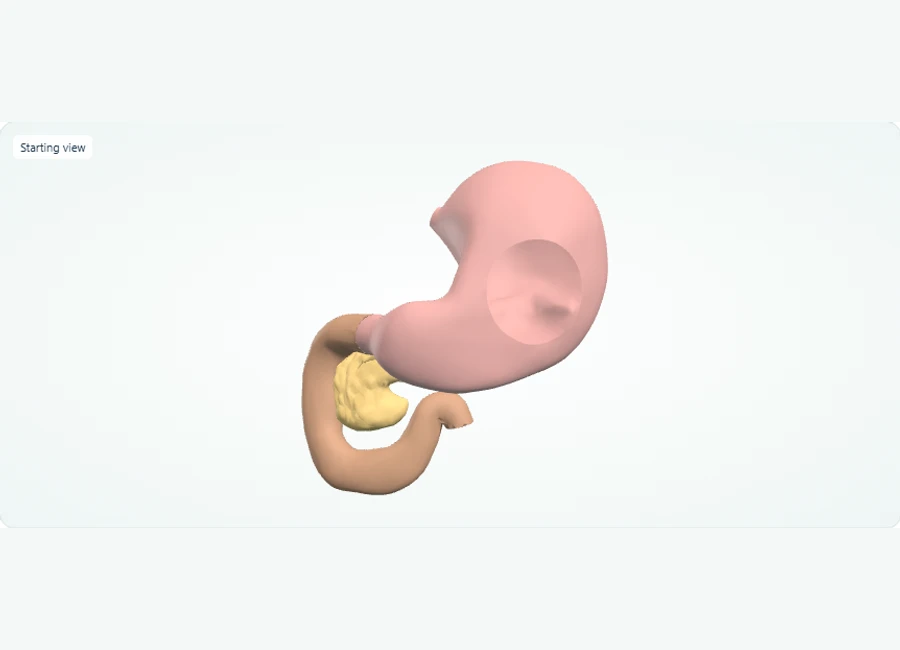
Rotate, isolate structures, and test your recall.
Rotate to the front view and zoom in to see the stomach and the duodenum continuing after it.
Select the duodenum and trace its curve, noting that the pancreatic head sits within that curve.
Use 'Hide selected' on the stomach so the pancreas, lying posterior to the stomach, is fully visible; then use 'Show all' to restore the view.
Try it yourself
Which organ has its head within the duodenal curve and lies posterior to the stomach?
Show answer and explanation
The pancreas.
After the stomach comes the duodenum, and the head of the pancreas lies within the duodenal curve; the pancreas also sits posterior to the stomach, so it is best inspected after hiding the stomach.
- The duodenum follows the stomach in the digestive pathway.
- The head of the pancreas lies in the curve of the duodenum.
- The pancreas lies posterior to the stomach, so hiding the stomach improves its exposure in this model.
Refeeding Syndrome: A Worked Scenario and the Right First Moves
Refeeding syndrome questions test sequencing, not definition recall. The correct response chain is screen for risk, correct potassium, magnesium, and phosphorus, consider thiamine, start calories conservatively, and trend labs as feed advances.
Worked example: a 62-year-old adult with a BMI around 16.5 and weeks of very poor intake is admitted with low-normal labs — phosphorus 2.8 mg/dL, potassium 3.6 mmol/L, magnesium 1.6 mg/dL. A plausible mistake is to advance enteral nutrition to full goal within the first day and reassess later, because nothing is overtly low. The scenario matters precisely because the trigger is the pattern of risk — prolonged deficit plus pending aggressive feeding — not a single alarming lab.
The better decision runs the chain in order: supplement potassium, magnesium, and phosphorus given how close these values sit to the danger zone, give thiamine before or alongside feeding, start calories well below goal, and recheck the electrolytes during the first days of advancement rather than after a week. Two days later, phosphorus has fallen further and the patient reports weakness — the earlier correction and conservative titration are what limited the shift. Rehearse writing this chain out loud so it becomes automatic under test pressure.
Choosing and Checking the Route: EN versus PN Decisions
Route selection is a trade-off decision driven by gut function, aspiration risk, hemodynamic stability, and expected duration. Once enteral is chosen, PN competence means knowing what to verify: dextrose load, lipid emulsion, calcium-phosphorus compatibility, and line type.
Second worked scenario: a 68-year-old after a stroke has dysphagia and a mild ileus that is resolving, with a usable distal gut. The plausible mistake is to start parenteral nutrition immediately because enteral access looks delayed and immediate delivery seems safer on the surface. The better decision is a post-pyloric enteral trial while the ileus resolves, with a documented plan for escalation to parenteral support if the gut cannot be used within a defined window. The trade-off — gut integrity and infection risk on one side, guaranteed delivery on the other — is exactly the reasoning this route decision hinges on.
When parenteral nutrition is the answer, shift to checking rather than choosing. Verify the dextrose concentration and glucose monitoring plan, the lipid emulsion choice against the patient's triglyceride picture, the calcium-to-phosphorus solubility margins in the compounded order, and whether the intended line matches the formula's osmolarity. Practice writing the checks as a short list, because exam scenarios compress this information into an order and expect you to notice which element is missing or conflicting.
Monitoring and Documentation That Close the Loop
A nutrition plan is incomplete until it names what to monitor, when to recheck, and what change triggers adjustment. Practice converting an intervention into a monitoring sentence that links the finding, the action, and the follow-up.
Two monitoring habits deserve deliberate rehearsal. Fluid and weight tracking anchors nearly every adjustment decision: daily weights, intake and output totals, and the trend of BUN relative to creatinine tell you whether an abnormal lab reflects the plan or the volume picture. Electrolyte schedules should be tied to regimen changes — checked during the first days of a new feed, after major order changes, and after any acute event — rather than on a fixed calendar unrelated to what you did.
Documentation practice for this credential means writing the rationale, not just the numbers. Compare 'protein 1.5 g/kg started' with 'protein ordered at 1.5 g/kg given wound burden and stable renal labs; recheck nitrogen balance and renal labs in one week before advancing.' The second version shows the interpretation chain connecting assessment to intervention to reevaluation. Building this sentence template during practice cases transfers directly to scenario questions that ask for the next appropriate action or the most defensible plan.
A Practice Exercise and Self-Check Rubric
Run a five-day case simulation on paper. Build one complex inpatient case, advance the feed daily, write the order and monitoring plan each day, and score yourself against a fixed rubric to find your weakest reasoning link.
The exercise: invent a paper case — for example, an older adult with a stroke, moderate obesity, and new central access — and write one entry per day for five days. Each day record the labs you would order, the feed you would advance to, one thing that could go wrong, and your documentation sentence linking the day's finding to tomorrow's plan. Introduce a complication on day three, such as a falling phosphorus or rising triglycerides, so you must revise rather than repeat.
Expected observations: most self-written cases reveal a predictable gap — the same missing step every day, commonly the electrolyte recheck before advancing or the rationale sentence. That repetition is the useful signal, because it identifies the single habit to drill. Repeat the exercise with a different complication pattern (inflammation-dominant, volume-dominant, route-change-dominant) and watch whether the gap moves or persists.
- Rubric item 1: Risk screening stated before feeding decisions, with the specific risk factors named (0–2 points).
- Rubric item 2: Every feed advance paired with a named lab recheck and timing (0–2 points).
- Rubric item 3: Route or order change includes at least one compatibility or safety verification (0–2 points).
- Rubric item 4: Documentation sentence links finding, action, and follow-up without a missing link (0–2 points).
- Interpretation: treat 7–8/8 as a milestone of readiness for that complication type, not a prediction of exam performance.
A Phased Preparation Sequence and Concrete Readiness Checks
Organize preparation into three phases: rebuild core concepts with decision triggers, drill scenario chains like refeeding and route selection, then rehearse full cases under time. Finish with readiness checks rather than feelings of confidence.
Phase one: build a concept sheet where each named concept — malnutrition indicators, refeeding shift, nitrogen balance, prealbumin behavior, PN compatibility checks — has a trigger and an action column. Phase two: work scenario chains, writing the refeeding chain and the route-decision chain from memory until each runs in a fixed order. Phase three: run full five-day cases from the exercise above under a timer, then redo your weakest case type. Adapt the phase lengths to your calendar rather than copying any fixed week count.
Readiness checks: you can write the refeeding chain with no notes; you can state three ways a lab panel can mislead you and the confirming step for each; you can pick an enteral versus parenteral answer and name the trade-off that drove it; your documentation sentences have no missing link under the rubric. If any check fails, return to phase two for that concept only. One short note: for administrative details such as eligibility and scheduling, go to the issuing board, the NBNSC, rather than inferring them from study materials.
- Write the complete refeeding response chain from memory: screen, correct, thiamine, conservative start, trend labs.
- Explain in one sentence each why prealbumin needs an inflammatory marker and why a high BUN is not automatically protein intolerance.
- Given any PN order excerpt, list the compatibility and safety checks you would make before it is finalized.
- Score at least two different paper cases 7–8/8 on the self-check rubric across different complication patterns.
References and further reading
Use these references to explore the concepts and check the latest information from the relevant organizations.