
Prepare for CSO-level practice by studying every topic as paired cases: the same symptom (unintentional weight loss) driven by inflammation, by intake failure, or by malabsorption leads to different classification, different goals, and different interventions. Anchor your review to three named frameworks — aetiology-based malnutrition classification, the nutrition-focused physical exam, and treatment-phase decision triggers — and rehearse justifying each intervention decision aloud as if presenting to a team.
Separating Cancer Cachexia from Starvation-Related Malnutrition
Cancer cachexia is an inflammation-driven syndrome with muscle loss that nutrition alone may not fully reverse; starvation-related malnutrition is intake-driven and responds to refeeding. The distinction changes goals, monitoring, and counseling.
The aetiology-based malnutrition framework separates three contexts: acute illness or injury with marked inflammation, chronic illness with mild-to-moderate inflammation, and social or behavioral circumstances without inflammation. Cancer cachexia is a related but distinct syndrome: anorexia plus ongoing muscle wasting driven by tumor and host inflammatory response, occurring with or without fat loss. Because the driver is systemic inflammation rather than intake alone, feeding more calories does not mechanically rebuild lean mass the way it does in pure starvation.
Apply the distinction by asking what is driving the deficit. A patient who lost weight after months of inadequate intake for social or behavioral reasons, with unremarkable inflammatory markers, is a refeeding candidate: aggressive oral nutrition can plausibly restore tissue. A pancreatic cancer patient with elevated C-reactive protein, early satiety, and visible temporalis wasting needs goals reframed around preserving function, managing symptoms, and setting realistic weight expectations. Same scale number, different plan — that mismatch is what case reasoning must resolve.
Classifying Malnutrition Severity When Inflammation Muddies the Picture
The framework uses six indicators — energy intake, weight loss, muscle loss, fat loss, fluid accumulation, and diminished functional strength — with any two required in the context of acute, chronic, or social/behavioral illness.
Learn the indicators as a working checklist, not isolated cutoffs. Weight-loss thresholds are steepest in acute illness: more than 2% in one week or more than 5% in one month supports severe classification in that context. The chronic-illness context uses different windows: more than 5% in one month or more than 7.5% in three months supports severe classification, while the social/behavioral context relies on longer-duration criteria. Energy intake cuts are context-dependent too — in acute illness, less than 50% of estimated energy needs for five days or more indicates severe malnutrition, versus substantially longer durations in the other contexts. Fluid accumulation counts as an indicator because it can mask weight change.
Worked scenario: a post-esophagectomy patient at surgical follow-up shows 3% weight loss in one week, intake below 50% of estimated needs for six days, ankle edema, and elevated CRP. Plausible mistake: dismissing 3% as trivial because it seems small in absolute terms. Better decision: classify as severe malnutrition in the context of acute illness — the weekly rate exceeds 2% and the intake criterion is met in that context, and fluid accumulation may be underestimating true loss. Why it matters: severity classification drives how closely you monitor, how quickly you escalate support, and how you document justification. Now contrast the identical 3% in one week with a stable outpatient tracked in a chronic-illness context: the same number does not reach the chronic severe window (>5% in one month or >7.5% in three months), so the classification and urgency differ. Context changes which thresholds apply, and case reasoning must name the context before citing the number.
Explore in 3D: Stomach, Pancreas and Duodenum: Spatial Relationships
Study the three selectable organs in this model — stomach, duodenum and pancreas — focusing on how they sit relative to one another: the duodenum follows the stomach, the pancreatic head lies in the duodenal curve, and the pancreas lies posterior to the stomach.
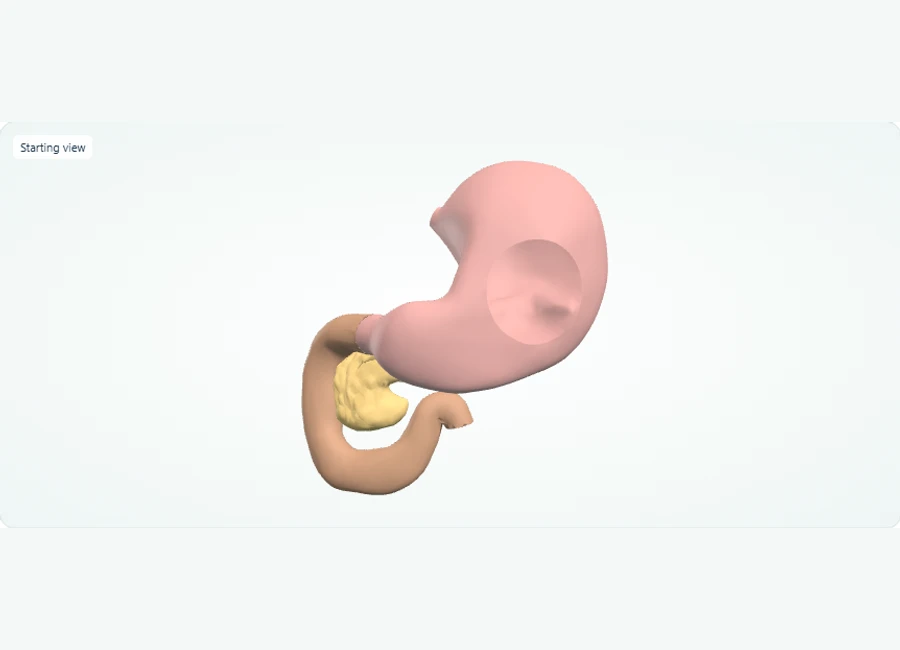
Rotate, isolate structures, and test your recall.
Rotate to the front view and zoom in to see the stomach and the duodenum continuing after it.
Select the duodenum and trace its curve, noting that the pancreatic head sits within that curve.
Use 'Hide selected' on the stomach so the pancreas, lying posterior to the stomach, is fully visible; then use 'Show all' to restore the view.
Try it yourself
Which organ has its head within the duodenal curve and lies posterior to the stomach?
Show answer and explanation
The pancreas.
After the stomach comes the duodenum, and the head of the pancreas lies within the duodenal curve; the pancreas also sits posterior to the stomach, so it is best inspected after hiding the stomach.
- The duodenum follows the stomach in the digestive pathway.
- The head of the pancreas lies in the curve of the duodenum.
- The pancreas lies posterior to the stomach, so hiding the stomach improves its exposure in this model.
Reading the Nutrition-Focused Physical Exam When Edema Hides the Scale Number
The physical exam finds what the scale hides: temporalis hollowing, clavicle prominence, interosseous muscle wasting, and orbital or triceps fat loss. In fluid-overloaded patients, these findings carry the classification.
Practice the named sites until they are automatic. Muscle assessment covers the temporalis, the clavicle and deltoid region, the interosseous muscles of the hand, and the quadriceps, each graded for mild, moderate, or severe hollowing or wasting. Fat assessment targets the orbital region, triceps, and thoracic or lower-back fat pads. Ascites, peripheral edema, and tumor bulk all inflate weight and even BMI, so a rising or stable scale weight says nothing about lean tissue in a fluid-retaining patient.
Apply this to a hepatic malignancy patient with ascites whose weight is up 3 kg this month. Plausible mistake: interpreting the gain as nutrition improvement and easing off. Better decision: perform the physical exam, document moderate temporalis and interosseous wasting, and track functional measures such as handgrip or a recorded walk test instead of raw weight. Why it matters: your classification and monitoring plan depend on tissue findings, and relying on weight here produces a confidently wrong trend.
Timing Enteral Access in Head and Neck Chemoradiation: Triggers, Not Reflexes
Enteral access decisions hinge on expected dysphagia duration and severity versus each route's risks. Build explicit nutrition triggers at treatment planning instead of reacting to weight loss mid-course.
Worked scenario: a 62-year-old with locally advanced laryngeal cancer starts seven weeks of concurrent chemoradiation. Baseline weight loss is 5%, no dysphagia, swallowing evaluation is normal, and the team debates whether a gastrostomy should be placed now. The reflex mistake goes one of two ways: placing a percutaneous tube for every chemoradiation patient regardless of risk, or having no plan until week four, when severe mucositis, dehydration, and a 10% loss force an urgent, higher-risk placement and threaten treatment continuity.
The better decision is a documented trigger framework set before treatment starts: define the weight-loss percentage, intake percentage, and dysphagia grade that prompt escalation, and discuss access route against expected duration — nasogastric for anticipated short-term use, gastrostomy when prolonged dependence is likely. In this case, baseline compromise and anticipated mucositis at treatment peak justify a concrete plan and early gastrostomy discussion rather than either reflex. Why it matters: a pre-agreed trigger turns a mid-crisis scramble into a scheduled decision.
Pancreatic Cancer Weight Loss: Assess Enzymes Before Adding Calories
In pancreatic and upper GI cancers, steatorrhea and ongoing loss can reflect exocrine insufficiency, not inadequate intake. Coordinating enzyme replacement with meals often precedes extra supplements in the intervention sequence.
Pancreatic disease reduces enzyme delivery either through ductal obstruction by the tumor or through resection such as a Whipple procedure. The signature is malabsorption despite intake: pale, greasy, floating stools; bloating; continued weight loss on an adequate oral pattern; and eventual fat-soluble vitamin (A, D, E, K) deficits. A patient can drink every supplement you recommend and still lose tissue if the fat and protein in it is not being absorbed.
Mini-scenario: a patient complies with three oral nutrition supplements daily yet keeps losing weight and reports oily stool. Plausible mistake: doubling the supplements and recording a counseling intervention. Better decision: compare documented intake against the loss, recognize the malabsorption pattern, coordinate enzyme replacement dosed with meals and snacks, and monitor fat-soluble vitamin status. Why it matters: unabsorbed calories do not count toward repletion, and labeling the problem as poor adherence misdirects the entire plan.
When the Gut Fails: Enteral Versus Parenteral Support and Refeeding Risk
Enteral nutrition is preferred when the gut functions; parenteral nutrition is reserved for a non-functioning GI tract such as obstruction or severe ileus. Refeeding risk screening dictates pace, electrolytes, and thiamine before dextrose.
Trace the decision path: if the GI tract is functional and accessible, use it — even partially — because enteral feeding maintains gut integrity and carries fewer infectious and metabolic risks. Bowel obstruction, prolonged ileus, or intolerance despite optimization shifts the decision to parenteral support. In advanced disease, add the ethics layer: artificial nutrition is a shared decision shaped by patient goals, expected benefit, and symptom burden, and documenting that conversation is part of the intervention, not an afterthought.
Refeeding syndrome deserves its own screen in oncology, where prolonged low intake is common. Flag patients with days to weeks of markedly reduced intake, significant recent weight loss, or heavy alcohol history. For high-risk patients, start calories low and advance gradually, correct phosphate, potassium, and magnesium, and give thiamine before dextrose exposure. A practical oncology nuance: hydration or premedication fluids containing dextrose can trigger the same shifts, so the risk screen applies to the whole admission, not just your feeding orders.
A Workable Study Sequence with a Classification Drill and Readiness Rubric
Sequence the content as paired-case practice: aetiology and classification first, then assessment tools, then treatment-phase management, then support and ethics, finishing with mixed timed cases and an error log.
An adaptable eight-week plan: weeks one and two, drill aetiology-based classification until you can name context, inflammation level, and two qualifying indicators for any vignette; weeks three and four, physical exam findings and lab interpretation, including why visceral proteins mislead during inflammation and how CRP contextualizes them; weeks five and six, treatment-phase cases across surgery, radiation, systemic therapy, and transplant; week seven, nutrition support, refeeding, and palliative ethics cases; week eight, mixed cases under time pressure plus a review of your logged errors. Free case-style practice on the CSO practice page (/free-practice/board-certified-specialist-in-oncology-nutrition-cso) fits naturally into weeks one, six, and eight of this plan.
Core exercise: write three mini-cases yourself — one acute-illness, one chronic-inflammation, one social/behavioral — using the same weight-loss number (e.g., 3% in one week) so you must classify each against its own context thresholds. Expected observations: you should identify which two indicators anchor each classification, explain why 3% in one week qualifies as severe in acute illness but not in the chronic-illness window, and articulate why the intake criterion shifts with context. Readiness checks: you can defend an access-route decision using duration-based reasoning, you can reclassify a case when new physical exam findings arrive, and your error log shows repeating mistake types shrinking week over week. Treat any self-score as a learning milestone, not a prediction.
- Names the correct context (acute, chronic, social/behavioral) for all three cases without notes.
- Cites at least two qualifying indicators per case and explains why context changes the thresholds that apply.
- Justifies any intervention (screening trigger, access route, enzyme coordination, support modality) by mechanism, not habit.
- Error log entries distinguish knowledge gaps from decision-pattern errors and show the second type declining.
| Category | Context | Inflammation | Primary driver | Nutrition focus |
|---|---|---|---|---|
| Acute illness/injury | Critical illness, major surgery, post-op course | Marked | Inflammatory response plus reduced intake | Early feeding, tight monitoring, support escalation thresholds |
| Chronic illness | Organ failure, ongoing malignancy | Mild to moderate | Inflammation compounded by intake limits | Function preservation, symptom management, realistic weight goals |
| Social/behavioral (starvation-related) | Prolonged inadequate intake without disease inflammation | Absent or minimal | Access, economics, behavior | Refeeding with syndrome precautions, tissue repletion achievable |
| Cancer cachexia (distinct syndrome) | Active tumor with host inflammatory response | Systemic | Tumor- and host-driven catabolism | Intake support helps but may not reverse muscle loss; prioritize function and quality of life |
References and further reading
Use these references to explore the concepts and check the latest information from the relevant organizations.