
Prepare for the CSP exam by training one habit above all: pediatric anchoring. Before interpreting any case data, establish the child's age, developmental stage, and growth trajectory, then derive needs relative to that trajectory rather than to adult reference ranges. Work through growth-chart scenarios, stage-by-stage comparisons, and timed case decisions, and use a self-check rubric to verify you can move from assessment to intervention to monitoring in one connected line of reasoning.
Why Adult Assessment Habits Break Down with Children
Pediatric assessment differs from adult assessment because every parameter — anthropometrics, intake, laboratory context, and planning targets — is interpreted against an expected growth trajectory and developmental stage, not fixed reference ranges.
In adult practice you can compare a weight, a BMI, or a lab value against a stable reference interval and move on. In pediatrics the reference itself moves: a value that is unremarkable at one age is a flag at another, and the more informative question is whether the child is tracking along their own established curve. Growth percentiles, weight velocity, and stage-typical feeding skills replace the fixed cutoffs you may rely on with adults.
Build a re-anchoring drill into early study sessions. Take any pediatric case and force yourself to write, in order: age, stage, current growth pattern, and only then an interpretation of intake or labs. If you catch yourself quoting an adult range first, stop and restate the finding relative to the child's curve. Practicing this ordering until it is automatic is the foundation every later topic builds on.
Reading Growth Charts: Static Percentile versus Growth Velocity
Distinguish a single percentile point from the direction of travel. A child can sit within normal printed limits while a downward trend across visit-to-visit measurements signals a problem worth full assessment.
Percentile describes where a measurement falls relative to peers at one moment; velocity describes change over time for that same child. These two readings frequently point in different directions, and confusing them is the mistake this scenario illustrates. Note: this is a simplified teaching example using commonly taught growth-chart conventions, not a rule about any real child.
Worked scenario: a 9-month-old's weight moved from roughly the 60th to the 25th percentile across three recorded visits, and weight-for-length drifted downward in parallel. A plausible mistake is to write 'weight within normal range, no intervention indicated' because every point remains on the chart. The better decision is to note the crossing of percentile lines and the declining weight-for-length trend, then complete a full assessment: detailed intake history, feeding behaviors, medical history, and a short-interval re-measurement plan. The distinction matters because a static reading hides the trend that triggers evaluation.
- Check that your written assessment names a trajectory ('declining weight-for-age velocity'), not just a category ('normal weight').
- Practice restating plotted chart data in words, and words back into an expected plot position.
Explore in 3D: Stomach, Pancreas and Duodenum: Spatial Relationships
Study the three selectable organs in this model — stomach, duodenum and pancreas — focusing on how they sit relative to one another: the duodenum follows the stomach, the pancreatic head lies in the duodenal curve, and the pancreas lies posterior to the stomach.
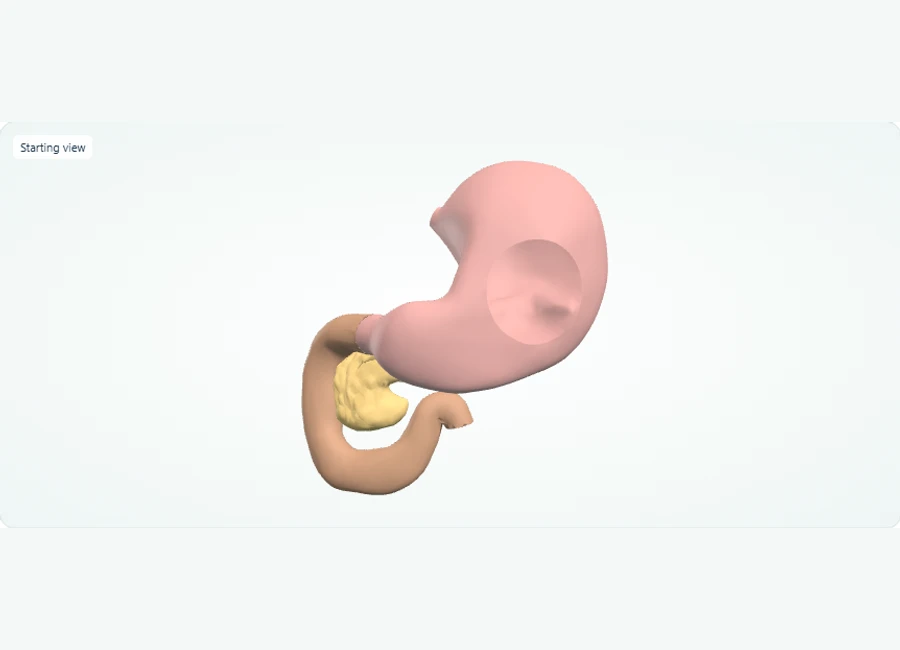
Rotate, isolate structures, and test your recall.
Rotate to the front view and zoom in to see the stomach and the duodenum continuing after it.
Select the duodenum and trace its curve, noting that the pancreatic head sits within that curve.
Use 'Hide selected' on the stomach so the pancreas, lying posterior to the stomach, is fully visible; then use 'Show all' to restore the view.
Try it yourself
Which organ has its head within the duodenal curve and lies posterior to the stomach?
Show answer and explanation
The pancreas.
After the stomach comes the duodenum, and the head of the pancreas lies within the duodenal curve; the pancreas also sits posterior to the stomach, so it is best inspected after hiding the stomach.
- The duodenum follows the stomach in the digestive pathway.
- The head of the pancreas lies in the curve of the duodenum.
- The pancreas lies posterior to the stomach, so hiding the stomach improves its exposure in this model.
Stage-by-Stage: How Infant, Toddler, School-Age, and Adolescent Assessment Differ
Nutrition priorities shift with each developmental stage because growth pace, feeding skills, and autonomy change. Train yourself to identify the stage first and let it select which assessment anchors and concerns apply.
Infancy is a period of rapid growth where milk or formula intake, introduction of complementary foods, and weight-for-length tracking dominate. Toddlerhood brings slowing growth, food refusal, and appetite variability that is often developmentally normal. School age introduces more external eating environments and weight-status concerns, while adolescence adds pubertal growth demands, body-image pressures, and increasingly independent food choices. Each stage changes what 'expected' looks like.
Use the table below as a self-quiz: cover the right-hand columns and generate the entries yourself for each stage. Where your entry is vague ('toddlers are picky'), replace it with a specific assessment anchor ('compare intake against stage-typical appetite variability and track weight-for-length over time'). Specificity is what makes stage knowledge usable in a case question rather than decorative.
| Stage | Growth pattern | Primary assessment anchors | Typical decision focus |
|---|---|---|---|
| Infant | Most rapid growth of childhood | Weight-for-age and weight-for-length trends, intake volume, feeding tolerance | Adequacy of milk or formula intake; complementary food readiness |
| Toddler | Growth slows markedly from infancy | Weight-for-length tracking, appetite variability, feeding skills | Distinguishing normal appetite dips from inadequate intake |
| School age | Steady growth with pre-pubertal variation | BMI-for-age trajectory, dietary pattern across settings | Weight-status support; balanced intake across environments |
| Adolescent | Pubertal growth spurt; timing varies | Linear growth, body-image context, independence in food choices | Meeting spurt demands; sensitive communication and autonomy |
From Assessment to Decision: A Case Reasoning Drill
Exam-style cases reward a connected chain — assessment finding, derived need, intervention, monitoring marker. Practice producing the whole chain, because a strong assessment with a disconnected intervention reads as incomplete reasoning.
Worked scenario (simplified): a 3-year-old on an enteral feeding regimen shows slower weight gain than their established trend. A plausible mistake is to immediately recommend a more concentrated formula — skipping recalculation against the child's current weight, skipping a check of total fluid provision, and skipping the question of whether the growth target itself is appropriate. The better decision is to restate the trajectory, recalculate the feeding against current weight and the stated goal, adjust within tolerance, and specify the monitoring marker and re-evaluation interval that will confirm whether the change worked.
The reason this chain matters is that it mirrors how a dietitian is accountable: an intervention without a monitoring plan cannot be verified, and an adjustment made without recalculating current parameters cannot be justified. In your drills, require yourself to finish every answer with 'and I would know it worked because I would see...' — a specific measurement, at a specific interval.
- For each practice case, write four linked lines: trajectory, need, intervention, monitoring marker.
- Grade yourself: if any line is missing or generic, the chain is incomplete.
Documentation That Shows Pediatric Reasoning
Strong pediatric documentation names the growth trajectory, the stage-based rationale for the plan, caregiver input, and a measurable monitoring plan — so the reasoning can be followed, not just the conclusion.
Practice writing assessment notes in which the growth interpretation is explicit: state what the child's curve has done, what you expected at this age and stage, and why you judged the gap significant or not. A note that says 'growth faltering suspected based on declining weight-for-length velocity with reduced oral intake over the past two months' communicates more than one that says 'inadequate oral intake,' because the evidence and the reasoning travel together.
Include the caregiver perspective as data: what the family reports about intake, feeding routines, and what they can realistically change. Then close every note with a monitoring plan tied to growth parameters and a stated interval. In practice drills, read your note back and ask whether a colleague could reconstruct your logic without asking a single question — that reconstruction test is the standard your documentation should meet.
Ethics and Safety: Family-Centered Pediatric Decisions
Pediatric ethics centers the child's wellbeing while working through caregivers, which creates specific judgment points: weighing caregiver reports against objective data, respecting family context, and recognizing when to escalate or refer.
Caregiver-reported intake and objectively measured growth sometimes conflict, and resolving that tension is a professional-judgment skill rather than a matter of choosing a side. Practice cases where a parent reports adequate eating while the growth curve says otherwise: the sound approach treats the report as important information about feeding dynamics, explores barriers without blame, and still lets the measured trajectory drive the clinical conclusion.
Build a short decision habit for scope and escalation: identify what falls within a dietitian's independent role, what requires a referral or a team conversation, and what urgency the growth pattern implies. In scenario practice, ask yourself after every case whether you identified the escalation point — a child whose trajectory is deteriorating needs a different response timeline than one with stable but suboptimal intake, and recognizing that difference is the safety skill these cases are built to teach.
A Six-Week Study Sequence with Readiness Checks
Sequence study from growth interpretation, through stage-based knowledge, into timed mixed cases. Use a scoring rubric on case drills so readiness is measured by the quality of your reasoning chain, not hours logged.
Practical exercise: select five case vignettes at varied ages. For each, in ten minutes, write the age and stage, describe the growth trajectory in words, derive one stage-appropriate need, propose one intervention, and name one monitoring marker with an interval. Score each element 0–2: 0 for missing, 1 for vague, 2 for specific and stage-correct. A total of 8/10 or above across three consecutive sets is a reasonable self-check milestone — a learning marker only, not a prediction of any exam result.
Adaptable sequence: weeks one and two, growth-chart interpretation and re-anchoring drills plus anthropometric reasoning; weeks three and four, stage-by-stage comparisons and single-topic cases; week five, documentation and ethics scenarios; week six, mixed timed cases scored with the rubric above. For administrative details about the credential itself — eligibility, exam format, and scheduling — consult the issuer directly at cdrnet.org rather than relying on third-party summaries.
- Readiness check 1: you can describe any plotted growth pattern in trajectory language without prompting.
- Readiness check 2: your case answers always end with a named monitoring marker and interval.
- Readiness check 3: given a conflict between caregiver report and measured growth, you state what drives the clinical conclusion.
- Readiness check 4: you can name the escalation or referral point in every scenario you practice.
References and further reading
Use these references to explore the concepts and check the latest information from the relevant organizations.