
Organize CSC preparation around the first 48 postoperative hours rather than around general cardiac critical care. The credential is a subspecialty certification for nurses who already hold a nationally accredited specialty certification, so the material that deserves your review time is the material specific to that early postoperative window: low cardiac output states, chest tube and drainage assessment, epicardial pacing, and early postoperative arrhythmias. Work paper scenarios that force you to distinguish among competing explanations — tamponade, bleeding, vasoplegia, ventricular failure — using the data a bedside nurse would actually see. Treat every clinical example here as a learning exercise on paper, not as a protocol, and link the issuer for eligibility and administrative details.
What the CSC actually certifies, and why it is not a harder CCRN
The CSC is an AACN subspecialty certification for nurses who already hold a nationally accredited specialty certification and specialize in direct care of adult cardiac surgery patients during the first 48 hours postoperatively.
This structural point should shape your whole study plan. Because the CSC is a subspecialty credential, it presumes the base knowledge of your existing certification and adds a defined body of cardiac surgery knowledge on top. Reviewing broad critical care content therefore earns you little: the distinct value you can build is in the surgery-specific layer — postoperative hemodynamics, surgical drains, pacing wires, and the immediate postoperative course.
The stated clinical settings are instructive too: cardiothoracic surgery, cardiovascular surgery, and post-anesthesia care units. That tells you the population is adults in the immediate postoperative period, not chronic cardiac medicine. If a review topic — such as long-term heart failure management — sits outside the first 48 hours after surgery, treat it as background rather than core study material. Confirm eligibility pathways and exam logistics directly with the issuer, since those details belong to the official handbook, not to a study guide.
- Subspecialty status: CSC sits alongside CMC as an AACN subspecialty certification and requires a qualifying base credential.
- Defined scope: direct care of adult cardiac surgery patients within the first 48 hours postoperatively.
- Practice settings named by the issuer include cardiothoracic surgery, cardiovascular surgery, and post-anesthesia care units.
Timeline-based review: anchoring each topic to a postoperative hour
Build your notes as an hour-by-hour map of the first 48 postoperative hours, attaching each clinical concept to the interval where it is most decision-critical rather than filing topics in textbook order.
The first hours after surgery are dominated by transitions: arrival from the operating room, settling of vasoactive infusions, rewarming, and stabilization of chest tube drainage. Concepts such as bleeding versus vasoplegia belong here. Move forward in time and the emphasis shifts: epicardial pacing management, atrial arrhythmias, and weaning decisions occupy the middle window. Map each topic to its interval and your review becomes a simulation of the shift itself.
This mapping also exposes gaps you would miss in topic-by-topic study. Write the timeline on one page — arrival, early hours, first night, next morning, second day — and place every syllabus concept you can under the interval where it matters most. Empty intervals are not fine print; they are study targets. When you later work scenario questions, you should be able to say not only what the problem is but when in the course this problem is most likely to surface and what has usually already been addressed by that point.
Explore in 3D: Heart chambers and great vessels
A four-chambered heart viewed from the front. The right ventricle supplies the pulmonary circulation via the pulmonary trunk; the left ventricle supplies the systemic circulation via the ascending aorta. This model shows external chamber surfaces and the visible great vessels only — no internal valves or conduction system.
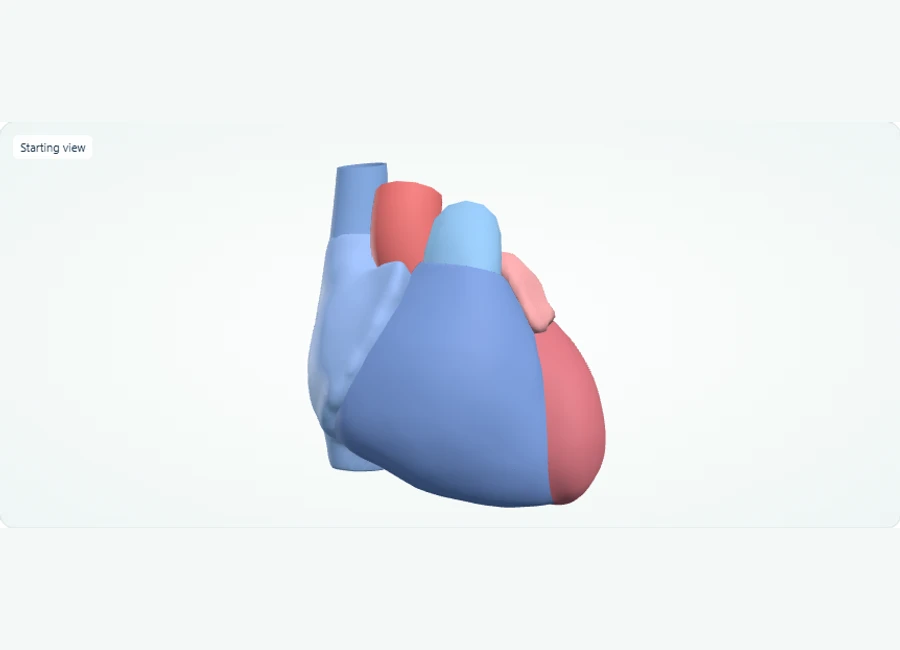
Rotate, isolate structures, and test your recall.
Choose Front and compare the four chambers. The right ventricle forms most of the anterior surface; the left ventricle contributes to the apex.
Select and isolate each chamber in turn, then use Show all to restore its relationship to the surrounding structures.
Select the pulmonary trunk and ascending aorta in turn. Name the circulation supplied by each, then use Test recall to practise identifying the listed structures.
Try it yourself
Which ventricle supplies the pulmonary trunk, and which supplies the ascending aorta?
Show answer and explanation
The right ventricle; it serves the pulmonary circulation.
On the front view, the right ventricle is the anterior-most chamber, and its outflow tract continues as the pulmonary trunk carrying blood to the lungs. The left ventricle instead empties into the ascending aorta for the systemic circulation.
- The right ventricle pumps blood into the pulmonary trunk toward the lungs; the left ventricle pumps into the ascending aorta to the body.
- The superior vena cava returns blood to the right atrium from above the heart.
- The two atria sit superior to the two ventricles; atria receive blood, ventricles eject it.
Low cardiac output after surgery: separating tamponade, bleeding, vasoplegia, and ventricular failure
Postoperative hypotension has several competing explanations with different bedside signatures. Study the discriminating pattern of each — filling pressures, drainage, waveform behavior, and response to intervention — as a decision exercise.
Bleeding usually announces itself through rising chest tube output with falling filling pressures and a compensatory tachycardia. Vasoplegia presents as low blood pressure with low systemic vascular resistance and often warm extremities, frequently in the setting of the inflammatory response after bypass. Tamponade combines falling output with rising filling pressures and equalization, and its pressure relationship can compress the freed heart differently than in medical patients. Ventricular failure shows a low output state with elevated filling pressures on the affected side and poor perfusion without disproportionate drainage.
The reason to study these as a set rather than as separate definitions is that the bedside picture is rarely clean: a patient can bleed and tamponade at once, because clotted blood in a closed pericardial space does not drain through patent tubes. Build a one-page comparison table from your own notes and quiz yourself with mixed paper cases. Watch for simplified teaching that converts these patterns into universal rules — real patients blur them, and recognition means weighing several findings together, not checking one box.
| Pattern | Typical bedside signature (study orientation, not a rule) | First-line nursing focus in a paper scenario |
|---|---|---|
| Bleeding | Rising chest tube output; filling pressures trending down; tachycardia; pallor or coolness | Quantify and trend drainage; monitor hematocrit and coagulation results; escalate per protocol |
| Vasoplegia | Low blood pressure with low SVR; often warm extremities; modest drainage | Support per orders with vasoactive titration; look for the inflammatory context after bypass |
| Tamponade | Falling output with rising, equalizing filling pressures; narrowing pulse pressure; drainage may have slowed because blood is clotted, not absent | Recognize the mismatch between low output and low drainage; urgent surgical notification and preparation for re-exploration |
| Ventricular failure | Low output with elevated filling pressures on the affected side; poor perfusion without disproportionate drainage | Support per orders; assess for ischemic changes; prepare for advanced support escalation per team plan |
Worked scenario: the quiet chest tube that is not good news
A patient four hours post-CABG has fallen blood pressure, climbing central venous pressure, and chest tube output that abruptly slowed. The tempting read is that bleeding has stopped; the safer interpretation weighs tamponade alongside bleeding.
The plausible mistake is to treat the slowed drainage as reassurance — bolus fluids for the low pressure, document stable drains, and continue. That reading ignores the direction of the filling pressures. In the immediate postoperative chest, a closed space that fills with clotted blood can stop showing output precisely because blood is no longer reaching the tubes. Falling blood pressure together with rising central venous pressure and narrowing pulse pressure is a pattern that calls for the tamponade question, not the stable-patient assumption.
The better decision is to name the competing hypotheses explicitly, continue cautious support per orders and protocol, and escalate to the surgical team promptly while preparing for possible re-exploration. Why it matters: tamponade in this window can progress to arrest with a chest that cannot be reopened quickly at the bedside in every setting, so the cost of waiting to see is far higher than the cost of an urgent call that proves unnecessary. Rehearse this discrimination on paper repeatedly until the mismatch — low output, low drainage, rising filling pressures — triggers recognition on sight.
Epicardial pacing wires and postoperative conduction: reading settings, capture, and sensing
Temporary epicardial pacing is a routine part of the early postoperative course. Study the external box as a system — mode, rate, output, and sensitivity — and practice interpreting capture and sensing from strip-and-setting pairs.
A common learning gap is reading the rate on the pacing box and stopping there. A complete read includes the mode (which chambers are being paced and sensed), the output in milliamps, and the sensitivity setting, each matched against the electrocardiogram. A pacing spike without a captured QRS, or inappropriate inhibition because the box senses T waves as P waves, are the two failure patterns worth drilling until you can identify them from a paper strip plus a described setting.
Turn this into a repeatable exercise: write ten small vignettes, each giving a mode, an output, a sensitivity, and a strip description, and grade yourself on a three-point check — is there capture, is sensing appropriate, and does the current setting match the patient's clinical need. A useful trap to rehearse is escalating output when capture is lost: if the problem is lead displacement rather than threshold rise, more milliamps will not fix it and the finding needs surgical awareness. Documented threshold trends are also a study point — a creeping threshold tells a different story than a sudden one.
Worked scenario: new atrial arrhythmia on the first postoperative night
A fast, irregular rhythm with lost atrial contribution appears on the first postoperative night. The tempting read is a rate problem to watch; the better decision weighs the hemodynamic cost of losing atrial filling in a freshly operated ventricle.
The plausible mistake is anchoring on the ventricular rate alone — it is controlled, the blood pressure is borderline, so the plan becomes observation until morning. That underweights what the rhythm removes. In a stiff, recently handled ventricle that has lost its atrial contribution, stroke volume can fall meaningfully even at an acceptable rate, especially in a patient still on vasoactive support whose margin for compensation is narrow.
The better decision is a structured paper response: assess perfusion markers immediately, anticipate that rate control and rhythm decisions will interact, and escalate for rhythm management earlier in an unstable postoperative patient than you would in a stable medical patient, following orders and protocol. Why it matters: atrial arrhythmias are among the recognized events of the early postoperative cardiac surgery course, and the decision of when an arrhythmia stops being tolerable is exactly the kind of judgment a timeline-based review trains. Rehearse the branch points on paper — stable versus unstable, rate versus rhythm, and what data you would gather at each step.
A case-mapping exercise and a preparation sequence you can adapt
Run a weekly case-mapping drill with a self-check rubric, then sequence your preparation: scope first, timeline second, discrimination practice third, and full paper scenarios in the final stretch.
Exercise: take one complex paper case per week — a full early postoperative course from OR arrival to the second morning. Annotate the case against your timeline map, marking where each decision occurred and which competing hypotheses were live at that moment. Score yourself on a simple rubric: named the top two competing explanations (yes/no), justified them with specific bedside data (yes/no), identified what would change your mind (yes/no), and stated the escalation trigger (yes/no). A run of honest noes on one rubric line is your next study topic, not a verdict on your ability — these are learning milestones, not passing predictions.
Adaptable sequence: week one, confirm scope and build the 48-hour timeline from your own notes; weeks two and three, deep-dive the low output states and build your comparison table; week four, drill pacing interpretation with setting-plus-strip vignettes; week five, add arrhythmia and drainage scenarios; final stretch, run full paper cases under time pressure and review every miss against the rubric. Throughout, keep your practice on paper and in supervised or simulation contexts as appropriate, and rely on the issuer's handbook and test plan for the authoritative list of content areas.
- Self-check rubric lines: competing hypotheses named; bedside data cited; disconfirming findings identified; escalation trigger stated.
- Interpret rubric scores as study signals: a repeated no marks the next review topic.
- Keep at least one full paper case per week in the final stretch, reviewed while the reasoning is fresh.
References and further reading
Use these references to explore the concepts and check the latest information from the relevant organizations.