
Treat ABOS certification as two separate preparation projects. Build Part I study around the published blueprint and applied clinical reasoning, and build Part II study around your case list: indications, alternatives, techniques, and complications for operations you actually performed. Rehearse orally with structured feedback.
One Credential, Two Examinations with Different Skills
ABOS certification involves a Part I examination and a Part II oral examination based on your own surgical cases. Each rewards a different kind of preparation, so study them as separate projects rather than one continuous review.
Part I is a written, computer-based examination developed against a published blueprint that spans the orthopaedic domains. Success depends on broad, accurate, retrievable knowledge and the ability to apply it to clinical vignettes under time pressure. Your study instrument here is organized content review plus question practice mapped to blueprint areas.
Part II is an oral examination in which examiners question you about cases drawn from a case list you compile from your own operative experience. Success depends on knowing your own patients cold and defending indications, techniques, and complication management out loud. No amount of textbook rereading substitutes for rehearsing structured verbal case presentation. The administrative details — application windows, fees, calendars — belong to the ABOS website (abos.org); this guide focuses on preparation itself.
Building a Defensible Case List Before You Practice Answering
A case list is the raw material of the Part II oral: a structured record of your operative cases following ABOS case list instructions. Accuracy, completeness, and adherence to inclusion rules matter more than volume.
ABOS publishes case list instructions, a sample scribe sheet, and an explicit list of procedures not to include. Treat those documents as required reading from day one: a case recorded with the wrong diagnosis, an omitted complication, or an included procedure that belongs on the exclusion list creates contradictions you must defend later. Record diagnoses, procedures, and complications contemporaneously, in the format the instructions specify.
A practical habit is to review your running list monthly during the collection period. For each entry, confirm that the diagnosis matches the operative indication, the procedure codes match what was actually done, and any return to the operating room or adverse event is captured. This ongoing audit is far easier than reconstructing an entire list retrospectively, and it produces a document whose internal consistency you can defend line by line when an examiner probes a specific case.
- Record cases contemporaneously using the ABOS scribe sheet format, not from memory at the end.
- Cross-check that each recorded procedure matches a documented diagnosis and indication.
- Screen entries against the published procedures-not-to-include list before submission.
- Log complications and secondary procedures as you go; gaps are harder to explain than events themselves.
Explore in 3D: Right knee: bony relationships
A right knee shown as four whole bones — femur, tibia, fibula and patella — in anatomical position. This model teaches which bone sits where around the knee, not soft-tissue joint anatomy: no menisci, cartilage, cruciate ligaments or tendons are included.
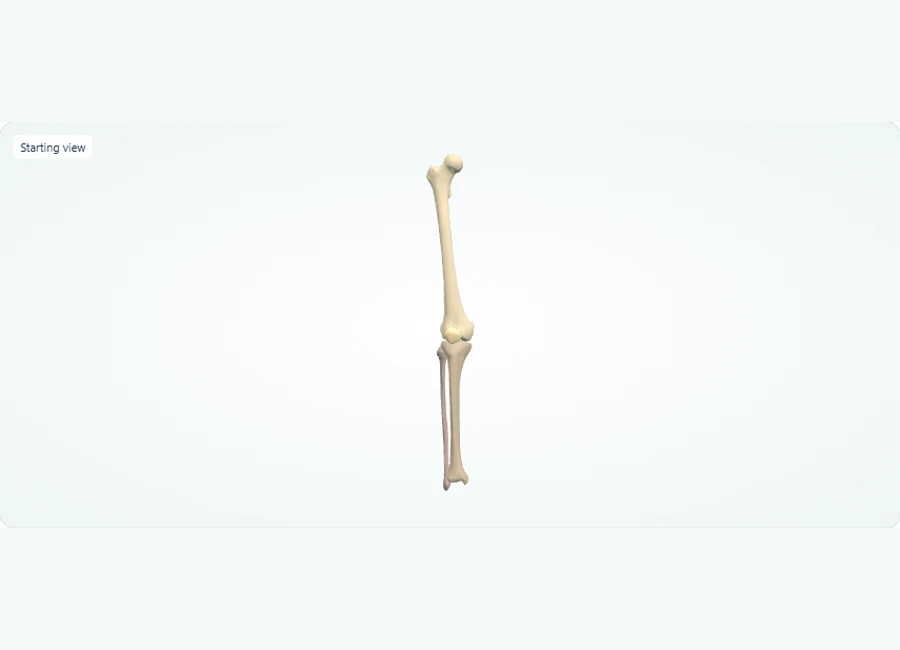
Rotate, isolate structures, and test your recall.
Compare Front, Back and Side views. Whole bones are included, so zoom and pan toward the knee region.
Select and isolate the patella to inspect it. Use Show all, then select and hide the patella to inspect the femur and tibia near the knee.
Use Show all and Test recall. Identify the highlighted bone, using the fibula’s lateral position and patella’s anterior position as clues.
Try it yourself
Which leg bone lies lateral to the tibia, and where is the patella relative to the knee?
Show answer and explanation
The fibula lies lateral to the tibia. The patella lies anterior to the knee.
In anatomical position, the fibula is the slender lateral leg bone, beside the larger tibia. The patella lies in front of the distal femur. These are bony relationships; the model does not include joint cartilage, menisci or ligaments.
- In anatomical position the fibula is the lateral bone of the leg, so it is your orientation landmark for left/right.
- The patella lies anterior to the femur–tibia articulation, so it appears at the front in a front view and overlaps the distal femur in profile.
- The knee region contains four bones here: femur above, tibia and fibula below, patella in front; joint soft tissues are not part of this model.
Answering 'Why This Operation?' — Indication Versus Technique Preference
Oral examiners probe the reasoning behind each case. A defensible answer separates the patient-specific indication from your technique choice and acknowledges reasonable alternatives rather than presenting one path as the only path.
Scenario one: an examiner asks why you performed a particular fixation for an ankle fracture in a patient with diabetes. The weaker answer describes the implant and construct — that is technique, not indication. The better answer states the patient factors that supported operative management (fracture pattern, displaced articular surface, the systemic factors that raised the stakes of both surgery and nonoperative care), then explains how those factors shaped the construct and the postoperative weight-bearing plan, and names what nonoperative management would have risked.
The distinction matters because the indication question tests clinical judgment while the technique question tests reasoning under constraint. When an answer runs in the wrong order, examiners must dig to find whether judgment exists underneath the description. A useful rehearsal rule: for every case, state the indication in one or two sentences, name at least one alternative you considered and why you rejected it, and only then explain technique. Practicing that sequence out loud turns scattered knowledge into a defensible structure.
Discussing Complications Without Defensiveness
Your case list will contain complications; the oral asks how you recognized, managed, and learned from them. Prepared answers describe facts, management, and prevention — not excuses or minimization.
Scenario two: a case list records a postoperative infection after internal fixation. A weaker pattern is to open with mitigators — 'it was a high-risk patient' — before describing what happened. A stronger answer follows the sequence: how the problem presented, what workup you ordered, the treatment decision and its basis, and the outcome. Mitigating context belongs after the factual account, framed as risk assessment rather than deflection.
The stronger response closes the loop: what changed in your practice afterward. For the infection example, that might mean revised prophylaxis timing, a modified dressing protocol, or stricter glycemic optimization in the perioperative plan. Rehearse every complication-bearing case in this four-part structure — recognition, workup, management, practice change. A command narrative invites follow-up questions you can answer; a defensive one opens new threads the examiner must pull, each deflection creating another probe point.
Part I Study Mapped to the Blueprint, Not to a Single Textbook Order
The ABOS publishes a Part I blueprint describing examination content domains. Using it to allocate review time keeps broad-coverage study honest instead of letting it drift toward the subspecialty areas you know best.
If your review drifts toward the topics that dominate your daily practice — sports, arthroplasty, or whichever area you enjoy most — the blueprint exists to catch that drift before it leaves basic science, tumors, hand, and pediatric orthopaedics undercovered. Build a study calendar in which each blueprint domain receives scheduled review proportional to its stated weight, and track completion domain by domain rather than page by page.
Pair each domain review with applied question practice: after reading a topic, answer vignette-style questions on it within days, then again weeks later. Part I questions present clinical scenarios, so isolated fact recall is not enough — you need to move from stem to diagnosis to management choice quickly. When a practice question exposes a gap, return to the source material for that specific concept rather than rereading the whole chapter. This feedback loop, organized around blueprint domains, converts a static reading plan into a measurable one.
A Mock Oral Exercise with a Self-Check Rubric
Rehearse the oral format directly: present one of your own cases aloud in a structured five-part format, have a colleague question you, and score the performance against explicit observations.
Exercise: choose one case from your list, ideally one with a complication or an unusual decision. Present aloud, without notes, in this order: (1) relevant history and examination, (2) imaging summary and diagnosis, (3) nonoperative options and why they were inadequate, (4) the operation performed and the reasoning for the approach, (5) outcome, complications, and any practice change. Then have your partner play examiner and ask 'why' at least three times, drilling into whichever answer was thinnest.
Score each run with this rubric: indication stated before technique (yes/no); at least one named alternative with a reason for rejection (yes/no); complication described factually before any context (yes/no); a concrete practice change identified (yes/no); answers stayed under roughly a minute without losing structure (yes/no). Repeat weekly with different case types — trauma, elective reconstruction, pediatric, and tumor cases if your list contains them. Expected observation: early sessions expose long, unstructured answers; by the fourth or fifth case, the five-part sequence should surface without notes. These are learning milestones, not score predictions.
An Adaptable Preparation Sequence and Readiness Checks
Sequence preparation in phases: case list hygiene first, blueprint-driven Part I review in parallel, then mock orals once the list is stable. Finish with explicit readiness checks for each examination rather than a general sense of readiness.
A realistic sequence: while the case list accumulates, run monthly audits (as above) and begin blueprint-mapped Part I review with question practice. Once your list is stable, shift weight toward oral rehearsal — weekly mock cases, complication narratives, and rapid indication-first answers. Adjust proportions to your timeline: whichever examination comes sooner dominates, but keep a small weekly touch on the other so neither skill decays.
Part I readiness check: you can answer mixed-domain vignette sets with consistent accuracy across every blueprint area, and your weakest domain no longer produces systematic errors. Part II readiness check: you can present any randomly selected case from your list, from memory, in the five-part structure; every complication has a rehearsed narrative ending in a practice change; and your list shows a clean audit against the case list instructions. If any check fails, that identifies the next phase of work — which is exactly what a readiness check is for.
Table: how the two preparations differ.
| Dimension | Part I preparation | Part II preparation |
|---|---|---|
| Core material | Blueprint domains, review content, vignette question practice | Your own case list and operative decisions |
| Dominant skill | Applied knowledge recall under time pressure | Structured verbal defense of judgment |
| Key documents | ABOS Part I blueprint | Case list instructions, sample scribe sheet, procedures-not-to-include list |
| Typical gap if untrained | Neglected non-dominant blueprint domains | Technique-first answers; unprepared complication narratives |
| Practice format | Timed mixed-domain question sets | Weekly mock orals with a questioning partner |
| Readiness signal | Uniform accuracy across all domains | Any case presentable from memory in the five-part structure |
References and further reading
Use these references to explore the concepts and check the latest information from the relevant organizations.