
The American Board of Plastic Surgery describes a pathway with separate written and oral examination processes, plus ongoing continuous certification after initial certification. That structure rewards a specific study habit: pairing recall with spoken justification. For every clinical topic, write the facts, then speak a two-minute plan that names the alternatives you rejected and why. This article builds that habit through two worked scenarios, a flap-naming drill, a self-scored rubric, and an adaptable three-phase sequence you can compress or extend based on your own baseline.
Written recall versus oral case defense: why the two exams need different study modes
The ABPS pathway separates a written examination from an oral examination, so preparation should pair a recall phase for the written with a spoken reasoning phase for the oral, rather than treating them as one continuous test.
A written examination rewards organized factual retrieval across the broad scope of the specialty: anatomy, wound healing, reconstructive options, and aesthetic principles. Study in closed-book bursts and track gaps in a running topic list. For the oral format, facts are only the entry ticket; the task to rehearse is defending a management plan aloud under follow-up questions. Structure your notes so every entry ends with a line reading “my plan and why,” so the transition between study modes happens on the page before it happens in the room.
Convert each topic into a three-part script: assessment, options with risks, and a chosen plan with justification. Practice delivering it in under two minutes, then answer self-invented follow-ups: what if the wound dehisces, what if a flap becomes congested, what if the patient declines the recommended option? Rehearsing the pivot between competing options is what connects the two exam formats instead of doubling your workload, because the same content is being retrieved, organized, and defended through increasingly demanding formats.
Graft, pedicled flap, or free flap: a worked closure decision
Closure decisions follow the reconstructive ladder from simplest to most complex, but ladder position must yield to wound conditions, tissue quality, and function, so the reasoning matters as much as the choice.
Scenario one: a paper case describes a stable distal lower-leg wound over the tibia after trauma, with exposed bone and a noted zone of injury in a healthy adult. A plausible mistake is jumping to the top of the ladder and designing a free flap, because free tissue transfer sounds like the definitive answer. The better decision is to work the ladder deliberately on paper: can a local fasciocutaneous flap plausibly reach and cover, does a pedicled regional option exist for this zone, and what do the stated wound conditions and the zone of injury imply about local tissue reliability?
In a written question, the correct option hinges on the conditions stated in the stem. In an oral defense, each rejected rung can be probed, so practice writing one sentence per rejected option explaining why it fails in this specific wound: local tissue lies within the zone of injury, the defect exposes structures that demand durable cover, or donor-site morbidity is unacceptable for this patient. Those rejection sentences turn a guess into a defensible plan and are reusable across nearly every reconstructive prompt you will study.
Use this comparison frame while drilling closure questions:
| Closure option | Best suited when, on paper | Key reasoning to state |
|---|---|---|
| Healing by secondary intention or simple closure | Small, clean, well-vascularized defects where contracture will not impair function | Why the defect is small enough and why function is preserved |
| Split-thickness skin graft | A vascularized wound bed with no exposed structures requiring bulk or durable cover | Graft requirements: adherence, bed vascularity, accepted contour trade-off |
| Pedicled regional flap | Defects within reach of a reliable regional vessel with local tissue outside the zone of injury | Reach of the pedicle, donor-site consequences, tissue reliability |
| Free tissue transfer | Large or complex defects needing specific tissue when local and regional options fail | Why each simpler rung fails, plus donor-site and anastomosis reasoning |
Explore in 3D: Maxilla and Mandible: Upper and Lower Jaws
This model shows the skeletal framework of the jaws: paired maxillae forming the upper jaw and the single mandible forming the lower jaw. Bones only, no teeth.
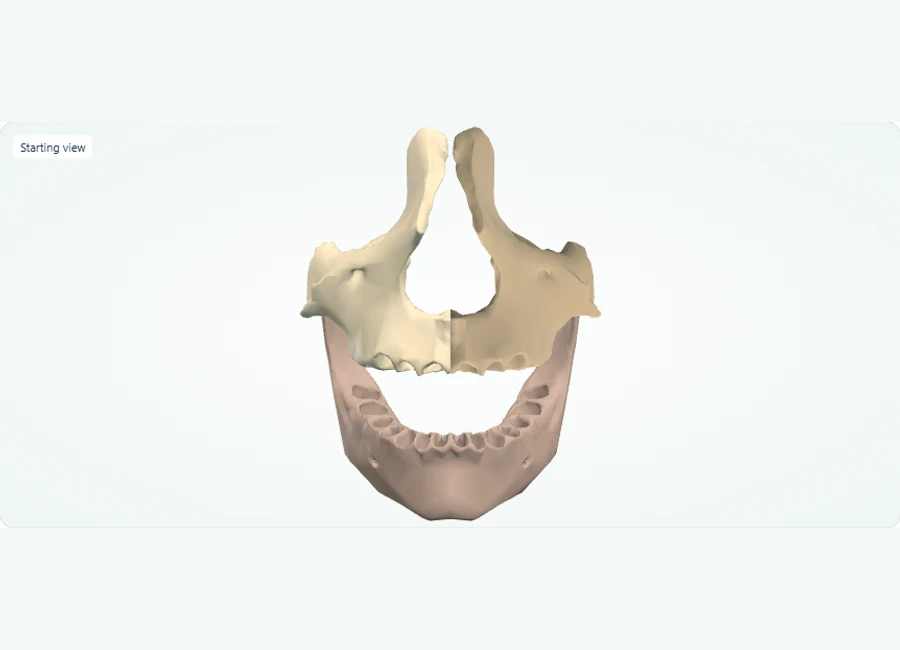
Rotate, isolate structures, and test your recall.
Choose Front and rotate to compare the paired maxillae above with the mandible below.
Select and isolate the right maxilla to inspect it. Use Show all before comparing it with the left maxilla.
Start Test recall, identify the highlighted bone, then use Reveal name to check.
Try it yourself
Which bones form the upper jaw, and which bone forms the lower jaw?
Show answer and explanation
The paired right and left maxillae form the upper jaw. The mandible forms the lower jaw.
The maxillae are paired upper-jaw bones, whereas the adult mandible is a single lower-jaw bone. This model shows those bones without teeth.
- The maxillae are paired bones that together form the upper jaw; the mandible is a single bone forming the lower jaw.
- The model contains only three selectable structures: right maxilla, left maxilla, and mandible, so recall answers come from that set.
- Teeth are not present in this bones-only model, so focus on the bones themselves rather than dental features.
Naming flaps precisely: movement, blood supply, and examples in both directions
Flap names encode movement and blood supply; being able to define each named type and its perfusion basis lets you justify a closure choice rather than merely recognize one.
Distinguish random versus axial patterns first, then the local movement types: rotation pivots around a fixed point, advancement stretches tissue along one vector, transposition crosses over intervening skin into the defect, and interpolation travels over or under normal tissue on a pedicle. Free flaps add microvascular transfer from a distant donor site. Conflating these categories in an oral answer undermines an otherwise sound plan, because the name is how your reasoning is communicated, not decoration on top of it.
Drill with a two-directional grid. Forward: for each flap type, write the movement, the typical basis of its blood supply, and one classic example. Backward: given a named example such as a forehead flap for nasal reconstruction, state the category and why that anatomy suits the defect. If the backward direction stalls, you have memorized labels without the mechanics, which is exactly the gap that surfaces when an examiner asks you to justify a choice you could previously only name.
Oral-style case defense: a breast reconstruction scenario with follow-ups
The oral format rewards candidates who state an assessment, commit to a staged plan, and revise it aloud when new facts arrive, instead of reciting every possible option at once.
Scenario two: you are handed a case of a patient seeking post-mastectomy reconstruction where prior radiation to the chest wall is documented. A plausible mistake is answering with an encyclopedic list of implants, expanders, pedicled flaps, and free flaps without committing to anything. The better decision is a spoken plan: acknowledge how radiation affects tissue pliability and healing on paper, favor autologous tissue in this scenario, note that implant-based pathways exist with their own trade-offs, then state your chosen pathway and its staging. Committing to a plan is what the format exists to hear.
Then the follow-up arrives: the case adds that abdominal donor tissue is inadequate. Practice revising aloud without discarding your reasoning: name what changed, identify which alternatives now become primary, and state what you would assess next. Rehearse this two-turn pattern of plan, then revise on new data, because a plan that cannot bend under one changed fact reads as memorized rather than reasoned. Run this exact loop on breast, lower-extremity, and facial cases so the pattern transfers across subsites rather than living in one scenario.
Keep the Hand Surgery Examination credential separate in your planning
The ABPS also administers a Hand Surgery Examination as its own certification pathway; treat it as an adjacent credential with overlapping content, not a subset of plastic surgery certification.
The overlap is real: hand anatomy, tendon principles, and upper-limb coverage questions draw on shared content, so study time invested once can serve both scopes. But conflation is costly. Eligibility, content, and certification status are distinct, and the Board publishes guidelines on stating certification status, which signals that holding or describing the wrong credential is treated as a professional-standards matter rather than a labeling preference.
A practical step: label your hand-content notes in two buckets, core to plastic surgery certification versus specific to the hand credential, so effort routes correctly. If hand surgery is a career direction, plan it as a separate application with its own timeline instead of assuming one exam covers both. Confirm the current scope, process, and requirements directly on the Board's hand surgery pages before committing study weeks to either pathway.
Ethics, safety, and documentation as scored reasoning inside clinical answers
Professional-standards content appears as decisions inside clinical scenarios, including informed consent, honest disclosure of complications, and accurate certification status, so study it as phrasing you would actually use.
For consent-heavy topics, practice the spoken version: name the procedure, the material risks in plain language, the realistic alternatives including no intervention, and the patient's role in the decision. In an oral case, saying “I would discuss the risk of tissue loss and revision before scheduling” demonstrates standards integration, while reciting only technique steps does not. Draft these sentences now for your highest-frequency topics, because the words you would actually say are hard to improvise under questioning.
Documentation reasoning pairs with safety: describe what you would record after a complication, covering findings, decisions, and communication with the patient and team, rather than offering vague assurances of thoroughness. Rehearse boundary scenarios on paper too: delegation limits, advertising claims, and how you state certification status, using the Board's own published guidance on the last point. Answering standards questions as concrete language makes them usable inside clinical cases instead of leaving them as detached trivia in a separate mental folder.
A three-phase adaptable sequence with a self-check rubric
Sequence preparation in three phases: content mapping, spoken case rehearsal, then mixed timed practice, adjusting phase length to your own baseline rather than to a fixed rule.
Weekly exercise: pick one reconstructive case, build a closure decision table with options, rejection reasons, and a chosen plan, then record a two-minute spoken defense. Score yourself on a four-point rubric: one point for a stated assessment, one for options with rejection reasons, one for a committed plan with risks, and one for a coherent revision after one self-invented change to the case. Expect early attempts around one or two points; a stable three-and-a-half to four across three different cases is a learning milestone signaling it is time to move phases, not a prediction of any exam result.
Adapt the sequence to what the rubric shows: expand the mapping phase if your topic list keeps surfacing factual gaps, or compress it and extend spoken rehearsal if recall is strong but defenses ramble. Concrete readiness checks before you stop studying: every topic entry has a plan-and-why line, you can define any flap type in one sentence in both directions, and you can revise a plan aloud after one changed fact without restarting. For administrative details such as dates, requirements, and deadlines, the Board's website at abplasticsurgery.org is the authoritative source; confirm them there rather than from any study material.
References and further reading
Use these references to explore the concepts and check the latest information from the relevant organizations.