
Prepare for the CMC by studying cardiac medicine as decision-making, not recall: pair similar presentations, name what distinguishes them, and rank immediate priorities in exam-style scenarios until the reasoning is automatic without notes.
CMC is a subspecialty layer: build your plan around the prerequisite, not the cardiac basics
The CMC is designed for nurses who already hold a nationally accredited clinical nursing specialty certification and specialize in direct care of adult cardiac patients across varied settings. Plan review around deepening cardiac judgment, not re-learning entry-level content.
According to AACN Certification Corporation's program descriptions, CMC candidates must hold a current nationally accredited specialty credential — examples listed by AACN include CCRN (direct care or tele-critical care pathways), PCCN (direct care), ACNPC-AG, CCNS, ACCNS-AG, CMSRN, and CEN. Settings named for CMC practice include CCUs, medical ICUs, telemetry, progressive care, heart failure clinics and home care, interventional cardiology, catheterization labs, and electrophysiology units.
This structure shapes your study plan directly. If your base credential is telemetry- or progressive-care-oriented, spend disproportionate time on critical-care-facing topics such as hemodynamic instability and advanced arrhythmia management; if you come from an ICU background, invest in ambulatory and chronic cardiac content such as heart failure management and outpatient medication titration concepts. The credential validates adult cardiac medicine breadth, so a gap audit against that breadth is the first productive step. Administrative details like eligibility verification live in the issuer's CMC handbook, which you should consult directly before applying.
Application and analysis items: why a correct cardiac fact can still produce a wrong answer
AACN's exam policy handbook states that most certification items are written at the application and analysis levels of a condensed Bloom's taxonomy, meaning items reward reasoning through situations rather than reproducing definitions or isolated facts.
The practical consequence is that you must rehearse the move from finding to decision. Recognizing 'ST-segment elevation' is knowledge; deciding what it means for this patient, in this setting, relative to the distractor answers, is application or analysis. When you review any cardiac topic, force a second question after each fact: what action, observation, or interpretation does this fact change? Facts that change nothing in a scenario are low-yield for this exam format.
Build this into practice question review. For every item, write one sentence naming the discriminating variable — the specific finding that separates the correct answer from the most attractive wrong answer. If you cannot articulate it, you learned the answer key rather than the reasoning. Rebuild missed items into new paper scenarios with altered numbers and findings so the discrimination transfers. This habit also exposes when you are memorizing exceptions without the underlying mechanism, which produces fragile reasoning on analysis-level stems.
Explore in 3D: Heart chambers and great vessels
A four-chambered heart viewed from the front. The right ventricle supplies the pulmonary circulation via the pulmonary trunk; the left ventricle supplies the systemic circulation via the ascending aorta. This model shows external chamber surfaces and the visible great vessels only — no internal valves or conduction system.
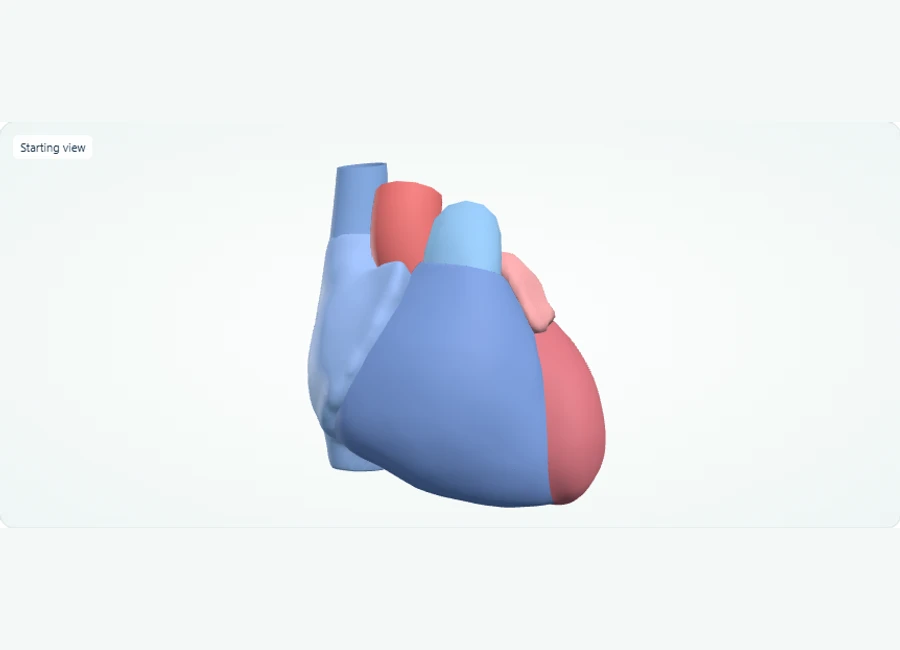
Rotate, isolate structures, and test your recall.
Choose Front and compare the four chambers. The right ventricle forms most of the anterior surface; the left ventricle contributes to the apex.
Select and isolate each chamber in turn, then use Show all to restore its relationship to the surrounding structures.
Select the pulmonary trunk and ascending aorta in turn. Name the circulation supplied by each, then use Test recall to practise identifying the listed structures.
Try it yourself
Which ventricle supplies the pulmonary trunk, and which supplies the ascending aorta?
Show answer and explanation
The right ventricle; it serves the pulmonary circulation.
On the front view, the right ventricle is the anterior-most chamber, and its outflow tract continues as the pulmonary trunk carrying blood to the lungs. The left ventricle instead empties into the ascending aorta for the systemic circulation.
- The right ventricle pumps blood into the pulmonary trunk toward the lungs; the left ventricle pumps into the ascending aorta to the body.
- The superior vena cava returns blood to the right atrium from above the heart.
- The two atria sit superior to the two ventricles; atria receive blood, ventricles eject it.
Scenario one: chest pain assessment where the ST-segment finding changes everything
Acute coronary syndrome review should center on what the ECG and troponin trajectory change: ST-elevation patterns demand immediate reperfusion pathways, while non-elevation ACS follows a different risk-driven sequence. Walk the worked case below until the ranking feels obvious.
Worked scenario: A 62-year-old on your telemetry unit reports substernal pressure for 40 minutes. The tracing shows ST elevation in leads V1–V4; the patient is diaphoretic and anxious. Plausible mistake: documenting the findings, administering as-needed oral medication, and waiting for the next scheduled assessment round because 'telemetry patients are stable.' Better decision: treat anterior ST elevation with ongoing symptoms as an evolving emergency — notify the provider and activate the facility's reperfusion pathway immediately, obtain a repeat 12-lead, and prepare the therapies ordered for the ACS pathway.
Why it matters: the setting label (telemetry) does not override the physiology; anterior ST elevation signals a large territory at risk where time-to-reperfusion drives outcome. The discrimination skill for exam purposes is recognizing that lead territory, symptom duration, and hemodynamic state jointly determine urgency — a stable-appearing rhythm strip never certifies stability when active ischemic signs are present. Practice by writing three variants of this case (posterior pattern, non-elevation with rising troponin, and vasospastic-pattern pain) and ranking the first three actions in each, then check your rankings against ACS pathway logic in your own unit's protocols.
Scenario two: a wide-complex tachycardia where the wrong rhythm assumption is the trap
Wide-complex tachycardia in an adult with known or suspected structural heart disease should be reasoned through as ventricular tachycardia until proven otherwise; the classic mistake is assuming a supraventricular origin and selecting an atrioventricular-nodal blocking agent.
Worked scenario: A 58-year-old three days after an inferior infarction develops a regular, wide-complex tachycardia at a rapid rate, blood pressure dropping but still measurable. Plausible mistake: the rhythm looks irregularly irregular in one lead and the reviewer recalls that 'some VT looks like SVT,' then reasons toward a supraventricular rhythm with aberrancy and considers an intravenous AV-nodal blocker. Better decision: in this clinical context — prior infarction, wide QRS, regular tachycardia — unstable ventricular tachycardia is the working interpretation, so synchronized cardioversion per the advanced life support algorithm is the priority, and AV-nodal blocking agents are avoided.
Why it matters: the clinical rule exists because misclassifying ventricular tachycardia as supraventricular can produce profound deterioration, and because AV-nodal blockade in ventricular tachycardia can worsen hemodynamics. This is a named discrimination pair worth writing on a study card: regular wide-complex in structural heart disease versus irregular narrow-complex; the discriminating variables are QRS width, regularity, and cardiac history, and each variable points to a different algorithm branch. Rehearse by drafting four rhythm scenarios across that pair and stating the discriminating variable and first action for each before consulting an ACLS reference.
Discrimination pairs worth building before anything else: a comparison table
Certain cardiac discrimination pairs reward concentrated early study because each member of the pair triggers a different management branch. Use the table below as a checklist: cover the right columns, read the left, and state the distinction aloud from memory.
Study each row in both directions. Forward practice — see the pattern, name the branch — builds recognition; reverse practice — hear the intervention, reconstruct the pattern that justified it — builds the mechanism understanding that analysis-level items probe. A row you can only do forward is half-learned, and the exam format is built to expose exactly that.
Add your own rows from unit experience: any situation where you have seen two similar findings lead to different orders is a candidate pair. Aim for a working set of eight to twelve pairs spanning ischemia, heart failure phenotypes, conduction disturbance, and electrolyte effects, then rotate through them in short sessions rather than one long pass.
| Assessment pattern | Key discriminating feature | Immediate exam-style priority |
|---|---|---|
| Chest pain with ST elevation vs. ACS without elevation | 12-lead ECG territory and elevation pattern, confirmed against troponin trajectory | Elevation: urgent reperfusion pathway; without elevation: risk-stratified pathway and serial assessment |
| Wide-complex tachycardia vs. supraventricular tachycardia with aberrancy | QRS width, regularity, and history of structural heart disease or prior infarction | Treat as ventricular tachycardia when unstable in structural disease; avoid AV-nodal blockade |
| Heart failure with reduced vs. preserved ejection fraction | Ventricular function on imaging drives which evidence-based medication classes apply | Accurate assessment findings and medication knowledge matched to the documented phenotype |
| High-grade AV block vs. blocked premature atrial contractions | P-to-P regularity and whether non-conducted P waves are premature or sinus-timed | True high-grade block: assess perfusion and prepare pacing pathway per protocol |
| Peaked T waves progressing to widened QRS vs. nonspecific T-wave flattening | Sequential hyperkalemia pattern on serial tracings plus serum potassium context | Suspected hyperkalemia pattern: urgent potassium level, provider notification, continuous monitoring |
Heart failure phenotypes and chronic cardiac content: the breadth the specialty settings demand
Because CMC practice settings span heart failure clinics and home care alongside CCUs, chronic cardiac management deserves equal standing with acute arrhythmia content, particularly the reduced-versus-preserved ejection fraction distinction.
Name the distinction precisely: heart failure with reduced ejection fraction and heart failure with preserved ejection fraction differ in ventricular systolic function on imaging, and that difference drives which evidence-based medication classes have supporting roles. Review the major heart failure medication groups by their mechanism and by what assessment finding you monitor for each, rather than as a flat drug list. Tie each class to a monitoring consequence — for example, what a patient on guideline-directed therapy should be asked about at a clinic visit, and which symptom change warrants escalation rather than reassurance.
Extend the same structure to other chronic-facing content: atrial fibrillation management concepts including rate versus rhythm strategies and anticoagulation considerations, hypertension management principles, and valvular disease recognition. A useful integration exercise: write one paragraph describing how you would explain to a patient why their specific phenotype justifies their specific regimen. If the explanation collapses into drug names without mechanisms, that content area needs another pass. This patient-education framing also rehearses the professional-standards dimension of subspecialty practice.
Ethics, safety, and documentation: the professional frame the credential assumes
AACN Certification Corporation grounds its programs in the ANA Code of Ethics for Nurses and frames certification as public protection, so professional-standards reasoning belongs in your review, not at the margins of it.
Translate that frame into scenarios: subspecialty-level items can ask what a nurse should do when reassurance, documentation accuracy, and escalation seem to conflict. Rehearse the reasoning that accurate, timely documentation of assessments and interventions is part of safe care, that ethical practice includes acting when observations suggest a deteriorating trajectory, and that knowing when to escalate beyond your current order set is a competency rather than an admission of uncertainty. Write one scenario from your own unit where documentation timing changed a downstream decision, and state what the ideal sequence would have been.
Pair this with a safety-focused review of high-alert cardiac medications: anticoagulants, antiarrhythmics, and vasoactive infusions, each tied to its monitoring requirements and the observations that signal an adverse trajectory. The exam-relevant skill is connecting a drug, an assessment finding, and a required response in one chain. A compact drill: for five cardiac medications you administer most often, write the one assessment you would never omit, the finding that would prompt you to hold the dose pending provider contact, and the documentation element that captures the reasoning.
A preparation sequence and self-check rubric you can run in four weeks
Sequence preparation in three passes: breadth audit against adult cardiac settings, discrimination-pair drilling with written scenarios, then timed mixed-case reasoning with a rubric. Run the rubric below at the end of each week to track movement.
Week one, audit breadth: list the CMC practice settings named in AACN's program description, mark which you have practiced in, and prioritize review in your weakest two. Week two, build and drill the discrimination-pair set, writing one fresh paper scenario per pair. Week three, draft multi-step cases combining an ECG finding, a hemodynamic state, and a medication decision, then rank the first three actions in each. Week four, run mixed cases under time pressure and score them against the rubric.
Self-check rubric for each practice case: (1) you can name the discriminating variable and at least one alternative it excludes, without notes; (2) your ranked priorities match protocol logic, and you can state the mechanism behind each ranking; (3) you can identify why the most attractive wrong answer is wrong in one sentence. Reaching all three consistently on unfamiliar cases is a meaningful learning milestone for self-assessment — it is a study benchmark, not a prediction of any score outcome. If a rubric point keeps failing, return to that topic's mechanism rather than doing more questions on it, since unresolved mechanism gaps reproduce themselves across new stems.
References and further reading
Use these references to explore the concepts and check the latest information from the relevant organizations.