
Study for the ARRT credential by building a reasoning chain for every concept: name the property involved, choose the correction that matches that property, and justify the choice with the principle behind it. This converts memorized lists into decisions you can defend in scenario-style practice.
From Term Lists to Reasoning Chains: The Core Study Move
Treat each topic as a three-step chain: name the concept, decide the correction or action, and justify it with the underlying principle. Recall alone leaves related terms tangled; a chain forces you to state which property each term controls.
Radiographic concepts arrive in tight clusters. kVp and mAs both change what an image looks like; brightness and contrast both describe gray tones; quantum mottle and motion blur both look like poor image quality until you inspect the edges. When several answer options describe plausible-sounding adjustments, the only reliable filter is being able to state, in one sentence, which property each option actually acts on. That is why chains beat lists.
Build the chain into your notes directly. For every flashcard or summary line, add two extra columns: one labeled 'first correction' and one labeled 'why.' A card that only says 'grid reduces scatter' stays inert; a card that says 'grid absorbs scattered photons, so use it where scatter is expected, and recognize it increases the exposure needed' gives you a decision and a justification. Practice writing these chains aloud until each one takes under fifteen seconds to complete.
Separating kVp and mAs: The Pair That Causes the Most Confusion
kVp governs the penetrating quality of the beam and the scale of contrast; mAs governs the quantity of photons and therefore receptor exposure. Assigning each factor its own job is the foundation of every technique decision you will reason through.
Keep the two jobs strictly separate in your mind. mAs changes how many photons reach the receptor, which drives overall receptor exposure or brightness; it does not change how penetrating the beam is. kVp changes beam quality, which affects both penetration through the part and the spread of gray tones, and it also influences patient dose. Because both factors visibly change an image, weak preparation treats them as interchangeable; strong preparation maps each image finding to exactly one of the two.
Worked example (practice numbers for reasoning, not a protocol): a tabletop extremity image shows adequate overall brightness but looks flat, gray, and low in contrast. A common mistake is to double the mAs, reasoning that the image needs 'more exposure.' But receptor exposure is already adequate, so adding mAs risks overexposure while leaving the gray-scale spread untouched. The better decision names the problem as a contrast-scale issue, which points to beam quality, and adjusts kVp downward with technique compensation. Why it matters: the correct chain solves the visible problem and avoids a dose-increasing repeat that would not have fixed anything.
Explore in 3D: Kidneys, Ureters and Bladder: The Urine Transport Pathway
This model shows five selectable structures: the right and left kidneys, the right and left ureters, and the urinary bladder. It demonstrates the gross pathway of urine transport from where urine forms (kidneys) to where it is stored (bladder). Note: the urethra and internal renal anatomy are not included in this model, so the pathway ends at the bladder.
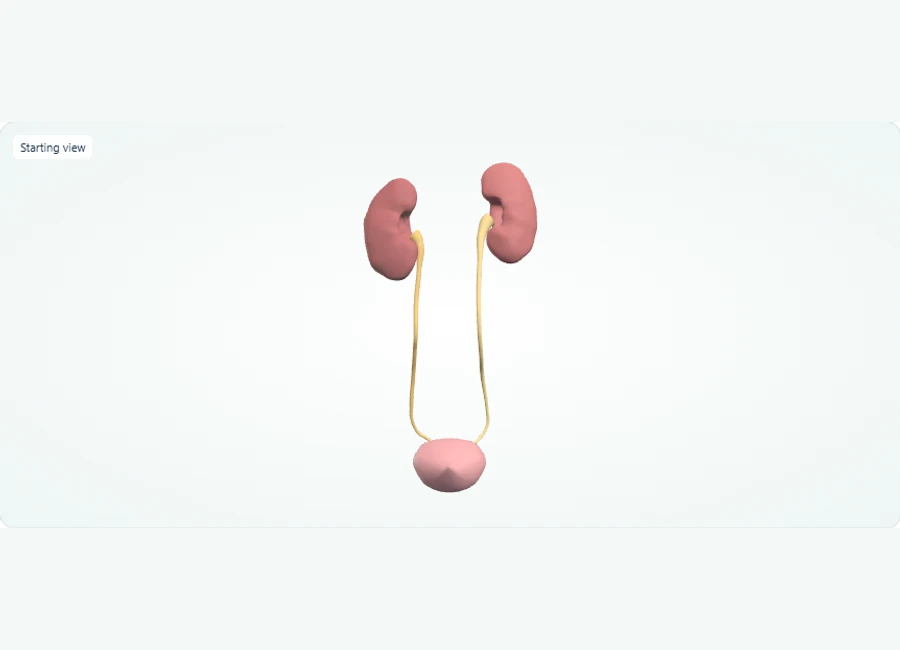
Rotate, isolate structures, and test your recall.
Choose Front. Select the right kidney, then its ureter, and follow the route toward the bladder with all structures visible.
Repeat on the left side. Select and hide each kidney separately if you want a clearer view of the ureters; use Show all to restore them.
Select the urinary bladder. Rotate the model and identify where the paired ureters meet the single bladder.
Try it yourself
Trace the three structures in the right-sided urine transport route shown here. What does the final structure do?
Show answer and explanation
Right kidney, right ureter, urinary bladder. The bladder stores urine until it leaves the body. (The left side follows the same pattern: left kidney and left ureter also deliver urine to the bladder.)
Urine flows from each kidney into its own ureter, which transports it down to the urinary bladder for storage. Both the right and left ureters empty into the single bladder. Because the urethra is absent from this model, the bladder is the terminal structure you can trace.
- Urine is formed in the kidneys; from each kidney, urine drains into that side's ureter (right ureter from right kidney, left ureter from left kidney).
- Each ureter carries urine downward to the urinary bladder, which stores urine until it is expelled; this model shows both ureters joining the bladder.
- This model is a gross transport overview only: the urethra and internal kidney structures are not shown, so urine flow beyond the bladder cannot be traced here.
Illustrated practice: Urinary Collecting System Drainage Route
Lets the learner trace the visible route from renal pelvis down each ureter to the bladder, grounding the timed opacification explanation in the actual drainage pathway.
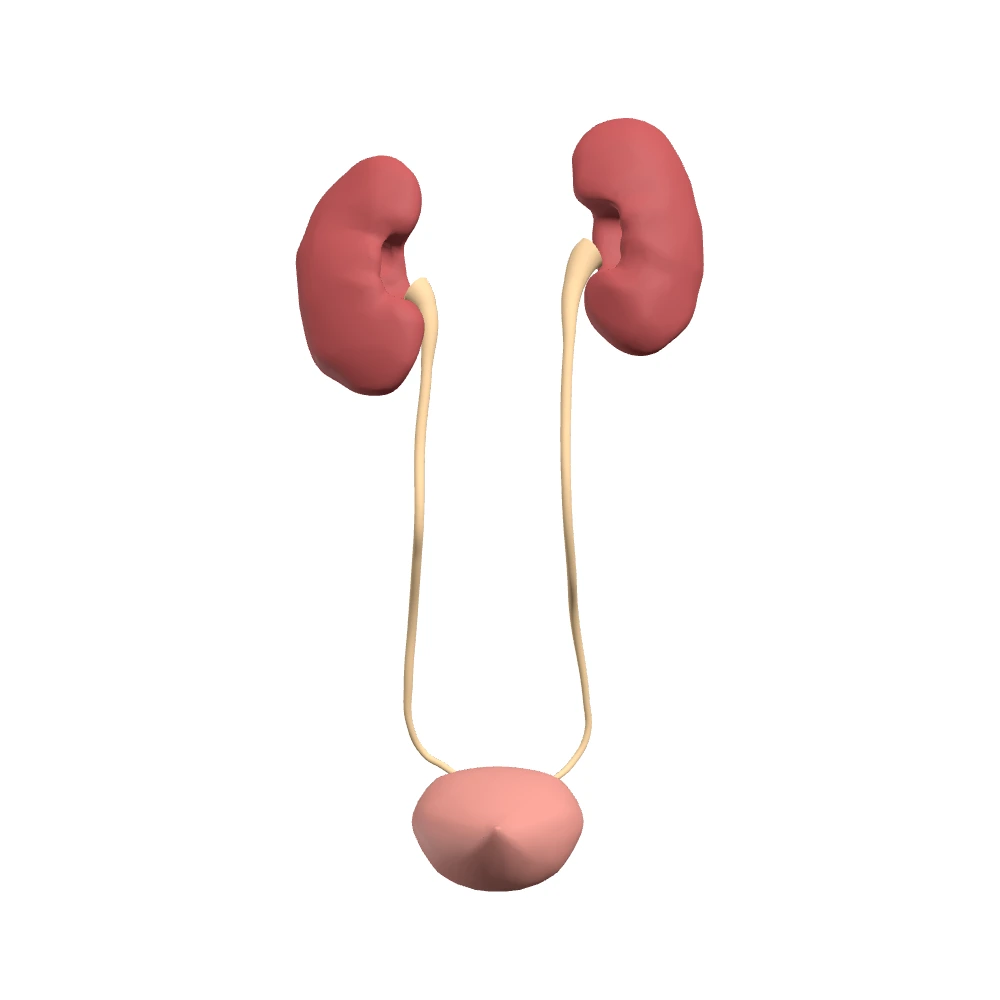
Anatomical study exhibit for the worked question below. Open the full-size view to inspect the structures.
Use the anatomical exhibit to work through the example. Choose an answer before opening the explanation.
Try it yourself
The accompanying illustration is a normal three-dimensional anatomical model of the urinary tract showing both kidneys, the paired ureters, and the urinary bladder; it is an anatomy reference only, not the patient's urogram. On a 5-minute intravenous urogram image, contrast opacifies the minor and major calyces and the renal pelvis bilaterally, but the urinary bladder shows no contrast. A student must explain the finding to the radiologist using the drainage route visible in the model. Which explanation is correct? A. Absent bladder opacification at five minutes indicates bilateral ureteral obstruction and requires terminating the study. B. Contrast remains intravascular at five minutes and has not yet reached the nephrons or collecting structures. C. The bladder opacifies before the ureters because the bladder wall actively absorbs contrast from adjacent vessels. D. Nephron filtrate drains through minor then major calyces into the renal pelvis and ureters, so delayed bladder filling at five minutes is expected.
Show answer and explanation
D. Nephron filtrate drains through minor then major calyces into the renal pelvis and ureters, so delayed bladder filling at five minutes is expected.
The model traces the uninterrupted drainage path: each kidney's collecting system drains through minor calyces into major calyces and the renal pelvis, and a long ureter descends to the bladder. Contrast filtered at the glomeruli follows this route, draining from nephrons into minor calyces, major calyces, and the renal pelvis, then descending the ureters by peristalsis; ureteral transit normally delays bladder opacification beyond five minutes, so the finding is expected. Bilateral obstruction is not inferred from a normal timed sequence, the bladder does not absorb contrast, and opacified calyces prove contrast has reached the nephrons.
Naming the Image Problem Before Choosing the Fix
Four distinct properties describe image quality: receptor exposure or brightness, contrast, spatial resolution or sharpness, and distortion. Quantum mottle, motion blur, and geometric distortion are different failures with different corrections, so diagnosis must precede adjustment.
Train yourself to describe the finding before naming any correction. A uniformly grainy image across the whole receptor points to too few photons reaching it, which is quantum mottle. Blurred edges while some structures stay sharp point to movement during the exposure. Uniformly enlarged anatomy with altered shape points to geometric distortion from part alignment or source-to-image distance relationships. Each of these has a different fix, and none of them is solved by the same adjustment.
Use the table below as a self-quiz aid: cover the right-hand columns, look only at the finding, and write your own concept name and first correction before checking. If your correction does not match the property you named, the chain is broken at step two. Note these are simplified study examples for reasoning practice; actual technique choices depend on equipment, orders, and department protocols.
| Image finding (study example) | Concept to name | Typical first correction to consider | Reasoning |
|---|---|---|---|
| Uniform grainy appearance across the image | Quantum mottle | Increase mAs | Too few photons reached the receptor |
| Edges blurred, some structures still sharp | Motion blur | Shorten exposure time or immobilize | Movement occurred during the exposure; quantity was not the issue |
| Flat, gray, low-contrast appearance | Scale of contrast | Adjust kVp using technique logic | Beam quality sets the gray-scale spread, not photon quantity |
| Uniformly enlarged anatomy with altered shape | Distortion | Review alignment and distance relationships | Geometry, not exposure, caused the size and shape change |
Radiation Protection: Dose Quantities and the Repeat Decision
Absorbed dose describes energy deposited per unit mass; effective dose applies weighting that accounts for differing tissue sensitivity. Protection reasoning, including your own repeat decisions, rests on justification and optimization of every exposure.
Keep the two dose quantities distinct because they answer different questions. Absorbed dose is a physical quantity: energy deposited in tissue per unit mass. Effective dose incorporates weighting factors that reflect how different tissues respond to the same physical deposition, which is why it is used when comparing broadly across different types of exposures. In scenario questions, notice which quantity a stem is actually describing before choosing among options that sound similar.
Worked scenario: a first image is diagnostically unacceptable and a repeat is needed. The mistake pattern is to repeat immediately at identical settings, treating the repeat as automatic. The better decision runs the chain first: name the failure, whether positioning, exposure, motion, or collimation, because each failure has a different correction, and repeating without a diagnosis risks a second unacceptable image and a second dose event. Why it matters: repeats are the exposures a technologist most directly controls, and optimization principles apply to your own technique choices, not only to equipment decisions made elsewhere.
Patient Care Scenarios: Adapting Without Abandoning the Goal
Patient-care scenario questions favor the option that first protects the patient, then communicates, then preserves diagnostic value. The skill is adapting a procedure to a real constraint rather than forcing a textbook position or skipping the examination.
Paper scenario for reasoning practice: a patient cannot achieve the rotation required for a planned oblique projection because of pain and limited mobility. A weak response forces the position anyway or abandons the projection entirely. A stronger response works through the constraint: explain what is needed and why, use supports or sponges to assist rather than muscle the part into place, consider an alternative projection that addresses the same clinical question, and document what was done and why. The exam-style skill is ranking patient welfare and honest documentation above positional perfection.
Infection-control and communication items follow the same ranking logic. Distinguish the everyday habit of hand hygiene between patients from the situation-specific choice of barrier precautions described in a scenario stem, and notice that scenario options which involve informing the patient before acting generally outrank options that act first and mention it later. In ethics-adjacent patient care, the option that conceals, delays disclosure, or skips documentation is essentially never the defensible one.
Ethics and Professional Standards: How Judgment Items Differ From Trivia
Ethics items test judgment against professional standards, not memorized definitions. The defensible option protects patient welfare, keeps records honest, works within scope, and escalates through proper channels rather than concealing or altering anything.
Approach ethics scenarios by translating each option into the principle it embodies. Options that alter or delete records, shade the truth about an error, exceed what your license or registration permits, or bypass reporting channels all violate the same underlying commitments: accuracy, honesty, and patient welfare ahead of convenience or self-protection. When you can name the principle an option serves, wrong options tend to eliminate themselves, because each one sacrifices the patient or the record for the technologist.
ARRT publishes standards of ethics describing the conduct expected of registered technologists, and reading those standards in your own words is more useful than memorizing their numbering. A practical drill: for each ethics scenario you practice, write a one-line justification for your chosen option in the form 'because patient welfare and record accuracy require X.' If you cannot finish that sentence, your chain is incomplete. See the administrative note below for where the issuer publishes its standards and related documents.
A Preparation Sequence, an Image-Analysis Exercise, and Readiness Checks
Sequence your review in three passes: concept mapping of the factor pairs, scenario drilling with written chains, then mixed timed practice with an error log. Readiness means every decision comes with a completed name-decide-justify chain.
A realistic adaptable sequence: first pass, build concept maps for the factor pairs and quantity pairs above, one page each, with the 'first correction' and 'why' columns filled in; second pass, work image-analysis and scenario questions in small sets, writing the full chain for every answer before checking the key; third pass, take mixed sets under time pressure and log every miss by which chain step failed, naming the property, matching the correction, or justifying the choice. Adjust the pacing to your schedule; the order matters more than the calendar.
Practical exercise with a rubric: select five image examples from a textbook or review resource. For each, write three lines, the property you name, the first correction you would consider, and the principle that justifies it. Expected early observation: your first drafts lean heavily on mAs increases and immediate repeats, because those are the habits untrained intuition reaches for. Self-check rubric, scored per image: named the correct property (1 point), correction matches that property (1 point), no unnecessary dose or patient burden added (1 point), justification sentence complete (1 point). A running total of 16 to 20 across five images suggests your chains are holding; treat the score as a learning milestone, not a prediction of any exam outcome.
Administrative note: eligibility requirements, current content specifications, fees, and scheduling for the ARRT credential are published by the issuer at arrt.org; this guide deliberately avoids restating logistics that change and should be confirmed there.
References and further reading
Use these references to explore the concepts and check the latest information from the relevant organizations.
Continue your preparation
2 practice options available
- ARRT Breast Sonography Examination
Breast Sonography
- ARRT Vascular Sonography Examination
Vascular Sonography