
Study this credential's content by pairing look-alike conditions within each domain and drilling the single finding that separates them: Weber and Rinne patterns in hearing loss, duration and hearing involvement in vertigo, age and duration in neck masses, and phase of stridor in pediatric airway. Work paper scenarios, log the discriminating feature you missed, and re-test until your error categories shrink.
The Core Difficulty: Look-Alike Presentations, Not Missing Facts
The topic areas here — assessment and interpretation, applied decision-making, and case analysis — reward discriminating between conditions that share one symptom. The skill to build is naming the single finding that separates two look-alikes and changes management.
Build study around look-alike pairs instead of isolated lists. Pick two conditions sharing a symptom, such as BPPV and Meniere's disease both causing spinning sensations, then write the discriminating feature from memory: episode duration, hearing involvement, provoking position, associated symptoms. If you cannot state the separator in one sentence, that pair goes on a re-drill list. This method scales across the whole syllabus because every domain contains pairs that differ along one or two axes rather than many.
Case-analysis questions add a second layer: they ask you to commit to a next step while some information is still missing. Train the habit of asking, for every case stem, what single additional finding would most change your management — an audiogram, a neurologic sign, a feeding history. Practicing that question forces you to reason about consequences rather than match keywords, and it mirrors how the decision-making and scenario topic areas are constructed.
Hearing Loss: Reading Weber and Rinne Together, Including the False-Negative Rinne
The interpretive work is combining Weber and Rinne patterns with laterality. A normal Rinne does not exclude significant loss, and asymmetric sensorineural loss carries different stakes than symmetric age-related decline.
Anchor the four patterns first. In normal hearing, air conduction exceeds bone conduction bilaterally and Weber does not lateralize. Conductive loss gives bone-greater-than-air on the affected side with Weber lateralizing toward it. Sensorineural loss gives air greater than bone on both sides, so Rinne appears normal, with Weber lateralizing away from the affected ear. The named pitfall is the false-negative Rinne in profound unilateral sensorineural loss: bone conduction is heard through the opposite cochlea, so the test looks normal. Weber resolves the ambiguity.
Worked scenario 1. A 58-year-old reports right-sided hearing loss and tinnitus without pain or discharge; otoscopy is normal. Rinne shows air greater than bone bilaterally, and Weber lateralizes left. Plausible mistake: reading the normal Rinne as reassuring and attributing the complaint to cerumen or aging, then recommending no follow-up. Better decision: a normal Rinne on the right with Weber lateralizing away from it is the sensorineural pattern on that side, and asymmetry with tinnitus shifts the differential toward retrocochlear pathology, prompting audiometric confirmation and otolaryngologic evaluation.
- Why the distinction matters: conductive and sensorineural losses lead down different pathways — middle-ear examination and correction versus inner-ear and retrocochlear assessment, including imaging considerations.
- Self-check: for any published tuning-fork vignette, state the pattern, the affected side, and the category before reading the explanation.
Explore in 3D: Trachea and Main Bronchi
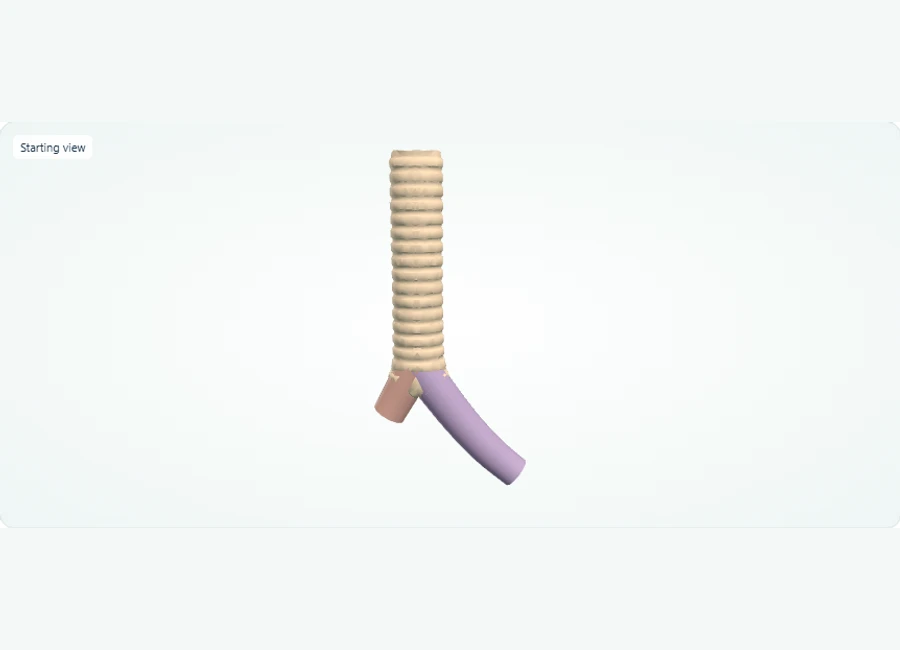
This model shows the trachea and its division into the right and left main bronchi. Only these three airway structures are present: there are no lobar branches, alveoli, or other respiratory structures, and the model shows normal anatomy with no pathology or devices.
Rotate, isolate structures, and test your recall.
Set the view to front and zoom to see the whole model: the trachea is the single central tube, with the right main bronchus and left main bronchus branching from its lower end.
Select each of the three structures in turn (Trachea, Right main bronchus, Left main bronchus), using isolate to view one at a time and show all to restore the full model.
Use Test recall to hide the labels; when a structure is highlighted, name it before pressing Reveal name, then use Return to study to continue.
Try it yourself
Test recall highlights the structure branching from the lower end of the trachea toward the body's left side. Which structure is it?
Show answer and explanation
Left main bronchus
In the front view, the trachea runs down the midline and splits into two main bronchi. The branch passing to the viewer's right (the body's left side) is the left main bronchus, while the branch to the body's right side is the right main bronchus.
- The trachea is the central airway that divides into two main bronchi, one for each lung side.
- The right main bronchus and left main bronchus are the first branches off the trachea; this model contains no smaller (lobar) branches or alveoli beyond them.
- Because only three structures are selectable, identification practice here means telling the trachea from the right versus left main bronchus.
Vertigo: Duration, Hearing, and Triggers Separate the Peripheral Syndromes
Episode duration, triggers, and hearing involvement separate the peripheral vertigo syndromes from each other and from central causes. Each combination points to a different immediate next step, which is the exam-relevant judgment.
Use the table as a decision aid, not a memorization target. Cover the condition column, read the profile, and name the condition plus the discriminating feature. Then reverse the drill: given a diagnosis, predict the profile. BPPV's seconds-long positional episodes, vestibular neuritis's days of continuous vertigo with preserved hearing, and Meniere's recurrent attacks bundled with fluctuating hearing differ along exactly the axes the table tracks, which is why these axes are worth committing to memory.
The peripheral-versus-central decision carries the highest stakes, so treat its red flags as a separate skill. New inability to stand or walk, limb weakness or dysarthria, severe new headache, or vertical or direction-changing nystagmus shift the differential toward a central process and toward emergency evaluation. Frame this conditionally: these features raise concern for a central cause; they do not by themselves confirm any single diagnosis. In paper scenarios, the safe answer is escalation and urgent assessment rather than outpatient positional testing.
| Condition | Typical episode profile | Hearing | Discriminating feature |
|---|---|---|---|
| BPPV | Seconds, provoked by head position or rolling over in bed | Usually normal | Brief, fatigable positional vertigo with latency |
| Vestibular neuritis | Days of continuous vertigo, often after a viral illness | Hearing spared | Severe imbalance with normal hearing |
| Meniere's disease | Twenty minutes to several hours, recurrent | Fluctuating low-frequency loss, tinnitus, aural fullness | Hearing symptoms bundled within the attacks |
| Central cause (e.g., posterior circulation) | Variable; may be constant | Variable | Neurologic signs, inability to walk, vertical or direction-changing nystagmus |
The Neck Mass: Age and Duration Drive the Differential and the Biopsy Decision
The neck mass differential is driven by age and duration. In children and young adults, congenital and inflammatory lesions dominate; in adults, a persistent unilateral mass must be investigated as a possible malignancy.
Learn the named anatomic clues. A midline mass that rises with tongue protrusion or swallowing suggests a thyroglossal duct cyst. A lateral mass in a younger patient suggests a branchial cleft anomaly or reactive lymphadenopathy, and inflammatory nodes are expected to resolve with time and treatment of the source. The pivot in adult cases is duration: a mass persisting for several weeks without signs of infection stops being managed as reactive and enters the neoplastic workup pathway, with tobacco and alcohol exposure and upper aerodigestive tract examination shaping the differential.
Worked scenario 2. A 47-year-old smoker has a painless left lateral neck mass present for six weeks, with no fever or recent illness. Plausible mistake: repeating empiric antibiotic courses across multiple visits while the mass persists. Better decision: after an appropriate interval without resolution, image the neck, examine the upper aerodigestive tract, and obtain tissue diagnosis by fine-needle aspiration — avoiding excisional biopsy as the first diagnostic move. Why it matters: if the mass is malignant, an unplanned excision before staging can complicate subsequent treatment planning, whereas the structured pathway preserves options.
- Red flags to track in any neck-mass case: persistence beyond the inflammatory window, fixation or hardness, associated ear symptoms on the same side, and adult age with relevant exposures.
Pediatric Stridor: Phase, Age at Onset, and Posture Localize the Lesion
Phase of stridor localizes the lesion: inspiratory suggests supraglottic or glottic levels, expiratory tracheal or bronchial involvement, and biphasic noise a fixed obstruction. Age at onset and posture or feeding effects refine the differential.
Map the common pairs. Laryngomalacia appears in the first weeks of life as inspiratory stridor that typically worsens supine and with feeding and often follows a self-limited course. Croup produces a barking cough with biphasic or inspiratory stridor after a viral prodrome in a young child. Sudden-onset stridor with a coughing episode suggests a foreign body. Connect each condition to its lesion level by phase, and the differential becomes derivable rather than memorized — you can reason from a new case instead of hoping it matches a stored list.
The urgent-decision logic is a separate drill. A drooling, toxic-appearing, anxious child sitting in a tripod posture raises concern for an epiglottitis-type emergency: keep the child calm, avoid agitating examinations, and secure the airway with an experienced team. In paper scenarios, the correct answer pattern is stabilization and escalation, not attempts to visualize the throat casually or send the child for routine studies first. Distinguish this acute presentation from chronic, stable stridor, where scheduled evaluation of growth, feeding, and work of breathing guides timing.
Ethics and Safety Scenarios: Applying Consent, Verification, Fire, and Escalation Principles
Professional-standards content tests applying principles to specific cases: informed consent as a process, site verification and time-out before surgery, airway fire prevention during procedures, and timely escalation of a deteriorating patient.
Treat informed consent as a documented process, not a form. The elements to recognize in scenarios are decision-making capacity, disclosure of material risks and reasonable alternatives, the patient's voluntary choice, and documentation of what was discussed and why. A case where a resident obtains a signature minutes before surgery without a discussion fails the process even though the form exists. To sharpen this, write the four consent elements as checkable questions — capacity? disclosure? voluntariness? documentation? — and run that checklist against every written vignette you study, marking which element is absent instead of restating the doctrine.
Safety scenarios reward named frameworks. The fire triad — an oxidizer such as supplemental oxygen, a fuel such as drapes or endotracheal tubes, and an ignition source such as electrocautery — explains airway fire prevention steps during airway surgery. Correct-site verification and the surgical time-out address wrong-site events. For a deteriorating patient, the tested judgment is escalation: speaking up, calling for senior help, and documenting the concern. In every version of these cases, the defensible answer is the systematic check plus communication, not silent individual heroics.
The Two-Condition Drill, a Rubric, and an Adaptable Preparation Sequence
Use a two-condition drill plus an error log: for each domain, write the discriminating feature from memory, answer a paper case stem, then audit whether your next step and its justification were correct against a rubric.
Exercise. Once a week, select one pair from each domain — for example, BPPV versus Meniere's, conductive versus sensorineural loss, thyroglossal duct cyst versus branchial cleft anomaly, laryngomalacia versus croup. From memory, write the discriminating feature for each pair in one sentence. Then answer a written case stem for one condition and record: the diagnosis, the single next step, and why the look-alike is wrong. Expected observations as you improve: your one-sentence separators get shorter and more specific, your next steps become single actions rather than vague workups, and your justifications stop relying on the answer options.
Adaptable sequence. Weeks one to two: map the domains and build your look-alike pair list. Weeks three onward: rotate one domain per session through the drill while adding mixed case sets that force cross-domain decisions. Final phase: work only from your error log — re-drill every pair you have missed and retake the corresponding mixed sets. Treat self-check scores as learning milestones, not predictions of any passing outcome; their purpose is to show whether your error categories are converging.
- Readiness check: if your last three mixed sets required no new pairs added to the error log, move to cross-domain case sets only.
- Readiness check: if any rubric row still fails consistently, return to that domain's pair list rather than adding new content.
| Self-check item | What success looks like |
|---|---|
| Differential generated cold | You can list the plausible conditions before seeing any answer options |
| Discriminating feature named | You state the one finding that separates the look-alikes in a single sentence |
| Next step committed | You name one specific action and its trigger, not a general category of tests |
| Distractor explained | You can say in one sentence why each wrong option is wrong |
| Error log trajectory | Over repeated mixed sets, your logged error categories become fewer and narrower |
References and further reading
Use these references to explore the concepts and check the latest information from the relevant organizations.