
This guide trains a management-first approach to Step 2 CK study: identify the patient's stability, the stage of the diagnostic process, and the physician task implied by the vignette, then practice choosing the action that logically follows that classification.
Why 'next best step' questions defeat diagnosis-first studying
The USMLE overview states that Step 2 CK assesses applying medical knowledge, skills, and clinical science to patient care under supervision. Studying organized purely by diagnosis leaves the decision layer — what to do next — unpracticed.
A Step 1 habit treats a vignette as a puzzle whose answer is a disease name. Because the exam's stated emphasis is application to patient care under supervision, preparation that ends at the disease name leaves the management sequence — treat before testing, test before treating, or observe with a plan — untrained. The worked scenarios later in this guide illustrate exactly how that gap shows up in an option list.
The fix is to convert every study note into a decision node. For each condition, write down three branches: the immediate action if the patient is unstable, the confirmatory step if the presentation is atypical, and the follow-up interval if the picture is controlled. This transforms passive review into the mental operation that management questions ask you to perform, and it surfaces gaps that diagnosis-only notes hide.
Reading the vignette for the physician task, not just the diagnosis
The Step 2 CK content outline describes physician tasks and competencies across systems and disciplines. Identify which task a vignette targets — establishing a diagnosis, selecting therapy, or health promotion — before evaluating the answer options.
The same disease can anchor several different questions. A pneumonia vignette can ask for the initial outpatient regimen, the indication for hospital admission, the follow-up imaging decision, or the vaccination recommendation. The diagnosis is constant; the physician task changes, and so does the correct answer. Before looking at options, state the task to yourself in one sentence: 'this is a test-selection question' or 'this is a treatment-timing question.'
Two stem cues help classify the task. When the stem gives a confident diagnosis and asks what to do, management or prevention is being tested, and you should think about guidelines for treatment and monitoring. When the stem emphasizes conflicting findings — an unusual test result, an atypical feature — diagnostic reasoning is being tested, and you should compare which option best narrows the differential. Tagging each practice question by task turns your error log into a map of which reasoning skill, not which disease, needs work.
- Stem with a clear diagnosis and a stable patient → likely therapy, admission, or follow-up selection.
- Stem with conflicting or incomplete findings → likely diagnostic test selection or differential narrowing.
- Stem with an asymptomatic patient and an age or risk factor → likely screening and prevention.
- Stem with vital-sign instability or an acute deterioration → likely immediate stabilization before any workup.
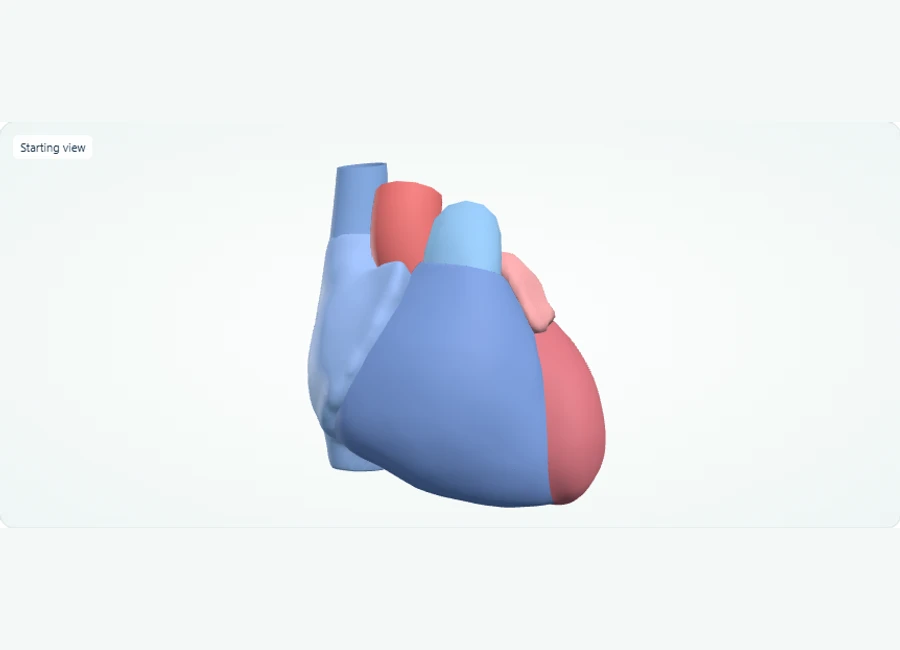
Explore in 3D: Heart chambers and great vessels
A four-chambered heart viewed from the front. The right ventricle supplies the pulmonary circulation via the pulmonary trunk; the left ventricle supplies the systemic circulation via the ascending aorta. This model shows external chamber surfaces and the visible great vessels only — no internal valves or conduction system.
Rotate, isolate structures, and test your recall.
Choose Front and compare the four chambers. The right ventricle forms most of the anterior surface; the left ventricle contributes to the apex.
Select and isolate each chamber in turn, then use Show all to restore its relationship to the surrounding structures.
Select the pulmonary trunk and ascending aorta in turn. Name the circulation supplied by each, then use Test recall to practise identifying the listed structures.
Try it yourself
Which ventricle supplies the pulmonary trunk, and which supplies the ascending aorta?
Show answer and explanation
The right ventricle; it serves the pulmonary circulation.
On the front view, the right ventricle is the anterior-most chamber, and its outflow tract continues as the pulmonary trunk carrying blood to the lungs. The left ventricle instead empties into the ascending aorta for the systemic circulation.
- The right ventricle pumps blood into the pulmonary trunk toward the lungs; the left ventricle pumps into the ascending aorta to the body.
- The superior vena cava returns blood to the right atrium from above the heart.
- The two atria sit superior to the two ventricles; atria receive blood, ventricles eject it.
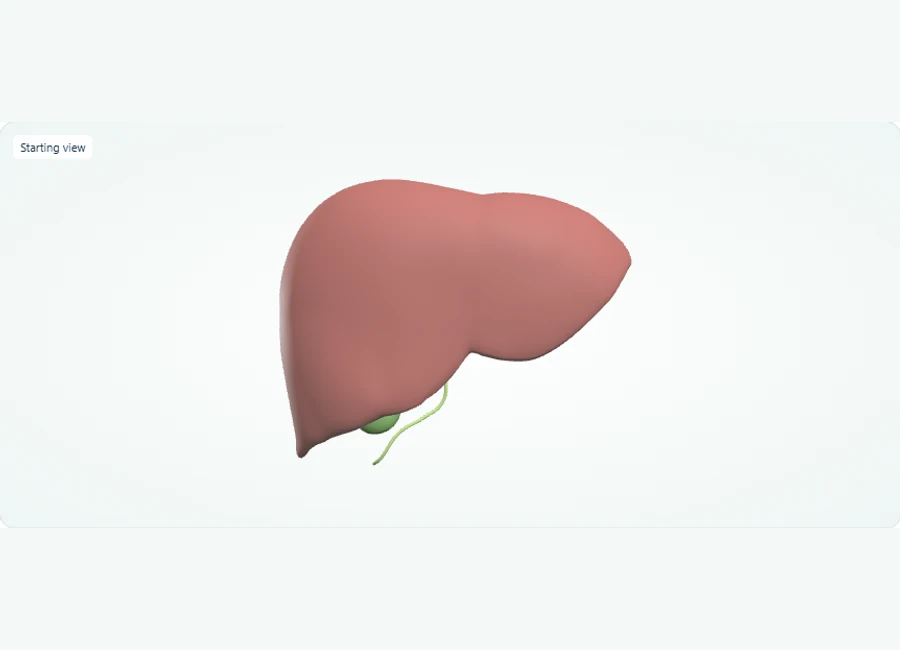
Explore in 3D: Liver and Gallbladder
Locate the gallbladder on the inferior surface of the liver, then inspect the included bile duct. The liver and gallbladder are accessory digestive organs outside the food passage.
Rotate, isolate structures, and test your recall.
Rotate below the liver to find the gallbladder on its inferior surface.
Select the gallbladder and isolate it to inspect its shape. Use Show all before comparing its position with the liver.
Select and hide the liver, then select the bile duct to inspect its course. Complete hepatic and cystic duct junctions are not separately represented.
Try it yourself
Which accessory digestive organ lies on the inferior surface of the liver?
Show answer and explanation
Gallbladder
The gallbladder sits on the inferior (underside) surface of the liver and stores bile; bile leaves via the bile duct shown in this model.
- The gallbladder lies on the inferior surface of the liver.
- The liver and gallbladder are accessory organs — they are outside the food passage.
- The bile duct is included on this model, but the junctions between hepatic and cystic ducts are not shown or separately labelled.
Worked scenario 1: stabilizing first when the patient is unstable
In an unstable patient, resuscitation precedes diagnosis. The error to watch for in your own practice is continuing to work up the cause when the stem has already supplied the vital-sign and mental-status evidence that mandates treatment now.
Scenario: A 24-year-old woman presents with hypotension, tachycardia, fever, and a painful, erythematous leg wound, and she appears confused. An option list includes wound culture, blood cultures, broad-spectrum intravenous antibiotics, and CT of the leg. A plausible mistake is selecting blood cultures alone or CT first, reasoning that confirming the source improves precision. The better decision is broad-spectrum intravenous antibiotics after cultures are drawn, because the combination of hypotension and confusion indicates the sepsis pathway: perfusion is threatened, and delaying empirical therapy to refine the diagnosis risks deterioration. Cultures matter, but they ride alongside treatment, not in front of it.
Why it matters: the vignette's stability cues — hypotension, altered mental status, tachycardia — are your signal for which branch of the decision tree to enter. Train a reflex: before evaluating any option, ask 'is this patient stable?' If the answer is no, options that merely gather information rank below options that restore perfusion, oxygenation, or airway. In your error log, mark every miss of this type as a sequencing error rather than a knowledge gap, because the treatment you already knew was correct.
Worked scenario 2: choosing between D-dimer and imaging by pretest probability
Diagnostic test questions are answered by pretest probability, not test sensitivity. Selecting a low-specificity screening test in a high-probability patient is a classic misstep to train against; the confirmatory path is the better decision.
Scenario: A 67-year-old man on a long flight presents with unilateral leg swelling, calf tenderness, and mild dyspnea, with no alternative diagnosis evident. Options include D-dimer, compression ultrasonography, CT pulmonary angiography, and empirical anticoagulation. A plausible mistake is ordering D-dimer, since it is a recognized test for venous thromboembolism. The better decision is compression ultrasonography of the leg, because the clinical probability is high enough that a negative D-dimer cannot reliably exclude disease; the screening test earns its place in low-probability patients, where a negative result meaningfully lowers the odds. In a high-probability patient, you go directly to imaging.
Why it matters: this scenario generalizes far beyond venous thromboembolism. Whenever a vignette asks for a test, classify the patient's pretest probability from the stem, then match the test's role to that probability: sensitive tests to rule out in low-probability patients, specific or confirmatory tests to establish disease in higher-probability patients. Practice narrating this aloud with every test-selection question. If you can articulate why the correct test fits the patient's probability stratum, you have mastered the reasoning pattern, not just one answer key.
A decision table for the first action in any vignette
Two axes sort many first-action questions: patient stability and diagnostic certainty. Crossing them yields four action classes, which narrows the options before you read them.
Use the table as a pre-answer filter. When you finish reading a stem, place the patient in one cell, generate the action class, and then reject options that belong to other cells. This takes seconds and helps you avoid option-level confusion such as picking a useful confirmatory test in a scenario where the patient needed stabilization, or picking surveillance where the diagnosis was still unknown.
The table is a learning scaffold, not a clinical rule; real patients and real questions can combine features, and complicated stems may move a patient between cells as new findings arrive. Treat it as a hypothesis generator: if none of the options fit your chosen cell, re-read the stem and ask which axis you misjudged. That re-reading habit is itself part of the diagnostic skill this approach trains.
| Patient state | Diagnosis is unclear | Diagnosis is fairly clear | Diagnosis is managed/stable |
|---|---|---|---|
| Unstable (abnormal vitals, altered mentation) | Stabilize airway, breathing, circulation; treat the most likely life-threatening cause empirically | Start definitive emergency treatment; obtain limited confirmatory data in parallel | Assess for acute decompensation or a new process before assuming stability |
| Stable, undifferentiated | Order the test that best narrows the differential given the pretest probability | Confirm with the appropriate diagnostic standard, then plan therapy | Verify control with targeted follow-up testing or monitoring |
| Stable with known diagnosis | Reconsider the differential if findings conflict | Treat per established management; address complications | Preventive care, medication adjustment, and scheduled surveillance |
Health promotion and prevention as a distinct task family
The Step 2 CK overview explicitly includes emphasis on health promotion and disease prevention. Prevention questions follow a different logic from management questions: the target is an asymptomatic person and a population-appropriate intervention.
A prevention vignette typically offers an asymptomatic patient defined mainly by age, sex, and risk factors, then asks for the appropriate screening, immunization, or counseling step. The reasoning is guideline-driven: what applies to this person's risk profile, at what interval, and what should be avoided because the harm or the evidence does not support it. Keep a separate notebook page for each prevention domain — adult screening, immunization schedules, and behavioral counseling — and update it as a living document while you study other subjects.
Distinguish three commonly confused concepts. Primary prevention prevents disease before it occurs, such as vaccination or lifestyle counseling. Secondary prevention detects disease early in asymptomatic people, such as screening tests. Tertiary prevention limits complications in established disease, such as retinal examination in diabetes. One concept-level error to check for in your own log is treating a screening recommendation as appropriate for a symptomatic patient, when symptoms shift the task from screening to diagnostic evaluation. Writing each practice question's task label into your notes keeps these families separated.
- Primary prevention: intervene before disease exists (immunization, risk-factor counseling).
- Secondary prevention: screen asymptomatic people to find early disease.
- Tertiary prevention: reduce complications and disability in diagnosed disease.
- Symptoms convert a screening question into a diagnostic question — re-read the stem for symptoms before selecting a screening option.
A practice exercise: two-line problem lists with next-step rationales
Convert practice questions into a written exercise: summarize each vignette in two lines, name the patient's cell in the decision table, state the next step, and justify it in one sentence. Score yourself with a rubric.
For a set of 10 practice vignettes, write for each: (1) a two-line summary listing the stability cues and the key clinical findings, (2) the decision-table cell, (3) your chosen next step before reading the options, and (4) one sentence explaining why the step fits that cell. Then read the options and compare. This deliberately slows you down for a short period so that the classification reflex becomes automatic and silent later.
Self-check rubric for the set of 10: three points if you correctly identified stability and the table cell; two points if your pre-option next step matched the correct answer; two points if your one-sentence rationale named the reasoning principle (probability, stabilization, guideline-based prevention) rather than restating a fact; one point each for catching a sequencing error and a test-role error when they occurred. A total of seven or higher on two consecutive sets suggests the classification habit is forming; a lower total tells you to slow the pace and keep writing rationales. These are learning milestones for your practice, not predictions of your score.
An adaptable preparation sequence and readiness checks
Sequence preparation in three phases: rebuild content by decision node, practice task-classified question blocks, then simulate mixed blocks under timing. Verify readiness with observable behaviors, not feelings.
Phase one: as you review each high-yield condition, write the three decision branches (unstable action, confirmatory step, follow-up plan) next to the disease facts. Phase two: do practice blocks, but before scoring, label every question by physician task — stabilization, test selection, therapy, prevention — and track accuracy per task rather than per subject. Phase three: run mixed blocks under timed conditions so that vignette triage becomes reflexive under pressure. Adapt the proportions to your own task-level error map; the sequence, not the calendar, is the point.
Readiness checks you can observe: you can state the table cell for a fresh vignette within your first read; your rationale sentences cite principles instead of memorized answers; your error log shows sequencing errors declining across weeks; and in timed blocks you can mark and move past a stalemated question without losing your classification habit. When those four behaviors hold, you have trained the reasoning this approach targets. For administrative details such as scheduling, eligibility, and current test-day logistics, rely on the USMLE program itself rather than secondhand summaries.
- Phase 1: rebuild notes as decision trees (unstable / confirm / follow-up branches per condition).
- Phase 2: practice blocks tagged by physician task; track errors by task type, not subject.
- Phase 3: timed mixed blocks to make vignette triage automatic.
- Readiness check 1: correct table-cell identification on first read of a new vignette.
- Readiness check 2: principle-based rationales and a declining share of sequencing errors in your log.
References and further reading
Use these references to explore the concepts and check the latest information from the relevant organizations.