
Study Step 1 by building mechanism chains: for every vignette finding, trace backward to the molecular or physiologic cause and forward to the therapy principle or complication the item tests. Practice this explicitly with worked scenarios, a written chain exercise with a self-check rubric, and mixed-system review blocks — not by memorizing lists discipline by discipline.
Why one Step 1 vignette can span three disciplines at once
The Step 1 content outline integrates basic science along two dimensions: organ system and process, such as normal function, disease mechanism, or mode of therapy. A single item can therefore require biochemistry, physiology, and pharmacology together.
This two-dimensional structure is the central structural fact about the exam, and it explains the experience of reading a long clinical stem that mentions a medication, a lab value, and a cellular finding in the same breath. The system dimension tells you which organ the item lives in; the process dimension tells you what kind of reasoning is demanded — explaining health, explaining disease, or explaining why a treatment works or harms.
The practical consequence is that discipline-by-discipline study (all biochemistry, then all physiology) builds knowledge silos that the item format deliberately stacks together. A better habit is to study by system and, within each system, deliberately ask three questions: what is normal here, what mechanisms break it, and what does each intervention change about the mechanism.
Before registration logistics or format details, confirm current administration information directly with the issuer, since the testing structure has changed before and the USMLE site is the authoritative source for it.
- System dimension: cardiovascular, renal, endocrine, and other organ-system groupings in the outline.
- Process dimension: principles and mechanisms underlying health, disease, and modes of therapy.
- Study unit: one system at a time, holding all three process questions above it.
Telling a mechanism item from a therapy-principle item
Mechanism items ask why a finding occurs at a cellular or physiologic level; therapy-principle items ask what changing that mechanism does clinically. Naming which type you face, before looking at options, prevents systematic misreading of the stem.
A mechanism item usually anchors on a finding described in structural or functional language — a biopsy appearance, a lab pattern, an auscultation finding — and the correct answer explains the pathway producing it. A therapy-principle item anchors on a drug, procedure, or physiologic intervention and asks you to predict the downstream effect of perturbing the mechanism, whether intended or adverse.
Train the distinction deliberately: after reading a stem, write one sentence naming the anchor (a finding or an intervention) and one sentence stating what the question wants (an explanation or a consequence). This two-sentence habit takes seconds, and it changes which answer options are even eligible, because explanation-style options cannot answer consequence-style questions and vice versa.
Explore in 3D: Heart chambers and great vessels
A four-chambered heart viewed from the front. The right ventricle supplies the pulmonary circulation via the pulmonary trunk; the left ventricle supplies the systemic circulation via the ascending aorta. This model shows external chamber surfaces and the visible great vessels only — no internal valves or conduction system.
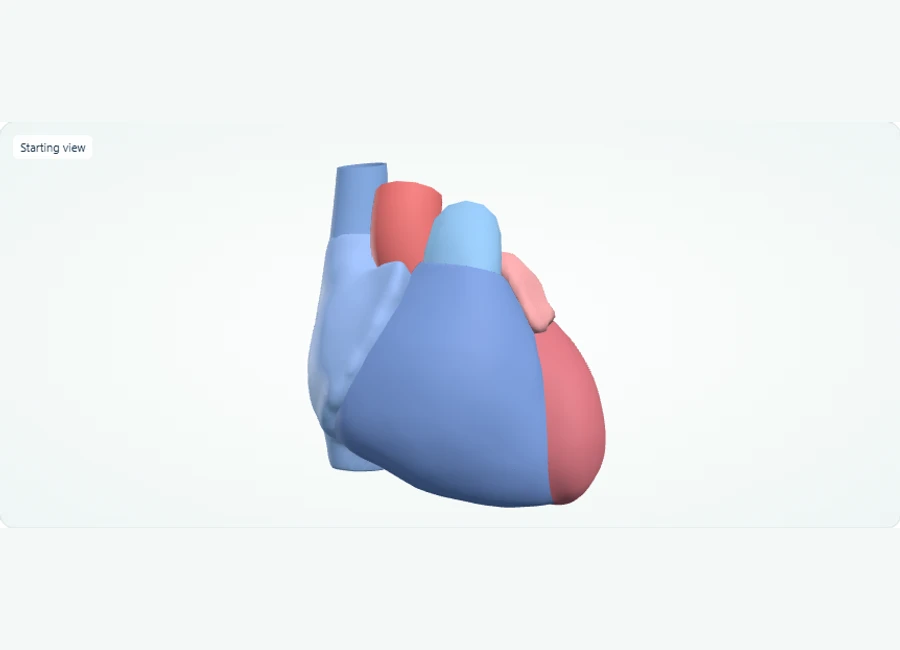
Rotate, isolate structures, and test your recall.
Choose Front and compare the four chambers. The right ventricle forms most of the anterior surface; the left ventricle contributes to the apex.
Select and isolate each chamber in turn, then use Show all to restore its relationship to the surrounding structures.
Select the pulmonary trunk and ascending aorta in turn. Name the circulation supplied by each, then use Test recall to practise identifying the listed structures.
Try it yourself
Which ventricle supplies the pulmonary trunk, and which supplies the ascending aorta?
Show answer and explanation
The right ventricle; it serves the pulmonary circulation.
On the front view, the right ventricle is the anterior-most chamber, and its outflow tract continues as the pulmonary trunk carrying blood to the lungs. The left ventricle instead empties into the ascending aorta for the systemic circulation.
- The right ventricle pumps blood into the pulmonary trunk toward the lungs; the left ventricle pumps into the ascending aorta to the body.
- The superior vena cava returns blood to the right atrium from above the heart.
- The two atria sit superior to the two ventricles; atria receive blood, ventricles eject it.
Worked scenario: an anemia vignette that hides a folate-versus-B12 fork
A macrocytic anemia vignette with neurologic signs points to vitamin B12 deficiency, not folate deficiency. The trap is pattern-matching on pallor and macrocytosis alone, which both deficiencies share.
Imagine a stem describing fatigue, pallor, macrocytic red cells, hypersegmented neutrophils on smear, and paresthesias with impaired vibration sense. The plausible mistake is to stop at 'megaloblastic anemia' and answer a folate-oriented option, since both deficiencies impair DNA synthesis and produce macrocytosis with hypersegmented neutrophils. Pattern-matching on the shared hematologic features causes the error.
The better decision is to run the chain backward: neurologic degeneration implicates a pathway folate deficiency does not explain, which identifies B12 deficiency as the unifying mechanism; running the chain forward then yields the teaching point that folate supplementation can correct the blood picture without resolving neurologic injury. This is exactly the style of integration Step 1 rewards — the hematologic findings localize the marrow mechanism, and the neurologic findings select the vitamin — and the forward step explains why the two deficiencies are not interchangeable in management.
Self-check: if your notes on this scenario record only 'macrocytic anemia = B vitamins,' redo the chain until the neurologic branch point is explicit.
Worked scenario: a drug side effect that tests a regulatory pathway
When a vignette pairs a medication with an unexpected lab or symptom, the tested skill is linking the drug's mechanism to a physiologic pathway. Treating the side effect as an isolated fact to memorize loses the connection.
Consider a stem in which a patient treated for hypertension develops a persistent dry cough, and the options ask for the underlying mechanism. A plausible mistake is to file 'cough = drug side effect' and answer by drug-name association without invoking the pathway. The better decision is to trace the enzyme the drug inhibits and recognize that the same enzyme degrades other peptides, so accumulation of one of those peptides explains the airway irritation.
Running the chain forward matters as much: the same mechanism predicts a separate adverse effect on potassium handling through reduced aldosterone, which means the item writer can test cough, hyperkalemia, or the reason a different drug class avoids both. When you learn a drug this way, one mechanism generates several predictable question targets — the intended effect, each adverse effect, and the logical substitute — which is far more durable than memorizing a side-effect list per drug.
Notice the structure shared with the anemia scenario: a finding, a mechanism that unifies it with other findings, and consequences that follow from the mechanism. That is the reasoning template to rehearse across every system.
The written chain exercise: reconstructing a vignette on paper
After each practice vignette, write two chains: backward from each key finding to a molecular or physiologic cause, and forward from the unifying mechanism to treatment and complications. Writing forces gaps into the open.
Do this with the vignette closed: reconstruct the stem from memory, list its two or three key findings, and draw arrows down to mechanisms until you reach something cellular or molecular, then arrows up to what an intervention would change. Where your arrows stop in vague language — 'hormones get messed up' — you have found a study target for tomorrow, specific to a named pathway rather than a general weakness.
Score yourself against a simple rubric after each session: (1) Can you name the molecular target or pathway for every finding, not just one? (2) Can you state why two wrong options contradict the chain, in one sentence each? (3) Could you predict one complication that was never mentioned in the stem, purely from the mechanism? Reaching all three consistently on a system is a learning milestone; treat it as evidence of chain fluency, not as a prediction of any score or passing outcome.
A second-year medical student preparing for Step 1 might run this exercise on ten vignettes a week across different systems, keeping a running page of 'arrow-stopping points' that becomes a personalized, mechanism-level review list by the final month.
- Rubric item 1: every key finding maps to a named pathway or molecular target.
- Rubric item 2: each rejected option is ruled out by an explicit contradiction with the chain.
- Rubric item 3: at least one unmentioned complication is predictable from the mechanism alone.
- Milestone: all three rubric points met on consecutive vignettes within a system before moving on.
Decision table: choosing the review route for a weak system
Match your review route to how your chains fail. Different failure patterns call for different materials and different next actions, and using the wrong route wastes limited study weeks.
Use the table below as a diagnostic shortcut after running the chain exercise for a week. Read your logged errors, sort them into the failure patterns listed, and pick the corresponding route. Reassess weekly, because a system can shift from one pattern to another as it improves.
The table also guards against a common sequencing mistake: drilling question volume at a system whose chains fail at the mechanism level, or rereading basic science for a system whose only failures are consequence-level reasoning. The failure pattern, not the subject name, determines the work.
| Failure pattern in your chain log | What it indicates | Review route to choose | Next-week action |
|---|---|---|---|
| Arrows stop before a molecular target | Foundational science gaps in that system | Targeted basic-science review of the named pathway only | Rewrite the chain from a clean page without notes |
| Findings map correctly but wrong options not ruled out | Explanation fluency without discrimination | Explain aloud why each distractor contradicts the chain | Add one distractor-analysis paragraph per vignette |
| Backward chain solid, forward predictions missing | Therapy-principle reasoning not yet attached | For each mechanism, list intervention, effect, and complication | Test yourself on the forward chain the next day |
| Chains correct but slow under time pressure | Reasoning accurate but not automatic | Timed mixed-system practice with the rubric applied after | Shorten the written chain to arrows and keywords |
A preparation sequence and concrete readiness checks
Sequence Step 1 preparation in three phases: map the content outline's systems and processes, build chains system by system, then shift to mixed, timed practice where the rubric is applied after each block.
Phase one: obtain the Step 1 content outline and specifications, and annotate your syllabus against its systems and process categories so every topic has a home on both dimensions. Phase two: work through systems one at a time, running the written chain exercise on practice vignettes and maintaining the failure-pattern log from the table above; add a system only when the rubric is met consistently on the current one. Phase three: switch to mixed-system sets done under time limits, applying the full rubric afterward, and reserve the final stretch for reviewing your arrow-stopping-point list rather than rereading entire subjects.
Concrete readiness checks for the final phase: you can reproduce a complete two-way chain, on a blank page, for a random vignette in any system you have covered; your distractor rulings are single-sentence and specific; your forward chains generate complications never stated in the stem; and your error log shows the mechanism-level pattern shrinking week over week. These are fluency milestones for your own tracking — they indicate growing command of the reasoning style, not a guaranteed or predicted result on the exam itself.
- Phase 1: map your materials onto the outline's system and process dimensions.
- Phase 2: one system at a time; written chains plus the failure-pattern table weekly.
- Phase 3: timed mixed sets, rubric applied afterward, final review from your own log.
- Readiness check: blank-page chain reproduction across all covered systems.
References and further reading
Use these references to explore the concepts and check the latest information from the relevant organizations.