
The TMC presents clinical situations in which several options look acceptable. Preparation should train a repeatable decision process: read what the stem asks, classify the data, and eliminate options that ignore a stated constraint. This guide teaches that method through worked scenarios, a data-pattern table, a decision drill, and a rubric for tracking your own readiness.
Why Scenario Items Reward Clinical Judgment Over Pure Recall
The TMC presents clinical situations in which several options look acceptable. Preparation should train a repeatable decision process: read what the stem asks, classify the data, and eliminate options that ignore a stated constraint.
The difficulty is not that the content is obscure; it is that plausible options coexist. An item about a hypoxemic patient can offer oxygen, positioning, and suction, and each helps some patient somewhere. Your defense is to treat every item as a miniature chart: extract the patient condition, the current therapy, the most recent data, and the specific request. Compared with a flashcard, which has one correct fact, an exam item has a hierarchy of reasonable choices, and the stem tells you which rung matters.
Build your review around domains and the decisions each one enables. For ventilator management, the decision is the direction and size of a change; for arterial blood gases, it is naming the disturbance; for equipment, it is selecting the appropriate device for the stated condition. After studying any topic, ask one question: what decision does this knowledge change? If you cannot answer, you have learned a fact rather than a decision, and facts alone rarely separate two attractive options.
Decoding the Stem: Initiate, Recommend, Adjust, or Determine
Stem verbs set the decision frame. 'Recommend initiating' asks for the first appropriate therapy; 'adjust' or 'decrease' assumes therapy exists and asks for direction; 'best determines' asks for a monitoring step, not an intervention.
Sort verbs into three families before touching the options. Assessment verbs — determine, evaluate, assess — call for data collection or interpretation, so any intervention falls outside the frame. Action verbs — initiate, recommend, implement — call for therapy; when the stem asks for therapy, a monitoring-only option can be too passive for what was asked. Modification verbs — increase, decrease, change — confirm therapy is already running and ask about direction. Misreading the family is how a correct clinical fact becomes a wrong answer: a superb intervention answers an assessment stem incorrectly.
Watch qualifiers as well: 'first,' 'initial,' 'most important,' and 'subsequently' reorder otherwise equal options. When two finalists differ mainly in timing, ask which one produces the information or safety check the other depends on; that dependency usually settles 'first' items. Direction words matter equally, because increase and decrease items are graded on the vector, not the therapy choice. In practice sets, underline the verb and every qualifier before reading options so your reasoning stays anchored to what was actually asked.
Explore in 3D: Trachea and Main Bronchi
This model shows the trachea and its division into the right and left main bronchi. Only these three airway structures are present: there are no lobar branches, alveoli, or other respiratory structures, and the model shows normal anatomy with no pathology or devices.
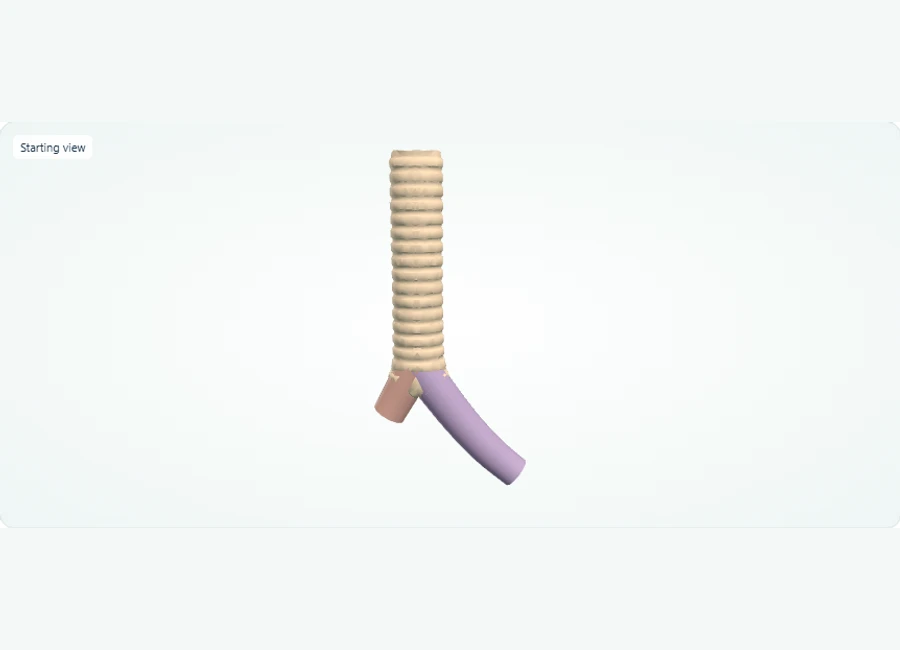
Rotate, isolate structures, and test your recall.
Set the view to front and zoom to see the whole model: the trachea is the single central tube, with the right main bronchus and left main bronchus branching from its lower end.
Select each of the three structures in turn (Trachea, Right main bronchus, Left main bronchus), using isolate to view one at a time and show all to restore the full model.
Use Test recall to hide the labels; when a structure is highlighted, name it before pressing Reveal name, then use Return to study to continue.
Try it yourself
Test recall highlights the structure branching from the lower end of the trachea toward the body's left side. Which structure is it?
Show answer and explanation
Left main bronchus
In the front view, the trachea runs down the midline and splits into two main bronchi. The branch passing to the viewer's right (the body's left side) is the left main bronchus, while the branch to the body's right side is the right main bronchus.
- The trachea is the central airway that divides into two main bronchi, one for each lung side.
- The right main bronchus and left main bronchus are the first branches off the trachea; this model contains no smaller (lobar) branches or alveoli beyond them.
- Because only three structures are selectable, identification practice here means telling the trachea from the right versus left main bronchus.
Explore in 3D: Lung lobes
This model shows the five lung lobes: three on the right (superior, middle, inferior) and two on the left (superior, inferior). The left lung has no middle lobe. Each colored lobe is a distinct selectable structure, separate from segments and bronchial branches. As a normal surface model, it shows healthy anatomy only.
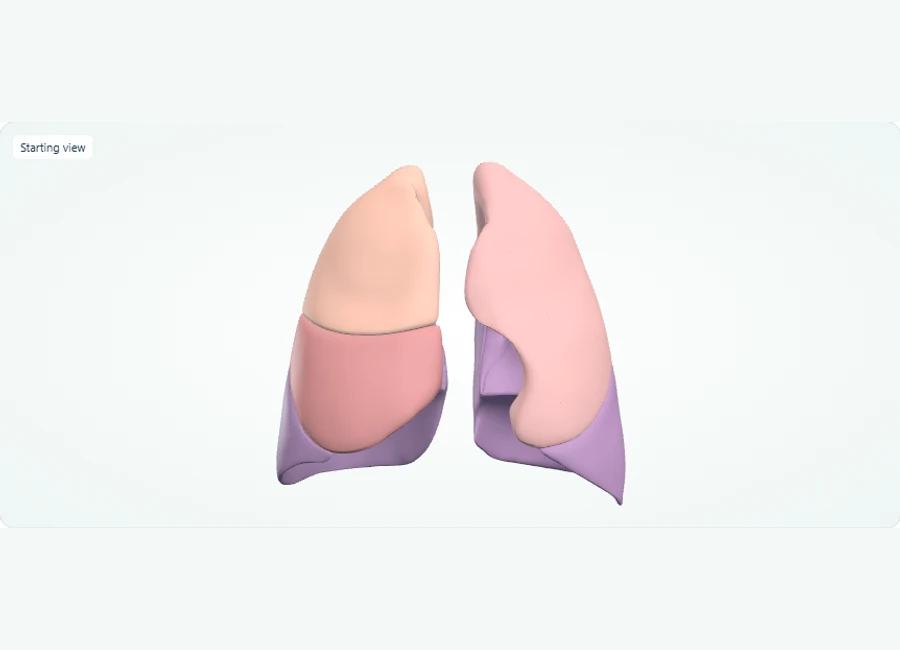
Rotate, isolate structures, and test your recall.
Choose Front. Use the Structure list to select each lobe and count three on the anatomical right and two on the left.
Select and isolate the right middle lobe, then use Show all and Back to inspect how it relates to the other right lung lobes.
Start Test recall, name the highlighted lobe, then select Reveal name to check your answer.
Try it yourself
How many lobes does each lung have, and which lobe name occurs only on the right?
Show answer and explanation
The right lung has superior, middle and inferior lobes. The left lung has superior and inferior lobes, with no middle lobe.
A lobe is a gross anatomical division of a lung. The right lung has three lobes and the left has two. These surface models show lobes, not individual bronchopulmonary segments or surgical margins.
- The right lung has three lobes: superior, middle, and inferior.
- The left lung has only two lobes: superior and inferior; there is no left middle lobe.
- Lobes are distinct from segments and bronchial branches, and a normal model shows no tumors or surgical margins.
Name the Data Pattern Before Reading the Options
Interpretation items become tractable when you convert raw numbers into named patterns — acute versus compensated acidosis, obstructive versus restrictive profiles — then predict the therapy direction and match it against the choices.
Run a two-question check every time: is the primary disturbance respiratory or metabolic, and is compensation acute or chronic? Only after naming the pattern should you look at options, and then match each option against your predicted direction. If your named pattern is acute respiratory acidosis and an option lowers minute ventilation, that option is out regardless of how sensible it sounds in isolation. Working data-to-pattern-to-direction prevents the common slip of reacting to one dramatic number while ignoring the pH.
The same pattern-first habit applies to PFTs and ventilator data. Obstructive and restrictive profiles lead to different device and therapy decisions, so practice naming the profile from a short description rather than from isolated numbers. On the ventilator, distinguish peak pressure from plateau pressure: a high peak with a normal plateau points toward airway resistance problems such as secretions or bronchospasm, while both rising together points toward a compliance problem. That distinction changes whether you suction and bronchodilate or reassess volume and PEEP.
| Pattern | Key data relationship | What it suggests | Typical decision direction |
|---|---|---|---|
| Acute respiratory acidosis | Low pH with high PaCO2 and near-normal bicarbonate | Alveolar ventilation has fallen without renal compensation | Raise minute ventilation or address the airway cause |
| Chronic (compensated) respiratory acidosis | High PaCO2 with elevated bicarbonate and near-normal pH | Long-standing CO2 retention with renal compensation | Support ventilation cautiously; avoid overcorrecting |
| Acute respiratory alkalosis | High pH with low PaCO2 | Ventilation exceeds metabolic need | Reduce minute ventilation or treat the driving cause |
| Metabolic acidosis with respiratory compensation | Low pH, low bicarbonate, low PaCO2 | Metabolic problem; lungs are compensating | Treat the metabolic cause; interpret the lung response |
| Obstructive PFT profile | Reduced FEV1 with a disproportionately reduced FEV1/FVC | Airflow limitation from airway disease | Bronchodilation and airway clearance decisions |
Worked Scenario: Raising Minute Ventilation When Plateau Pressure Is High
In volume-controlled ventilation with respiratory acidosis and an elevated plateau pressure, increasing tidal volume worsens lung stress; increasing the set rate raises minute ventilation without adding distending pressure.
Consider a paper case: an adult on volume-controlled ventilation, set tidal volume 500 mL at 12 breaths per minute, plateau pressure 32 cm H2O, and a new arterial blood gas showing pH 7.27 with PaCO2 62 mmHg. The tempting choice is to increase tidal volume to 600 mL, because a larger breath 'blows off CO2.' That choice reads the acidosis correctly but ignores the constraint: the elevated plateau pressure already signals high alveolar distending pressure, and a bigger tidal volume raises it further. Numbers here are illustrative for practice, not universal targets.
The better decision is to increase the set rate, raising minute ventilation without enlarging each breath. In a patient with obstructive disease, check that a faster rate does not create auto-PEEP and breath stacking, and obtain a follow-up blood gas to confirm the direction worked. The reasoning generalizes beyond this case: acidosis from CO2 retention calls for more alveolar ventilation, but every adjustment is filtered through the pressure constraint the stem stated. Naming the constraint out loud before choosing is what keeps the direction change safe.
Worked Scenario: Drowsy COPD Exacerbation — Oxygen, NIV, or Intubation
For a patient with a COPD exacerbation who can still protect the airway and is hemodynamically stable, controlled oxygen with noninvasive ventilation addresses oxygenation and ventilation while avoiding an invasive airway first.
Second paper case: a patient with a COPD exacerbation, oxygen saturation in the high 80s on nasal cannula, rising PaCO2 with acidosis, and increasing drowsiness but still responsive. The tempting choices sit at both extremes: a high-concentration nonrebreather that improves saturation but does nothing for ventilation, or immediate intubation that skips less invasive support. The mistake in both is treating the saturation number as the whole problem; the acidosis shows ventilation failing too, which oxygen delivery alone cannot correct.
The better decision, in this simplified scenario, is controlled oxygen delivered with noninvasive positive pressure ventilation, assuming the stated stability holds: the patient can protect the airway, tolerate a mask, and lacks contraindications. If deterioration continues, escalation to an invasive airway follows. On paper items, read the stability cues the stem provides rather than importing real-unit protocols, because the answer is built from what is stated. The underlying principle is to match the least invasive therapy that addresses the named physiologic problem, then reassess.
Safety, Scope, and Documentation Checkpoints Inside Scenario Items
A scenario item may embed a checkpoint before the technical choice: verify the order and device, apply infection-control steps, stay within respiratory therapy scope, and document the response after intervening.
Sequence discipline handles this structure cleanly. When a stem asks what to do first among a set-up, a delivery, and a documentation step, safety checks precede therapy: confirm the order or protocol, identify the patient, verify the device settings, then deliver the therapy and record the result and the patient's response. These steps look mundane next to ventilator strategy, but within an item they separate an option that is merely effective from one that is effective and correct for the question asked.
Scope and communication options follow the same logic. When an option asks you to act outside respiratory therapy practice, to change an order unilaterally, or to proceed despite an unclear physician order, the defensible choice is to clarify with the physician or supervisor and document the conversation. Framing this as a decision — clarify versus act — rather than an etiquette rule makes it easier to spot: if acting requires authority the stem never grants you, clarification is the action.
Decision-Drill Exercise, Self-Check Rubric, and Preparation Sequence
Convert practice items into decision drills: label the stem verb, name the data pattern, write why the best distractor fails, and score yourself against a rubric each session to track your own readiness.
The drill: take ten multiple-choice items and write three lines for each before checking the answer — the verb family and qualifiers, the named data pattern, and one sentence on why the strongest wrong option fails. Check answers, then repeat with ten fresh items the next day. Expected observations after about a week: you name the pattern before finishing the stem, your written distractor rationale shifts from 'it sounds wrong' to a specific physiologic reason, and hesitation between two finalists drops because your tiebreaker is explicit.
An adaptable sequence: spend two weeks mapping each domain into decision statements; two weeks on data-interpretation drills using the table above as your answer key; two weeks on mixed scenario blocks under light timing; and a final week on timed mixed sets plus your error log, re-drilling every missed item with the three-line format. Compress or stretch the phases to fit your calendar. Score movements are learning milestones for you, not predictions of any exam outcome.
One administrative note: eligibility, scheduling, fees, and current exam requirements belong to the issuer, so confirm those details directly with the NBRC rather than relying on study materials.
- You can name an ABG pattern, including compensation, in under a minute from a short stem.
- For every missed item, you can state the verb, the pattern, and the distractor's specific flaw.
- You can explain the peak-versus-plateau distinction and the decision each finding triggers.
- You can list the safety checks that precede any therapy step in a 'first action' item.
- Your rubric scores are consistent across consecutive sessions before you change study methods.
References and further reading
Use these references to explore the concepts and check the latest information from the relevant organizations.