
Prepare for the CSE by training decision-branch reasoning: at every stage of a case, decide whether to gather data, act, or continue current management, and always plan a reassessment point after an intervention. Work through paper scenarios section by section, map each option's consequence, and use the free NBRC practice exam to learn the software before test day.
Why the Simulation Format Demands a Different Study Method Than the TMC
The CSE presents clinical problems that unfold in stages, so you study by practicing branch-by-branch reasoning, not by drilling isolated multiple-choice facts the way you did for the TMC.
On the Therapist Multiple-Choice Examination, each question stands alone. On the CSE, each problem simulates a realistic clinical setting where your selections at one stage determine what information and options appear in the next. This means a fact you memorized in isolation may never surface, while your habit of sequencing actions correctly gets tested on every problem.
Start by running the free NBRC practice examination, which reproduces the actual exam experience in identical software. Work one problem slowly and narrate aloud why you selected each option: was it to collect missing information, to treat an identified problem, or to continue a plan you believe is working? That narration habit, not volume of questions, is what transfers to new cases.
Gather Data or Act Now: The Core Judgment at Every Decision Point
At each stage, classify options into three named categories: gather-data choices, intervention choices, and continue-or-monitor choices. When the patient is unstable with a clear cause, act; when the picture is incomplete, assess first.
Gather-data selections include assessments, diagnostic studies, and chart review that fill an information gap. Intervention selections change the patient's care, such as adjusting a ventilator setting, initiating a therapy, or recommending a procedure. Continue-or-monitor selections keep the current plan in place. The judgment that matters is matching the category to the case: an intervention chosen before you understand the problem, or endless data gathering while a patient deteriorates, both represent poor sequencing.
A practical rule for paper practice: before choosing any option, ask what question it answers. If you cannot state the question, the option is probably premature. Conversely, if a case presents an immediately dangerous value with an identifiable cause, delay data gathering only for the minimum needed to confirm the cause. The table below summarizes how these cues differ in a study scenario.
| Observation in the case | Lean toward gathering data first | Lean toward acting now |
|---|---|---|
| Abnormal value, unclear cause | Yes — confirm the mechanism before treating a number | Only if the value is immediately life-threatening |
| Confirmed problem, available treatment | No — a known problem with a standard treatment calls for action | Yes — intervene, then plan reassessment |
| Conflicting assessment findings | Yes — resolve the contradiction with targeted assessment | No — acting on a contradictory picture risks the wrong therapy |
| Stable patient, borderline values | Yes — trend the values before changing therapy | No — premature changes can obscure the true trajectory |
| New information contradicts the current plan | Yes — reassess the working diagnosis | Only if the patient's condition demands it immediately |
| Before starting an invasive procedure | Yes — verify indication, readiness, and alternatives | No — invasiveness raises the cost of a wrong choice |
Explore in 3D: Trachea and Main Bronchi
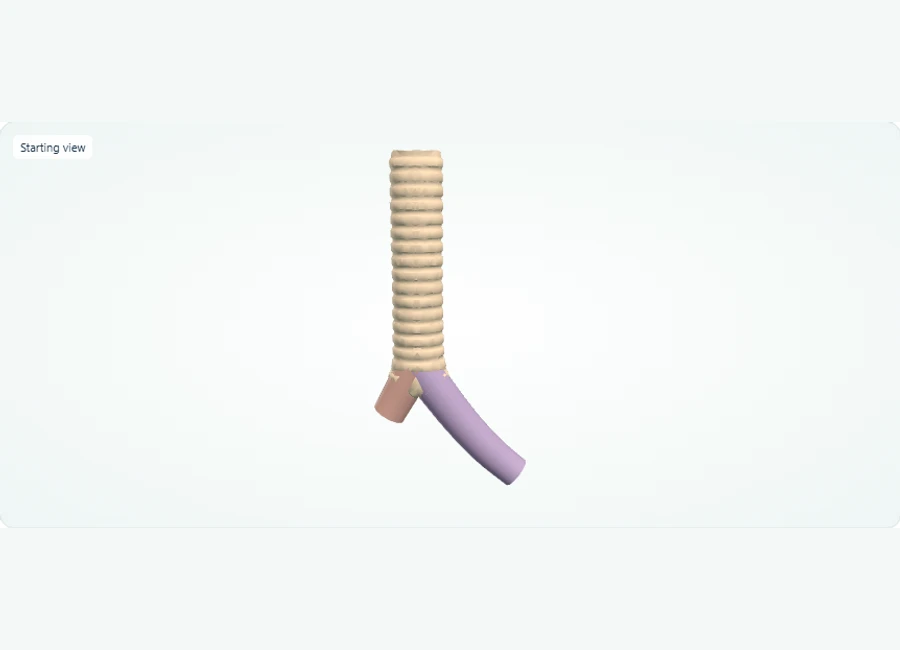
This model shows the trachea and its division into the right and left main bronchi. Only these three airway structures are present: there are no lobar branches, alveoli, or other respiratory structures, and the model shows normal anatomy with no pathology or devices.
Rotate, isolate structures, and test your recall.
Set the view to front and zoom to see the whole model: the trachea is the single central tube, with the right main bronchus and left main bronchus branching from its lower end.
Select each of the three structures in turn (Trachea, Right main bronchus, Left main bronchus), using isolate to view one at a time and show all to restore the full model.
Use Test recall to hide the labels; when a structure is highlighted, name it before pressing Reveal name, then use Return to study to continue.
Try it yourself
Test recall highlights the structure branching from the lower end of the trachea toward the body's left side. Which structure is it?
Show answer and explanation
Left main bronchus
In the front view, the trachea runs down the midline and splits into two main bronchi. The branch passing to the viewer's right (the body's left side) is the left main bronchus, while the branch to the body's right side is the right main bronchus.
- The trachea is the central airway that divides into two main bronchi, one for each lung side.
- The right main bronchus and left main bronchus are the first branches off the trachea; this model contains no smaller (lobar) branches or alveoli beyond them.
- Because only three structures are selectable, identification practice here means telling the trachea from the right versus left main bronchus.
Worked Scenario 1: Postoperative Adult with a Drifting Oxygen Saturation
In this paper case, a postoperative adult on controlled ventilation shows a slowly falling saturation with rising airway pressures. The plausible mistake is repeatedly raising oxygen; the better decision is targeted assessment of the cause, then cause-directed action.
The plausible mistake: over three consecutive stages you select increase FiO2 each time the saturation ticks down. This feels responsive, but a chain of same-category oxygen adjustments treats the displayed number rather than the mechanism. In the scenario, the underlying problem — retained secretions causing worsening compliance — remains unaddressed, and each oxygen increase consumes a decision without changing the trajectory.
The better decision: at the first pressure change, gather targeted data — auscultate the chest, check the plateau pressure trend, and review the most recent chest film. When the findings point to secretions, intervene with suctioning, then select a reassessment option in the following stage to confirm improvement. Why it matters: this sequencing demonstrates a complete management loop (assess, act, re-evaluate) rather than a reflex loop, and the reassessment branch generates the information the rest of the case depends on.
Worked Scenario 2: Premature Infant with Rising Work of Breathing on CPAP
In this paper case, a premature infant on noninvasive support shows increasing effort and recurrent apneic episodes. The mistake is escalating straight to invasive ventilation without testing whether adjusted noninvasive support holds; the better decision is stepwise escalation matched to the trend.
The plausible mistake: when the first apneic episode appears, you select immediate intubation and mechanical ventilation. In the scenario, the infant had been stable on the initial settings for hours, and the case offers intermediate options — adjusting the noninvasive support level and closely monitoring the apnea pattern. Skipping those stages commits the case to the invasive pathway before the trend justifies it, an especially consequential choice in a low-reserve neonatal patient.
The better decision: adjust noninvasive support, then use the next information stage to observe the trend. If apneic episodes persist or desaturations deepen despite the adjustment, that documented failure of the noninvasive approach becomes the clear justification for escalation. Why it matters: escalation matched to a trend is defensible in either direction — you neither expose a stable infant to avoidable invasiveness nor leave a deteriorating one unsupported — and the written trend is what makes the escalation decision coherent.
Interpreting Information as It Arrives Over Time, Not All at Once
Simulation problems reveal laboratory values, imaging, and assessment findings progressively. Practice reading each new item against the trend and your current working plan, and be willing to revise the plan when new information contradicts it.
Because information arrives in stages, a value that looked acceptable in stage one may be part of a deteriorating trend by stage three. Train yourself to interpret deltas: a saturation falling steadily from a normal starting point deserves a different response than one stable abnormal reading. In your notes, track each key variable across stages of a practice case, so you can see the trajectory the way the case is designed to present it.
Also practice responding to contradiction. If the chart says one thing and your assessment findings say another, that discrepancy is itself information demanding resolution before major action. A useful drill: whenever you see conflicting data in a practice case, write down the two competing explanations and identify the single most discriminating assessment that would separate them. This converts scattered findings into a decision framework you can reuse across settings.
Practical Exercise: Build a Decision Map and Score It Against This Rubric
Take a written clinical case, list every option at each decision point, sort them into gather, act, or continue categories, and sketch the consequence of each branch. Score your map against the rubric below.
Work one paper case per session. At the first decision point, write down every option the case offers and label each as a data-gathering choice, an intervention, or a continue-or-monitor choice. Then advance one stage, note what changed, and repeat. Expected observations after two or three maps: you discover at least one point where you were about to select a data category you had already obtained, and at least one intervention that lacked a planned reassessment afterwards.
Self-check rubric (learning milestones, not a passing prediction): one point if every intervention on your map has a named reassessment option at the next stage; one point if no data category is repeated within the same stage; one point if you can justify each selection with a stated question it answers; one point if your map shows escalation only after a documented failed attempt at a less invasive step; one point if you identified the trend, not a single value, as the basis for your key decision. Three or more points suggests your sequencing logic is forming; below three, redo the same case before moving on.
Adaptable Preparation Sequence and Concrete Readiness Checks
Sequence your preparation: map the content outline against your weak areas, learn the software with the free practice exam, drill decision maps, then take timed simulations. Finish with the readiness checks listed here.
A realistic sequence you can compress or extend: first, read the CSE Detailed Content Outline and mark the patient care settings and content areas where your knowledge feels thinnest, then review those domains with a case-based resource rather than flashcards alone. Second, complete the free NBRC practice examination in one sitting to learn navigation and pacing in the identical software. Third, run the decision-map exercise across cases from different settings in the outline. Fourth, if you want calibrated feedback, the official Self-Assessment Examination provides committee rationales for each best response; treat its feedback as a map of areas to remediate, not as a score guarantee.
A short note on administration: fees, scheduling, application steps, and current eligibility windows are covered on the NBRC CSE page, which also notes the examination's scheduled end date and the transition to the new Respiratory Therapy Examination. Readiness checks before your appointment: you can complete a paper case end-to-end while stating a justification for every selection; your last three decision maps score at least three of five on the rubric; you can explain, for one adult and one neonatal case, what trend justified your key escalation or non-escalation; and you can describe the three option categories without looking at your notes.
References and further reading
Use these references to explore the concepts and check the latest information from the relevant organizations.