
Work every 5331 practice item in four steps: (1) name the look-alike pair the scenario is contrasting, (2) underline the one discriminating feature (error consistency, fluency, comprehension, modifiability), (3) choose the option that follows from that feature, and (4) write one sentence on why the nearest wrong option fails. Build paired notes — each concept stored next to its most confusable neighbor — and track your feature-identification rate across practice sets as a learning milestone.
Why differential reasoning beats isolated topic recall for SLP study
Several 5331 syllabus areas contain look-alike condition pairs whose features overlap, so studying each concept in isolation leaves two options looking plausible. Differential reasoning — naming the contrast, finding the discriminator, matching the decision — resolves that overlap.
Case-style practice scenarios describe a client and ask what to do next, so the trained skill is extracting discriminating features — error consistency, fluency, comprehension, modifiability — and matching the option that fits that feature pattern. A good scenario supplies a handful of decisive features alongside plausible background detail: age, setting, a parent quote, a test score. Every answer option may be defensible for some client somewhere, but only one follows from the features the scenario actually states. Reading actively — underline the features, name the two or three conditions being contrasted, then let the discriminator select the answer — turns each practice item into contrast training rather than a recall quiz.
Contrast this with recall-first studying, where each topic gets an isolated page of facts and the connections between neighbors never form. In a contrast-first system, every concept is stored next to its nearest confusable neighbor, with one decisive discriminator and one therapy implication written for the pair. That note format mirrors how the decision must be made when you meet the pair inside any case scenario. This guide addresses only reasoning content; for registration steps, test format, and state certification requirements, treat the issuer at praxis.ets.org as the administrative authority.
Speech sound look-alikes: phonological pattern, articulation, and apraxia of speech
Separate the three by planning level and consistency: articulation errors are stable motor distortions of specific phones, phonological errors follow patterns across sound classes, and apraxia of speech adds inconsistency, groping, and disrupted prosody.
An articulation disorder lives at the motor-production level: one or a few phones are produced incorrectly in roughly the same way across contexts, such as a lateralized /s/ in every word position. A phonological disorder lives at the rule level: the child's error patterns, such as fronting or cluster reduction, affect whole classes of sounds and reflect an underlying system still operating on simplified rules. Apraxia of speech is a motor-planning problem: the same word is produced differently across repeated attempts, and you may see visible or audible groping for postures along with disrupted timing or stress.
The classification drives the intervention decision, which is why these three are worth drilling as one set rather than as three separate topics. Traditional motor drill on individual phones suits a stable articulation error; a patterns-based approach such as minimal pairs or cycles suits a phonological system; motor-planning intervention built on many repetitions of carefully sequenced movements suits apraxia. Use the table to rehearse the discriminators until naming the pair from a one-line description becomes automatic, then check that the therapy implication you would select follows from the row you identified.
| Feature | Articulation disorder | Phonological disorder | Apraxia of speech |
|---|---|---|---|
| Error type | Stable distortion or substitution of specific phones | Patterned errors across sound classes (e.g., fronting, cluster reduction) | Variable errors on the same word across trials |
| Consistency | High — same error in most contexts | High within the pattern, varies by linguistic context | Low — the same target changes across repetitions |
| Other cues | Isolated to the affected sound(s) | Whole-system simplification; intelligibility drops on longer utterances | Groping, vowel errors, disrupted prosody or syllable stress |
| Therapy focus | Traditional motor practice on the target phone | Patterns-based approaches (minimal pairs, cycles) | Motor sequencing with high-repetition practice |
Illustrated practice: Ear Anatomy and the Conductive Pathway in Recurrent Otitis Media
Provides a normal anatomical reference of the ear's conductive and sensory compartments so learners can locate where middle ear effusion would accumulate and why it impairs sound transmission to the cochlea without damaging it.
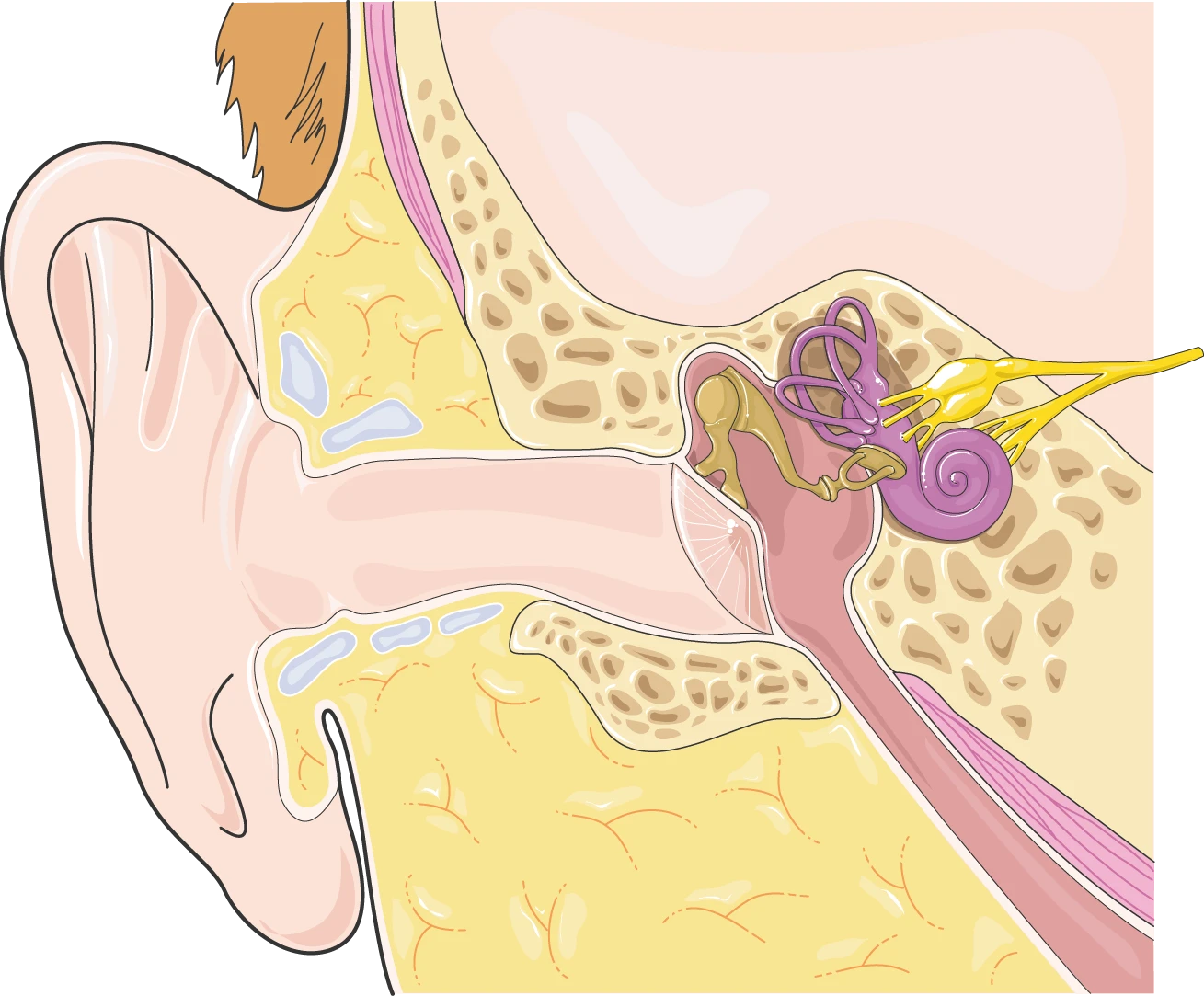
Anatomical study exhibit for the worked question below. Open the full-size view to inspect the structures.
Use the anatomical exhibit to work through the example. Choose an answer before opening the explanation.
Try it yourself
The accompanying cross-section of a normal ear (an anatomical reference illustration, NOT an image of this child's ear) shows the external ear canal, tympanic membrane, middle ear cavity with ossicles, cochlea, semicircular canals, and auditory nerve. Use it to orient the structures as you answer. A 15-month-old who had six episodes of otitis media with effusion before age one is referred for a well-child speech-language review. Expressive vocabulary is approximately 12 words, and the parent asks whether ear infections can affect talking. Applying recognized etiologic principles, which response is most accurate? A. Ear infections affect the ear canal only and have no documented relationship to speech or language outcomes, so no monitoring is needed. B. Recurrent middle ear effusion in the first year is a recognized risk factor for fluctuating hearing, which can disrupt speech and language input, so hearing status should be monitored along with language development. C. Because vocabulary is already above 10 words, the child's language is confirmed normal regardless of hearing history. D. Recurrent otitis media causes permanent sensorineural hearing loss, so language intervention should begin immediately regardless of current hearing.
Show answer and explanation
B. Recurrent middle ear effusion in the first year is a recognized risk factor for fluctuating hearing, which can disrupt speech and language input, so hearing status should be monitored along with language development.
In the illustration, sound normally travels through the external ear canal, vibrates the tympanic membrane, and is transmitted by the ossicles across the air-filled middle ear cavity to the inner ear. In otitis media with effusion, fluid would occupy that middle ear cavity and dampen ossicular sound transmission, producing a fluctuating conductive hearing loss; the cochlea and auditory nerve shown beyond the oval window are not damaged, which is why the loss is typically intermittent rather than permanent sensorineural. Recurrent effusion in the first year is therefore an established risk factor for degraded auditory language input, and combining hearing surveillance with language monitoring is the standard prudent response. The other options either dismiss the risk or overstate it as permanent loss.
Worked scenario: the preschooler whose errors 'change every time'
The scenario's decisive feature is error variability across repeated productions of the same word. A sound-specific drill answer ignores that feature; the better decision targets motor planning and sequencing rather than two isolated phones.
Practice stem: a four-year-old is unintelligible to unfamiliar listeners; 'banana' is produced three different ways across a two-minute sample, vowels shift between attempts, and the child visibly gropes when starting longer words. The oral-motor screen shows no weakness, and hearing has been cleared. Plausible mistake: selecting 'traditional articulation therapy for /k/ and /r/,' because the summary line mentions distorted productions and that option names familiar sounds. That decision treats the sound labels in the description, not the described behavior, and it is the kind of near-miss worth writing down when you make it.
The better decision recognizes the defining combination — inconsistent errors on repeated trials, groping, prosodic disruption — as the apraxia-of-speech pattern, and selects the option describing motor-planning intervention with many structured repetitions and movement sequencing. Why it matters: drilling two phones leaves the whole-system variability untouched, so even a technically careful drill plan fails the actual profile. When a case includes repeated-production evidence, re-read it before choosing any sound-specific answer, and let the pattern row in the table, not the sound names, drive the selection.
Adult neurogenics: fluent versus nonfluent profiles drive the next step
Classify aphasia on three switches — fluency, auditory comprehension, repetition: Broca is nonfluent with spared comprehension, Wernicke fluent with poor comprehension, conduction fluent with impaired repetition, anomic essentially word-finding only.
Run the three switches in order. Fluency first: nonfluent, effortful, agrammatic output with relatively spared comprehension points to Broca's aphasia; fluent, well-articulated output with empty content or neologisms points to the Wernicke-anomic-conduction family. Comprehension next: Wernicke's aphasia shows poor auditory comprehension, while anomic aphasia shows comprehension largely spared. Repetition last: conduction aphasia separates from Wernicke's because repetition is disproportionately impaired despite good comprehension. Paraphasia type supports the call — phonemic paraphasias in conduction, neologisms in Wernicke's — and a concomitant right hemiparesis points to left-hemisphere perisylvian involvement.
The classification changes the intervention option, which is the reason to drill this classifier rather than memorize definitions in a list. A fluency-focused, melody-based option fits a nonfluent Broca profile; comprehension-heavy, multimodal communication approaches fit Wernicke's aphasia; repetition-targeted tasks fit the conduction profile. A quick self-check: write four one-sentence practice stems, one per type, using only the three switches, then name the type and one matching intervention. If you cannot build those stems yourself, the classifier is not yet yours — rework the pairs before moving to timed practice sets.
Assessment interpretation: what the numbers say and when they run out
Know what standard scores, percentiles, and confidence intervals communicate, and recognize when norm-referenced results need supplementing with dynamic assessment or language sampling before a defensible decision can be made.
A standard score locates a client relative to the normative sample — with the common convention of a mean of 100 and standard deviation of 15 — and a percentile restates that position as the percentage of the normative sample scored at or below. A confidence interval gives the range within which the true score plausibly falls given measurement error, which is why a score sitting near a boundary should be read as imprecise, not exact. Subtest scatter deserves the same caution: a single low subtest is a flag for further analysis, not a conclusion by itself.
Norm-referenced results also have known limits that practice cases can train you to spot. When a client's language experience or dialect differs substantially from the normative sample, the score describes performance on that test, not a disorder, and converging evidence is required. Dynamic assessment supplies that evidence: teach a skill, then examine modifiability — how much support the learner needed, how quickly performance changed, and whether gains generalized. A language sample adds context the score lacks. The decision-relevant contrast is score-first versus converging-evidence-first; the second is what defensible case decisions are built from.
Worked scenario: the bilingual learner with low English vocabulary scores
A low score in the second language alone cannot separate language difference from disorder. The decisive evidence is performance across both languages and the learner's response to teaching — the modifiability pattern from dynamic assessment.
Practice stem: a six-year-old with eighteen months in an English-medium school earns a low standard score on an English vocabulary test; the teacher reports limited classroom participation. Plausible mistake: recommending intervention on that score alone and selecting an option framed entirely around English vocabulary instruction. The error is treating a norm-referenced result from a language the learner is still acquiring as if it measured underlying language ability, which neither the score's purpose nor its normative sample supports. This is exactly the contrast the paired-note format is meant to make visible.
The better decision gathers converging evidence: information about the home language, a language sample, and a dynamic assessment in which a narrative or vocabulary skill is explicitly taught and the learner's modifiability is observed. Rapid improvement with modest cues points toward a language difference; persistently low response to teaching across both languages points toward a disorder. Why it matters: the two paths lead to different decisions about eligibility and about which language services support, so the interpretation step — not the score itself — is the learning point this scenario drills. Watch for cases that hand you a single number and no teaching data; that absence is itself a cue.
A vignette-decoding drill, self-check rubric, and preparation sequence
Practice decoding case scenarios, not just answering them: name the contrast, identify the discriminating feature, choose the decision, and state why the nearest wrong option fails; score the work with a simple rubric.
The exercise: pull ten case-style items from the free practice page for this exam and, for each, write four lines — the look-alike pair, the single discriminating feature, your answer, and one sentence rejecting the nearest distractor. Expected observations: in early sets you may articulate the decisive feature for only half the items and default to 'it sounded right' for the rest; that gap is the skill being trained. Self-check rubric per item, out of five: two points for correctly naming the pair, two points for a specific distractor rejection, one point for the right answer, giving a fifty-point maximum per ten-item set. A working milestone is a set total of forty or more out of fifty — equivalently, eight items earning full marks — which measures training progress, not a passing prediction.
An adaptable sequence: week one, map the domains and write paired notes for every look-alike pair you meet; week two, a daily two-pair contrast drill using the table format; week three, vignette decoding with the rubric; week four, a mixed timed set reviewed by contrast type, so every miss becomes a new pair for your notes. Readiness checks before test day: classify all four speech-sound profiles from one-sentence stems, run the three-switch aphasia classifier unprompted, explain a confidence interval in one sentence, and apply the modifiability logic to a paper case. For registration and current test logistics, see praxis.ets.org; the study guides hub can help you slot this plan around other review materials.
References and further reading
Use these references to explore the concepts and check the latest information from the relevant organizations.