
Prepare for the AANPCB nurse practitioner certification exam by treating every practice item as a clinical encounter: name the population, interpret the assessment findings, and commit to a management decision before looking at options. Compare the FNP, AGNP, PMHNP, and ENP exam families so your content matches your intended population, then work full paper scenarios with a self-check rubric that evaluates your reasoning chain, not just your final answer choice.
Why a 100% clinical, competency-based format changes how you should study
AANPCB examinations test clinical knowledge and competency rather than recalling definitions, so your practice must center on encounters: interpreting findings and selecting management, not memorizing lists.
The issuer describes each of its certification examinations as an entry-level, competency-based test of clinical knowledge. In practice, that means a question is less likely to ask what a term means and more likely to present a patient, some findings, and four next steps, asking which step is correct for that patient at that moment. Your study sessions should therefore produce reasoning practice, not just review notes.
A concrete habit: after reading any content topic, immediately convert it into at least one stem you write yourself, such as an adult with a new finding and four plausible actions. Writing the distractors forces you to think about near-miss decisions, which is exactly the judgment a competency-based format assesses. Reviewing the topic again afterward consolidates both the fact and its application.
This is also why generic test-taking tips underperform here. The skill being measured is the chain from history and findings to interpretation to plan, so every practice block you run should end with you articulating that chain aloud or in writing, one sentence per link, before you check whether your selected option matches.
FNP, AGNP, PMHNP, or ENP: matching the exam family to your population
AANPCB offers four certification examinations with different population scopes: FNP across the life span, AGNP from adolescent through older adult, PMHNP across the life span, and ENP across the life span in emergency specialty care.
Choosing the wrong scope wastes preparation time in both directions. If you sit the FNP examination, your review must include pediatric, adolescent, adult, and geriatric presentations, because the credential covers family and individuals across the life span. If you sit the AGNP primary care examination, the population is adolescent to older adult, so early-childhood content falls outside your tested scope and deep geriatric content becomes central.
The specialty examinations change the frame rather than only the population. The PMHNP examination tests psychiatric mental health knowledge across the life span, so lifespan coverage returns but through a mental health lens. The ENP examination tests emergency specialty care across the life span, which shifts emphasis toward acute, undifferentiated presentations. Confirm your intended role against these scopes before building a study calendar, and note that administrative details such as application steps live on the issuer's site at aanpcert.org.
A useful check is to read your last ten clinical cases from work or rotations and classify each by population and specialty lens. Whichever examination family matches that pattern is the one whose published scope should drive your content map.
| Examination | Population scope per issuer | Primary content lens | Best fit when your practice involves |
|---|---|---|---|
| FNP | Family and individuals across the life span | Broad primary care over all ages | All ages in family or primary care settings |
| AGNP (Primary Care) | Adolescent through older adult | Adult and geriatric primary care | Adolescent, adult, and older adult populations |
| PMHNP | Psychiatric mental health across the life span | Mental health assessment and management | Psychiatric and mental health care at any age |
| ENP | Emergency specialty care across the life span | Acute and emergency presentations | Emergency or urgent care across ages |
Illustrated practice: Upper Versus Lower Urinary Tract Anatomy
Distinguish the upper tract (kidneys, flanks) from the lower tract (bladder, urethra) to support the cystitis-versus-pyelonephritis localization reasoning.
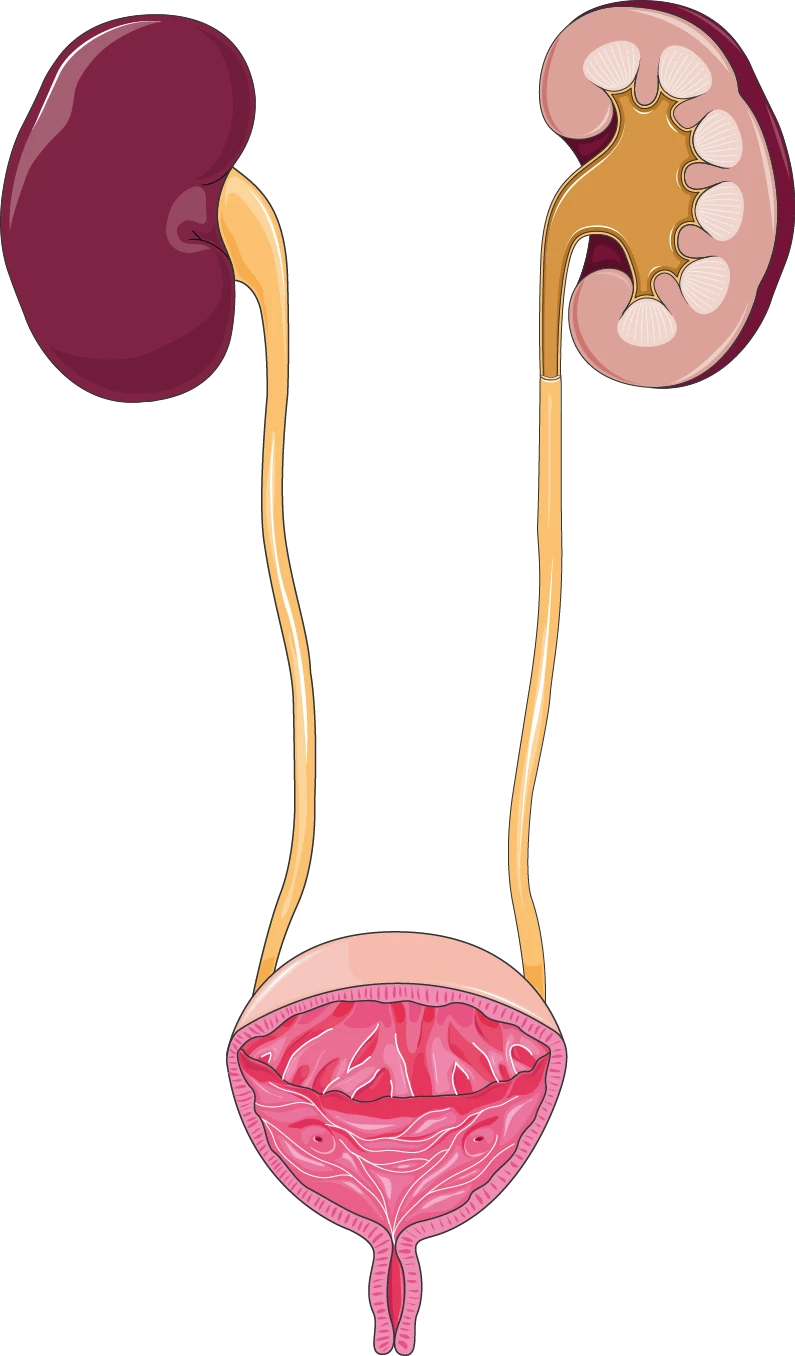
Anatomical study exhibit for the worked question below. Open the full-size view to inspect the structures.
Use the anatomical exhibit to work through the example. Choose an answer before opening the explanation.
Try it yourself
A 24-year-old woman presents with two days of dysuria, urinary frequency, and suprapubic discomfort without fever or flank pain. Urinalysis results: positive leukocyte esterase, positive nitrite, 40 white blood cells per high-power field, no hematuria, no casts. Vital signs are normal, and costovertebral angle tenderness is absent. An anatomical exhibit is provided: a frontal schematic of the normal female urinary tract showing the paired kidneys, the ureters descending to the bladder, and the bladder with its short urethra. This is a normal anatomical reference for orientation; it is not a patient image and does not depict the patient's findings or any disease. Which interpretation best characterizes these combined findings? A. Interstitial cystitis requiring urology referral B. Acute pyelonephritis requiring inpatient treatment C. Asymptomatic bacteriuria requiring antimicrobial therapy D. Uncomplicated acute cystitis appropriate for outpatient management
Show answer and explanation
D. Uncomplicated acute cystitis appropriate for outpatient management
Positive leukocyte esterase and nitrite with pyuria plus classic irritative symptoms support bacterial lower urinary tract infection. The absence of fever and flank pain makes upper tract involvement less likely in this presentation, but does not by itself exclude it. Asymptomatic bacteriuria is ruled out by her symptoms, and interstitial cystitis typically yields a bland urinalysis without nitrite positivity. The exhibit helps organize the reasoning spatially: the lower tract is the bladder and urethra, whose irritation produces suprapubic pain and irritative voiding symptoms, whereas the upper tract comprises the kidneys at the level of the flank, where infection may produce fever, flank pain or costovertebral angle tenderness. White-cell casts can support renal involvement when present; their absence does not rule it out. The ureters shown connecting kidneys to bladder are the route by which infection ascends, which is why lower-tract symptoms without upper-tract signs localize the process below.
Separating assessment from plan inside every stem
Many stems test whether you gather enough assessment before acting. Practice labeling each question stage: what findings are given, what interpretation they support, and whether the options are assessment steps or management steps.
When you read a stem, run a three-column mental sort: given findings, working interpretation, and option type. If the options are all diagnostic or assessment actions, the question is asking what information you still need. If the options are all treatments, dispositions, or counseling steps, the question assumes your assessment is complete and asks for the plan. Mismatching those two modes is a distinct reasoning error from not knowing the content.
Train this with a marking exercise. Take a set of practice questions and, before answering, write A or M in the margin depending on whether the stem wants assessment or management. Only then answer. When you review, note each miss as a content miss or a mode miss. Keeping those two categories separate tells you whether to review material or to slow down at the interpretation step.
Watch for mixed option sets, where three choices are assessment steps and one is a premature treatment, or vice versa. In those items the mode mismatch itself is the discriminator: acting before completing the assessment, or reassessing endlessly instead of committing to a plan, is what the option set is built to expose.
Worked scenario 1: the older adult with an abrupt change in cognition
An AGNP-style item about acute confusion tests whether you complete an assessment before settling on a single cause. The common paper mistake is anchoring on the first plausible explanation and choosing treatment immediately.
Scenario: an 82-year-old community-dwelling patient is brought in by a daughter for two days of fluctuating confusion and reduced attention. Findings include a low-grade temperature, urinary frequency, and a new medication started last week. The options are: start an antibiotic for a presumed urinary source; order a focused infection workup plus medication review and further assessment; reassure and recheck in a week; refer directly for a head CT as the only step. The tempting choice is the antibiotic, because one cause explains most of the findings and the distractor feels decisive.
The better decision is the comprehensive assessment option. Abrupt, fluctuating cognitive change is by definition an acute change that warrants systematic evaluation of reversible contributors, and when several plausible contributors coexist, new medications and infection both need evaluation rather than a single-cause guess. Choosing reassurance under-responds to an acute change, and a head CT alone narrows the evaluation to one domain. The reasoning chain you should be able to state is: acute change plus fluctuation means urgent assessment, multiple plausible contributors means evaluate all likely ones, and treatment follows from completed assessment.
Score yourself on three points: did you identify the change as acute rather than chronic, did you notice that two independent contributors were planted in the stem, and did you resist choosing an option that commits to one cause before assessment? Missing the second point is the mistake this scenario is designed to surface.
Worked scenario 2: a lifespan item where age changes the answer
FNP items distribute across the life span, so an identical presentation can have different correct management at different ages. The paper mistake is applying adult-pattern reasoning to an adolescent or pediatric stem.
Scenario: a 15-year-old presents with persistent low mood, declining grades, and withdrawal from activities, accompanied by a parent. Options include: manage as a normal adjustment and recheck in six months; perform an age-appropriate mental health assessment including confidential adolescent interview and risk screening before any plan; begin the same management approach used for adults in the practice; refer immediately without assessment. The tempting choice, borrowed from adult primary care habit, is to normalize the presentation as adolescence.
The better decision is the structured assessment option. The PMHNP and FNP scopes both include adolescent mental health, and persistent functional decline in an adolescent warrants formal assessment, including speaking with the adolescent and screening for risk, before any plan is chosen. Waiting six months leaves a persistent, functionally impairing presentation unassessed; immediate referral without assessment skips the primary care evaluation step. The chain is: functional decline plus persistence triggers formal assessment, adolescents require an age-appropriate confidential interview, and risk screening precedes planning.
The lifespan lesson generalizes: build your notes so each major topic lists how presentation and management differ by age band within your examination's scope. For FNP that spans all ages; for AGNP it runs from adolescence through older adulthood. A topic note without age bands is incomplete for a lifespan-competency examination.
A weekly scenario exercise with a self-check rubric
Run a repeating exercise: write or select one full scenario per major topic, answer it cold, then score your reasoning chain against a five-point rubric rather than only checking the letter choice.
The exercise: once a week, pick a topic from your content map and write one complete encounter for it, including demographic details, presenting complaint, three to five findings, and four options of which at least one is a mode mismatch (a treatment among assessment steps, or the reverse). Answer it the next day, cold. Then score it with the rubric below and write one sentence describing the single weakest link in your chain.
Expected observations after three or four weeks: your mode-mismatch error rate should fall first, because labeling assessment versus plan is a fast skill to build; content misses should shift from broad topics toward specific age bands; and your written chains should get shorter as interpretation becomes automatic. If your scores plateau, the rubric line you repeatedly miss tells you which stage to drill, rather than suggesting you should reread everything.
Keep a one-page error log with two columns: chain stage where the error occurred (assessment, interpretation, or plan) and topic. Reviewing the log before each practice block turns the rubric into a targeting tool instead of a grade.
- Rubric point 1 - Population: correctly identified the age band and examination scope the stem implies.
- Rubric point 2 - Mode: correctly labeled the stem as asking for assessment or for management.
- Rubric point 3 - Completeness: noticed all planted findings, including contributors that compete with the obvious cause.
- Rubric point 4 - Discrimination: could state why each rejected option is wrong in one sentence.
- Rubric point 5 - Chain: produced a stated reasoning chain (findings, interpretation, decision) before checking the answer key.
- Self-check benchmark: aim to score 5/5 on your own scenarios within four weeks; this is a learning milestone, not a prediction of exam performance.
An adaptable preparation sequence and concrete readiness checks
Sequence preparation in three phases: map content to your exam family's scope, then drill decision chains with scenario blocks, then rehearse mixed blocks. Finish when you meet specific readiness checks, not when the calendar ends.
Phase one (roughly the first third of your timeline): confirm your examination family against the issuer's published scopes, then build a content map for that population. For FNP, ensure every topic carries pediatric, adolescent, adult, and geriatric notes; for AGNP, weight adult and geriatric depth; for PMHNP, keep lifespan coverage but through mental health presentations; for ENP, emphasize acute and undifferentiated presentations across ages.
Phase two: convert the map into scenario practice using the weekly exercise above, two to three topics per week, always with the rubric. Phase three: run mixed blocks that shuffle ages, modes, and specialties so you practice recognizing which population and which question mode you are in before answering. Close each session by updating the error log. For administrative matters such as applications, scheduling, and renewal requirements, use the issuer's site directly rather than secondary sources.
Readiness checks before you finish: you can state your examination family's population scope from memory; you score 5/5 on your own rubric across three consecutive scenarios from different age bands; your error log shows no mode-mismatch errors in the last two weeks; and mixed blocks no longer change your accuracy relative to single-topic blocks. Treat these as milestones you set for yourself, and adjust your timeline if any check remains unmet.
References and further reading
Use these references to explore the concepts and check the latest information from the relevant organizations.
Continue your preparation
3 practice options available