
The FNP-BC examination tests entry-level family nurse practitioner decision-making across the lifespan, and its difficulty lies less in any single topic than in switching between reasoning modes: one item asks for a diagnosis, the next for the correct management step, the next for age-appropriate prevention. Build preparation around the ANCC test content outline, practice classifying what each question stem actually asks before reviewing answers, and rehearse red-flag recognition so escalation decisions become automatic. Confirm current administrative requirements, including the outline version active for your test date, directly on the ANCC certification page.
Turn the ANCC test content outline into a study map
The published test content outline lists the domains this competency-based exam covers. Convert it into a working checklist: one page per domain, mapped to your strongest and weakest coursework and clinical experiences.
ANCC describes the FNP-BC exam as competency-based, assessing entry-level clinical knowledge and skills and aligned with the APRN Consensus Model. The outline published for your test date is therefore your syllabus: it names the content domains and their relative emphasis. Copy each domain into a spreadsheet, then rate your confidence from your graduate coursework and faculty-supervised clinical hours. Study the low-confidence domains first, and revisit the map weekly so no domain remains unaddressed.
Your program's three APRN core courses — advanced physiology/pathophysiology, advanced health assessment, and advanced pharmacology — supply the underlying science, while health promotion and differential diagnosis and disease management supply the applied content the outline highlights. Instead of rereading textbooks cover to cover, attach each domain to concrete case types: pediatric wellness, adult chronic disease, older-adult polypharmacy, reproductive health. This turns an abstract domain list into scenarios you can rehearse and self-test against.
Decode the stem: diagnosis, action, test, or teaching evaluation
Exam-style items fall into a few recognizable phrasings, and each demands different reasoning. Classify the stem — most likely diagnosis, next best action, best initial test, or evaluation of understanding — before reading the options.
Most likely diagnosis items reward pattern matching: list the salient findings, compare them against classic presentations, and eliminate options whose age, tempo, or associated features do not fit. Next best action items instead ask what you do with the information now — stabilize, escalate, gather more data, or treat — and the correct answer often depends on whether a red flag is present rather than on which disease is statistically likeliest.
The trap is answering the wrong question well. A flawless differential is useless when the stem asks for the immediate management step, and a treatment reflex is wrong when the stem asks which finding best supports a diagnosis. Practice reading the final sentence of each stem twice, underline the actual task, and only then evaluate the options. The table below gives you a reusable decode key.
| Stem phrasing | What it is really asking | Reasoning mode | Common trap |
|---|---|---|---|
| Most likely diagnosis | Which condition best explains the findings | Pattern matching against classic presentations | Treating an incidental finding as the answer |
| Next best action | What to do with the information right now | Triage: red flag escalates; otherwise evaluate further | Choosing a test the workup has already effectively answered |
| Best initial test | First step on the diagnostic ladder | Least invasive test that changes management | Jumping straight to the definitive or gold-standard test |
| Appropriate health promotion | Which preventive task fits this patient | Match guideline task to age band and risk profile | Applying an adult screening logic to a pediatric or adolescent visit |
| Indicates understanding or needs further teaching | Which statement reflects correct patient learning | Evaluate statements against what was taught | Misreading the negation in the stem |
Explore in 3D: Right eye: layers, lens, and optic nerve
This model shows the right eye as five selectable parts: cornea, lens, retina, sclera, and optic nerve. The cornea and lens sit anteriorly, the retina lines the posterior interior, and the optic nerve exits posteriorly. Surfaces are opaque until hidden, so hiding the sclera is the key step to see inside.
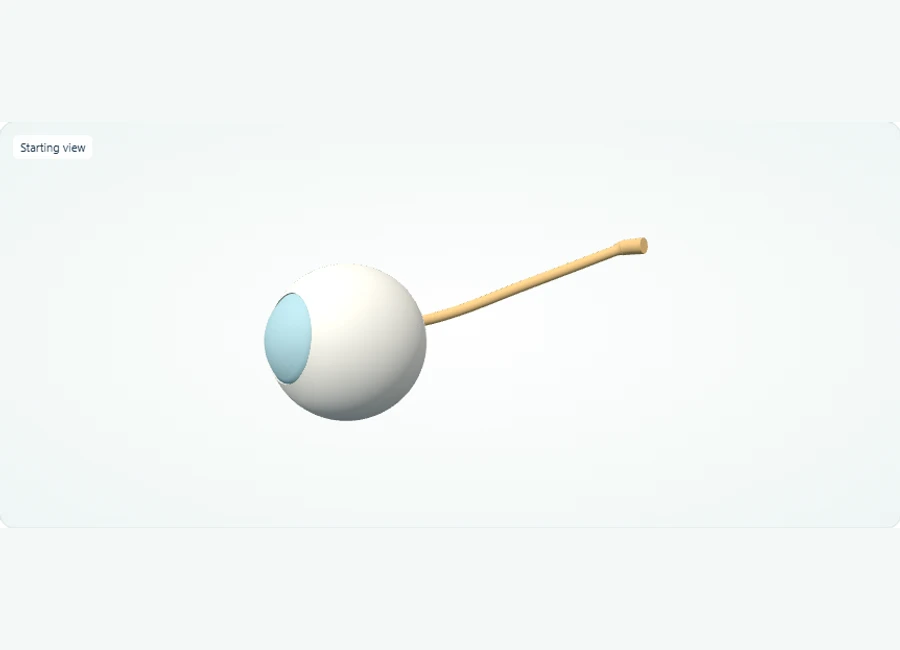
Rotate, isolate structures, and test your recall.
Select and isolate the right cornea, then the right lens, to inspect these anterior structures individually. The study model uses opaque surfaces.
Use Show all. Select and hide the sclera to expose deeper layers, then isolate the retina to inspect its shape.
Use Show all and choose Side or Back. Select the optic nerve to trace its exit from the posterior eye.
Try it yourself
Which structure exits the posterior eye, and which light-sensitive layer lines the posterior interior?
Show answer and explanation
The optic nerve (cranial nerve II) exits posteriorly; the retina lines the posterior interior.
From the back of the model, the nerve trunk is the structure leaving the eyeball, and the retinal lining sits within the posterior interior. Note the entire retina is shown as one part, and the macula is not separately labelled in this model.
- Refractive structures (cornea and lens) are anterior; the light-sensitive retina is posterior.
- The optic nerve (cranial nerve II) leaves the eye posteriorly, carrying visual information toward the brain.
- The sclera is the opaque outer coat; hide it to expose the cornea-lens axis and the internal retinal lining.
Explore in 3D: Liver and Gallbladder
Locate the gallbladder on the inferior surface of the liver, then inspect the included bile duct. The liver and gallbladder are accessory digestive organs outside the food passage.
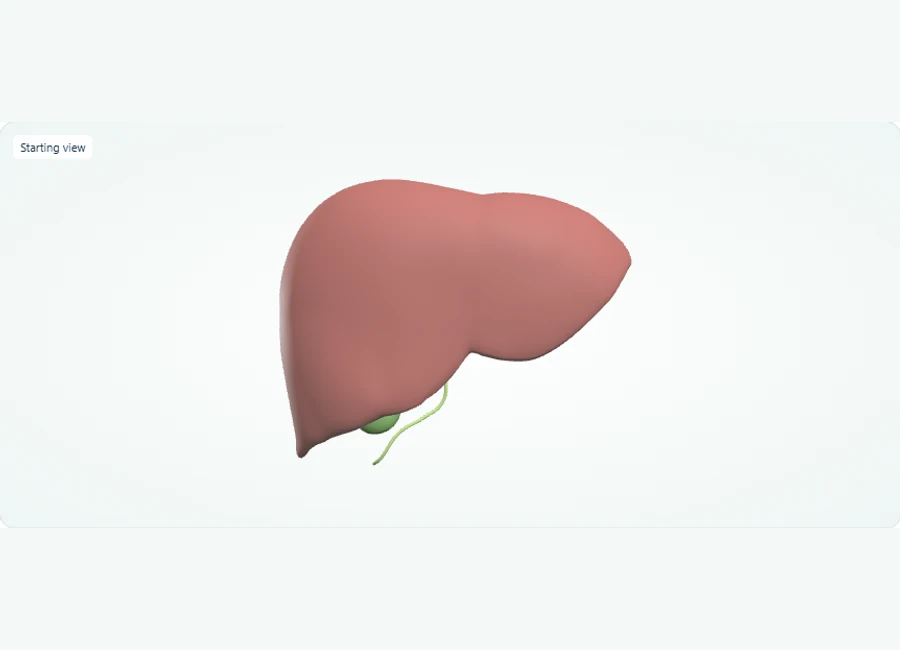
Rotate, isolate structures, and test your recall.
Rotate below the liver to find the gallbladder on its inferior surface.
Select the gallbladder and isolate it to inspect its shape. Use Show all before comparing its position with the liver.
Select and hide the liver, then select the bile duct to inspect its course. Complete hepatic and cystic duct junctions are not separately represented.
Try it yourself
Which accessory digestive organ lies on the inferior surface of the liver?
Show answer and explanation
Gallbladder
The gallbladder sits on the inferior (underside) surface of the liver and stores bile; bile leaves via the bile duct shown in this model.
- The gallbladder lies on the inferior surface of the liver.
- The liver and gallbladder are accessory organs — they are outside the food passage.
- The bile duct is included on this model, but the junctions between hepatic and cystic ducts are not shown or separately labelled.
Red flags that override probabilistic reasoning
In paper scenarios, certain findings change the task from careful differential work to immediate escalation. When a red flag appears, the safest action consistent with the stem outranks the most statistically probable diagnosis.
Worked scenario: a 58-year-old woman with hypertension presents with two weeks of exertional fatigue and jaw tightness that resolves with rest; vitals are stable and lungs are clear. A plausible mistake is selecting a lipid panel and routine follow-up in two weeks, reasoning that fatigue is common and nonspecific. The better decision is to recognize exertional jaw tightness as a possible anginal equivalent in a patient with cardiac risk factors and arrange urgent same-day evaluation, including electrocardiography, rather than routine scheduling.
Practice materials phrase these as next best action items precisely because entry-level practitioners must act on the possibility of serious disease even when benign causes are more common — and the same logic governs real practice. Keep a personal list of presentation red flags: exertional chest or jaw symptoms, new severe headache, focal neurologic deficits, fever with a petechial rash, suicidal ideation. Drill the paired action — usually immediate evaluation or referral — until it fires before differential curiosity does.
Lifespan and health-promotion items: match the task to the age
Health-promotion items test whether the preventive task fits the patient's age, risk profile, and developmental stage. Adolescent well visits are a rich case type because they combine confidentiality, psychosocial screening, and immunization decisions in one scenario.
Worked scenario: a 15-year-old attends with a parent for sports clearance, and the parent answers every question. A plausible mistake is completing the physical, signing the form, and ending the visit. The better decision is to conduct part of the visit with the adolescent alone, using a structured psychosocial screening approach covering home, school, activities, substances, safety, and mood, then review immunizations and explain the limits of confidentiality before rejoining the parent.
The same principle applies across the lifespan: match the preventive action to the life stage rather than to the chief complaint. Build an age-band grid — infant, young child, adolescent, adult, older adult — and for each band list the visit type, screening priorities, and anticipatory guidance you rehearsed during clinical rotations. When an option describes the right action for the wrong age band, treat it as a distractor rather than a judgment call.
Professional role, ethics, and safety items are not trivia
The outline's non-clinical content — ethics, safety, and professional standards — rewards the same structured thinking: identify the principle in play, then choose the action consistent with scope of practice and established standards.
Scope of practice is set by state law and varies by state, so an option that is appropriate in one jurisdiction may not be in another; when a stem emphasizes a practice-authority constraint, respect it rather than importing habits from a preceptorship elsewhere. Ethics items typically turn on autonomy, informed consent, confidentiality, and duty to protect — decide which principle the stem is testing before choosing among options that all sound compassionate.
Safety and documentation items reward explicit reasoning: record assessments, differential considerations, and the rationale for escalation or watchful waiting, and communicate findings through the mechanism the scenario provides. Rehearse the phrase the nurse practitioner should first applied to non-clinical situations — a colleague whose performance raises concern, a patient refusing treatment, a boundary issue — so your answers rely on defined standards and processes rather than workplace improvisation.
A stem-decode drill with a self-check rubric
Once a week, take ten untimed practice items and, before answering, write the stem type, the task, and any red flags. Grade yourself against a process rubric rather than only against right and wrong answers.
Procedure: use ANCC's published sample questions plus any reputable question set, including the free practice bank linked on this site. For each item record three lines — the stem type (diagnosis, action, test, promotion, or teaching evaluation), the exact task words in the final sentence, and any red flags or age-band cues. Then answer, and for every miss write one sentence on why each discarded option fails. Ten items done this way is a complete exercise; expect the first session to feel slow.
Score each session from 0 to 2 on four behaviors: (1) stem classified before reading options, (2) red flags identified on a first read, (3) age-band cue noted for prevention items, (4) distractor rationale written for every miss. A total of 6 to 8 signals the drill is taking hold; below that, slow down and use five items per session instead. These self-check scores track your process habits — they are learning milestones, not predictions of exam performance.
- Line 1 — stem type: diagnosis, action, initial test, promotion, or teaching evaluation
- Line 2 — task words: quote the final sentence verbatim before answering
- Line 3 — cues: red flags, age band, risk factors, or scope constraints in the stem
- Miss review: one written sentence on why each wrong option fails
An adaptable preparation sequence and readiness checks
A six-week skeleton adapts to most schedules: map the outline, drill stems, close content gaps, then simulate. Readiness means predictable process, not a streak of perfect practice scores.
Weeks 1–2: build the outline map and complete the stem-decode drill twice. Weeks 3–4: study your weakest domains through case review, adding one age-band grid and one red-flag list per week. Week 5: run mixed timed practice sets, reviewing every miss with a written distractor rationale. Week 6: take a full-length practice test under exam conditions, then do a light review of the outline, your red-flag list, and the age-band grid. Compress or stretch the weeks to fit your clinical schedule.
You are process-ready when you can state the outline's domains from memory, classify any practice stem within a first read, name the escalation action for every red flag on your list, and complete a timed set without changing your answering pattern halfway through. ANCC offers its own sample questions and readiness materials on the certification page. Administrative details — eligibility documents, scheduling, and the outline version active for your test date — change over time, so confirm them there before finalizing your plan.
References and further reading
Use these references to explore the concepts and check the latest information from the relevant organizations.