The NPTE-PTA is the U.S. licensure examination for entry-level physical therapist assistants, administered by FSBPT and governed by the content outline effective January 2024. It is a 180-question, computer-based multiple-choice exam with 4 hours of testing time; you need a scaled score of 600 to pass. Prepare by studying the musculoskeletal, neuromuscular, and cardiovascular & pulmonary systems first because they carry the largest item ranges, then cover the smaller systems, the nonsystem areas such as safety and equipment, and finish with FSBPT's official practice tools.
What the NPTE-PTA is and which version applies
The NPTE-PTA is the national licensure examination for entry-level physical therapist assistants in the United States, and the current content outline is the version effective January 2024.
The Federation of State Boards of Physical Therapy (FSBPT) develops and administers the National Physical Therapy Examination for both physical therapists and physical therapist assistants. The PTA version is designed to measure whether you have the knowledge required of an entry-level physical therapist assistant working under the supervision of a physical therapist, with a focus on applying knowledge to safe and effective patient care.
This guide follows the NPTE-PTA Test Content Outline effective January 2024, Version 1.1, and the NPTE Candidate Handbook version 2025.02. Check FSBPT's website before your exam date in case a newer outline or handbook has been published.
Passing the exam is one part of licensure. Each U.S. jurisdiction's licensing authority grants the license and may add its own requirements beyond the national exam, so confirm your jurisdiction's rules early.
Official documents behind this guide: FSBPT NPTE-PTA Test Content Outline, effective January 2024 (Version 1.1) — Blueprint table and detailed content descriptions; FSBPT NPTE Candidate Handbook, version 2025.02 — Sections 3-8 (eligibility, format, scoring, registration, test day)
Exam format and how scoring works
You will answer 180 multiple-choice questions across four sections in 4 hours of testing time, and you need a scaled score of 600 to pass.
The exam is computer-based at Prometric testing centers and given on set dates four times per year: January, April, July, and October. The PTA exam has four sections of 45 questions each, for 180 total questions, with 4 hours of testing time inside a 4 hour 30 minute appointment. A scheduled 15-minute break follows the second section; time spent on optional breaks after other sections is deducted from your exam clock.
Up to 35 PTA questions can be scenario-based, appearing at the end of each section and sharing a clinical scenario. Each scenario question is independent: you can answer them in any order, and missing one does not hurt you on the others. You can move freely within a section, but once you end a section you cannot return to it.
Scoring is straightforward in structure. There is no penalty for a wrong answer, so answer every question. Raw scores convert to a scaled score from 200 to 800, and the passing standard is 600. The number of correct answers needed for 600 can vary slightly by exam form, but per the handbook it stays within roughly a one-to-two question range.
One distinction that confuses candidates: the exam administers 180 questions, but 40 of them are unscored pretest items being evaluated for future use, and the published content outline totals 140 scored items. The two figures describe different things, and 180 minus 40 pretest items leaves 140 scored questions.
Official documents behind this guide: FSBPT NPTE-PTA Test Content Outline, effective January 2024 (Version 1.1) — Blueprint table and detailed content descriptions; FSBPT NPTE Candidate Handbook, version 2025.02 — Sections 3-8 (eligibility, format, scoring, registration, test day)
Explore in 3D: Right knee: bony relationships
A right knee shown as four whole bones — femur, tibia, fibula and patella — in anatomical position. This model teaches which bone sits where around the knee, not soft-tissue joint anatomy: no menisci, cartilage, cruciate ligaments or tendons are included.
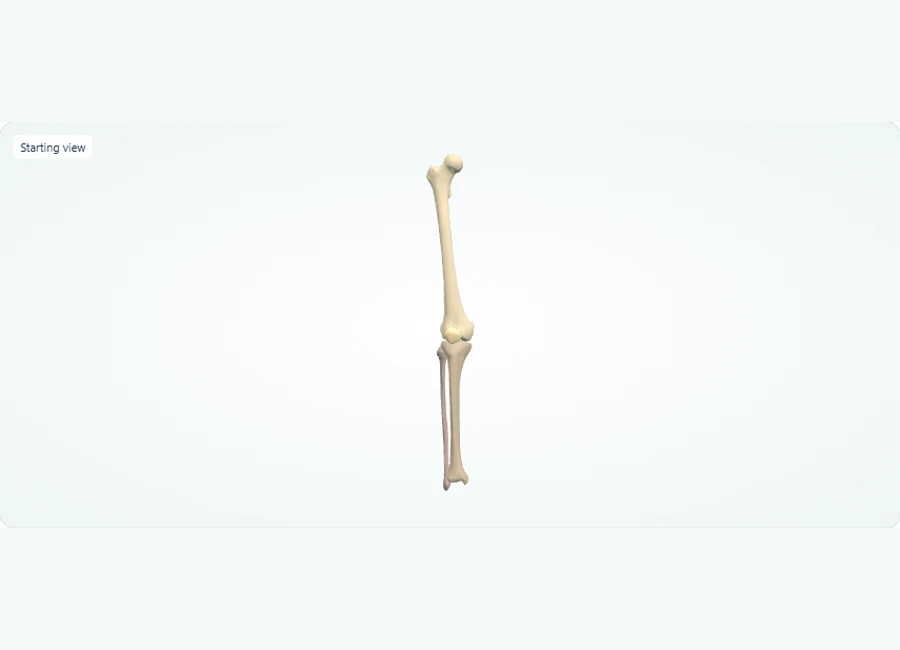
Rotate, isolate structures, and test your recall.
Compare Front, Back and Side views. Whole bones are included, so zoom and pan toward the knee region.
Select and isolate the patella to inspect it. Use Show all, then select and hide the patella to inspect the femur and tibia near the knee.
Use Show all and Test recall. Identify the highlighted bone, using the fibula’s lateral position and patella’s anterior position as clues.
Worked practice example
Which leg bone lies lateral to the tibia, and where is the patella relative to the knee?
Show solution
The fibula lies lateral to the tibia. The patella lies anterior to the knee.
In anatomical position, the fibula is the slender lateral leg bone, beside the larger tibia. The patella lies in front of the distal femur. These are bony relationships; the model does not include joint cartilage, menisci or ligaments.
- In anatomical position the fibula is the lateral bone of the leg, so it is your orientation landmark for left/right.
- The patella lies anterior to the femur–tibia articulation, so it appears at the front in a front view and overlaps the distal femur in profile.
- The knee region contains four bones here: femur above, tibia and fibula below, patella in front; joint soft tissues are not part of this model.
What the exam covers: the official content outline
The outline organizes scored items by body system across three categories, plus five nonsystem areas, with published item ranges for each.
For each body system, questions fall under physical therapy data collection, diseases and conditions that impact effective treatment, and interventions. The nonsystem areas cut across systems: equipment, devices, and technologies; therapeutic modalities; safety and protection; professional responsibilities; and research and evidence-based practice.
The table shows the published item ranges. Remember these are ranges, not fixed counts, and the exact mix varies from form to form.
The outline also notes that some important areas, such as communication skills, teaching techniques, and telehealth, are not listed as separate rows but are embedded across multiple content areas, so they still appear in test content.
| Content area | Data collection | Diseases/conditions | Interventions | Total items |
|---|---|---|---|---|
| Cardiovascular & pulmonary systems | 5-8 | 7-9 | 8-10 | 20-27 |
| Musculoskeletal system | 9-12 | 10-13 | 12-15 | 31-40 |
| Neuromuscular & nervous systems | 8-10 | 9-12 | 10-13 | 27-35 |
| Integumentary system | 1-2 | 1-3 | 1-3 | 3-8 |
| Metabolic & endocrine systems | - | 2-3 | 2-3 | 4-6 |
| Gastrointestinal system | - | 0-2 | 0-2 | 0-4 |
| Genitourinary system | - | 0-2 | 0-2 | 0-4 |
| Lymphatic system | 0-2 | 1-2 | 1-2 | 2-6 |
| System interactions | - | 5-7 | - | 5-7 |
| Equipment, devices, & technologies | - | - | - | 8-10 |
| Therapeutic modalities | - | - | - | 5-7 |
| Safety & protection | - | - | - | 6-8 |
| Professional responsibilities | - | - | - | 2-4 |
| Research & evidence-based practice | - | - | - | 1-3 |
| Total scored items | 140 |
Official documents behind this guide: FSBPT NPTE-PTA Test Content Outline, effective January 2024 (Version 1.1) — Blueprint table and detailed content descriptions
Eligibility, registration, and fees
You must meet six national eligibility conditions, register and pay $485, and be approved by your jurisdiction before the approval deadline; a separate $92 Prometric fee applies when you schedule.
To sit for the NPTE you must be at least 18, submit an online registration and pay the exam fee, have no open registration for the same exam level, hold a degree from a CAPTE-accredited program or an education judged substantially equivalent by a recognized credentialing agency, have no open security investigation or unfinished sanctions, and be approved by the licensing authority where you intend to practice. Your jurisdiction may add requirements beyond these, so review them before you register.
Registration runs through your FSBPT dashboard, and the exam fee is $485. Two deadlines matter on every administration: the registration and payment deadline, and the jurisdiction approval deadline about seven days later. If your jurisdiction has not approved you by that deadline, your registration closes and your fee is refunded minus a $50 processing fee.
After approval, you receive an Authorization to Test (ATT) letter by email with instructions for scheduling at Prometric, where a separate $92 fee applies to the PTA exam. Check the ATT letter immediately: your first and last names must exactly match the identification you bring on test day, or you will not be admitted.
If you are in a CAPTE-accredited program, your school must validate that you are on track to graduate before you can register, and FSBPT allows testing up to 90 days before your graduation date. Jurisdictions can be stricter, so confirm with yours. In many jurisdictions FSBPT approves CAPTE graduates directly under the Alternate Approval Pathway; others require their own review, especially for non-CAPTE graduates.
Retake limits also apply: you cannot test more than three consecutive times in a 12-month period, more than six times in your lifetime at the PTA level, or at all if you have previously received two scores below 400.
Official documents behind this guide: FSBPT NPTE Candidate Handbook, version 2025.02 — Sections 3-8 (eligibility, format, scoring, registration, test day)
A weight-aware study order
Study the three largest body systems first, then the smaller systems and the nonsystem areas, and save timed mixed practice for the final phase.
The published ranges make the priorities clear. Musculoskeletal content can reach 40 scored items, neuromuscular and nervous systems 35, and cardiovascular and pulmonary 27, so those three areas dominate the exam. Among the nonsystem areas, equipment and devices (8-10) and safety and protection (6-8) outweigh professional responsibilities and research. This ordering is editorial advice drawn from the outline's ranges, not an official study plan.
A practical sequence: spend your first block on the three large systems, covering each system's data collection, diseases and conditions, and interventions as the outline defines them. Next cover the smaller systems and system interactions, then the five nonsystem areas. In the final weeks, mix systems within single practice sessions, because switching between domains is its own skill.
Do not skip the small areas entirely. Integumentary, lymphatic, and the minor systems contribute few items each, but together with the nonsystem areas they can represent a meaningful slice of your score, and they are often the least-reviewed material.
Worked practice example
Two quick calculations using official numbers. (1) The exam gives you 4 hours of testing time for 180 questions. If you spread time evenly, how many seconds per question does that allow? (2) The outline allots the musculoskeletal system at most 40 of the 140 scored items. What percentage of scored items does that maximum represent, to one decimal place?
Show solution
(1) 80 seconds per question. (2) About 28.6%.
Four hours equals 14,400 seconds, and 14,400 divided by 180 gives 80 seconds per question. For the weighting, 40 divided by 140 is approximately 0.2857, or 28.6%. Assumptions: the even-pace figure treats all 180 questions alike, including the 40 unscored pretest items, and the percentage uses the maximum of the outline's published range for musculoskeletal items. The handbook states that exam time is a single block and sections are not separately timed, so treat 80 seconds as an average planning figure rather than a per-section rule.
Official documents behind this guide: FSBPT NPTE-PTA Test Content Outline, effective January 2024 (Version 1.1) — Blueprint table and detailed content descriptions
Official preparation resources
FSBPT provides the full content outline, a paid timed practice exam (PEAT), a demonstration exam, and short video guides.
Start with the complete NPTE-PTA content outline on FSBPT's website; the handbook's appendix only includes an abridged version. Reading the full outline descriptions tells you what each content category actually covers before you choose study materials.
The Practice Exam and Assessment Tool (PEAT) is a timed, computer-based practice exam with the same question types as the real NPTE, automatic scoring, a performance report by content area and body system, and explanations for answers. Your $99 purchase includes two timed exams for your level with 90 days of access.
The NPTE Demonstration Examination shows you exactly how the exam interface works, including the security agreement, navigation tutorial, and sample questions with answers. Working through it before test day removes a whole category of surprises. FSBPT's NPTE in Sixty Seconds videos cover common administrative questions, and the free practice questions on this site add scenario volume between study phases.
Official documents behind this guide: FSBPT NPTE Candidate Handbook, version 2025.02 — Sections 3-8 (eligibility, format, scoring, registration, test day)
Test-day checklist
Arrive 30 minutes early with two matching forms of ID, leave your phone alone entirely, and know what you can bring into the testing room.
Check-in includes identity scans, a photo, a digital fingerprint, and a metal-detector sweep, so build in the time. Arriving at least 30 minutes before your scheduled start keeps the process calm.
The security rules have real consequences. Accessing your cell phone at any point during the exam, including breaks, ends your exam immediately and counts toward your six-attempt lifetime limit. If you skip a section by mistake and fail, that result does not count toward your lifetime limit, but you must register and pay again.
- Bring one government-issued photo ID with your signature (driver's license or passport) plus one secondary ID with your pre-printed name and signature, both matching your ATT letter exactly.
- Leave the phone in the car if you drive, or off and locked in your locker; do not access it on breaks.
- Permitted items are soft earplugs and water in a clear, labeled-free container with a removable lid; the center provides headphones and an erasable note board.
- Dress in layers, since testing room temperature varies and heavy jackets are not allowed.
- You may only take a break when your exam is on the break screen, and you cannot leave the testing site or access study materials or devices in your locker.
- If a disruption occurs, notify Prometric staff first, and contact FSBPT if you believe the environment affected your performance.
Official documents behind this guide: FSBPT NPTE Candidate Handbook, version 2025.02 — Sections 3-8 (eligibility, format, scoring, registration, test day)
Official documents behind this guide
Key facts verified against official sources: