
You will prepare for the NBCOT OTR certification exam using the 2022 content outline that has applied to all OTR exams since January 2, 2024. The exam is a four-hour, 180-item computer-based test at a Pearson test center, mixing three- and four-option multiple-choice items with six-option multi-select scenario sets. Domain 3 (Select and Manage Interventions) carries the largest share at 38%, so your study plan should weight it accordingly. This guide covers eligibility, the application and approval timeline, the item types and their scoring, the four domains, test-day rules, and what happens after the exam.
What the OTR exam certifies and which outline applies
The OTR exam measures entry-level competence for occupational therapists, and every OTR exam since January 2, 2024 is built on the 2022 content outline.
The National Board for Certification in Occupational Therapy (NBCOT) is the national certification body for occupational therapy professionals in the United States. Most states require NBCOT initial certification as part of occupational therapy licensing. The exam's stated purpose is to protect the public by certifying only candidates with the knowledge needed for entry-level practice.
The current version matters for your study plan. Beginning January 2, 2024, all OTR exams are based on the content outline that resulted from the 2022 practice analysis. If you started studying from pre-2024 materials, check them against the current outline because the item mix changed.
Pearson VUE is NBCOT's exclusive test administration partner. The exam is a timed, four-hour, computer-based test taken in person at a Pearson Professional Center or Pearson Authorized Test Center Select location.
Official documents: NBCOT Certification Exam Handbook for OTR and COTA candidates (v26, rev 12/16/25) — Eligibility, application, exam format, exam day, retake, and renewal sections; NBCOT 2024 Exam Frequently Asked Questions — Exam content and format questions
Eligibility and the application timeline
You must graduate from an ACOTE-accredited entry-level OT program, agree to the NBCOT Code of Conduct, and clear a character review before you can sit the exam.
OTR candidates need an entry-level occupational therapy degree from an ACOTE-accredited program. If you earned your entry-level master's or doctoral degree outside the United States, you apply through the Occupational Therapist Eligibility Determination (OTED) process instead of the standard route.
Submit the application yourself online at nbcot.org; applications completed by third parties are invalid and can cost you three months of ineligibility plus fees. Once submitted, the application is valid for 90 days, so apply when you realistically plan to test within that window.
All components must be approved before you receive an Authorization to Test (ATT) letter, which is the document that lets you schedule with Pearson. The ATT letter arrives within three business days of approval and is active for 90 days. It can only be reissued while the underlying application is still unexpired; once the application expires, you must submit a new application and pay the fees again.
NBCOT accepts either an official final transcript or a Degree Verification Form (DVF) to establish eligibility. Students within six months of anticipated graduation can use a DVF, but it must be used in the same calendar year as graduation, and a final official transcript is still required before certification is granted.
- Read the Certification Exam Handbook before applying; NBCOT treats this as a required step.
- Provide a valid street address, not a P.O. Box, because the background check needs one.
- Answer the character questions honestly; a Yes answer requires documentation but does not automatically deny your application.
- Request testing accommodations in the application if needed, and upload at least one supporting document; accommodation review can lengthen processing time.
- Order your one free Score Transfer and one free Eligibility Confirmation Notice at the time you submit the application; later or additional requests cost $35 each.
Official documents: NBCOT Certification Exam Handbook for OTR and COTA candidates (v26, rev 12/16/25) — Eligibility, application, exam format, exam day, retake, and renewal sections
Explore in 3D: Right Femur: Orientation and Key Ends
The femur is the thigh bone. This model shows one whole bone, the right femur, as a single selectable structure. You can identify side and ends by checking that the head faces medially at the proximal end, while the distal end helps form the knee.
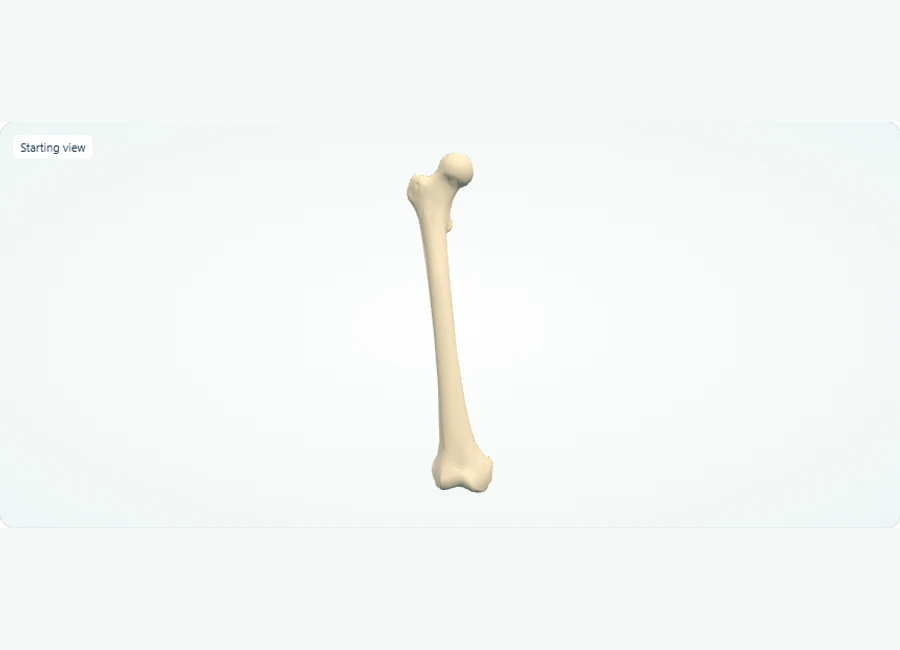
Rotate, isolate structures, and test your recall.
Locate the rounded head at the proximal end. In the body, this head faces medially toward the midline.
Switch between Front and Back to compare the proximal head with the broader distal end at the knee.
Zoom and rotate to review the ends again. Only the whole bone is selectable; individual landmarks do not have separate labels.
Practice item
Which end of the femur has the rounded head, and does that head face toward or away from the body’s midline?
Show answer
The proximal end has the rounded head. It faces medially, toward the body’s midline.
The femoral head is proximal, at the hip. The broader distal end contributes to the knee. Use anatomical directions relative to the body; screen directions change when the model is rotated.
- The femur lies in the thigh and is the single bone of that region.
- The head faces medially at the proximal end; use this to tell anatomical right from left on screen.
- The distal end of the femur contributes to the knee joint.
The format: 180 items and how scenario sets are scored
The OTR exam has 180 items: three- and four-option single-response multiple-choice questions and six-option multi-select scenario sets, completed in four hours.
Each single-response item asks one question with three or four options and exactly one correct answer. Scenario sets are the other item type: an opening scene with practice background, followed by four related items. Each item offers six options and you must select the three best choices.
The scoring rule is important for strategy. You receive credit for each correct option you select, and no points are deducted for incorrect selections. There is no penalty for a wrong choice, so an educated third pick is always worth making.
Scenario sets are interspersed throughout the exam rather than grouped at the start. You can change your responses within a scenario item and flag items to return to before submitting. On-screen tools include highlighting, strike-out for eliminating options, and zoom up to 200%.
Plan your timing around the clock rules. Your exam time is four hours; the full appointment runs roughly four hours and 45 minutes including check-in and tutorials. You must accept the pre-exam acknowledgment within seven minutes or the exam closes and the appointment is forfeited. Breaks are allowed but the clock keeps running, and you may not leave the test center building.
Practice item
Practice item, formatted like a scenario-set item. Opening scene: A client is relearning to prepare a cold sandwich in a rehabilitation kitchen several weeks after a mild stroke. The client can complete every step of the task when given occasional verbal reminders, states that making an independent lunch is the top priority, and has no stated precautions that limit kitchen activity. Question: Which three strategies best fit a graded, occupation-based approach to this goal? Select the three BEST responses. A. Practice the full sandwich-making task while the therapist gradually reduces verbal cues as steps become consistent. B. Schedule isolated grip-strengthening sessions only and delay all sandwich practice until grip strength normalizes. C. Break the task into steps, teach them in sequence, and add the next step once the previous one is consistent. D. Have kitchen staff prepare the sandwich at each session while the client observes the technique. E. Simplify the task by pre-placing ingredients in order of use while the client still performs each step. F. Provide a written energy-conservation program for household tasks with no sandwich-making practice.
Show answer
The three best responses are A (graded cueing within the actual task), C (chaining the steps in sequence), and E (task simplification with the client still performing each step).
All three correct options are strategies the exam outline names under interventions that support participation: graded cueing, chaining, and task simplification. Each keeps the client performing the priority occupation (sandwich-making) while adjusting demands to a level the client can currently manage with support, which matches the stated facts that the client can complete steps with reminders. The distractors fail on the scenario's own facts, not on general preference. B defers the stated priority occupation indefinitely behind a preparatory activity the scenario does not require. D removes the client's own engagement, which contradicts the goal of independent performance. F targets a different problem than the one the scenario presents. Scoring reminder from the handbook: credit is given for each correct option selected and nothing is deducted for wrong selections, so you should always commit to a third choice.
Official documents: NBCOT Certification Exam Handbook for OTR and COTA candidates (v26, rev 12/16/25) — Eligibility, application, exam format, exam day, retake, and renewal sections; NBCOT 2024 Exam Frequently Asked Questions — Exam content and format questions
The four domains and a weight-aware study order
Domain 3, Select and Manage Interventions, is the largest share of the exam at 38%, followed by Domains 1 and 2 at 23% each and Domain 4 at 16%.
The handbook lists the domain weights that every exam form must meet. Each domain contains task and knowledge statements published in the full 2022 content outline, which is the authoritative list of what can be tested. The examples inside the outline are illustrative, not exhaustive, so use the task statements as your coverage checklist rather than memorizing only the examples.
As editorial study advice, not an official requirement: allocate your review time roughly in proportion to the weights. That means intervention selection and management deserve the largest block, evaluation and analysis each deserve substantial blocks, and practice management should not be left to the final days simply because it is smallest. Scenario sets draw on several domains at once, so build mixed-topic practice sessions rather than studying one domain in complete isolation.
| Domain | Weight | Focus |
|---|---|---|
| Domain 1: Evaluation and Assessment | 23% | Acquiring information on factors that influence occupational performance, including development, conditions, assessments, and activity analysis. |
| Domain 2: Analysis, Interpretation, and Planning | 23% | Synthesizing assessment results, collaborating with clients and teams, and monitoring and modifying the intervention plan. |
| Domain 3: Select and Manage Interventions | 38% | Selecting and implementing interventions, including preparatory techniques, occupation-based strategies, orthotics, assistive technology, and environmental modifications. |
| Domain 4: Competency and Practice Management | 16% | Evidence-based practice, risk management, legal and regulatory compliance, and professional development under the NBCOT standards. |
Official documents: NBCOT 2022 OTR Examination Content Outline (ID 82, rev 01/29/25), used for exams from January 2024 — Domains 1-4 task and knowledge statements; NBCOT Certification Exam Handbook for OTR and COTA candidates (v26, rev 12/16/25) — Eligibility, application, exam format, exam day, retake, and renewal sections
Turning content review into scenario reasoning
Scenario items reward a repeatable reading routine: extract the client's priorities and context, note stated precautions, choose the intervention approach, then check who should act.
This section is study strategy, not official exam content. Before reading the options in any practice scenario, write down two things from the stem: the occupations the client names as priorities, and any constraints or precautions the stem states. The outline treats precautions and contraindications tied to a client's condition or stage of recovery as tested knowledge, and a stated precaution is the cleanest reason to eliminate an otherwise reasonable option.
Then classify the approach. The outline distinguishes methods for grading an activity based on client status and response to intervention from compensatory and remedial strategies such as graded cueing, task simplification, and adaptive equipment. Ask whether the scenario describes a client still recovering, where grading keeps demands matched to capacity, or a plateaued or permanent deficit, where compensation through adaptations becomes the stronger fit.
Finally, test the role dimension. The outline includes roles, responsibilities, and scope of practice among interprofessional teams, and some options in practice items describe actions that belong to a different team member's responsibilities. Labeling each option as safe or unsafe, remedial or compensatory, and in-role or out-of-role gives you three concrete criteria instead of one vague sense of which answer feels best.
Official documents: NBCOT 2022 OTR Examination Content Outline (ID 82, rev 01/29/25), used for exams from January 2024 — Domains 1-4 task and knowledge statements
Test day, results, and retakes
Arrive 30 minutes early with two matching IDs, expect a four-hour exam inside a longer appointment, and check results in your MyNBCOT account on the published scoring dates.
You must arrive 30 minutes before your appointment and present two forms of identification whose first and last names match your ATT letter exactly; a name mismatch means you will not be admitted. Personal electronics, watches, and jewelry other than wedding and engagement rings are prohibited throughout the facility. A wet-eraser note board is available on request during the exam, but writing before the exam clock starts is not allowed.
Scores are released according to NBCOT's scoring calendar, which is published on its website; taking the exam at least three days before a desired release date protects that schedule. You can view results in your MyNBCOT account. If you do not pass, the feedback report includes domain-level performance information intended for diagnostic use as you prepare to retake the exam.
Retake waiting periods increase with attempts: 30 days after your second or third attempt, 60 days after attempts four through six, and six months from the seventh attempt onward. Each retake requires a new exam application and fees through your existing MyNBCOT account.
Passing starts the renewal clock. Your first renewal falls four years from the year you pass, and after that you enter a three-year renewal cycle requiring 36 accrued units, adherence to the Code of Conduct, and a renewal application with fee. Renewal keeps your OTR mark active and in good standing.
Official documents: NBCOT Certification Exam Handbook for OTR and COTA candidates (v26, rev 12/16/25) — Eligibility, application, exam format, exam day, retake, and renewal sections
Official documents
Facts checked against NBCOT sources: