
Build your review around three interlocking skills: transposing prescriptions accurately in both notations, applying Prentice's rule forward and backward, and explaining why lens power changes with vertex distance. Practice each with a verification step that catches sign and direction errors. For administrative details such as eligibility, scheduling, and the current content outline, refer to the issuer at abo-ncle.org; this guide covers the subject matter, not exam logistics.
Reading a Prescription as an Optical System, Not a Shopping List
Treat each prescription as three coupled values: sphere power, cylinder power with its axis, and the vertex distance at which it was refractioned. Changing any single element changes the behavior of the whole lens, so read the complete Rx before calculating anything.
The sphere corrects power evenly in all meridians. The cylinder contributes no power along its own axis and its full power 90 degrees away, which is why the axis value describes orientation rather than strength. When you later transpose or decentre a lens, you are manipulating this coupled system, and an error in one value propagates into every downstream check.
Before any calculation, build a reading habit: circle the cylinder sign so a minus never masquerades as a plus, confirm which eye each value belongs to, and check whether a vertex distance is recorded for powers high enough that lens position matters. This thirty-second scan is the cheapest error-catching step in opticianry, because most calculation mistakes begin with a misread sign or an ignored working distance.
- Sphere: uniform power in every meridian.
- Cylinder: zero power on its axis, full power 90 degrees away.
- Axis: an orientation from 0 to 180 degrees, not a power.
- Vertex distance: the lens-to-eye distance the refraction assumed.
Transposition Without Sign Errors: The Two-Line Method
Transposition rewrites a prescription in the opposite cylinder notation. New sphere equals old sphere plus old cylinder, the cylinder sign flips, and the axis moves 90 degrees. Omit or reorder any step and you describe a different lens.
Worked scenario: transpose OD -2.00 -1.00 x 180 to plus-cylinder form. New sphere: -2.00 + (-1.00) = -3.00. New cylinder: +1.00. New axis: 180 + 90 = 90. A plausible mistake is flipping the cylinder sign but leaving the axis at 180, which describes a lens correcting the wrong meridian; a second common slip is subtracting the cylinder from the sphere instead of adding algebraically. The better decision is to run all three steps as one written line, then verify by transposing back and confirming you recover the original Rx exactly.
Why it matters: prescribers write in both conventions, and labs stock blanks in one, so transposition appears whenever you compare a written Rx against a verification reading or a previous pair. The transposition works because both notations describe the same physical lens - the cylinder is simply specified from the other meridian. Practicing the backward direction is what cements it: given +1.75 -0.50 x 045, transpose, then reverse, and check the round trip lands on the starting numbers every single time.
- Step 1: new sphere = old sphere + old cylinder (algebraic sum).
- Step 2: flip the cylinder sign, keep its magnitude.
- Step 3: move the axis 90 degrees (add or subtract, staying within 0-180).
- Always verify: transpose back and confirm you return to the original.
Explore in 3D: Right eye: layers, lens, and optic nerve
This model shows the right eye as five selectable parts: cornea, lens, retina, sclera, and optic nerve. The cornea and lens sit anteriorly, the retina lines the posterior interior, and the optic nerve exits posteriorly. Surfaces are opaque until hidden, so hiding the sclera is the key step to see inside.
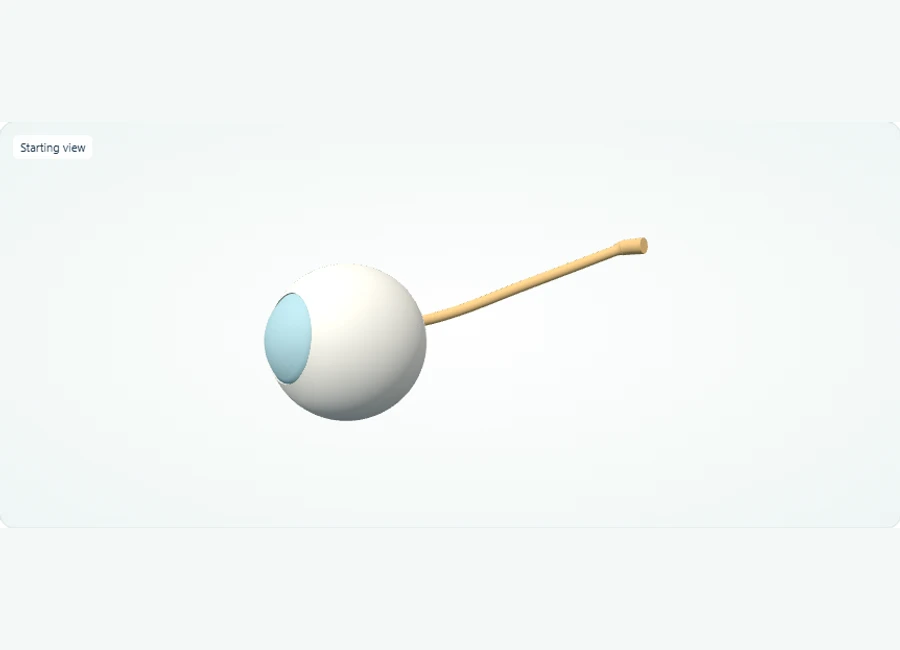
Rotate, isolate structures, and test your recall.
Select and isolate the right cornea, then the right lens, to inspect these anterior structures individually. The study model uses opaque surfaces.
Use Show all. Select and hide the sclera to expose deeper layers, then isolate the retina to inspect its shape.
Use Show all and choose Side or Back. Select the optic nerve to trace its exit from the posterior eye.
Try it yourself
Which structure exits the posterior eye, and which light-sensitive layer lines the posterior interior?
Show answer and explanation
The optic nerve (cranial nerve II) exits posteriorly; the retina lines the posterior interior.
From the back of the model, the nerve trunk is the structure leaving the eyeball, and the retinal lining sits within the posterior interior. Note the entire retina is shown as one part, and the macula is not separately labelled in this model.
- Refractive structures (cornea and lens) are anterior; the light-sensitive retina is posterior.
- The optic nerve (cranial nerve II) leaves the eye posteriorly, carrying visual information toward the brain.
- The sclera is the opaque outer coat; hide it to expose the cornea-lens axis and the internal retinal lining.
Prentice's Rule in Both Directions: Predicting and Explaining Induced Prism
Prentice's rule states prism diopters equal decentration in centimeters times lens power: Δ = c × F. Use it forward to predict prism from a fitting error, and backward to calculate the decentration needed to surface a prescribed prism.
Worked scenario: a patient measures 62 mm PD but a -5.00 DS pair is mounted with optical centers 66 mm apart. Each optical center sits 2 mm temporal of the pupil, so each eye views 2 mm nasal to its optical center. Prism per eye: 0.2 cm × 5.00 = 1.0Δ. A plausible mistake is using the total 4 mm difference (0.4 × 5.00 = 2.0Δ per eye), doubling the answer, or reversing the base direction. The correct reading: in a minus lens the base lies away from the optical center, so viewing nasal to the center gives base-in prism, about 1.0Δ base-in per eye. The better decision is to recheck the PD and remount, or order lenses cut with centers at the measured PD.
Why it matters: even a base-in effect of this size changes convergence demand at near and can produce pulling sensations or reading fatigue without any obvious cause. The backward direction is equally testable: to surface 2.0Δ base-out in a +4.00 lens, decentration = Δ / F = 2.0 / 4.00 = 0.5 cm per lens if placed in one eye, or 2.5 mm per lens (5 mm across the pair) when the prism is split between the two eyes. Run both directions until the algebra is automatic, because the forward direction diagnoses complaints and the backward direction fills orders.
- Forward: Δ = c(cm) × F. Backward: c(cm) = Δ / F.
- Plus lens: prisms act base-to-base; base points toward the optical center.
- Minus lens: prisms act apex-to-apex; base points away from the optical center.
- Splitting prism across two eyes halves the per-eye decentration needed.
- Decentration is measured per eye, not across the full frame.
| Lens sign | Viewing nasal to OC | Viewing temporal to OC | Typical patient report |
|---|---|---|---|
| Plus (+) | Base-out effect | Base-in effect | Greater convergence demand when centers sit wide |
| Minus (-) | Base-in effect | Base-out effect | Reduced convergence demand; possible outward pull |
| Either | Effect scales with power and decentration | Effect scales with power and decentration | Higher powers show symptoms at smaller errors |
Lensometry: Turning a Lensmeter Reading Into a Verification Verdict
Lensometry converts a physical lens into sphere, cylinder, axis, and prism values you can compare against the prescription. The skill is procedural discipline: a repeatable sequence that separates true lens power from artifacts of positioning.
The standard sequence: focus the eyepiece to your own eye first, then locate the narrowest line focus for the sphere power, rotate to find the second line focus for cylinder, and read the axis from the scale. Dot the optical center where the target crosses, then compare that dot against the frame's geometric center to judge decentration. Each step protects the next; skipping the eyepiece focus alone can shift every subsequent power reading.
Prism detection is the interpretive step: if the mire sits displaced from center with the lens properly positioned, the lens contains ground-in prism, read from the prism scale in the direction of displacement. Distinguish this from decentration by rechecking with the lens centered on the stage - decentration shows as an off-center dot relative to the frame, while ground prism shows as a displaced target even when the lens is centered. Recording both observations separately is what turns a lensmeter into a verification tool rather than a power-readout device.
Vertex Distance: Why High Powers Change When a Lens Moves
Lens effective power depends on its distance from the eye. When a high-power lens moves to a new vertex distance, its required power changes according to the effective power relationship, and low powers barely move at all.
Worked example: a -10.00 DS refraction at a 12 mm vertex is converted to a zero-vertex working distance. Using the effective power relationship F_new = F / (1 - dF), with d = +0.012 m moving toward the eye: -10.00 / (1 - (0.012 × -10.00)) = -10.00 / 1.12 ≈ -8.93, rounding to -9.00 in standard quarter steps. A plausible mistake is using the wrong sign for d, which produces an answer moving the wrong direction - stronger instead of weaker for a minus lens brought closer. The better decision is to sanity-check the direction first: minus lenses need less power as they approach the cornea, plus lenses need more.
Why it matters: the change scales with the square of the power, so a -2.00 lens moved 12 mm shifts by only a fraction of a step and rarely matters, while the -10.00 example shifts a full diopter. This is why vertex distance gets recorded in the refraction for high powers and why re-vertexing a low Rx is unnecessary work. A quick self-check before calculating: estimate the direction of change from the lens sign and movement direction, then let the formula supply the magnitude.
Fitting Decisions: Segment Height and Centering Trade-offs in Case Analysis
Fitting choices are optical decisions, not just comfort calls. Segment heights, optical center placement, and frame selection each interact with the calculations above, so case analysis means weighing patient anatomy against the optics simultaneously.
Scenario: a patient's right pupil sits 2 mm lower than the left, and bilateral segments are set to match the frame rather than the individual eyes. The mistake is defaulting to symmetric heights for facial symmetry's sake; the better decision is to measure each eye independently and fit the segments to the measured heights, because the near working position differs between eyes. The consequence of the symmetric fit is unequal near sightline geometry, which the patient experiences as uneven near clarity or a head-tilt habit developing over weeks.
Frame selection feeds the same reasoning: a frame that positions optical centers far from the measured PD imports Prentice's rule prism before the lens is even edged, and steep pantoscopic tilt alters effective power at the eye. When analyzing an exam-style case, read the scenario for its numbers first - PD, powers, segment specifications - then ask which coupling applies. A case mentioning a wide frame and a high minus is a decentration-prism case; a case mentioning a new working distance is a vertex case. Identifying the governing concept before computing is the fastest path through case items.
- Measure segment height per eye; facial asymmetry is common, not exceptional.
- Frame PD relative to patient PD predicts induced prism before fabrication.
- Tilt changes effective power; large angles belong in the calculation, not the assumption.
- In case scenarios, extract the numbers first, then name the governing principle.
A Four-Week Practice Sequence With Readiness Checks
Sequence the material so each week's skill feeds the next: prescription reading and transposition, then Prentice's rule both directions, then lensometry and verification, then mixed case analysis. Close each week with a self-scored drill and a written error log.
Week 1: transpose ten prescriptions in each direction, in writing, and verify every round trip. Week 2: solve ten Prentice items forward (prism from decentration) and ten backward (decentration from prism), including at least one minus-lens base-in case and one split-prism case. Week 3: practice the lensometry sequence in order and write verification verdicts for five lenses, stating power, axis, any prism, and centering. Week 4: mix everything into timed case analyses and rework every logged error from weeks one through three.
Readiness checks as learning milestones, not pass predictions: you can transpose any Rx both directions and catch your own sign errors; you can state the base direction for any lens sign and viewing position without hesitating; you can explain why a high minus needs re-vertexing while a low minus does not; and in a case scenario you can name the governing concept before touching a calculator. A practical exercise for week 2: write out the base-direction table from memory, then check it against the table in the Prentice section - any cell you missed marks exactly which relationship needs another round of deliberate practice.
- Week 1 milestone: 9/10 correct round-trip transpositions.
- Week 2 milestone: Prentice solved forward and backward, base directions stated from memory.
- Week 3 milestone: verification verdicts written for every practice lens, prism and centering separated.
- Week 4 milestone: case analyses completed with the governing concept named before calculating.
- Maintain an error log; rework it in week 4 rather than starting new material.
References and further reading
Use these references to explore the concepts and check the latest information from the relevant organizations.