
The INBDE's scope centers on integrated concepts and case-style analysis, so this guide teaches a case-loop method: re-anchor every biomedical, clinical, and behavioral topic you review into a short patient scenario, then read practice cases with a fixed preamble-to-decision workflow. For each option, explain why it fails, not only why the right answer works, and track the habit with a five-point self-check rubric across a four-week cycle.
The Integration Problem: When Memorized Lists Stop Matching the Question
The exam's scope includes integrated concepts and case-style analysis, so a single case can combine biomedical science, clinical findings, procedural judgment, and professional ethics. Study each topic by re-anchoring it to a patient presentation so the fact and its clinical use are learned together.
Compare two ways of learning, for example, the oral manifestations of a systemic condition. Silo learning stores the list of manifestations as text. Case-loop learning stores the same list inside a patient: a presenting complaint, a medical history line, an intraoral description, and a question about what the findings suggest. When a case later supplies only some of those elements, the case-loop version gives you a retrieval path; the silo version gives you a list you must re-map under time pressure.
Make the loop concrete with a written habit. After reviewing any topic, write a three-to-five sentence patient scenario that would make that topic the correct answer, plus one sentence describing a distractor presentation that would point to a different diagnosis. This single exercise converts a passive summary into an applied concept, and it builds the exact skill of predicting what evidence a case would need to show. Expect your early scenarios to be clumsy; the usefulness is in forcing the fact into clinical context, not in polished prose.
Reading a Patient Case: A Fixed Preamble-to-Decision Workflow
Read every INBDE-style case in the same order: chief complaint, medical history, clinical findings, then the question stem. Summarize each element in one line before looking at the options. This prevents option-first reading, where answer choices pull your attention before the picture is complete.
The workflow has four steps you should keep constant. First, state the chief complaint and its duration in your own words. Second, extract the medically relevant history items and ask what each one changes about risk or management. Third, list the clinical findings and separate what was directly observed from what was reported by the patient. Fourth, and only now, read the question and predict your answer before scanning the options. Prediction-then-verify keeps your clinical reasoning in charge instead of letting plausible-sounding distractors steer you.
Practice this with any case-based question bank or self-written scenario, including the free practice material on this site. Time yourself loosely, but score yourself on process, not just the answer: did you produce a one-line case summary, did you flag which history items changed management, and did you commit to a predicted answer before reading options? Record these three checks in a simple tally. Over a week of practice, a rising tally matters more than raw accuracy, because the process transfers to any case content you have not seen before.
Visual anatomy review: Use a 3D atlas to distinguish the upper and lower jaws
Locate the upper jaw referenced by the maxillary tooth location without treating the normal atlas image as a disease finding.
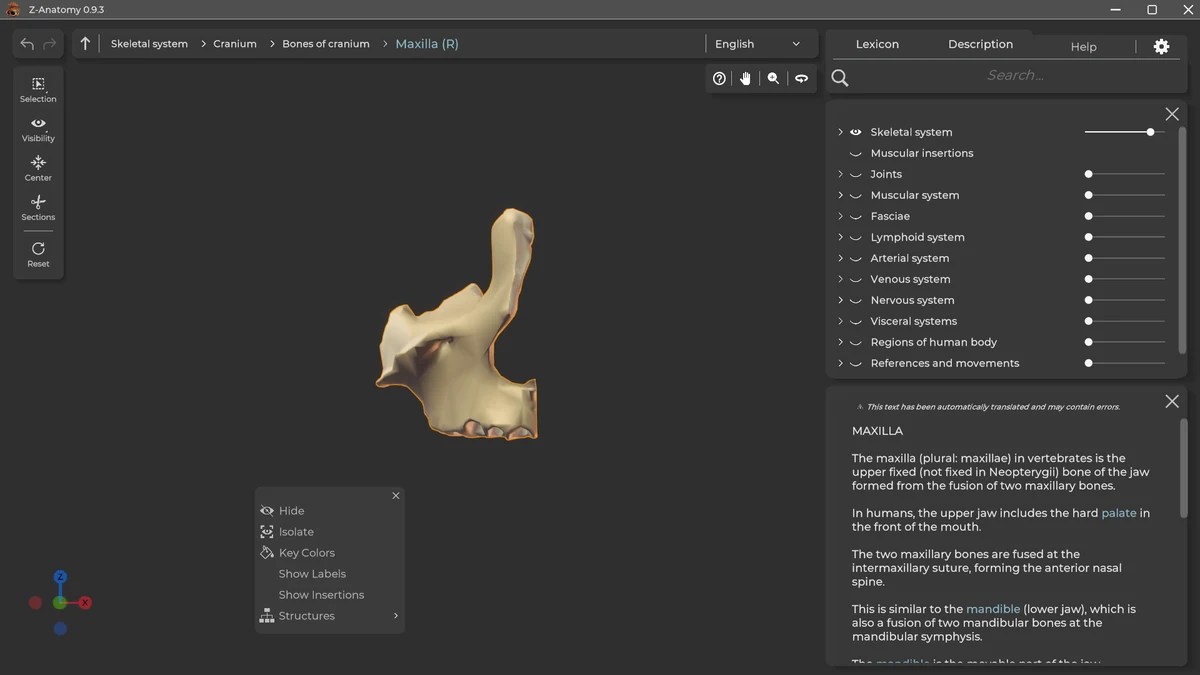
Z-Anatomy’s published application screenshot isolates the right maxilla. The upper jaw and mandible are different bones; this screenshot does not show a fracture or an osteotomy.
The maxilla forms the upper jaw. The mandible forms the lower jaw. When a report describes work on both, identify each anatomical target separately before interpreting the procedure terminology.
Open the Z-Anatomy project and use its atlas application to select the maxilla and mandible. Isolate each, rotate the view and name the upper and lower jaws again with labels hidden.
Try it yourself
A report describes a maxillary osteotomy and a mandibular osteotomy. Are these interventions on the same jaw bone?
Show answer and explanation
No. They concern the upper jaw and the lower jaw, respectively.
Anatomical location is one part of interpreting a procedure. The atlas does not determine code selection, bundling or the work documented in an individual case.
Assessment Versus Interpretation: Naming What You See Versus What It Means
Assessment describes observed and reported information; interpretation assigns that information diagnostic, risk, or prognostic meaning. Keep the two layers explicitly separate when you summarize a case, because a stem that asks for an assessment is asking for description, not inference.
A disciplined two-line summary works like this. Line one, assessment: the patient reports pain on chewing of two weeks' duration; there is swelling at the buccal fold; a restoration is fractured. Line two, interpretation: the findings are consistent with pulpal involvement with possible periapical extension. Writing both lines trains you to see which questions are asking for the first layer and which are asking for the second.
As you practice, check each option against the stem's layer: cross out any option that supplies an interpretation when the stem asks what was observed, or an observation when the stem asks for the most likely diagnosis. Apply the same separation to risk statements — a history item is an assessment fact, while 'places the patient at increased risk of X' is an interpretation that depends on current guidance and patient context. Build study pairs: one card with the raw finding, one with the defensible interpretation and the conditions under which it holds.
Ranking Options: A Rule-Out Table Beats Option-First Guessing
For applied practice and decision-making questions, rank options by elimination with a reason attached to each rejection. A four-column rule-out table turns a vague sense of 'best answer' into a defensible chain you can reproduce under time pressure.
The table below is a template for practicing decision questions from any case source. Fill it for every option in a practice item. If you cannot write a rejection reason for a wrong option, that is a gap in your understanding of the concept, not of the question. Gaps found this way are precise: you know exactly which topic, in which clinical context, needs review, which makes your study sessions self-targeting instead of broad rereading.
Revisit your filled tables a day later and check one thing only: does each rejection reason cite evidence from the case, or is it a generic impression? A reason such as 'not the best choice' teaches nothing; 'the case states the diagnosis is already established, so a diagnostic step is redundant' teaches a reusable pattern. Keep completed tables in a running file, because they double as a condensed review of decision rules you personally struggled to articulate.
| Option | Reject or keep? | Reason | What would change the decision? |
|---|---|---|---|
| Most definitive treatment now | Reject | Undiagnosed finding or unresolved medical risk must be addressed first | Finding ruled out and risk clarified |
| Diagnostic step first | Keep | Reduces uncertainty at the lowest cost to the patient | Diagnosis already established in the case |
| Watchful waiting | Reject | Time-sensitive signs make delay indefensible | Findings stable and confirmed benign |
| Referral to another provider | Reject or keep | Depends on whether the needed expertise exceeds the case's stated setting | Case states the skill or equipment is unavailable |
Worked Scenario: The Medically Complex Patient in a Routine Case
When a case adds a medical history item, ask immediately what it changes. In this paper scenario, the mistake is treating a routine presentation as routine anyway; the better decision is reordering the plan around the history item before choosing any treatment option.
Scenario (a learning exercise, not a real exam item): a middle-aged patient presents with a loose restoration and reports a recent diagnosis requiring anticoagulant medication, noted casually in the history. The question asks for the appropriate next step. A plausible mistake is selecting the same plan you would choose for any loose restoration, because the chief complaint looks ordinary and the history line feels like background detail. That error treats integration as decoration rather than as the point of the case.
The better decision runs the workflow: the history item is flagged in step two, interpreted in step three as a factor that changes bleeding risk and therefore the order and documentation of procedures, and the options are ranked with the rule-out table, where 'definitive treatment now' is rejected pending clarification of the medical picture. Why it matters: the same clinical presentation with a different history line has a different defensible answer. Practicing this scenario teaches you to let history items reorder plans, and to notice when a case is testing whether you read the preamble as carefully as the radiograph.
Worked Scenario: Ethics and Documentation Woven into a Clinical Case
Treat professional standards as something you hunt for inside every case you review, not a separate chapter you read once. As you read, ask two standing questions: who needs to know what here, and what must the record show? Tag consent, disclosure, and documentation choices whenever they appear.
Scenario (a learning exercise, not a real exam item): during care, a patient mentions they stopped taking a prescribed medication because of side effects but asks you not to record it, worried about insurance consequences. The clinical question in the case also requires a treatment decision. The plausible mistake is answering the clinical question cleanly and treating the disclosure request as an aside, or worse, omitting the information from the plan to honor the request uncritically. Unrecorded, clinically relevant information is itself a professional and safety problem.
The better decision separates the patient's concern from the clinical obligation: acknowledge the concern respectfully, explain that accurate records are part of safe care, record the medication change factually, and adjust the treatment decision accordingly. Why it matters: integrated, case-style practice means one scenario can test clinical reasoning and professional standards at once, and the ethics element can change the correct procedural answer rather than sit beside it. In your practice log, tag every case where an ethics element altered the clinical plan; if that tag never appears in a week of practice, write your own scenario where it does, such as a consent refusal or a documentation discrepancy.
A Four-Week Case-Loop Plan with a Self-Check Rubric
Run a four-week cycle: week one, convert core topic lists into case scenarios; week two, drill the case-reading workflow on mixed cases; week three, add rule-out tables and ethics tagging; week four, do timed mixed sets and audit your rubric scores. Adjust the cycle length to your schedule.
Week one, pick your highest-priority topics and write two patient scenarios per topic as described earlier, one supporting the concept and one supporting a distractor. Week two, use those scenarios plus any case bank, including the free practice questions on this site, applying the four-step reading workflow with the three-point process tally. Week three, add the rule-out table to every decision item and tag ethics elements. Week four, assemble timed mixed sets and complete a written self-audit. If you study part-time, stretch the cycle rather than skipping stages; the stages build on each other. For administrative matters such as eligibility, scheduling, and current exam policies, rely on the Joint Commission on National Dental Examinations at inbde.org; this guide covers study method only.
Exercise and rubric: at the end of each week, score yourself 0 to 2 on each of five observations, for a maximum of 10. One: your case summaries separate assessment from interpretation. Two: you can state what each history item changes. Three: you predict answers before reading options. Four: you can write a rejection reason for every wrong option. Five: you identify ethics elements that alter clinical plans. A score of 8 or more before your final week signals the method is sticking; treat this as a learning milestone for your own tracking, not as a prediction of any exam outcome. Concrete readiness checks: you can summarize an unfamiliar case in two lines within your target time, your rejection reasons cite case evidence rather than vibes, and your week-four audit shows the rubric trends upward across the cycle.
References and further reading
Use these references to explore the concepts and check the latest information from the relevant organizations.