
Study NBEO Part II as management reasoning. For each patient scenario, practice a four-link chain: synthesize findings, assign severity stage, screen contraindications, then choose the next step — and work cases where the diagnosis alone steers toward the wrong option.
From diagnosis to next step: the reasoning chain Part II scenarios demand
NBEO describes Part II PAM as patient-based scenarios testing interpretation, management planning, and evidence-based care. So a scenario names a condition indirectly in order to ask what you would do about it — and the next step depends on more than the name.
Build a four-link chain and apply it before reading any answer options. Link one: synthesize the findings into a working diagnosis. Link two: assign severity — which stage or grade does the described examination support? Link three: screen for contraindications in the systemic history, medications, and ocular findings. Link four: state the next step in one sentence. Writing that sentence first forces the reasoning to run through all four links rather than stopping at the diagnosis.
The chain matters because severity and patient context can point somewhere different from the disease label. Take a paper case of nonproliferative diabetic retinopathy where the label suggests routine annual monitoring, but the same stem reports center-involving macular edema — a finding that changes the disposition entirely. The mini-exercise here: take any practice case, write your one-sentence next step before looking at the choices, and if that sentence could describe three different options, your severity assessment is too vague. Go back to the findings and rank them urgent, soon, or routine.
PAM and TMOD: two halves of one management loop
NBEO lists Part II as PAM/TMOD: PAM covers patient assessment and management reasoning, while TMOD content addresses treatment and management of ocular disease. Study them as one loop — assess, then manage — rather than as separate subjects.
The practical difference is emphasis. PAM-style items lean on interpreting examination data and deciding what comes next; TMOD-style content leans on the management itself — which therapy class fits, what monitoring the disease stage requires, and when another provider must be involved. A glaucoma case can exercise both halves in sequence: interpret the optic nerve and visual field findings, then choose initial therapy and structure follow-up.
Prepare accordingly: pair every condition you review with its assessment anchors (the findings that establish stage) and its management anchors (first-line approach, contraindications, co-management triggers). Reviewing a disease with only one anchor leaves you strong on one half of the loop and weak on the other, and scenario questions are written directly across that seam. Check: for your five highest-priority conditions, can you state the assessment anchor and the management anchor for each from memory? Any condition missing one anchor goes back on your active list.
Visual anatomy review: Separate anterior eye structures from the retina
Orient the retinal and macular findings within the eye before reviewing the diagnostic reasoning.
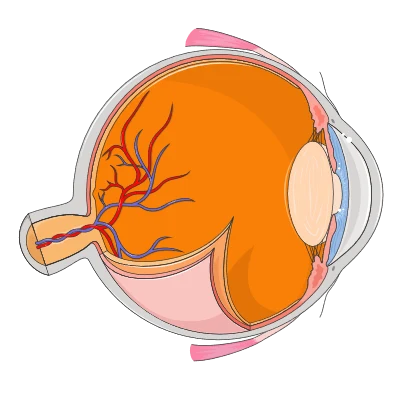
Normal eye cross-section for orientation. This is not an OCT scan or fundus photograph and does not depict a retinal tear, edema or retinopathy.
The cornea and lens are toward the front of the eye. The retina lines the posterior inner wall. Distinguish the structure examined or treated from the technique used to examine or treat it.
In Z-Anatomy, locate the eyeball and optic nerve and compare front and back views. Describe where the cornea, lens and retina belong before returning to the clinical or coding scenario.
Try it yourself
Would imaging the anterior segment and imaging the macular region examine the same anatomical location?
Show answer and explanation
No. The anterior segment is at the front of the eye; the macula is a region of the retina at the back.
Location matters even when an imaging technique has the same name. This normal schematic supports anatomy recall, not a diagnosis from an actual clinical image.
Staging systems are the bridge from findings to management tiers
Named staging and classification systems exist precisely to convert examination findings into a management tier. Learn the stages together with the action attached to each, because the findings described in the stem determine which tier — and which answer — applies.
Worked scenario: a paper case describes a patient with diabetes whose dilated exam shows intraretinal hemorrhages and venous beading in both eyes, no neovascularization, and OCT showing fluid involving the center of the macula in one eye. A plausible mistake is answering 'annual dilated follow-up' because the retinopathy is nonproliferative. The better decision recognizes that severity is not one number: retinopathy stage and edema status are separate dimensions, and center-involving edema drives an urgent referral for edema treatment evaluation. Why it matters: collapsing the case into a single label produces the wrong disposition, while evaluating each severity dimension on its own produces the right one.
Apply this pattern across systems you review: glaucoma damage staging, hypertensive retinopathy grading, and uveitis anatomic classification all attach an action to a finding pattern. For each system, write a two-column note — stage on the left, the management action that stage triggers on the right — and drill by covering the action column. Exercise: take ten practice scenarios and, for each, name the classification system in play and the exact stage before answering. Expected observation: scenarios that felt ambiguous tend to become clear once the stage is named, and the ones that stay ambiguous are missing a second severity dimension you overlooked.
Treat, co-manage, or refer: setting thresholds you can defend
A disease can support different management tiers depending on presentation severity, threat to vision or systemic health, and whether required treatment exceeds office scope. Build explicit thresholds and be able to cite the specific finding that placed each case in its tier.
Worked scenario: a paper case gives a patient with a severely painful red eye, markedly reduced vision, a mid-dilated fixed pupil, and a hazy cornea. A plausible mistake is pattern-matching 'red eye' to conjunctivitis and selecting topical antibiotic drops. The better decision recognizes the acute angle-closure pattern — pain, reduced vision, mid-dilated pupil, corneal edema — and selects urgent same-day referral for pressure reduction. Why it matters: the antibiotic answer is a reasonable therapy for a different, milder presentation; the severity cues in the stem are what separate treat-now-in-office from refer-now.
Write your own three-tier decision table and revise it as you study, so each row reflects your reasoning rather than a memorized list. Then test it: for each practice case, state which tier you chose and cite the finding that justified the tier. If you cannot cite a finding, your threshold is a guess, and guessed thresholds wobble under exam pressure. Self-check rubric for tier decisions: (1) you named the time frame the stem implies — same day, days, weeks, or months; (2) you cited the severity finding that set the tier; (3) you could say what in-office management would cover and where it would stop. Hitting all three consistently is a readiness milestone for this skill, not a score prediction.
The contraindication screen that should precede every treatment answer
Before selecting any therapeutic option, run a contraindication screen across the patient's systemic history, current medications, and ocular findings. A therapy can be standard for the disease and still be the wrong choice for the specific patient described.
Short paper vignette: initial open-angle glaucoma therapy in a patient with moderate asthma. A plausible mistake is selecting a topical beta-blocker because it is a well-known first-line class. The better decision screens the systemic history first and selects a different class without bronchospastic concern, documenting the reasoning. Why it matters: the screen must run before the options are read, or the first familiar drug name anchors your choice. The same screen catches a prostaglandin analog avoided with active uveitis, or systemic carbonic anhydrase inhibitors avoided with sulfa-related concerns — each is a class-level reasoning point rather than a dose to memorize.
Turn this into a drill: for each drug class you study, write one line — the condition it treats, the classic contraindication pattern, and the substitute class. Quiz yourself in reverse: read the contraindication and recall both the class to avoid and its replacement. This pairing is the transferable skill — knowing which alternative survives the patient's profile, not just which drug treats the disease. Weekly check: pick five treatment questions you answered recently and note whether you ran a contraindication screen before reading the options. If the count is low, make the screen a written step in your scenario routine rather than an afterthought.
Practicing multi-item scenario sets without assuming a shared-chart format
Part II is built on patient-based scenarios. As a conditional preparation strategy, practice with multi-item sets built on one evolving case, so that carrying earlier findings and treatment decisions forward becomes automatic — whatever structure the actual exam takes.
Practical method: using practice materials, work multi-item sets where later items reveal new data about the same patient. On your scratch material, maintain one line per case — key diagnoses, severity stage, what has already been done, and current contraindications. Update the line whenever new data appears before answering. When a later item builds on a medication already prescribed or a test result already obtained, a fresh reading of the stem alone is how that connection gets missed; the running summary line is what preserves it.
Notice how extended cases change the reasoning task: an early item may ask for interpretation, a middle item for the immediate next step, and a later item for follow-up structure after treatment. The follow-up answer depends on the tier you reasoned to earlier — if your scratch line says 'urgent referral, no in-office therapy,' a later question about in-office monitoring over that interval should trigger a consistency check rather than a fresh guess. Exercise: work one multi-item set and write your scratch summary line first. Expected observation: later items become faster because interpretation is already done, and you catch at least one continuity constraint — usually a prior result or treatment — that re-reading the stem would not have surfaced.
A four-week preparation sequence with concrete readiness checks
Sequence preparation by decision skill rather than by disease list: two weeks anchoring stage-to-action tables and contraindication pairs, one week on tier thresholds under time, one week on extended scenario sets and review of every missed reasoning link.
Weeks one and two: each day, convert two or three conditions into stage-to-action two-column notes and drug classes into treat-contraindication-substitute triads. Week three: run timed scenario sets, forcing a written one-line next step before reading options, and log every miss into one of three causes — wrong stage, missed contraindication, or wrong tier. Week four: work extended scenario sets and re-drill your miss log; by now your errors cluster into patterns, which tells you exactly what to review instead of rereading everything.
Readiness checks to finish with: (1) you can state assessment and management anchors for your priority condition list without notes; (2) on a timed set, you write a next-step sentence before options on every scenario, not just some; (3) your tier decisions pass the three-point rubric from the referral section; (4) on extended scenario sets, your scratch line stays consistent with every answer. These are learning milestones — measures of how complete your decision process is — not predictions of any score. One administrative note: exam format, scheduling, eligibility, and fees are set by NBEO and change over time, so confirm current details directly at optometry.org rather than relying on any third-party summary.
- Priority list first: cover high-frequency management conditions with both assessment and management anchors before broadening.
- Miss log with causes: label every practice miss as stage, contraindication, or tier — review the pattern, not the question.
- Timed next-step habit: a written one-sentence plan before options, on every scenario, until it is automatic.
| Finding pattern in the stem | Implied time frame | Reasoning direction | Tier to argue for |
|---|---|---|---|
| Threat to vision with severe pain or acute onset cues | Same day | In-office options insufficient; stabilization needed | Urgent referral |
| Progressive or moderate severity, treatment within office scope | Days | Initiate appropriate therapy; set explicit follow-up | Treat and monitor closely |
| Early or stable findings, no edema, no neovascularization pattern | Months | Confirm stability, document baseline, schedule interval | Routine monitoring |
| Findings requiring surgical, laser, or specialty intervention | Scheduled, not emergent | Co-manage; define what each provider handles | Co-management |
References and further reading
Use these references to explore the concepts and check the latest information from the relevant organizations.
Continue your preparation
1 practice options available