
Treat MRCPCH preparation as decision training. For every practice case, first identify what the stem asks you to decide, then use the child's age and presentation to narrow plausible options before comparing them. Log errors by decision type.
Why 'most likely diagnosis' and 'most appropriate next step' are different questions
A diagnosis question asks you to name the condition that best explains the findings; a next-step question asks which single action should follow now. Confusing these two decision types is the reasoning trap this concept is built on.
Compare the two formats directly. 'Which of the following is the most likely diagnosis?' rewards pattern assembly: you weigh history, examination findings and observations against each option and choose the best explanatory fit. 'What is the most appropriate immediate management?' rewards prioritisation: several listed options may be true or eventually necessary, but only one belongs at the front of the queue. Read the stem's final sentence twice, underline the verb — diagnose, investigate, manage or reassure — because that verb defines what 'correct' means for that item.
Worked scenario: a stem describes a toddler with respiratory distress, tracheal tug and falling saturations, then asks for the most appropriate immediate step. A plausible mistake is selecting the option naming definitive treatment for the suspected cause, because the narrative seems to point there. The better decision is the option addressing the child's physiology right now — positioning, oxygen and escalation of support — before cause-directed therapy. It matters because whenever an accurate diagnosis sits alongside a wrong next step, the sequence is what separates the answers. In your log, label this a 'sequence error' so it becomes visible across cases.
- Diagnosis stems: weigh explanatory fit against every option.
- Next-step stems: ask 'what does this child need in the first minutes?'
- Investigation stems: ask which result would most change management, not which test is most comprehensive.
Using the child's age band to cut the option list in half
Paediatric answers are age-dependent: the same symptom maps to different likely conditions, different normal ranges and different urgencies at different ages. Filtering options by age band before comparing them is a repeatable structural habit.
Treat the age in the first line as an answer-elimination tool, not background detail. A feeding difficulty in a neonate, a limp in a toddler and a headache in an adolescent pull from almost disjointed differential lists. Developmental questions shift even faster: a finding reassuring at one age is a referral trigger at another. Before looking at the options, state to yourself the two or three condition groups plausible for this age and presentation, then test every option against that shortlist.
If your training has been mostly with adult patients, adult-style reasoning can feel like the default, so build this filter deliberately rather than trusting instinct. When an option attracts you strongly but belongs to a different age band, write down why it appealed — the note usually exposes a gap in age-specific knowledge worth targeted review. Worked scenario: an infant not yet walking where walking is expected, with otherwise normal examination. A plausible mistake is anchoring on a dramatic neurodevelopmental diagnosis. The better decision works through the domains first — gross motor, fine motor, speech and language, social — asking whether the delay is isolated and what the age-appropriate expectation is, then choosing the option consistent with that structured assessment.
- Read age before options and predict a plausible shortlist.
- Check all developmental domains, not just the one named in the stem.
- When an out-of-age-band option attracts you, note why — it marks a knowledge gap.
Explore in 3D: Heart chambers and great vessels
A four-chambered heart viewed from the front. The right ventricle supplies the pulmonary circulation via the pulmonary trunk; the left ventricle supplies the systemic circulation via the ascending aorta. This model shows external chamber surfaces and the visible great vessels only — no internal valves or conduction system.
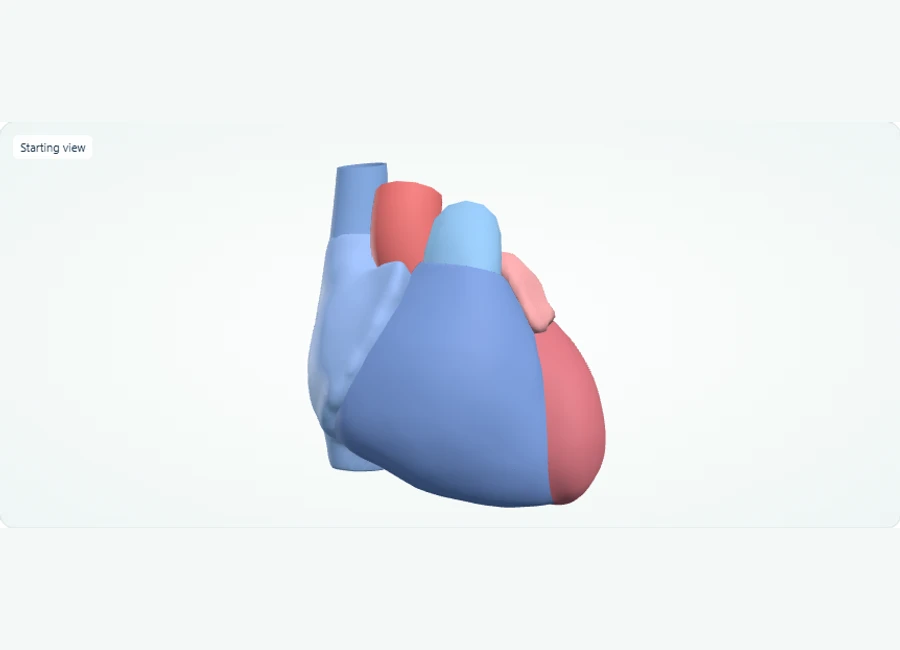
Rotate, isolate structures, and test your recall.
Choose Front and compare the four chambers. The right ventricle forms most of the anterior surface; the left ventricle contributes to the apex.
Select and isolate each chamber in turn, then use Show all to restore its relationship to the surrounding structures.
Select the pulmonary trunk and ascending aorta in turn. Name the circulation supplied by each, then use Test recall to practise identifying the listed structures.
Try it yourself
Which ventricle supplies the pulmonary trunk, and which supplies the ascending aorta?
Show answer and explanation
The right ventricle; it serves the pulmonary circulation.
On the front view, the right ventricle is the anterior-most chamber, and its outflow tract continues as the pulmonary trunk carrying blood to the lungs. The left ventricle instead empties into the ascending aorta for the systemic circulation.
- The right ventricle pumps blood into the pulmonary trunk toward the lungs; the left ventricle pumps into the ascending aorta to the body.
- The superior vena cava returns blood to the right atrium from above the heart.
- The two atria sit superior to the two ventricles; atria receive blood, ventricles eject it.
Separating resuscitation actions from definitive management in acutely unwell children
Acute scenario questions ask you to order care, not merely identify it. Recognition, immediate support, targeted investigation and definitive treatment are distinct layers, and the correct answer depends on which layer the stem has reached.
Practise narrating a structured approach on paper: assess physiological status, support airway, breathing and circulation as needed, then move to focused assessment and cause-directed treatment. The layer is usually signalled by cues — normal observations with a diagnostic puzzle point to investigation; deranged observations with distress point to immediate support; a stable child with an established diagnosis points to definitive management. Train the reflex of asking 'where in this sequence is this child right now?' every time an acute vignette opens.
Worked scenario: a febrile child with reduced responsiveness and abnormal perfusion, stem asking for the most appropriate next step. A plausible mistake is choosing an imaging or laboratory option that would clarify the cause, because the story emphasises diagnostic uncertainty. The better decision restores and supports circulation now, with cause-directed work-up following once the child is stabilised. It matters because the layers are individually defensible — oxygen, fluids, antibiotics and imaging can all be true for some version of the child — and trend words like 'deteriorating' or 'improving' tell you whether to act or clarify. This is a paper exercise for exam reasoning, never a substitute for your clinical setting's protocols.
- Ask which layer the child is in: recognition, support, investigation, or definitive care.
- Trend words in the stem — deteriorating, improving — signal whether to act or to clarify.
| Stem asks for... | What it really tests | Typical trap | First move |
|---|---|---|---|
| Most likely diagnosis | Pattern fit across history, findings and age | Choosing a dramatic but poorly fitting option | Build the differential, then compare each option's fit |
| Most appropriate immediate management | Ordering of care in an unstable child | Selecting a true-but-later treatment | Support physiology before cause-directed therapy |
| Most useful next investigation | Which result would change management | Picking the most comprehensive test | Ask what decision each result would enable |
| Most appropriate overall management | Complete, age-appropriate care plan | Answering only the presenting symptom | Include treatment, safety-netting and follow-up |
Interpreting growth, development and observation data without over-calling pathology
Data-interpretation items reward calibrated judgement: recognising genuine deviation from expected patterns while avoiding false alarms. Learn the reference framework, then practise separating single abnormal values from meaningful trends.
Growth and development questions hinge on pattern, not isolated numbers. A single measurement on an extreme centile invites scrutiny, but serial measurements showing a child crossing centile lines carry far more weight, and stems often supply exactly that trend as a deliberate clue. Developmental items usually embed evidence across several domains, and the decision — reassure, monitor or refer — follows from whether the overall picture is an isolated variation or a broader deviation. Summarise the pattern aloud in one sentence before reading the options.
Calibration also means knowing what normal variation looks like across ages, which is learnable content rather than intuition. Build reference ranges and milestones into flashcards grouped by age band, then shuffle mixed-age decks so the boundaries stay sharp. Practical exercise: take ten data-interpretation cases covering growth charts, development and routine observations. Before each answer, write (1) the pattern in one sentence, (2) whether it is a single point or a trend, (3) which domain or parameter is genuinely outside expectation, and (4) your decision. Expected observation: accuracy improves most on items where the decisive clue was a trend or a second affected domain, training you to hunt for corroboration before committing.
- State the pattern in one sentence before reading options.
- Distinguish single-point findings from trends across time.
- Group milestone and reference flashcards by age band and shuffle them.
When safeguarding changes the answer: recognition and documentation as examinable decisions
Safeguarding is not a separate topic bolted onto paediatrics; in scenario items it changes what the correct action is. Recognition of concern, structured documentation and appropriate escalation are decision points that can be tested directly.
Run a safeguarding check on every vignette, not only those flagged with obvious cues. Inconsistent or unexplained injury mechanisms, delay in presentation, injuries inconsistent with the child's developmental stage, and repeated unexplained attendances are recognition triggers. When such cues appear, the answer usually shifts from purely medical management toward actions that secure the child's safety — and an option that is medically sound but silent on safety is then incomplete, because safeguarding scenarios by their nature test whether safety considerations are explicit rather than assumed.
Documentation is the second examinable decision. High-quality written answers record findings precisely and contemporaneously, quote explanations in the child's or family's own words where relevant, and separate observation from interpretation. Worked scenario: an injury whose stated mechanism does not fit the child's developmental abilities, stem asking for the most appropriate course of action. A plausible mistake is an option treating the injury and arranging routine follow-up, treating the mismatch as incidental. The better decision treats the discrepancy as a child-protection concern requiring structured assessment, clear documentation and escalation through the appropriate pathway — the sequence that actually protects the child.
- Run a safeguarding check on every vignette, not just obvious ones.
- Document observations separately from interpretations; record explanations verbatim.
- In items, prefer options that make safety actions explicit over medically complete but silent ones.
Evidence and audit questions: deciding what the numbers ask you to conclude
Items built around research evidence test whether you can read a study's design and statistics and state what they do and do not support. Learn the core concepts, then practise mapping each statistic to the conclusion it licenses.
Start with the concept-to-conclusion map. Sensitivity and specificity describe test performance; predictive values shift with disease prevalence in the population studied; confidence intervals show how precise an estimate is; study design determines what causal language is permitted. When a stem presents an abstract or results table, the answer usually turns on one of these mappings — for example, recognising that a test performing strongly in a high-prevalence setting cannot be assumed to perform identically elsewhere. Build flashcards pairing each concept with the conclusions it does and does not justify.
Audit questions follow related logic: what does the stated finding imply for practice? Distinguish audit from research, check whether a proposed change addresses the measured problem, and spot options that overreach the evidence. Practical exercise with a self-check rubric: take five evidence-based items and score each answer on five checks — did I identify the study design; state the population studied; map each quoted statistic to its correct meaning; note one limitation; keep my conclusion within what the design supports? Treat satisfying all five consistently as a personal reasoning milestone, not a prediction of any exam outcome. Expected observation: early attempts fail most on the population and limitation checks, pointing you toward practising with full abstracts rather than isolated statistics.
- Map each statistic to the conclusion it licenses — and to the ones it does not.
- Write the study's design, population and one limitation before reading options.
- Use the five-check rubric as a personal reasoning milestone, not a score prediction.
A practice sequence that exposes reasoning gaps before they cost you marks
Content review alone leaves decision errors invisible. Structure your preparation in phases — framework building, untimed decision practice, timed mixed practice, and communication or clinical rehearsal — and audit your error log between each phase.
Phase one: build the age-band framework — milestones, common presentations by age, structured assessment approaches — as your own one-page summaries rather than borrowed notes. Phase two: untimed practice focused purely on decision type. Label every item diagnosis, next step, investigation or management plan, and record the decision type in your error log. Untimed work is deliberate: it lets you notice reasoning habits without clock pressure distorting the signal.
Phase three: timed mixed blocks, with the error log reviewed after every session and recurring decision-type errors converted into micro-drills — for example, a run of next-step-only items if sequence errors dominate. Phase four: peer-observed rehearsal of clinical and communication dimensions, using the documentation rubric from the safeguarding section for written exercises. For current exam structure, booking and other administrative details, use the RCPCH website; this guide does not cover them. Adaptable sequence: (1) two weeks of age-band summaries; (2) untimed decision-labelled practice; (3) timed mixed blocks with log-driven drills; (4) peer rehearsal; (5) re-attempt every logged error, confirming you can state the decision type, the trap, and the discriminating clue. Readiness checks: you can name the decision type from the stem's final sentence within seconds; predict a shortlist from age and presentation alone; your log shows no decision type recurring; and a peer confirms your documentation separates observation from interpretation.
- Phase 1: age-band framework with self-written summaries.
- Phase 2: untimed items labelled by decision type.
- Phase 3: timed mixed blocks with log-driven micro-drills.
- Phase 4: peer-observed clinical and communication rehearsal.
- Phase 5: re-attempt the full error log until every entry is explainable.
References and further reading
Use these references to explore the concepts and check the latest information from the relevant organizations.