
Preparing for the MRCOG is less about accumulating facts and more about grounding every answer in a named, current UK source: a Green-top Guideline, a Consent Advice document, a Scientific Impact Paper, or equivalent UK guidance such as NICE. Guidance drift — the gap between what your notes once said and what UK guidance now says — is the central difficulty to manage, so anchor each revised topic to a document family and learn its headline recommendation plus one exception. Treat each question format as a distinct decision skill: ranking options in single best answers, separating near-neighbour options in extended matching, and demonstrating structured consultation behaviour in OSCE-style stations. Check administrative details only on the RCOG's own exam pages.
Guidance drift: the concept-level difficulty you must train around
Obstetric and gynaecological guidance is revised, supplemented and superseded over time, so the difficulty to manage is the gap between familiar notes and the current UK position.
A textbook sentence can be accurate as written yet sit alongside a revised recommendation, an interim position statement, or a qualified exception introduced after your notes were made. In obstetrics and gynaecology this happens often enough that 'true' and 'currently endorsed in the UK' are not the same question. A topic learned years ago, from a different jurisdiction, or from a summary of a summary, can carry a once-standard framing that UK guidance has since moved past.
The practical adjustment is to treat every clinical topic as having an 'anchor document' — a Green-top Guideline, a Scientific Impact Paper, a Consent Advice document, or an equivalent UK source such as NICE guidance — and to phrase your learning as the anchor's headline recommendation plus its exceptions. When you revise a topic and cannot name its anchor or its main exception, that is a signal to revisit it rather than to move on.
- Name the anchor document for each revised topic
- Learn the headline recommendation plus one exception
- Flag topics where your local practice differs from UK guidance
Telling Green-top Guidelines, Consent Advice and Scientific Impact Papers apart
The RCOG publishes distinct document families with different purposes; confusing them leads to citing the wrong authority for a decision in written answers and clinical scenarios.
Green-top Guidelines are clinical practice guidelines on defined obstetric and gynaecological topics. Consent Advice documents support the information-giving and consent conversation around specific procedures. Scientific Impact Papers review evidence on emerging or scientifically significant questions. The RCOG also publishes patient information leaflets, which reflect what women and families are told rather than what clinicians decide between options.
Each family answers a different revision task. A 'what should the team do' scenario points to a Green-top Guideline or equivalent UK guidance. A 'what should you tell the patient before this procedure' scenario points to consent content. A 'why does practice rest on this evidence' question may draw on a Scientific Impact Paper. Reading any document while asking 'what kind of learning task could this support' converts passive reading into format-aware revision.
The RCOG also issues interim clinical guidance and position statements when advice needs updating between full documents, so a recently refreshed topic may be governed by a newer, shorter publication rather than the guideline you first learned.
| Document family | Purpose | Best used for | Revision focus |
|---|---|---|---|
| Green-top Guideline | Clinical recommendations for a defined topic | Management decisions and protocols | Headline recommendation, thresholds, exceptions |
| Consent Advice | Procedure-specific consent information | What to disclose before a procedure | Key risks, alternatives, and capacity and consent points |
| Scientific Impact Paper | Evidence review on a scientific question | Justifying why practice has changed | Direction of evidence and its clinical implication |
| Patient information leaflet | Information for women and families | Plain-language explanation tasks | What patients are told, in their terms |
Explore in 3D: Kidneys, Ureters and Bladder: The Urine Transport Pathway
This model shows five selectable structures: the right and left kidneys, the right and left ureters, and the urinary bladder. It demonstrates the gross pathway of urine transport from where urine forms (kidneys) to where it is stored (bladder). Note: the urethra and internal renal anatomy are not included in this model, so the pathway ends at the bladder.
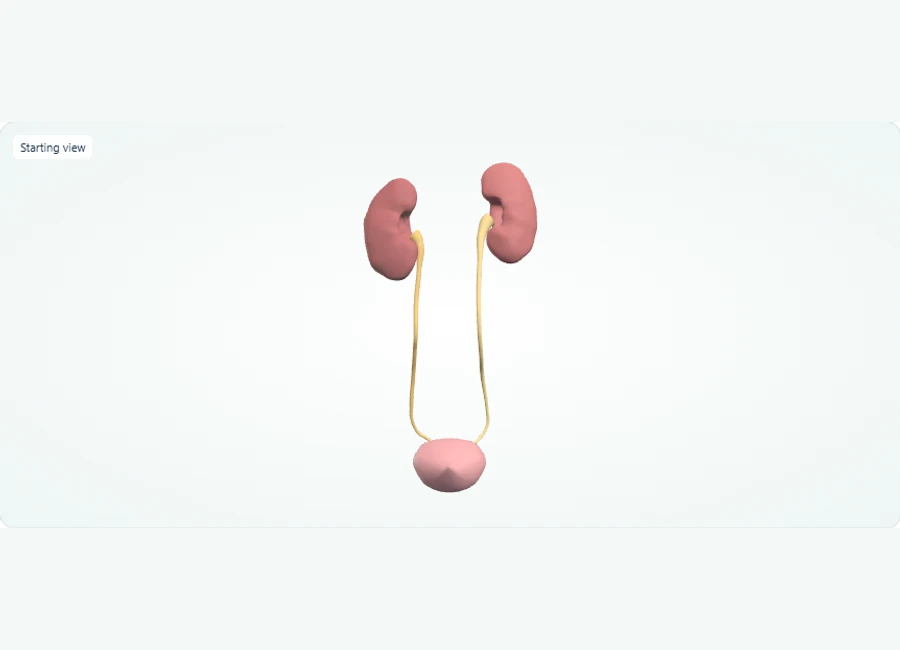
Rotate, isolate structures, and test your recall.
Choose Front. Select the right kidney, then its ureter, and follow the route toward the bladder with all structures visible.
Repeat on the left side. Select and hide each kidney separately if you want a clearer view of the ureters; use Show all to restore them.
Select the urinary bladder. Rotate the model and identify where the paired ureters meet the single bladder.
Try it yourself
Trace the three structures in the right-sided urine transport route shown here. What does the final structure do?
Show answer and explanation
Right kidney, right ureter, urinary bladder. The bladder stores urine until it leaves the body. (The left side follows the same pattern: left kidney and left ureter also deliver urine to the bladder.)
Urine flows from each kidney into its own ureter, which transports it down to the urinary bladder for storage. Both the right and left ureters empty into the single bladder. Because the urethra is absent from this model, the bladder is the terminal structure you can trace.
- Urine is formed in the kidneys; from each kidney, urine drains into that side's ureter (right ureter from right kidney, left ureter from left kidney).
- Each ureter carries urine downward to the urinary bladder, which stores urine until it is expelled; this model shows both ureters joining the bladder.
- This model is a gross transport overview only: the urethra and internal kidney structures are not shown, so urine flow beyond the bladder cannot be traced here.
Different decision skills for written items and OSCE-style stations
Practise single best answers as ranking against current UK guidance, extended matching as discriminating between near-neighbour options on a shared list, and OSCE-style stations as structured consultation behaviour.
In a single best answer, several options can be partially defensible, so the discipline to practise is ranking rather than recognising. Read the question for the task verb — manage, investigate, advise, refer — then test each option against the anchor document's framing. An option that was true historically but has been superseded, or that is correct for a different clinical situation, ranks below the option matching the current UK recommendation for the scenario as written.
In extended matching, the difficulty shifts to near-neighbour options: closely related management steps or investigations that differ in one decisive detail. Practise eliminating options against the scenario's limiting features rather than searching for a perfect fit. In OSCE-style stations, the assessable behaviour is structure — a clear opening, an organised history or explanation, explicit consent content where relevant, safety-netting, and a summary that closes the loop with the patient.
Worked scenario: a VTE question where two options both sound right
When two options both look clinically sensible, the tie-breaker to train is checking whether a newer UK publication on that topic exists before trusting an older framing from memory.
Imagine a written scenario on reducing the risk of venous thromboembolism during pregnancy. A candidate who learned VTE prevention years ago recalls a familiar risk-assessment approach and selects the option closest to that memory. The plausible mistake is anchoring on an outdated framing when the RCOG has published interim clinical guidance aligning VTE risk reduction in pregnancy with the Maternity Care Bundle — meaning the current UK position on this topic is defined by a newer publication than the candidate's original learning.
The better decision is to ask, for any topic recently revised or in the news, whether a newer RCOG statement exists, and to prefer the option consistent with that statement. This matters because recently updated topics are exactly where your old notes and current UK guidance are most likely to diverge, so habit and the current framing can point to different options. Trace the same logic across your revision list: any topic marked as recently updated deserves a fresh check of the RCOG's guidance pages before you trust your existing notes.
Worked scenario: structuring a consent station when a long risk list feels safer
In a consent-focused station, a structured conversation built on Consent Advice principles demonstrates the behaviour being practised better than reciting an unorganised list of complications.
Imagine an OSCE-style station in which you must discuss a gynaecological procedure with a patient. A common approach is to recite every complication you can remember, hoping volume demonstrates knowledge. The weakness is that information given without order does not show judgement about what is material to this patient, and it leaves no room for the patient's own concerns, questions, or decision.
The better decision is to structure the conversation the way Consent Advice documents frame it: what the procedure involves, the material risks in plain language, the realistic alternatives including doing nothing, and a check of the patient's understanding before she decides. This matters because consent content is a named RCOG document family with a defined purpose — practising the structure gives the station a repeatable shape, so under time pressure you produce an organised conversation rather than a memory dump. Rehearse the structure aloud until the sequence survives nervousness.
A guidance-mapping exercise with a self-check rubric
Map ten core topics to their anchor document type, headline recommendation and main exception; your completion rate is a learning milestone, not a pass prediction.
Choose ten topics spanning the MRCOG syllabus areas, for example one common obstetric emergency, one early pregnancy complication, one gynaecological oncology topic, one benign gynaecology topic, and one procedure with consent implications. For each topic write four lines: the anchor document family, the headline recommendation in one sentence, one exception or qualified situation, and one point where your local practice differs from the UK framing. Work from the RCOG guidance pages and equivalent UK sources rather than from memory.
Score yourself against this rubric: eight or more topics with all four lines completed means you are ready to spend most of your time on question practice; five to seven means revisit the weaker topics before adding more volume; fewer than five means reread the document families first so you know what each publication is for. Expect a specific observation from this exercise: your exception lines will be the weakest, because exceptions are the details most likely to be missing from notes built on memory, and they are exactly what unmapped revision omits.
An adaptable preparation sequence and concrete readiness checks
Sequence preparation as mapping, then format practice, then scenario rehearsal, then a guidance refresh; declare yourself ready only against explicit self-checks, not time spent.
Phase one: map your syllabus to anchor documents and complete the ten-topic exercise above. Phase two: practise written items as decision skills — for every single best answer, write a one-line ranking rationale naming the governing guidance; for every extended matching set, note which scenario feature eliminated each rejected option. Phase three: rehearse OSCE-style stations aloud, including a full consent structure for one procedure station per session. Phase four: re-check every topic you flagged as recently updated against the RCOG's guidance pages.
Readiness checks: you can name the anchor document family for most topics on your map unprompted; you can produce a ranking rationale for a written item without reopening the source; you can deliver a complete consent conversation structure aloud, cold, in under two minutes; and your mapping rubric score sits in your target band. These are learning milestones only and do not predict exam outcomes. One short note on administration: for dates, fees, eligibility and format logistics, rely on the RCOG's own examination pages, which the College keeps current.
- Phase 1: map syllabus topics to anchor documents
- Phase 2: rank SBAs and eliminate EMQ options with written rationales
- Phase 3: rehearse OSCE-style stations aloud, consent structure included
- Phase 4: refresh every topic flagged as recently updated
References and further reading
Use these references to explore the concepts and check the latest information from the relevant organizations.