
Prepare for MEDSURG-BC by pairing every content domain with decision practice: rank patients using airway-breathing-circulation and stability reasoning, build two-column differentials for look-alike conditions, attach a required pre-administration check to every high-alert medication, and rehearse delegation decisions against scope rules. Use the ANCC test content outline and sample questions as your structure, and run a weekly scenario-writing loop drawn from your own shifts to check that your reasoning, not just your recall, is exam-ready.
Anchor Your Review to the ANCC Test Content Outline
Download the official test content outline and sample questions first, then assign each outline domain to specific calendar blocks instead of reading a review book front to back.
ANCC describes this examination as a competency-based assessment of entry-level medical-surgical clinical knowledge, and it publishes a test content outline showing what that competency covers. Copy the outline into a simple grid, rate your confidence in each domain honestly, and give your weakest areas the earliest and longest blocks. A chapter-by-chapter march through a large text spends equal time on content you already use daily and content you avoid.
Use the published sample questions diagnostically before you study anything. Answer them untimed, then write one sentence per item explaining why the correct answer is correct and why each distractor is attractive. Missed items cluster into patterns, such as prioritization errors, misread labs, or scope-of-practice confusion, and each pattern points to a different fix than simply rereading a chapter.
- Map every outline domain to named calendar blocks; revisit the map weekly.
- Answer official sample questions before studying to locate your decision-making gaps.
- Keep a missed-question log with the reason for each miss, not just the topic.
Prioritization: ABCs Versus Acute-Unstable Thinking
Rank patients first by airway, breathing, and circulation, then by stability: an acute, worsening problem outranks a chronic or stable one even when the stable problem is loud and uncomfortable.
The airway-breathing-circulation sequence is the entry point, not the whole framework. After clearing immediate physiological threats, ask two more questions: is the problem acute or chronic, and is the patient stable or deteriorating? New-onset findings and worsening trends outrank longstanding stable ones. Practice stating your rationale in one sentence while treating every answer option as if it were defensible, because only the reasoning separates the options you chose between.
Worked scenario: you receive report on two patients. Patient A has COPD and is now speaking in short phrases with a rising respiratory rate; Patient B, one day postoperative, reports incision pain of 7 out of 10 and requests medication. The tempting choice is Patient B because the pain has a clear number and an immediate fix. The better decision is Patient A: shortened phrases and an escalating rate signal impending ventilatory failure, which can deteriorate in minutes, while pain, though urgent, is not immediately life-threatening. The skill being tested is matching intervention urgency to physiological risk, not to how vividly the complaint is presented.
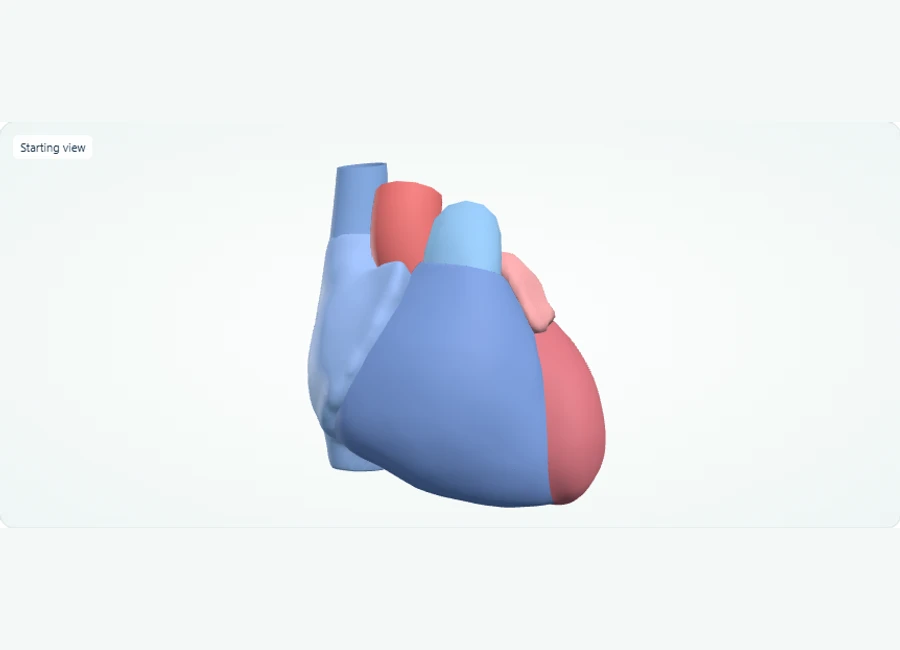
Explore in 3D: Heart chambers and great vessels
A four-chambered heart viewed from the front. The right ventricle supplies the pulmonary circulation via the pulmonary trunk; the left ventricle supplies the systemic circulation via the ascending aorta. This model shows external chamber surfaces and the visible great vessels only — no internal valves or conduction system.
Rotate, isolate structures, and test your recall.
Choose Front and compare the four chambers. The right ventricle forms most of the anterior surface; the left ventricle contributes to the apex.
Select and isolate each chamber in turn, then use Show all to restore its relationship to the surrounding structures.
Select the pulmonary trunk and ascending aorta in turn. Name the circulation supplied by each, then use Test recall to practise identifying the listed structures.
Try it yourself
Which ventricle supplies the pulmonary trunk, and which supplies the ascending aorta?
Show answer and explanation
The right ventricle; it serves the pulmonary circulation.
On the front view, the right ventricle is the anterior-most chamber, and its outflow tract continues as the pulmonary trunk carrying blood to the lungs. The left ventricle instead empties into the ascending aorta for the systemic circulation.
- The right ventricle pumps blood into the pulmonary trunk toward the lungs; the left ventricle pumps into the ascending aorta to the body.
- The superior vena cava returns blood to the right atrium from above the heart.
- The two atria sit superior to the two ventricles; atria receive blood, ventricles eject it.
Separating Look-Alike Conditions: Build Two-Column Differentials
Study confusing condition pairs as side-by-side cue lists rather than as separate topics, so a stem's distinguishing words, such as abrupt onset or fluctuating course, trigger the right condition immediately.
Build the skill of assembling a condition from a cue cluster that never names it. The reliable technique is to construct a two-column comparison for each look-alike pair you find yourself confusing, drawing cues from your textbooks and from the ANCC reference list, then quizzing yourself on the columns until the distinguishing adjectives are automatic. When you read a practice stem, underline the adjectives: abrupt, insidious, fluctuating, progressive. Each word is doing diagnostic work.
Worked scenario: an older adult who had surgery two days ago becomes agitated at night, cannot focus on your questions, and does not know where they are; family says they were perfectly oriented yesterday. A common mistake is filing this under a chronic memory disorder because the patient is elderly. The better decision is recognizing an acute, fluctuating confusional state with new onset, and acting on the reversible causes that must be urgently evaluated. The distinction matters because the two conditions lead to completely different first actions: searching for an acute reversible trigger versus long-term cognitive support.
| Feature | Delirium | Dementia | Depression |
|---|---|---|---|
| Onset | Abrupt, often over hours to days | Insidious, over months to years | May be abrupt or gradual, often tied to life events |
| Course | Fluctuates during the day; typically worse at night | Slowly progressive decline | May show daily patterns, often morning worsening |
| Attention | Markedly impaired; cannot sustain focus | Relatively preserved early on | May show poor effort more than true inattention |
| First nursing focus | Identify and report acute reversible causes promptly | Support orientation, safety, and routine | Assess mood, safety, and need for further evaluation |
Pharmacology: Attach a Pre-Administration Check to Every Drug
Organize medication study around the required check before each dose, such as a lab value, vital sign, or assessment finding, rather than around memorized drug-class lists.
For each medication you review, write down the specific data you must verify before administering, the finding that makes you hold the dose, and the teaching point expressed in patient language. High-alert categories such as insulin, anticoagulants, opioids, and cardiac glycosides deserve the deepest treatment because their checks are concrete and testable: a glucose value, a clotting parameter, a respiratory rate, an apical pulse and electrolyte pattern.
Worked scenario: a scheduled cardiac glycoside dose is due. You count an apical pulse within the acceptable range, but the morning laboratory report shows a critically low serum potassium. The tempting decision is to give the dose because the rate check passed and the schedule says it is due. The better decision is to withhold the dose and report the laboratory finding before administration, because low potassium potentiates toxicity of this drug, meaning a normal pulse with abnormal electrolytes can still precede serious adverse effects. The lesson generalizes: a single passing check does not clear a dose when another relevant result is abnormal, so practice resolving stems where two data points point in different directions.
Delegation Decisions You Can Defend
Delegate by task predictability and by scope: assessment, teaching, and evaluation remain with the RN, and any task involving an unstable or newly admitted patient should not leave the RN's hands.
Apply the recognized delegation principles: the right task, right circumstance, right person, right direction, and right supervision. In practice, two questions resolve most items. First, does the task require nursing judgment, such as assessing a new finding or teaching a patient? Second, is the patient's condition stable and the outcome predictable? If either answer is no, the task stays with you, and assistive personnel are limited to routine, reportable tasks on stable patients.
Worked scenario: an admissions unit receives a patient with chest pain arriving for evaluation, while a stable patient awaiting a routine procedure needs a set of scheduled vital signs. The tempting choice is to send assistive personnel to take the new arrival's first vital signs because taking vital signs is a routine task. The better decision is for the RN to obtain and interpret the first data on the patient with chest pain, delegating the stable patient's routine signs instead. The reason matters: first-round data on a potentially unstable patient is an assessment, not a task, because what you observe and how you interpret it will direct immediate care.
A Weekly Scenario Practice Loop With a Self-Check Rubric
Three times per week, take one real patient situation from your shift and work it into a full exam-style decision set, then score yourself against a fixed rubric to expose reasoning gaps early.
For each scenario, write the situation in two or three sentences, then answer four prompts: name the top priority problem and why it outranks other issues; list two assessments you would perform next and what abnormal findings would look like; write one teaching statement in plain patient language; and state what could be delegated and to whom, with justification. Check each answer against a reference before moving on, and record which rubric point you missed.
Self-check rubric for each scenario: one point if the priority is stated with a physiological rationale rather than a habit, one point if expected versus abnormal findings are described concretely, one point if the teaching statement contains no unexplained jargon, and one point if the delegation decision correctly keeps assessment with the RN. Expected observations after several weeks: your rationales shorten and sharpen, your delegation answers become consistent, and the specific rubric point you miss shifts from week to week, which tells you precisely what to drill next.
- Three scenarios per week, drawn from your own clinical shifts.
- Score each with the four-point rubric and log the missed point.
- Rework last week's scenarios from memory to confirm the reasoning held.
A Realistic Preparation Sequence and Readiness Checks
Plan roughly six to eight weeks: diagnose with sample questions, rotate through outline domains while building differentials, drill pharmacology and delegation, then finish with timed full-length practice and rationale review.
Weeks one and two: take the published sample questions as a baseline, map the test content outline, and start your missed-question log. Weeks three through five: rotate through the domains, dedicating each block to one differential pair and one medication check set, and run the scenario loop three times weekly. Week six: concentrate on delegation and documentation style, since these cut across every domain. The final stretch: complete timed full-length practice and spend more time reading rationales than answering new items, because the log is what changes your decisions.
Readiness checks before test day: you can name a top priority patient and defend it in under thirty seconds; you can reproduce your differential tables, such as the confusion trio, from memory; your delegation answers are consistent across scenarios; your missed-question log shows repeat categories shrinking; and your rubric scores on self-written scenarios are consistently full marks. These are learning milestones that show your reasoning is settled, not a prediction of any particular result. For application requirements, scheduling, fees, and renewal rules, use ANCC's official certification page and handbook rather than secondhand summaries, since administrative details change.
- Weeks 1-2: baseline sample questions and outline mapping.
- Weeks 3-5: domain rotation paired with differentials and drug checks.
- Week 6: delegation and documentation drills across all domains.
- Final stretch: timed full-length practice plus rationale review.
References and further reading
Use these references to explore the concepts and check the latest information from the relevant organizations.