
Treat CURN preparation as training in differential judgment: for every scenario, name the urologic mechanism (e.g., stress leakage versus detrusor overactivity, bacteriuria versus symptomatic infection) before selecting the nursing action. This guide shows how to do that with worked examples, a comparison table, and a readiness rubric.
Nursing judgment versus medical diagnosis in CURN-style questions
Scenario items on specialty nursing exams tend to ask what the nurse should do next, not what the physician will diagnose. Separating the nurse's independent role from dependent, provider-ordered actions clarifies which answer options are even within scope.
A practical habit is to label each option in a practice scenario as independent (nursing assessment, positioning, teaching, escalation), dependent (administering a prescribed anticholinergic, carrying out an ordered catheter change), or collaborative (reporting a finding so the provider can decide). Many plausible-sounding distractors describe actions that are correct clinically but not initiated by the nurse independently. Sorting options this way trims the field before you weigh clinical merit.
This distinction also shapes how you study content. When you review a condition such as benign prostatic hyperplasia or bladder cancer, study the nurse's contribution—symptom assessment, teaching, stoma or catheter care, surveillance for complications—alongside the medical management. A question about intravesical therapy, for example, is more likely to test pre- and post-instillation nursing measures than the pharmacology itself. Build notes in two columns: what the condition is, and what the nurse does about it.
- Independent actions: assessment, teaching, positioning, documentation, escalation
- Dependent actions: implementing provider orders for medication, irrigation, or procedures
- Collaborative actions: reporting findings and monitoring responses to ordered therapy
Telling stress, urge, overflow, and functional incontinence apart
Incontinence types overlap in presentation but differ in mechanism, and the mechanism drives both teaching and intervention. Comparing the four named types side by side is the fastest way to make the distinctions durable.
Stress incontinence involves leakage with a pressure increase—coughing, laughing, lifting—with no strong urge beforehand. Urge incontinence involves a sudden, intense need to void that is hard to defer, often with leakage en route to the bathroom. Overflow incontinence involves dribbling from a bladder that never empties fully, common with obstruction or an underactive detrusor. Functional incontinence occurs when the urinary system works but mobility, cognition, or environment blocks toilet access. Patient self-descriptions are often imprecise, which is exactly what scenario writers can exploit.
Train yourself to ask three questions of any incontinence vignette: What triggered the leakage? Was there urge first? Does the bladder appear to empty? The answers usually isolate one type. This matters because nursing responses differ—pelvic floor muscle teaching and timed voiding support one pattern, scheduled toileting and environmental modification support another, and persistent incomplete emptying calls for assessment and provider notification rather than reassurance alone. A wrong mechanism produces a confidently wrong intervention.
| Type | Key mechanism | Typical trigger in a vignette | Nursing emphasis |
|---|---|---|---|
| Stress | Pressure on the sphincter exceeds closure pressure | Leak with cough, sneeze, or lifting; no warning urge | Pelvic floor muscle teaching; Bladder habit review |
| Urge | Involuntary detrusor contraction | Sudden urge, leakage before reaching the toilet | Timed voiding; Bladder irritant and fluid timing teaching |
| Overflow | Incomplete emptying, overdistension | Constant dribbling; small frequent voids; distended bladder | Assess emptying (e.g., post-void residual per order); Report incomplete emptying |
| Functional | Urinary system intact; access or mobility impaired | Incontinence tied to mobility, cognition, or distance to toilet | Scheduled toileting; Environmental and clothing modifications |
Explore in 3D: Kidneys, Ureters and Bladder: The Urine Transport Pathway
This model shows five selectable structures: the right and left kidneys, the right and left ureters, and the urinary bladder. It demonstrates the gross pathway of urine transport from where urine forms (kidneys) to where it is stored (bladder). Note: the urethra and internal renal anatomy are not included in this model, so the pathway ends at the bladder.
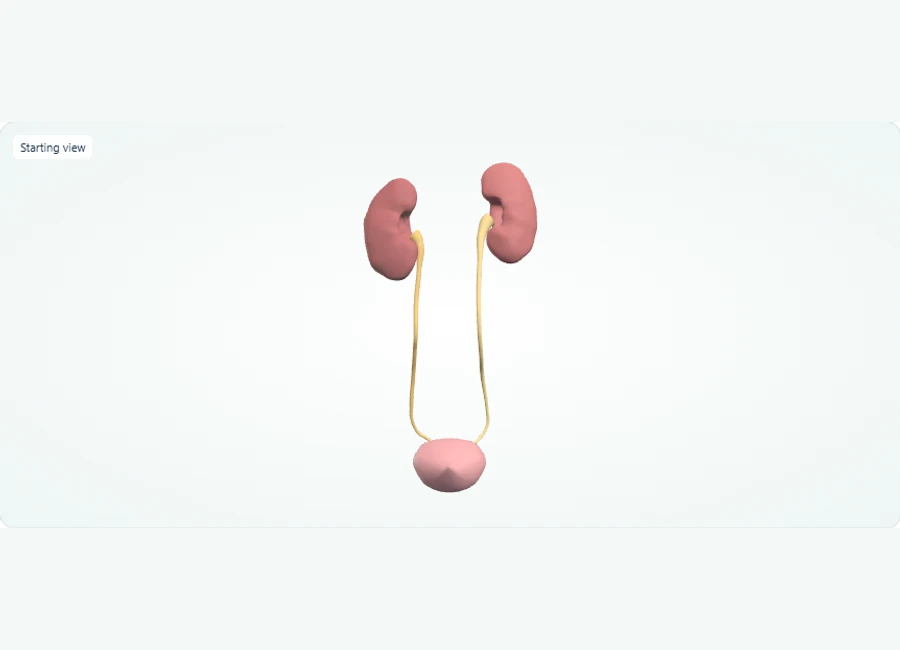
Rotate, isolate structures, and test your recall.
Choose Front. Select the right kidney, then its ureter, and follow the route toward the bladder with all structures visible.
Repeat on the left side. Select and hide each kidney separately if you want a clearer view of the ureters; use Show all to restore them.
Select the urinary bladder. Rotate the model and identify where the paired ureters meet the single bladder.
Try it yourself
Trace the three structures in the right-sided urine transport route shown here. What does the final structure do?
Show answer and explanation
Right kidney, right ureter, urinary bladder. The bladder stores urine until it leaves the body. (The left side follows the same pattern: left kidney and left ureter also deliver urine to the bladder.)
Urine flows from each kidney into its own ureter, which transports it down to the urinary bladder for storage. Both the right and left ureters empty into the single bladder. Because the urethra is absent from this model, the bladder is the terminal structure you can trace.
- Urine is formed in the kidneys; from each kidney, urine drains into that side's ureter (right ureter from right kidney, left ureter from left kidney).
- Each ureter carries urine downward to the urinary bladder, which stores urine until it is expelled; this model shows both ureters joining the bladder.
- This model is a gross transport overview only: the urethra and internal kidney structures are not shown, so urine flow beyond the bladder cannot be traced here.
Post-procedure scenarios: irrigation fluid, hyponatremia signs, and heavy diuresis
Postoperative urologic scenarios reward nurses who monitor for named complications—absorption of hypotonic irrigation fluid after transurethral resection, and post-obstructive diuresis after relief of obstruction—rather than attributing new symptoms to routine recovery.
Worked scenario one: A patient is several hours post transurethral resection of the prostate, with continuous bladder irrigation running. He becomes restless and confused, reports nausea, and you note the irrigation returns are pale while his serum sodium result is reported low. The common mistake is attributing the confusion to residual anesthetic or simply slowing the irrigation and moving on. The better decision is to recognize the pattern—irrigation fluid absorption presenting with hyponatremia and neurologic changes—as a reportable finding, notify the provider promptly, and continue close monitoring of mental status and intake-output balance. It matters because this complication progresses and depends on early recognition at the bedside.
A related scenario follows catheter removal after prolonged obstruction: urine output is strikingly high for hours. Distinguishing expected post-obstructive diuresis from a degree that risks volume depletion is a monitoring task, not a diagnosis task. Track hourly output, vital signs, and mental status; document the trend precisely; and escalate when output is sustained at a level that threatens hemodynamic stability. In both vignettes the nursing skill is the same: keep a named complication on your differential so new findings get interpreted, not dismissed.
Catheter and intermittent catheterization decisions: bacteriuria versus symptomatic infection
With long-term catheters and clean intermittent catheterization, organisms in the urine are common; infection is defined by symptoms. Distinguishing colonization from symptomatic urinary tract infection changes what the nurse reports, documents, and teaches.
Worked scenario two: A patient who performs clean intermittent catheterization phones the clinic; a routine culture shows bacteria, but she feels well, voids between catheterizations, and has no fever, flank pain, or new leakage. The plausible mistake is treating any positive culture as an infection and expecting antibiotics. The better decision, consistent with the colonization-versus-infection distinction, is to review for symptoms—fever, chills, flank pain, suprapubic discomfort, new confusion, changes in urine odor or clarity alongside systemic signs—and to report symptomatic findings rather than an isolated culture value. It matters because unnecessary treatment drives resistance, while missing true symptoms delays care.
This distinction also anchors teaching content. For patients and families, explain that cloudy or odorous urine alone does not confirm infection, and coach them to report the symptom cluster instead. For catheter care, connect maintenance practices—secure drainage system positioning, unobstructed flow, perineal hygiene, hand hygiene before manipulation—to the goal of reducing bacterial entry rather than sterilizing urine. A useful drill for any catheter-related scenario: before looking at the options, write the symptom review you would complete first; then check whether the option you are considering addresses symptoms or skips straight to a treatment decision, and note exactly which symptom it ignored. Rehearsing the symptom checklist this way keeps assessment ahead of escalation as an automatic habit.
Assessment findings into defensible documentation: a self-check exercise
Specialty scenario items reward documentation thinking that links an observation, an interpretation, and an action. Practice converting raw findings into that chain, then audit your own answers against a short rubric.
Exercise: take three practice questions in a row and, before looking at the options, write one documentation-style sentence for the vignette: finding, interpretation, action. Example form: 'Reports leakage when coughing without preceding urge (finding); pattern consistent with stress-related leakage (interpretation); initiate teaching on pelvic floor muscle exercises and scheduled voiding review (action).' Then compare your sentence against the answer options. Expected observations after a week of this drill: you notice when an option addresses the finding but not the interpretation, when it names an action without a stated reason, and when it silently changes the mechanism you identified.
Score each attempt with this three-point rubric and track it: one point if the mechanism you named matches the option's implied mechanism; one point if the action stays within nursing scope as independent, dependent, or collaborative; one point if the timing is right (immediate escalation versus routine teaching versus scheduled follow-up). A useful learning milestone is sustained full scores across ten consecutive items before you shift focus to a new content area. Sub-threshold scores are a signal about the concept involved—mechanism, scope, or urgency—not a prediction of exam performance.
Ethics, safety, and professional boundaries in urologic care scenarios
Intimate urologic care raises consent, privacy, and dignity questions that exam scenarios can embed in otherwise clinical vignettes. Treating these as explicit decision points—alongside the clinical ones—prevents them from being overlooked.
Build a short checklist for any vignette involving catheterization, examination, or treatment of the genitourinary area: Is consent evident or implied for this step? Is exposure limited to what the task requires? Is a chaperone or same-gender staffing consideration addressed where policy would require it? Is the patient's decision honored when they decline or postpone a non-urgent intervention? Options that omit these elements can be clinically efficient yet incomplete; naming the missing element is what the scenario is testing.
Safety items in this domain also include protecting yourself and the environment: standard precautions with body fluids, safe handling of chemotherapeutic agents used in intravesical therapy, and correct disposal of contaminated supplies. Study these as named practices with a rationale—why PPE at instillation and removal, why spill procedures matter—rather than as a list to memorize. When a scenario includes an immunocompromised patient receiving intravesical treatment, for example, infection-prevention reasoning and dignity considerations interact; rehearsing that interaction in practice questions makes it a habit rather than an afterthought.
A realistic CURN study sequence and readiness checks
A six-week, content-then-scenario sequence fits this credential well: core concepts first, procedures and documentation second, mixed scenarios last. Finish with readiness checks tied to your rubric scores, not to a predicted pass mark.
Adaptable sequence: Weeks one and two, build the concept map—incontinence types, lower urinary tract symptoms, stone disease, common urologic cancers and treatments, neurogenic bladder—with the two-column condition/nursing-role format. Weeks three and four, add procedures and their nursing chains: catheterization and clean intermittent catheterization, irrigation, stoma care, intravesical therapy support, plus the documentation sentence drill from the exercise above. Week five, do mixed scenario blocks under time pressure and sort every option by scope before judging merit. Week six, review the complications list (post-procedure red flags, infection indicators) and re-test the items you previously scored below full marks.
Readiness checks to finish with: you can define each incontinence type and assign a vignette to one within seconds; you can state the colonization-versus-infection distinction and list its symptom cluster without notes; you can name at least three post-procedure complications and the monitoring findings for each; and your three-point rubric scores have held at full marks across a fresh mixed set. If any check fails, return to that concept's section rather than adding generic question volume. For administrative details about the credential—eligibility and current exam administration—rely on CBUNA directly, as issuer policies are not restated in study materials.
- Weeks 1–2: condition/nursing-role two-column notes across core urologic concepts
- Weeks 3–4: procedures, their nursing chains, and the documentation sentence drill
- Week 5: timed mixed scenarios; sort options by scope before judging clinical merit
- Week 6: complications review plus re-testing previously missed concepts
- Final checks: concept definitions from memory, rubric at full marks on a fresh set
References and further reading
Use these references to explore the concepts and check the latest information from the relevant organizations.