
Study for the CGRN by organizing GI nursing content into observation, interpretation, immediate action, and escalation trigger. Facts become usable when they are attached to the moment a nurse would need them, so practice with written scenarios and grade your own reasoning, not just your recall.
Upper versus lower GI bleeding: reading the clues in sequence
Location clues include stool character, emesis appearance, and hemodynamic trend. The practice task is not naming the source; it is recognizing that the suspected source changes procedure sequencing, monitoring intensity, and how urgently you report.
Melena, which is black, tarry, and foul-smelling, generally points to blood digested above the colon, while bright red blood per rectum more often suggests a lower source, though brisk upper bleeding can also present this way. Coffee-ground emesis suggests blood altered by gastric acid, and hematochezia with hypotension behaves clinically like an upper bleed until proven otherwise. Each pattern carries a different default assumption about urgency and monitoring intensity.
In a written case, classify the bleeding pattern first, then ask which immediate action it changes: positioning, large-bore access, monitoring frequency, or notifying the physician before a planned procedure proceeds. Worked comparison: a pre-procedure patient reports two days of dark tarry stool and one episode of coffee-ground emesis. The tempting move is to focus the assessment on bowel prep completion and treat it as a routine lower GI case. The better decision is to flag the possible upper source and report it before the planned sequence is confirmed, since a suspected upper bleed can change which procedure happens first and how closely vital signs are watched.
- Melena: black, tarry stool; typically suggests a source above the colon
- Coffee-ground emesis: blood altered by gastric acid; suggests an upper source
- Hematochezia with unstable vital signs: treat as potentially brisk bleeding regardless of assumed source
- Stable chronic pattern: document, reassess on schedule, report changes in trend rather than in isolation
Bowel prep quality: adequacy versus hydration, two different problems
Prep adequacy is judged from the character of the effluent, completeness of the regimen, tolerance, and hydration status. Your role is to recognize inadequate prep before the procedure and report it so the plan can be adjusted.
Assessment spans several threads: the patient's report of intake versus the instructions, tolerance of the regimen such as nausea or inability to finish doses, urine output and signs of dehydration, and the appearance of the final effluent, which should progress from brown particulate matter to clear or light yellow liquid. A patient who stopped halfway through, or who is vomiting doses, is heading toward an inadequate prep even if they insist they finished everything.
Written scenarios turn this into judgment calls. A patient reporting clear liquid effluent but dizziness on standing raises a hydration problem, not a prep problem, and the intervention is fluid review and safety teaching. A patient with thick brown return the morning of the procedure raises a prep-adequacy problem, and the intervention is timely reporting so the schedule and physician can decide. Practice drill: write four one-line patient reports, label each as adequate prep, inadequate prep, hydration concern, or tolerance concern, and name the single action each requires. Expected observations when you self-grade: reports mentioning effluent color and clarity belong to the prep categories, reports mentioning lightheadedness or decreased urination belong to the hydration category, and reports of vomiting doses belong to tolerance. If you cannot label a report in one sentence, you are blending observations with conclusions.
Explore in 3D: Stomach, Pancreas and Duodenum: Spatial Relationships
Study the three selectable organs in this model — stomach, duodenum and pancreas — focusing on how they sit relative to one another: the duodenum follows the stomach, the pancreatic head lies in the duodenal curve, and the pancreas lies posterior to the stomach.
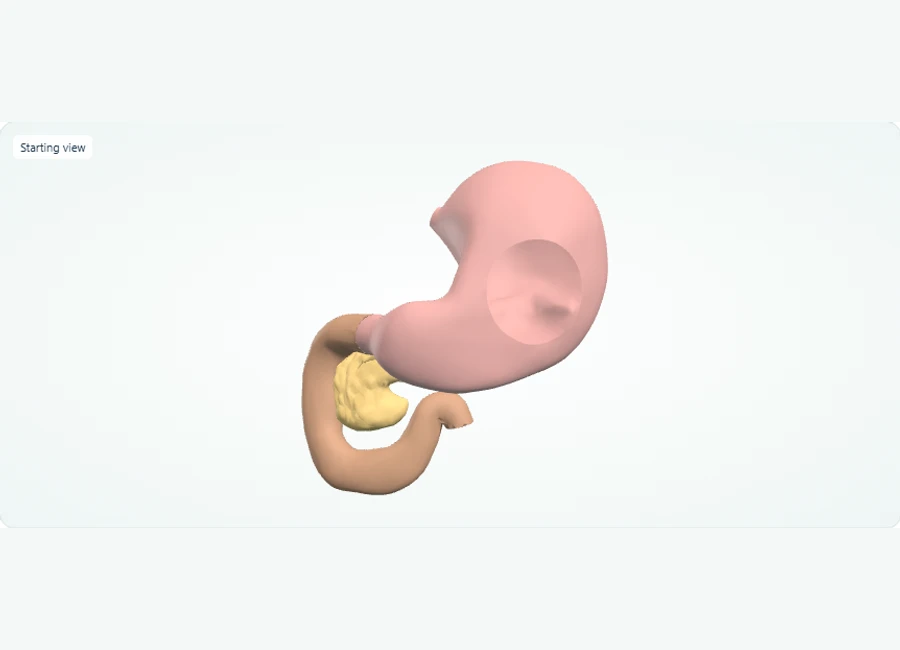
Rotate, isolate structures, and test your recall.
Rotate to the front view and zoom in to see the stomach and the duodenum continuing after it.
Select the duodenum and trace its curve, noting that the pancreatic head sits within that curve.
Use 'Hide selected' on the stomach so the pancreas, lying posterior to the stomach, is fully visible; then use 'Show all' to restore the view.
Try it yourself
Which organ has its head within the duodenal curve and lies posterior to the stomach?
Show answer and explanation
The pancreas.
After the stomach comes the duodenum, and the head of the pancreas lies within the duodenal curve; the pancreas also sits posterior to the stomach, so it is best inspected after hiding the stomach.
- The duodenum follows the stomach in the digestive pathway.
- The head of the pancreas lies in the curve of the duodenum.
- The pancreas lies posterior to the stomach, so hiding the stomach improves its exposure in this model.
Explore in 3D: Liver and Gallbladder
Locate the gallbladder on the inferior surface of the liver, then inspect the included bile duct. The liver and gallbladder are accessory digestive organs outside the food passage.
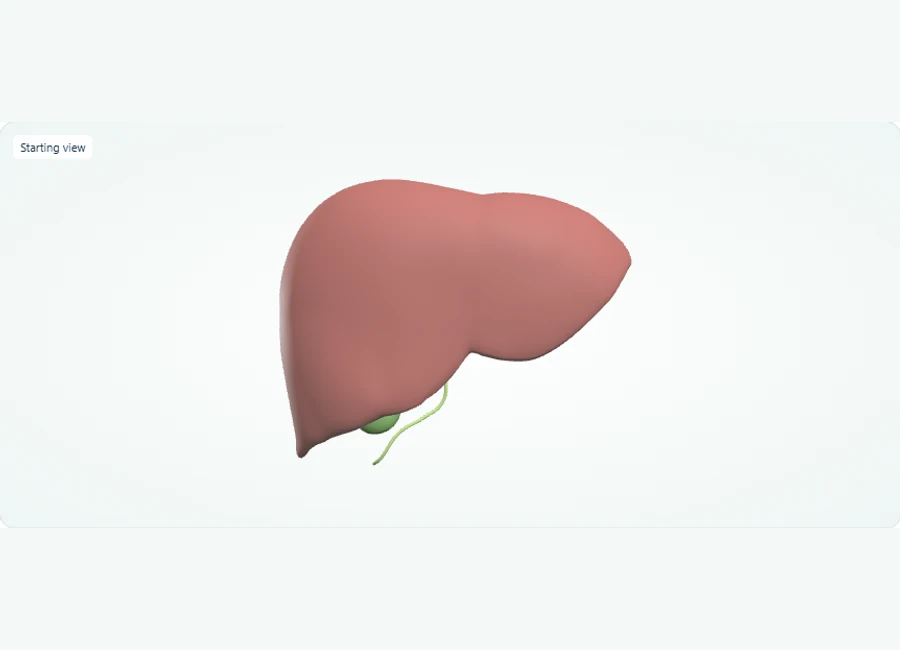
Rotate, isolate structures, and test your recall.
Rotate below the liver to find the gallbladder on its inferior surface.
Select the gallbladder and isolate it to inspect its shape. Use Show all before comparing its position with the liver.
Select and hide the liver, then select the bile duct to inspect its course. Complete hepatic and cystic duct junctions are not separately represented.
Try it yourself
Which accessory digestive organ lies on the inferior surface of the liver?
Show answer and explanation
Gallbladder
The gallbladder sits on the inferior (underside) surface of the liver and stores bile; bile leaves via the bile duct shown in this model.
- The gallbladder lies on the inferior surface of the liver.
- The liver and gallbladder are accessory organs — they are outside the food passage.
- The bile duct is included on this model, but the junctions between hepatic and cystic ducts are not shown or separately labelled.
Sedation recovery: acting on trends instead of single values
During and after moderate sedation, nursing judgment runs on a cycle: reassess airway, breathing, circulation, and responsiveness; act on small trends rather than waiting for crisis values; and escalate when stimulation and repositioning do not restore the baseline trajectory.
The core skill is trend interpretation. A patient whose responsiveness drifts down two points in a row, or whose oxygen saturation responds to a jaw thrust but slips again after stimulation, is showing a trajectory, not a blip. Normal recovery involves progressive return toward baseline responsiveness and stable saturations under the prescribed monitoring. Your practice cases should capture the difference between a value that is briefly low and a value that keeps drifting despite intervention, because each calls for a different response.
Worked scenario: after an EGD with moderate sedation, a patient is difficult to arouse five minutes after arrival in recovery, saturations dip to a level that responds to stimulation and a firmer jaw position, then drift down again. The plausible mistake is letting the patient continue sleeping and rechecking at the routine interval, assuming deep sedation is expected right after the procedure. The better decision is to treat the non-sustained response as an escalation trigger now: stimulate, optimize airway positioning and oxygen delivery, shorten the reassessment interval, and notify the physician promptly because the intervention is not holding. The difference between a slow drift and an airway emergency is measured in reassessment intervals, which is why recognizing when stimulation stops working deserves its own line in your notes.
Post-polypectomy problems: perforation red flags versus expected discomfort
Expected post-procedure discomfort is typically gas-related bloating that eases with passage of flatus; perforation red flags include progressively worsening localized pain, rigidity, distension, fever, or tachycardia. The distinction drives whether you reassure and observe or escalate immediately.
Air insufflation during colonoscopy commonly causes bloating and cramping that patients describe as gas pain; it is diffuse, tolerable, and improves over hours. Perforation, by contrast, tends to produce pain that escalates rather than eases, may localize, and is often accompanied by board-like rigidity, distension, fever, or unexplained tachycardia. The pattern over time, not the presence of pain itself, is the discriminating observation.
Worked scenario: several hours after a polypectomy, a patient calls saying the cramping that started in recovery is now constant, worse with movement, and the abdomen feels tight. The plausible mistake is reassuring the patient that gas pain is normal and scheduling a follow-up call tomorrow. The better decision is to treat escalating, localized pain with rigidity as a same-hour escalation: direct the patient to urgent evaluation and report the polypectomy history to the physician immediately. Why it matters: perforation management is time-sensitive, and the assessment skill worth drilling is pattern recognition over time rather than any single symptom's presence. Build the same contrast for post-polypectomy bleeding, which may appear days later with hematochezia or syncope, and for vasovagal responses during scope manipulation, writing the expected version and the red-flag version side by side until you can state the red flags from the reasoning.
| Observation | Most consistent with | Immediate nursing action | Escalation trigger |
|---|---|---|---|
| Black tarry stool with coffee-ground emesis | Probable upper GI source | Assess vitals and report before the planned procedure proceeds | Signs of hemodynamic instability |
| Clear to light yellow liquid effluent before colonoscopy | Adequate prep | Proceed with routine confirmation and documentation | None from prep alone |
| Dizziness on standing mid-prep | Hydration concern | Review intake, safety teaching, report per protocol | Syncope or sustained hypotension |
| Saturation dips that reverse with stimulation then recur | Sedation trend, not a blip | Stimulate, optimize airway and oxygen, shorten reassessment interval | Trend not holding after intervention |
| Escalating localized pain with rigidity after polypectomy | Possible perforation | Urgent evaluation and immediate physician notification | This presentation is itself the trigger |
Documentation and reporting that survive a review
Strong procedural documentation records objective observations, the time and response of each intervention, who was notified and when, and patient teaching given. It separates what you observed from what you concluded, so a reviewer can retrace your reasoning.
Compare two notes for the same event. 'Patient tolerated procedure well' is a conclusion with no observable basis. 'Arousable to voice, saturations 95 percent on 2 L, voided 200 mL clear yellow urine before discharge' is a set of observations a second reader can verify. In sedation records, each reassessment should be time-stamped with values and any action taken, so the trend is visible on the page rather than reconstructed from memory afterward.
Reporting has a parallel structure: state the observation, the trend, and what you have already done. 'Saturations dipped to the low 90s twice in fifteen minutes, responded to stimulation and repositioning, currently 96 percent, asking whether you want parameters changed' gives the physician a decision-ready picture. Self-check rubric for your rewritten notes: every claim is observable and measurable; times are present for each reassessment and intervention; physician notification appears with the time and response received; teaching is recorded with confirmation of understanding rather than 'educated patient.' Score one point per element. A three out of four as a learning milestone usually means notification or teaching documentation is the habit still under construction, and it is a practice target, not a prediction of any exam result.
Consent, specimens, and safety obligations across the procedure cycle
GI endoscopy carries procedure-specific obligations: verifying informed consent matches the planned scope, tracking specimens from retrieval to labeling, confirming equipment and emergency readiness, and applying infection prevention practices consistently across the procedure cycle.
Consent verification is more than a signature present: confirm the consent names the procedure planned, that the patient can restate the procedure's purpose in their own words, and that any change in plan mid-procedure is addressed by the physician with the patient or representative per policy. Specimen handling has a chain-of-custody character: a polyp removed during colonoscopy must be labeled, matched to the correct patient and site, and documented in the record. A labeling error caught at retrieval is a correction; discovered days later, it is a far costlier problem.
Frame safety as a three-phase cycle rather than one undifferentiated list: pre-procedure verification of patient, consent, allergies, and anticoagulation history; intraprocedure vigilance for equipment function, sedation monitoring, and specimen management; post-procedure monitoring and discharge teaching covering warning signs to report. Exercise with expected observations: take one fictional colonoscopy case and write three columns, pre, intra, and post-procedure, listing every safety obligation per column. Expected observations when you self-grade: a complete pre-procedure column includes consent match and anticoagulant history; intraprocedure includes specimen labeling at retrieval and sedation vigilance; post-procedure includes discharge warning signs. Missing an entire phase, rather than a single item, signals your mental model needs the cycle structure.
Scenario fluency: an adaptable study sequence and readiness checks
Rotate through topic blocks in this order: GI concepts, assessment and interpretation, applied practice decisions, procedures and documentation, ethics and safety, then mixed case analysis. Finish each block by writing your own scenario and solving it cold a week later.
A sequence adapted to this credential's cataloged topic areas: spend the first pass on core GI concepts, linking each disease fact to the observation it produces. The second pass covers assessment and interpretation, converting observations into ranked interpretations. The third pass is applied practice, where the four-part habit of observe, interpret, act, escalate becomes automatic. The fourth pass handles procedures, documentation, ethics, and safety as a phase cycle. Reserve the final stretch for mixed cases that force you to identify which area a scenario tests before answering.
When writing your own scenarios, use realistic GI situations with one deliberate ambiguity: a bleeding patient with an unclear source, a prep report mixing adequacy and hydration signals, a sedation trend hovering near protocol parameters. Solve each one cold a week later, writing observation, interpretation, first action, and escalation trigger before rereading your notes; the gap between the two versions shows which layer of the habit is underdeveloped. For practice volume, the free CGRN practice questions on this site pair well with this sequence, and the study guide library applies the same method to adjacent certifications.
Readiness checks: given any bleeding description, you can state the likely source category and one action it changes within a minute. Given a sedation sequence of values, you can say whether it is a blip or a trend and name the escalation point. You can rewrite any vague GI note to score four for four on your own documentation rubric. On mixed scenarios, you can name the topic area before answering. These are learning milestones for gauging your own preparation, not predictions of a score. For administrative details such as eligibility, scheduling, and current policies, use the certifying board's own site rather than secondary summaries.
References and further reading
Use these references to explore the concepts and check the latest information from the relevant organizations.