
Study the CPC by practicing the decision chain behind each code: identify which code set the question asks about, apply the conventions of that code set to the documented facts, and justify the selection with phrases from the note. Worked scenarios, a modifier decision table, a documentation-first drill with a rubric, and an adaptable preparation sequence carry this approach through the whole article.
CPT, ICD-10-CM, and HCPCS Level II answer three different questions
CPT describes procedures and services, ICD-10-CM describes diagnoses, and HCPCS Level II covers items and services outside CPT. Every scenario answer begins by asking which of these three questions the item is really asking.
Keep the three code sets separated by their question. A scenario describing a knee injection with a diagnosis of osteoarthritis needs a CPT code for what was performed, an ICD-10-CM code for why, and possibly a HCPCS Level II code for the drug supplied. Confusing the questions produces the classic error of searching the wrong book first. When you review practice items, label your answer with the code set and the question before checking the key.
A useful drill is to take mixed cases and tag each required code as procedure, diagnosis, or supply. Watch for the boundary cases: some HCPCS Level II codes look procedural, and some drug administration codes live in CPT while the drug itself is a J-code. The skill worth building is recognizing which book answers the item, not speed of lookup. Speed comes later; the code-set question comes first, every time.
| Code set | Answers the question | Typical example |
|---|---|---|
| CPT | What procedure or service was performed? | Knee joint injection |
| ICD-10-CM | Why was the service medically necessary? | Osteoarthritis of a specific knee |
| HCPCS Level II | What item or substance was supplied? | Injectable drug identified by a J-code |
NOS, NEC, and unspecified: the ICD-10-CM conventions that decide the code
NOS means the documentation left the detail unspecified; NEC means the documentation was specific but no dedicated code exists. Choosing between them is a reading task, not a preference for the more specific-looking code.
Work the distinction through a scenario. A note documents abdominal pain without stating a site: the correct choice is the unspecified-location code, because NOS-style conventions code what the provider documented, and the site was simply not given. Contrast that with a note documenting a precisely described condition that lacks its own dedicated code entry; there the NEC-style convention routes you to the residual category. A plausible mistake is grabbing the NEC option in the first case because it looks more detailed.
Laterality works the same way: it follows documentation, not inference. If the note says left knee, the laterality-specified code is available; if it says only knee, the unspecified code is the honest answer, even when the encounter elsewhere in the record implies a side. Practice by writing, next to each diagnosis code, the exact documented phrase that fixed the specificity. If you cannot quote a phrase, you have likely defaulted on a convention.
Explore in 3D: Right Femur: Orientation and Key Ends
The femur is the thigh bone. This model shows one whole bone, the right femur, as a single selectable structure. You can identify side and ends by checking that the head faces medially at the proximal end, while the distal end helps form the knee.
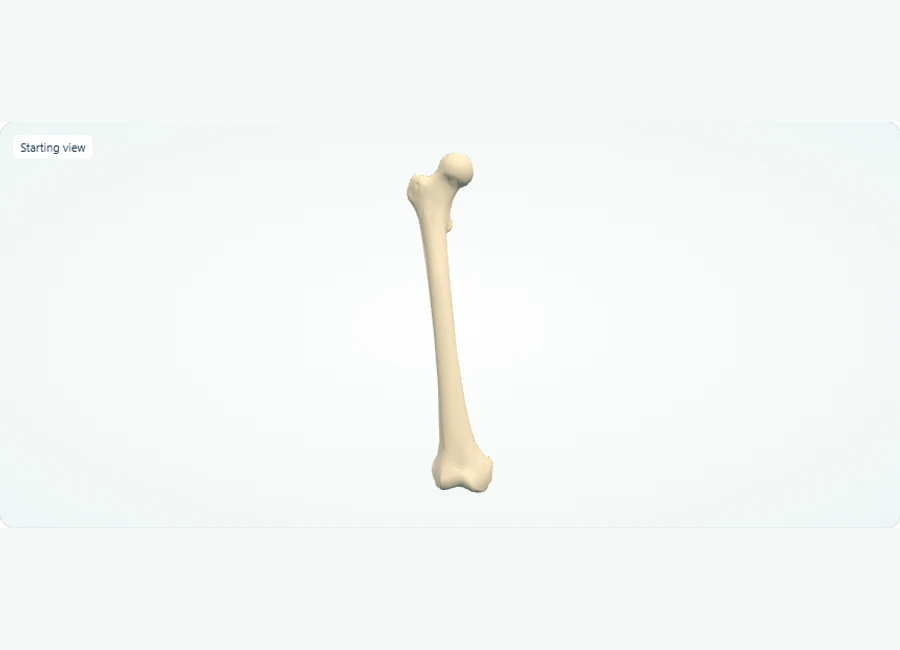
Rotate, isolate structures, and test your recall.
Locate the rounded head at the proximal end. In the body, this head faces medially toward the midline.
Switch between Front and Back to compare the proximal head with the broader distal end at the knee.
Zoom and rotate to review the ends again. Only the whole bone is selectable; individual landmarks do not have separate labels.
Try it yourself
Which end of the femur has the rounded head, and does that head face toward or away from the body’s midline?
Show answer and explanation
The proximal end has the rounded head. It faces medially, toward the body’s midline.
The femoral head is proximal, at the hip. The broader distal end contributes to the knee. Use anatomical directions relative to the body; screen directions change when the model is rotated.
- The femur lies in the thigh and is the single bone of that region.
- The head faces medially at the proximal end; use this to tell anatomical right from left on screen.
- The distal end of the femur contributes to the knee joint.
Illustrated practice: Femoral Regional Anatomy for Musculoskeletal Coding
Lets the learner see the spatial separation between the diaphyseal shaft and the distal condyles, grounding the supracondylar-versus-shaft distinction that drives the CPT anatomical-site decision.
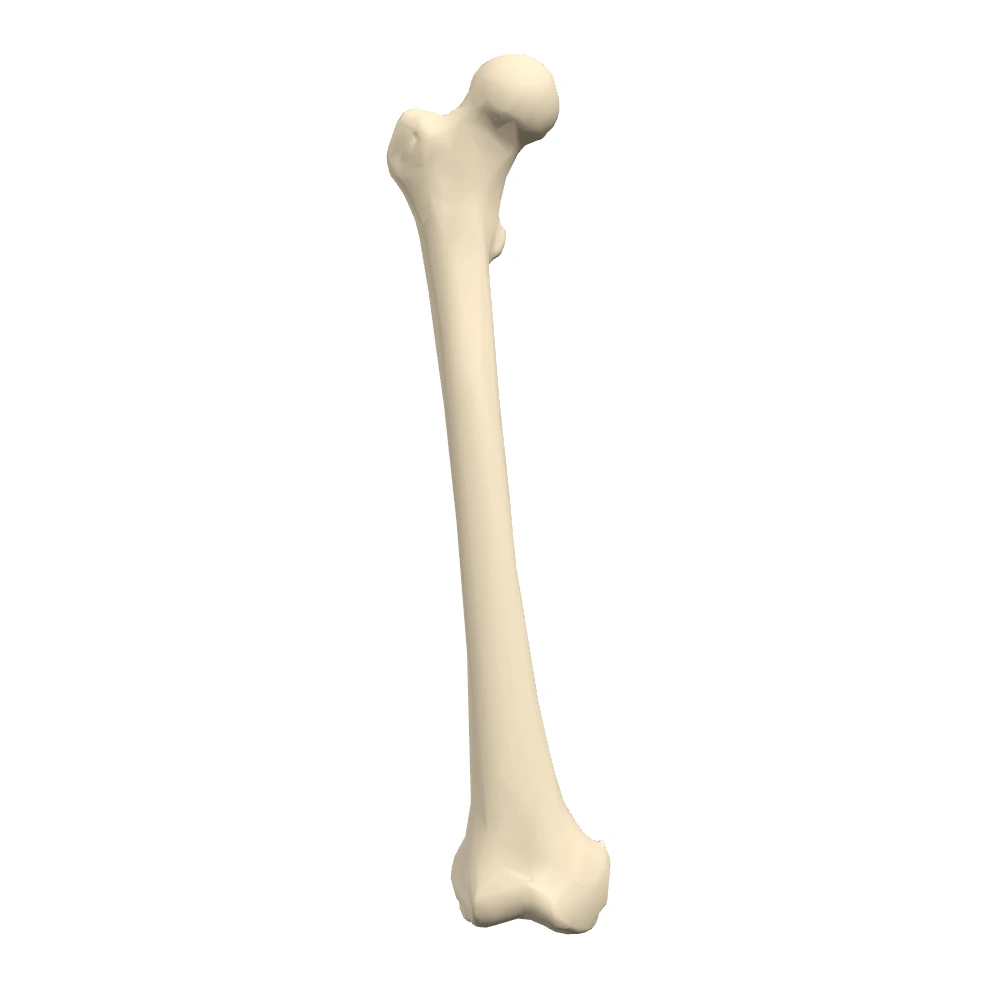
Anatomical study exhibit for the worked question below. Open the full-size view to inspect the structures.
Use the anatomical exhibit to work through the example. Choose an answer before opening the explanation.
Try it yourself
An orthopedic surgeon disputes a coder's work: the coder reported a femoral shaft fixation, but the operative note states 'plate fixation of a supracondylar fracture of the distal femur.' The accompanying illustration is a normal anatomical reference render of an isolated femur, anterior view (not a patient image and not the operative site), showing the proximal head and neck, the long diaphyseal shaft, and the distal condyles. Which anatomical clarification resolves the discrepancy? A. The supracondylar region is the proximal femur near the greater trochanter, so the coder should select a hip-region code B. The supracondylar region describes the femoral neck near the hip joint and requires a proximal femur code C. The femoral condyles are part of the femoral shaft, so the original selection was acceptable D. The supracondylar region is the distal femur just proximal to the femoral condyles, which is anatomically distinct from the diaphyseal shaft, so a shaft procedure code does not describe this fixation
Show answer and explanation
D. The supracondylar region is the distal femur just proximal to the femoral condyles, which is anatomically distinct from the diaphyseal shaft, so a shaft procedure code does not describe this fixation
Supracondylar means the area of the distal femur immediately above the condyles, separate from the diaphysis (shaft). In the render, the condyles are the paired distal expansions at the far end of the bone, and the shaft is the long mid-portion; the supracondylar region lies just above those condyles and is visibly distinct from the mid-shaft. Because CPT musculoskeletal codes are keyed to anatomical site, the shaft code misrepresents the treated region. The femoral neck and greater trochanter, also visible proximally in the render, are not supracondylar locations.
Visual anatomy review: Follow the digestive route and accessory organs
Trace the upper endoscope route before interpreting which work the report documents.
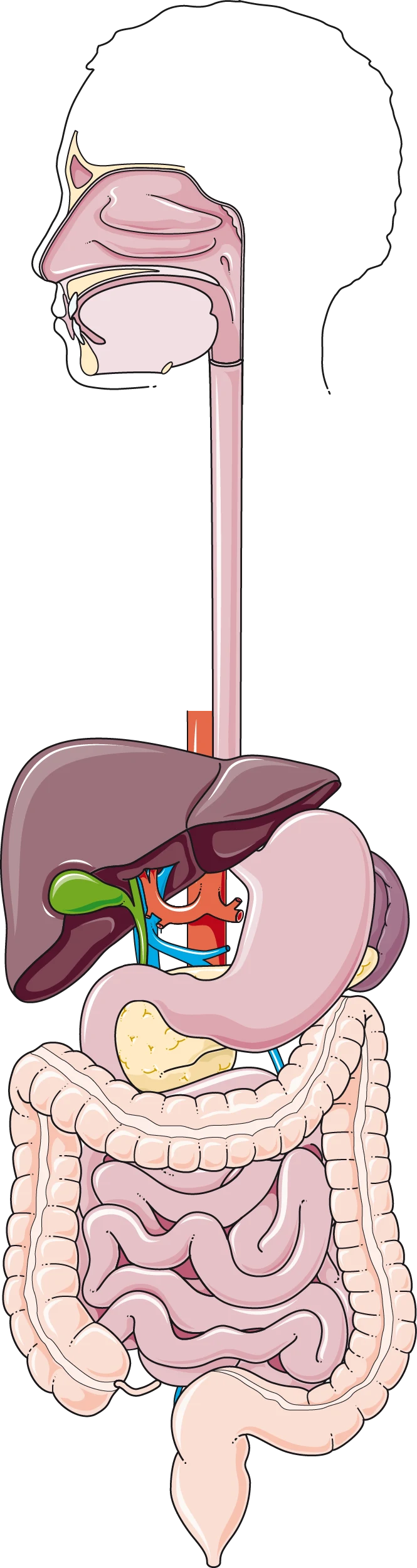
The digestive tract is a continuous passage; the liver, gallbladder and pancreas are accessory organs. Open the full-size illustration for the smaller abdominal structures.
Trace the esophagus into the stomach and then the small intestine. The duodenum comes first, followed by the jejunum and ileum. The gallbladder lies beneath the liver; it is not part of the passage through which food travels.
In Z-Anatomy, locate the stomach, duodenum, liver and gallbladder. Rotate the visceral structures to inspect their relationships, then describe the food passage without including the accessory organs in it.
Try it yourself
An upper endoscope passes through the esophagus and stomach. Which small-intestinal segment does it reach first, and is the gallbladder part of that route?
Show answer and explanation
It reaches the duodenum first. The gallbladder is an accessory organ outside that food passage.
Separate the route of access from the target of a procedure. The diagram supports location recall; the actual operative findings and work performed determine the procedure being described.
E/M level selection: applying the MDM elements instead of judging the patient
Office visit levels rest on documented medical decision making or documented time. The MDM route scores three elements—problems addressed, data reviewed, and risk—and the level must be supported by the note, not the chart's problem list.
Scenario: a note describes a patient with diabetes and hypertension, states both chronic conditions were addressed and stable, records that outside lab results were reviewed, and documents a medication change. A plausible mistake is selecting the level by counting the chronic diagnoses sitting on the problem list, which inflates the problem element with conditions the visit never touched. The better decision is to score only what the note says was addressed, count the data element from the documented review of outside results, and weigh the risk from the prescription drug management decision.
Why it matters: MDM requires meeting or exceeding the threshold in two of the three elements, so miscounting one element changes the answer. The discipline to build is the word addressed. Train yourself to underline every condition the note actively managed and ignore the ones merely carried forward. The same habit guards the time pathway: if a case codes by time, the note must support the total time and the activities described, and that is a different documentation trail than MDM.
Modifier 25 versus modifier 59: a decision table for same-day services
Modifier 25 attaches to an E/M code to signal a separately identifiable visit on the same day as a procedure; modifier 59 and its X variants attach to procedures to signal a distinct service. Their placement and meanings are not interchangeable.
Scenario: a visit includes a problem-focused E/M service and a lesion removal performed the same day. A plausible mistake is appending modifier 59 to the procedure code, as if 59 meant same-day in general. The better decision is modifier 25 on the E/M, because 25 exists precisely to tell the payer that the evaluation and management was significant and separately identifiable from the usual work around the procedure. Appending 59 to the procedure here distorts the message the modifier was built to carry.
Why it matters: modifiers change the meaning of the code they accompany, so a wrong modifier does not just risk a denial; it misdescribes the encounter. Before finalizing any modifier, complete the sentence the modifier implies: this E/M was separately identifiable because the note documents a distinct problem addressed, or this procedure was distinct because the note documents separate lesions, sites, or sessions. If you cannot finish the sentence with documented facts, the modifier is not ready.
| Modifier | Attaches to | What it signals | Documentation you look for |
|---|---|---|---|
| 25 | The E/M code | A significant, separately identifiable visit on the same day as a procedure | A distinct problem evaluated and managed beyond routine pre- and post-procedure work |
| 59 | A procedure code | A distinct procedural service under circumstances that normally bundle | Separate lesion, site, session, or encounter documented in the note |
| XE, XS, XP, XU | A procedure code | More specific versions of the 59 idea: separate encounter, site, provider, or service | The note isolating exactly which circumstance made the service distinct |
Procedure scenarios: laterality, approach, and the separate-procedure flag
Procedure answers hinge on details the note must state: which side, which approach, and whether a listed separate procedure was genuinely independent. Each of these details maps to a different code choice, and each fails silently when assumed.
Build a checklist of three questions for every procedure scenario. First, laterality: does the note name the side, and does the CPT family offer separate codes for it? Second, approach: open, arthroscopic, percutaneous, and endoscopic wording in the note usually maps to different codes, and guessing the approach from the procedure name is a recurring trap. Third, CPT's separate procedure designation: a code flagged that way describes something bundled into a larger service unless the documentation establishes it was truly independent.
Scenario: a note describes a carpal tunnel release but never states the side. A plausible mistake is selecting a laterality-specific code because the scheduled procedure header mentioned it. The better decision is to work from the operative documentation itself: if the body of the note omits the side, the honest code is the one the note supports, and in real coding work that gap is what a documentation query exists for. Practicing this observation now trains the habit the credential is meant to certify: code follows the written record.
A documentation-first drill you can run daily, with a self-check rubric
Take one short practice note per day and code it in four passes: read without coding, list the documented facts, select codes, then annotate each code with its supporting phrase and each convention you invoked.
The drill works because it exposes where you are inferring instead of reading. Pass one: read the note once straight through, no code book. Pass two: list every documented finding, decision, side, approach, and quantity. Pass three: select codes. Pass four: annotate. Expected observations in early sessions: annotations that reference the problem list instead of the note body, laterality you assumed from context, and MDM elements scored from diagnosis counts. These observations are the point of the exercise, not failures in it.
Score yourself on this rubric after each drill. Four points means every code carries a quoted supporting phrase; three means every NOS, NEC, laterality, and modifier choice is named as a convention; two means no code rests on chart inference rather than the note; one means you reread the note fully before opening the code book. Treat the score as a learning milestone that should trend upward across a week of drills, not as a prediction of any exam outcome. When an annotation is impossible to write, that code is the one to study.
- Pass 1: read the full note once with no code book open.
- Pass 2: list documented findings, sides, approaches, decisions, and quantities.
- Pass 3: select codes from the correct code set for each question.
- Pass 4: quote the supporting phrase beside every code and name every convention used.
- Rubric milestone: four quotable annotations in a row before moving to a new topic.
An adaptable preparation sequence and readiness checks before you sit the exam
Sequence your study by decision skill: code sets and conventions first, then E/M and modifiers, then procedure sections, then mixed timed cases. Finish when your error log shows convention errors shrinking and every annotation habit holding under time.
An adaptable sequence: start with the three code sets and the ICD-10-CM conventions of NOS, NEC, laterality, and etiology sequencing, using daily documentation-first drills. Next, spend a block on E/M pathways and the modifier family, since both reward the same annotate-before-you-answer habit. Then move through the CPT procedure sections, applying the laterality, approach, and separate-procedure checklist. Close with mixed practice sets under a self-set clock and an error log sorted by convention type. Adjust the length of each block to your starting familiarity rather than a fixed calendar.
Readiness checks: you can state the difference between NOS and NEC without a reference; you can explain modifier 25 and modifier 59 in one sentence each, including which code each attaches to; you can complete a full drill with four quotable annotations; your error log shows the same convention mistakes stopping; and you can work a mixed scenario at your self-set pace while still annotating. For administrative details about the credential itself, including current eligibility and exam logistics, go to the issuer at aapc.com; those specifics belong to the official source, not to a study guide.
References and further reading
Use these references to explore the concepts and check the latest information from the relevant organizations.