
Study for the BOC ATC by training one habit: before reading any scenario's options, name the practice domain it tests and restate the decision point in your own words. Then apply domain rules — triage order for emergency stems, criterion-matching for rehabilitation, policy-following for professional items — and log every miss by type so knowledge gaps separate cleanly from stem misreads.
What the Stem Is Testing: Find the Decision Point Before the Options
Every scenario item centers on a decision point: the moment the clinician must choose the next action. Naming that decision before reading the options keeps you from answering a question the stem never asked.
The same case can serve several purposes. A basketball player who lands awkwardly and grabs her knee could anchor an evaluation item about which stress test to perform, an immediate-care item about what to do before moving her, or a treatment item about the first phase of rehabilitation. The injury is identical across all three; the wording of the stem and the options define which practice decision is under review. Treat the stem's final question as the contract, and treat each option as a claim about that contract.
Build one habit into every practice session: after reading the stem, pause and restate the decision in your own words — 'this is asking what I do first,' or 'this is asking which finding points to a specific structure.' Only then read the options. When you miss a question, classify the miss: did you lack the knowledge, or did you answer the decision point you assumed instead of the one written? That second type of miss is invisible unless you log it deliberately.
Down-Athlete Scenarios: Sequence the Primary Survey Before Any Special Test
When a stem describes an athlete who is down or unresponsive, the tested decision is triage order. Confirm responsiveness and rule out life-threatening conditions, and follow the emergency action plan, before assessing the injured limb.
Worked scenario one: a soccer midfielder collapses after a collision, clutching her lower leg, and an assistant coach shouts for you to splint it. The options include applying a splint, performing a knee stress test, checking responsiveness and breathing, and calling the athlete's parent. The tempting choices all describe the visible injury. The better decision is the survey: verify consciousness, airway, breathing, and circulation concerns and confirm scene safety first, because manipulating an athlete with an unrecognized life threat can turn a limb injury into a catastrophic one.
This distinction matters because evaluation-domain questions quietly assume a stable athlete; stems often signal that with a phrase such as 'after confirming no head or neck involvement.' Immediate-care questions test the sequence itself. When you drill, sort down-athlete items into these two buckets and rehearse the order aloud: scene safety, responsiveness, life threats, emergency activation, then limb care. If your practice answer jumps straight to the ankle, that is the pattern to fix — not a knowledge gap about splinting.
Explore in 3D: Right knee: bony relationships
A right knee shown as four whole bones — femur, tibia, fibula and patella — in anatomical position. This model teaches which bone sits where around the knee, not soft-tissue joint anatomy: no menisci, cartilage, cruciate ligaments or tendons are included.
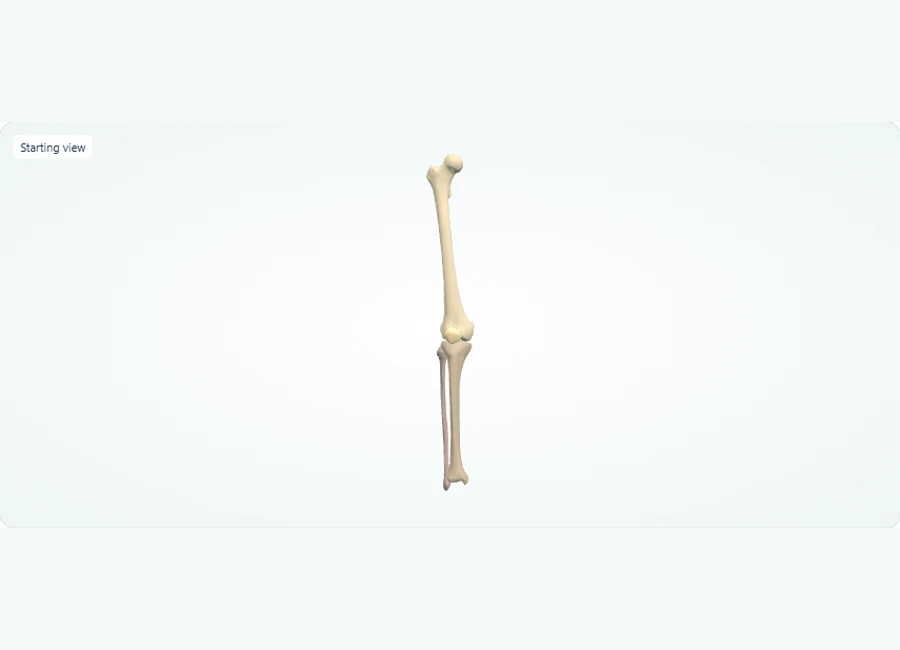
Rotate, isolate structures, and test your recall.
Compare Front, Back and Side views. Whole bones are included, so zoom and pan toward the knee region.
Select and isolate the patella to inspect it. Use Show all, then select and hide the patella to inspect the femur and tibia near the knee.
Use Show all and Test recall. Identify the highlighted bone, using the fibula’s lateral position and patella’s anterior position as clues.
Try it yourself
Which leg bone lies lateral to the tibia, and where is the patella relative to the knee?
Show answer and explanation
The fibula lies lateral to the tibia. The patella lies anterior to the knee.
In anatomical position, the fibula is the slender lateral leg bone, beside the larger tibia. The patella lies in front of the distal femur. These are bony relationships; the model does not include joint cartilage, menisci or ligaments.
- In anatomical position the fibula is the lateral bone of the leg, so it is your orientation landmark for left/right.
- The patella lies anterior to the femur–tibia articulation, so it appears at the front in a front view and overlaps the distal femur in profile.
- The knee region contains four bones here: femur above, tibia and fibula below, patella in front; joint soft tissues are not part of this model.
Heat Illness Paper Cases: Use CNS Findings, Not Skin Appearance
Written heat-illness scenarios hinge on central nervous system function. Disorientation, unusual behavior, or collapse with confusion signals the more dangerous exertional heat stroke category rather than exhaustion with sweating and cramping.
Worked scenario two: during a hot-weather practice, a lineman stumbles to the sideline, responds slowly, and seems combative when approached; his jersey is soaked. The options include providing fluids in the shade and reassessing in thirty minutes, sending him to the locker room to rest, and activating the emergency action plan for immediate cooling. The plausible mistake is the wait-and-see fluid option — a reasonable response to heat exhaustion but a dangerous delay once altered cognition appears. The better decision pairs the CNS findings with the EAP and rapid cooling.
Skin condition is the unreliable clue in these cases: a heat-stroke scenario can describe either wet or dry skin, so it cannot carry the diagnosis by itself. Train your eye on mentation, behavior, and the sequence of collapse instead. Two cautions keep this honest: these are simplified paper cases, and real-world protocols — cooling methods, temperature assessment, transport decisions — come from your emergency action plan and supervising medical direction, not from any exam-preparation text.
Evaluation Versus Treatment Items: Match the Option to the Phase of Care
Acute cases ask which protected examination step comes next; rehabilitation cases ask about progression criteria and goals. Choosing a special test on a rehab item — or an exercise on an acute one — signals a phase misread.
Run this contrast deliberately: an athlete who inverted her ankle ten minutes ago with swelling beginning and pain over the lateral ligaments, versus the same athlete two weeks later with swelling resolved and full weight-bearing. On the acute stem, defensible options involve protection and gentle, structure-respecting assessment; an aggressive flexibility drill is the distractor. On the two-week stem, the question shifts to progression — which criterion, such as pain-free range or a normal gait, justifies the next exercise stage — and a special test is now the out-of-phase choice.
Goal-writing items belong to the same discipline. A correct short-term goal names the impairment, the measurable change, and the timeframe: 'increase ankle strength' is a direction, not a goal, while 'restore pain-free dorsiflexion equal to the uninvolved side within two weeks' is checkable. When you review rehabilitation questions, ask what evidence in the stem justifies progression — pain level, range of motion, gait, swelling — and confirm your chosen option cites one of those criteria rather than a modality or an instinct.
Professional-Responsibility Items: Follow the Pathway, Not the Pressure
Ethics and organization items ask which action follows documentation, scope of practice, and referral pathways. The correct action follows the written pathway rather than the response that best satisfies a coach, a parent, or the athlete.
Consider the sideline case: an athlete with a suspected concussion wants to return, the coach says the game depends on him, and the parents insist he is fine. Options include clearing him to finish the half, clearing him with a warning, removing him and following the documented pathway that includes physician referral, and negotiating a compromise. The mistake is reading the item as a loyalty test. The better answer follows the written criteria and the referral pathway, even though it disappoints everyone in the scene.
Documentation items apply the same logic. Records capture observations and actions — what you saw, what you did, what you communicated, and when — rather than speculation or blame. When a stem asks which note entry is most appropriate, eliminate options that editorialize, that skip a contemporaneous record of a significant decision, or that assign documentation responsibility vaguely. Practice this by drafting a three-line note after each scenario you study: what happened, what you assessed, and what you decided with your reasoning.
Decision Drill: Domain-Mapping Practice With a Self-Check Rubric
Take ten practice scenarios and, before reading the options, write the domain and the decision point for each stem. The table and rubric below turn that habit into a measurable weekly milestone.
Run the drill on any mixed question set. For each item, give yourself ninety seconds to record two things: the domain you believe the stem tests, and the decision point restated in your own words. Then answer normally. After scoring, sort your misses into three piles: knowledge gaps, where you did not know the content; mapping errors, where you knew the content but answered the wrong decision; and option traps, where you read the decision correctly but chose a distractor that sounded better.
Use the table above as your mapping key whenever a domain is hard to name. Expected observations: mapping accuracy of eight or more out of ten is a reasonable weekly milestone — a learning benchmark, not a prediction of any exam result — and mapping errors tend to concentrate at the boundary between immediate care and evaluation. Re-run the drill each week with fresh questions and watch whether the knowledge-gap pile shrinks faster than the mapping pile; if it does not, spend one session reading stems only.
Use the table above as your mapping key when a domain is hard to name. Expected observations from the drill: mapping accuracy of eight or more out of ten is a reasonable weekly milestone — a learning benchmark, not a prediction of any exam result — and mapping errors concentrate at the boundary between immediate care and evaluation. Each week, re-run the drill with fresh questions and watch whether the knowledge-gap pile shrinks faster than the mapping pile; if not, spend a session re-reading stems only.
| Practice domain | Typical stem cue | First decision in the scenario |
|---|---|---|
| Risk and illness prevention | Pre-season, environmental, or equipment conditions | Identify the hazard and the policy or screening that addresses it |
| Clinical evaluation and diagnosis | A stable athlete with a new or evolving complaint | Choose the next assessment step that narrows the differential |
| Immediate and emergency care | Collapse, unresponsiveness, or an unstable scene | Confirm life threats and activate the emergency action plan |
| Treatment and rehabilitation | A documented injury moving through recovery stages | Match the next intervention to the stated progression criteria |
| Organizational and professional responsibility | Coach, parent, or documentation pressure | Follow the written policy, scope, and referral pathway |
An Adaptable Study Sequence With Concrete Readiness Checks
Prepare in three passes: map domain content by body region and condition, drill mixed scenario sets with the mapping exercise, then run timed mixed blocks until your decision-point identification stays accurate under pressure.
A workable sequence: in the first phase, study content through the domain lens — for each body region, list the prevention measures, the evaluation sequence, the emergency differentials, and the rehabilitation progression. In the second phase, shift to mixed sets and run the ten-item mapping drill weekly, keeping an error log with the three miss types. In the final phase, run timed blocks, review every miss against the log, and re-test yourself on the decision points, not just the answers. Compress or extend each phase to fit your calendar.
Check readiness against behaviors, not scores: you can restate any practice stem's decision point before reading the options; you can sequence a down-athlete case aloud without hesitating; you can separate the two heat-illness categories using CNS findings alone; your error log shows mapping errors becoming rare; and timed blocks no longer change your mapping accuracy. One administrative note: eligibility, scheduling, and credential-maintenance details are published by the Board of Certification for the Athletic Trainer at bocatc.org.
References and further reading
Use these references to explore the concepts and check the latest information from the relevant organizations.