
Study for the ABIM internal medicine certification by building a reasoning layer on top of factual recall: classify each practice question by what it asks, use likelihood ratios to justify workup choices, and drill the confirm-versus-act decision on branching paper cases.
Telling "Most Likely Diagnosis" from "Best Next Step" Questions
Board-style stems ask three distinct things: the most probable diagnosis, the single best action right now, or the most appropriate long-term management. Classify the question before reasoning, because each type rewards a different first move.
Diagnosis questions use cues like "most likely explains" or "most likely diagnosis"; here you compare illness scripts against the vignette. Next-step questions use "most appropriate next step" or "best initial management"; here you weigh urgency and what information would change your action. Long-term questions use "most appropriate management" or "best maintenance therapy," where complication prevention and durable control matter more than acute sequencing. Read the final sentence of the stem first and name the type before touching the options.
The same vignette legitimately supports different answers under different stems. A 55-year-old smoker with productive cough, low-grade fever, and focal crackles points to community-acquired pneumonia as a diagnosis answer; but if the stem instead says the patient is hypotensive and confused, the next-step answer shifts to immediate resuscitation and empiric treatment rather than naming the organism. Practicing this switch deliberately teaches you that options are not right or wrong in isolation; they are right or wrong relative to the question asked.
Missing this distinction is a reasoning error, not a knowledge gap: you can know every fact about a disease and still choose a workup answer when the stem demanded an action, or name a diagnosis when the stem demanded disposition. Build the classification habit early so it runs automatically under time pressure.
| Stem cue | What it tests | First move | Typical reasoning slip |
|---|---|---|---|
| "Most likely diagnosis" / "most likely explains" | Discriminating between look-alike conditions | Compare illness scripts feature by feature | Locking onto a label mentioned earlier in the vignette |
| "Best next step" / "most appropriate next action" | Sequencing care under urgency | Ask what harms the patient if delayed | Ordering a confirmatory test when the risk of waiting is the real issue |
| "Most appropriate management" / "best long-term therapy" | Sustained control and complication prevention | Match therapy to disease stage and goals | Reusing an acute-phase answer for a chronic-phase question |
Applying Likelihood Ratios Without Misreading a Positive Result
Sensitivity and specificity describe a test; likelihood ratios translate a result into revised probability. Learn to combine the pretest probability from the vignette with the result before choosing the next diagnostic move.
Sensitivity answers: if the disease is present, how often is the test positive? A highly sensitive negative result pushes probability toward disease-absent, which is the logic behind using sensitive tests to rule out. Specificity answers: if disease is absent, how often is the test negative? A highly specific positive result pushes toward disease-present, the logic of rule-in tests. Likelihood ratios package both: multiply the pretest odds by the LR of the observed result to get post-test odds.
Worked teaching example (simplified, for illustration only): suppose 2% of a screened population has the disease and a test with 95% sensitivity but modest specificity is applied to 10,000 people. Roughly 190 of the 200 diseased people test positive, but a large number of the 9,800 healthy people also test positive, so the majority of positive results come from people without disease. In a different vignette where the pretest probability is 60% from history and examination, the very same test result carries far different meaning. Train yourself to state the pretest probability a vignette implies before interpreting any result.
In practice questions, this skill shows up as the choice between proceeding to a confirmatory test, reassuring the patient, or treating empirically. A positive result on a low-specificity test in a low-probability patient rarely justifies invasive confirmation without a more specific follow-up test, while a strong history in a high-probability patient may justify action before any result returns.
Explore in 3D: Stomach, Pancreas and Duodenum: Spatial Relationships
Study the three selectable organs in this model — stomach, duodenum and pancreas — focusing on how they sit relative to one another: the duodenum follows the stomach, the pancreatic head lies in the duodenal curve, and the pancreas lies posterior to the stomach.
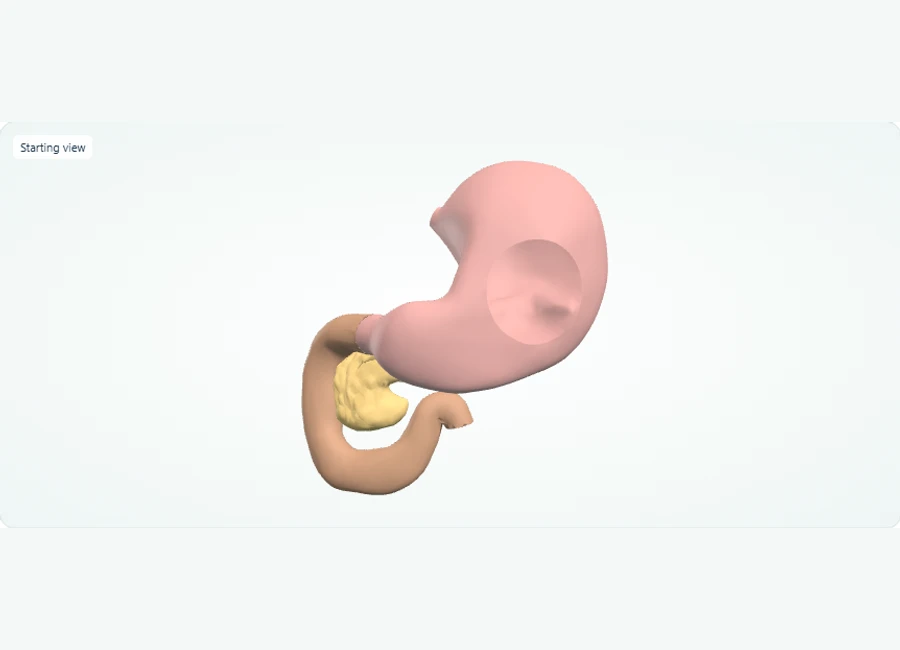
Rotate, isolate structures, and test your recall.
Rotate to the front view and zoom in to see the stomach and the duodenum continuing after it.
Select the duodenum and trace its curve, noting that the pancreatic head sits within that curve.
Use 'Hide selected' on the stomach so the pancreas, lying posterior to the stomach, is fully visible; then use 'Show all' to restore the view.
Try it yourself
Which organ has its head within the duodenal curve and lies posterior to the stomach?
Show answer and explanation
The pancreas.
After the stomach comes the duodenum, and the head of the pancreas lies within the duodenal curve; the pancreas also sits posterior to the stomach, so it is best inspected after hiding the stomach.
- The duodenum follows the stomach in the digestive pathway.
- The head of the pancreas lies in the curve of the duodenum.
- The pancreas lies posterior to the stomach, so hiding the stomach improves its exposure in this model.
Explore in 3D: Kidneys, Ureters and Bladder: The Urine Transport Pathway
This model shows five selectable structures: the right and left kidneys, the right and left ureters, and the urinary bladder. It demonstrates the gross pathway of urine transport from where urine forms (kidneys) to where it is stored (bladder). Note: the urethra and internal renal anatomy are not included in this model, so the pathway ends at the bladder.
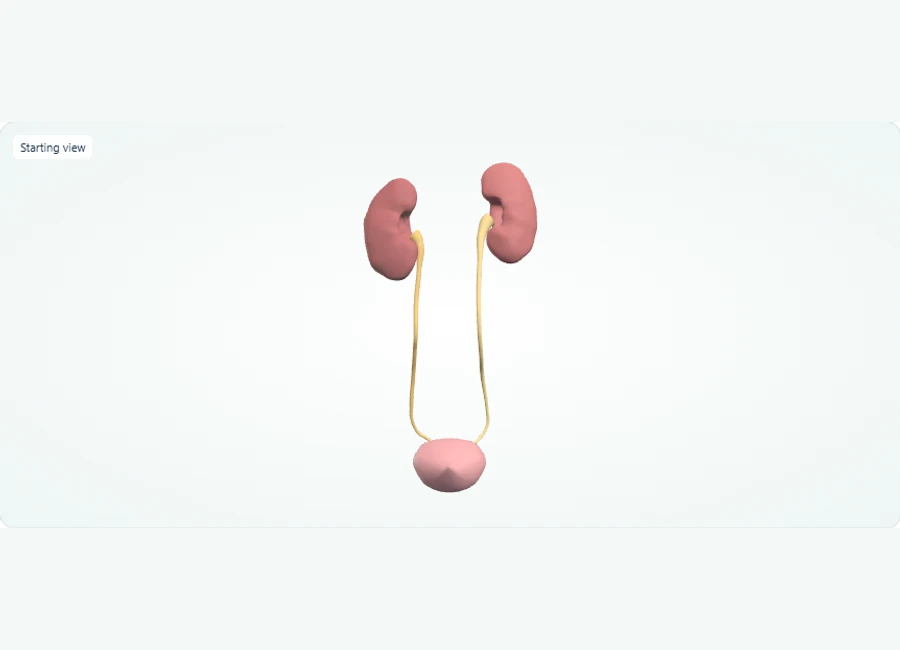
Rotate, isolate structures, and test your recall.
Choose Front. Select the right kidney, then its ureter, and follow the route toward the bladder with all structures visible.
Repeat on the left side. Select and hide each kidney separately if you want a clearer view of the ureters; use Show all to restore them.
Select the urinary bladder. Rotate the model and identify where the paired ureters meet the single bladder.
Try it yourself
Trace the three structures in the right-sided urine transport route shown here. What does the final structure do?
Show answer and explanation
Right kidney, right ureter, urinary bladder. The bladder stores urine until it leaves the body. (The left side follows the same pattern: left kidney and left ureter also deliver urine to the bladder.)
Urine flows from each kidney into its own ureter, which transports it down to the urinary bladder for storage. Both the right and left ureters empty into the single bladder. Because the urethra is absent from this model, the bladder is the terminal structure you can trace.
- Urine is formed in the kidneys; from each kidney, urine drains into that side's ureter (right ureter from right kidney, left ureter from left kidney).
- Each ureter carries urine downward to the urinary bladder, which stores urine until it is expelled; this model shows both ureters joining the bladder.
- This model is a gross transport overview only: the urethra and internal kidney structures are not shown, so urine flow beyond the bladder cannot be traced here.
Building Illness Scripts That Separate Look-Alike Diagnoses
An illness script organizes a disease by typical patient, tempo, key findings, and mechanism. Scripts built around discriminating features, not shared features, are what let you choose between two similar answer choices.
For each major condition you study, write a one-line script with four slots: who typically gets it, how fast it develops, the one or two findings that stand out, and the underlying mechanism. A script such as "older adult with vascular risk factors, sudden focal deficit, embolic or thrombotic brain injury" is usable at the bedside and in a question stem because it predicts what should and should not be present.
Then build paired comparisons for classic confusions: conditions sharing a chief complaint but differing on tempo, demographics, or a single pivotal finding. For example, two causes of acute dyspnea may both produce hypoxia, but one typically features pleuritic pain and risk factors for venous thrombosis while the other features orthopnea and a history of ventricular dysfunction. When you later face a stem, the shared features confirm you are in the right differential, and the discriminating features select the answer. Keep a running table of pairs per organ system rather than isolated disease notes.
A useful drill: for each pair, force yourself to state one finding that, if present, would make condition A nearly impossible and condition B likely. If you cannot name such a discriminator, your knowledge of at least one of the two conditions is still descriptive rather than diagnostic, and that pair deserves another pass.
Worked Scenario 1: Sequencing an Acute Metabolic Emergency
Urgent paper scenario: a patient with severe hyperkalemia shows peaked T waves and widened QRS complexes on ECG. The question asks for the best next step, and the answer hinges on ordering interventions by what each one accomplishes.
Plausible mistake: selecting a potassium-eliminating measure, such as a potassium-binding agent or dialysis discussion, as the first action. This feels definitive because it addresses the root problem, but elimination works over hours, and meanwhile the myocardium remains electrically unstable. The reasoning error is matching the intervention to the disease rather than to the immediate threat named in the stem.
Better decision, commonly taught as the stabilize-then-shift-then-remove sequence: first stabilize the cardiac membrane with intravenous calcium to reduce the risk of fatal arrhythmia within minutes; then drive potassium transiently out of the extracellular compartment with insulin given with glucose; then arrange actual removal from the body through binding agents, enhanced excretion, or dialysis depending on the setting. Each step answers a different question, and only the first one addresses what can kill the patient in the next few minutes. The teaching point generalizes: when a stem shows an immediate life threat, sort the options by speed of effect, not by how thoroughly they fix the underlying cause.
Practice this on paper with three or four metabolic and toxicologic scenarios, writing the sequence before looking at options. Note that specific agents, doses, and local protocols evolve, so anchor your study to the sequence logic and verify current details against up-to-date clinical references.
Worked Scenario 2: When to Act Before Confirming the Diagnosis
Second paper scenario: a febrile, hypotensive patient with suspected sepsis waits for culture results before treatment. The reasoning fork is confirm-first versus act-first, and the deciding variable is the cost of delay.
Plausible mistake: choosing "obtain blood cultures and wait for results before starting therapy" because it sounds rigorous and evidence-minded. That rhetorical appeal is exactly why the option deserves scrutiny: careful-sounding language can hide a reasoning error. The error here is applying the confirm-first rule, which is appropriate when delay is harmless, to a situation where every hour of untreated infection worsens outcomes.
Better decision: draw the cultures first, because they are quick and preserve diagnostic yield, but start empiric broad-spectrum antibiotics and resuscitation immediately, then narrow therapy when results return. The governing principle is that empiric action is justified when the pretest probability is high, the downside of treatment is manageable, and the downside of waiting is severe. Contrast this with the opposite fork: a stable patient with a vague symptom usually warrants the least invasive confirmatory step first, because premature treatment can obscure the diagnosis and expose the patient to harm without benefit.
Rehearse the fork explicitly: for each management item in your own practice sets, write one sentence stating what delay costs and one stating what premature treatment costs, then pick the branch whose cost is lower. This habit converts management questions from memorized answers into derivable ones, which is what makes the reasoning transferable across specialties within internal medicine.
A Ten-Question Tagging Drill with a Self-Check Rubric
Once or twice a week, take ten mixed practice questions and, for each, record the question type, the discriminating feature, and your decision rule. Score yourself against a four-point rubric rather than right or wrong alone.
The drill works because it separates reasoning errors from knowledge errors. After answering, do not just mark the score; classify each item: Was it a diagnosis, next-step, or long-term management question? Did I name the discriminating feature before choosing? Did I state a test-characteristic or time-sensitivity justification? Did I change my answer for the right reason or for no reason? Ten items produce a compact error profile in under an hour.
Expected observations as you repeat the drill across weeks: your classification speed improves from slow and deliberate to near-instant; the proportion of items where you cannot name a discriminator should fall as paired-comparison tables fill in; and answer changes should become rarer and more often justified. A reasonable self-check milestone is that, by the third drill session, you can articulate a one-line rationale for at least eight of ten items before revealing the answer key. These milestones measure study progress only; they are learning indicators, not predictions of any pass or score outcome.
Rotate the ten-question sets across different organ systems so the rubric captures whether your classification habit holds outside the cardiology and pulmonology material you may have practiced most. Link the drill to the question sets available through the site's free practice page so the format stays familiar.
- Question type identified before reading options: yes or no
- Discriminating feature named for diagnosis items, or decision rule stated for management items
- Test-characteristic logic cited when the item turns on ordering or interpreting a test
- Time-sensitivity reasoning cited when the item turns on immediate versus delayed action
- Answer changes logged with a stated reason, not changed on second-guessing alone
An Adaptable Six-Week Sequence and Concrete Readiness Checks
Structure preparation in three phases: build scripts and paired comparisons first, drill question-type classification second, and spend the final stretch on timed mixed sets with error review. Adjust phase lengths to your baseline.
Weeks one and two: cover the major organ systems, writing illness scripts and paired-comparison tables as you go, and re-derive the stabilize-shift-remove and confirm-versus-act frameworks on paper cases. Weeks three and four: shift to question sets, running the tagging drill twice weekly and dedicating a fixed review block to every missed item, classified as knowledge error, question-type error, or reasoning error. Weeks five and six: move to timed mixed sets, keep the classification habit, and rework only the reasoning-error categories that remain, since knowledge gaps narrow fastest once the reasoning layer is stable.
Readiness checks to finish with: you can classify the question type from the final sentence of a stem within seconds; for ten consecutive diagnosis items you can name the discriminating feature before looking at options; you can state, for any management item, both the cost of delay and the cost of premature treatment; and your error log shows no unanswered reasoning-error categories. If any check fails, return to the matching phase rather than accumulating more volume of practice questions on top of the same gap. For administrative details such as registration, format, and scheduling, consult ABIM directly rather than secondary summaries.
- Phase 1 (about two weeks): illness scripts, paired-comparison tables, framework derivations on paper cases
- Phase 2 (about two weeks): untimed question sets plus the ten-question tagging drill twice weekly
- Phase 3 (final stretch): timed mixed sets, error-log review by category, targeted rework of remaining reasoning errors
- Adapt the proportions to your baseline: heavier Phase 1 if script gaps dominate your log, heavier Phase 3 if timing degrades your classification accuracy
References and further reading
Use these references to explore the concepts and check the latest information from the relevant organizations.