
The Registered Medical Assistant (RMA) exam is administered by American Medical Technologists (AMT) and follows the 2026 content outline: 210 questions split into General Medical Assisting (31%), Administrative Medical Assisting (14%), and Clinical Medical Assisting (55%). You qualify through one of five routes, pay a $150 non-refundable application fee, and schedule after AMT approves you. Build your study plan around the clinical work area first, use the outline as your topic map, and confirm duration and passing score in the AMT candidate handbook.
What the RMA exam covers
The exam contains 210 questions across three work areas: General Medical Assisting (31.0%), Administrative Medical Assisting (14.0%), and Clinical Medical Assisting (55.0%), per AMT's 2026 examination specifications.
American Medical Technologists publishes the Registered Medical Assistant (RMA) certification examination. The 2026 competency document sets the total at 210 questions and assigns each work area a fixed share of the exam. That distribution is your single most useful planning fact, because it tells you where the questions actually live.
Clinical Medical Assisting alone carries 55% of the exam, more than the other two areas combined. General Medical Assisting contributes 65 items and Administrative Medical Assisting 30. Weigh your calendar the same way: the clinical outline deserves the largest block of your preparation time.
| Work area | Questions | Share of exam |
|---|---|---|
| I. General Medical Assisting | 65 | 31.0% |
| II. Administrative Medical Assisting | 30 | 14.0% |
| III. Clinical Medical Assisting | 115 | 55% |
| Total | 210 | 100.0% |
Official sources: American Medical Technologists RMA examination content outline, 2026 — Competencies and examination specifications summary table; task inventory notes
Choosing your eligibility route
AMT offers five routes to RMA eligibility: Education, Competency & Work-Based Learning, Work Experience, Military, and Instructor. Every applicant must pass the AMT RMA examination to become certified.
The Education Route is for graduates, or students scheduled to graduate, from an accredited medical assisting program within the past four years. The program must include 720 hours of instruction with at least 160 hours of externship. Required documentation is official final transcripts showing graduation from the medical assisting program.
The Competency & Work-Based Learning Route combines education and work experience. You need either a 720-hour didactic and clinical program including a minimum 160-hour externship, or an approved alternative training course of at least 500 hours that includes 160 hours of externship. You must also document practical competence through a structured competency evaluation and submit a valid CPR card showing theoretical and in-person demonstration of CPR proficiency.
The Work Experience Route requires at least three years of employment as a medical assistant within the past seven years, including both clinical and administrative duties. AMT counts three years of full-time work at 36 hours per week as 5,616 hours. Documentation includes a high school diploma or equivalent, an RMA Employment Verification Form covering that experience, and a valid CPR card.
The Military Route is for recent graduates, or those scheduled to graduate, from a formal medical services training program of the United States Armed Forces within the last four years. A Joint Services Transcript or DD214 showing graduation serves as documentation.
The Instructor Route applies to people currently instructing in an accredited medical assisting program. With five or more years of full-time teaching experience, you submit a transcript in a related healthcare discipline plus a verified employment form. With more than one but fewer than five years of teaching, you also document three years of full-time clinical experience in a profession whose scope equals or exceeds medical assisting.
Official sources: Registered Medical Assistant Certification - RMA | AMT — Eligibility routes, application fee, and scheduling sections
Explore in 3D: Heart chambers and great vessels
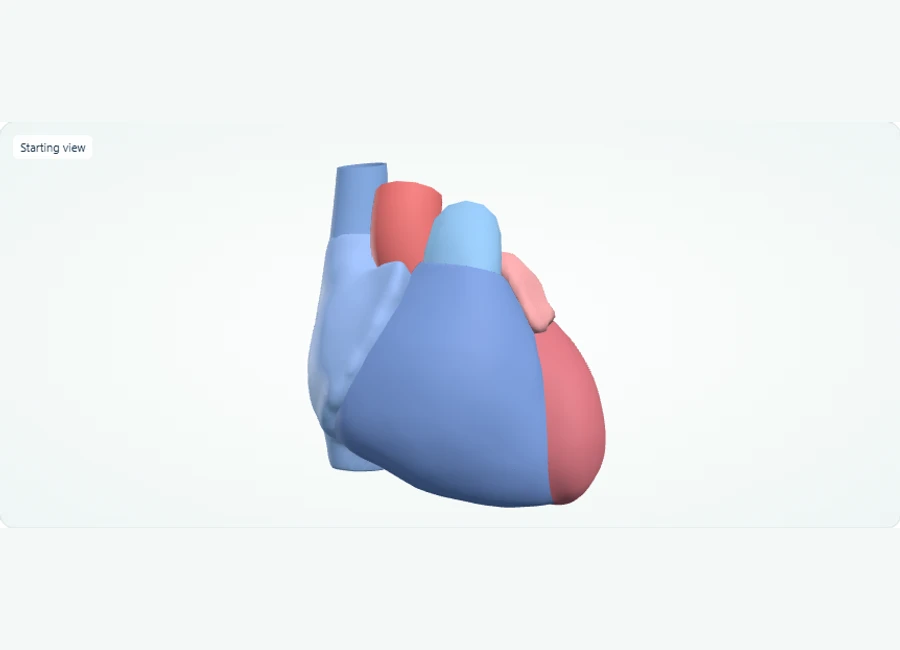
A four-chambered heart viewed from the front. The right ventricle supplies the pulmonary circulation via the pulmonary trunk; the left ventricle supplies the systemic circulation via the ascending aorta. This model shows external chamber surfaces and the visible great vessels only — no internal valves or conduction system.
Rotate, isolate structures, and test your recall.
Choose Front and compare the four chambers. The right ventricle forms most of the anterior surface; the left ventricle contributes to the apex.
Select and isolate each chamber in turn, then use Show all to restore its relationship to the surrounding structures.
Select the pulmonary trunk and ascending aorta in turn. Name the circulation supplied by each, then use Test recall to practise identifying the listed structures.
Practice exercise
Which ventricle supplies the pulmonary trunk, and which supplies the ascending aorta?
Show answer
The right ventricle; it serves the pulmonary circulation.
On the front view, the right ventricle is the anterior-most chamber, and its outflow tract continues as the pulmonary trunk carrying blood to the lungs. The left ventricle instead empties into the ascending aorta for the systemic circulation.
- The right ventricle pumps blood into the pulmonary trunk toward the lungs; the left ventricle pumps into the ascending aorta to the body.
- The superior vena cava returns blood to the right atrium from above the heart.
- The two atria sit superior to the two ventricles; atria receive blood, ventricles eject it.
Explore in 3D: Trachea and Main Bronchi
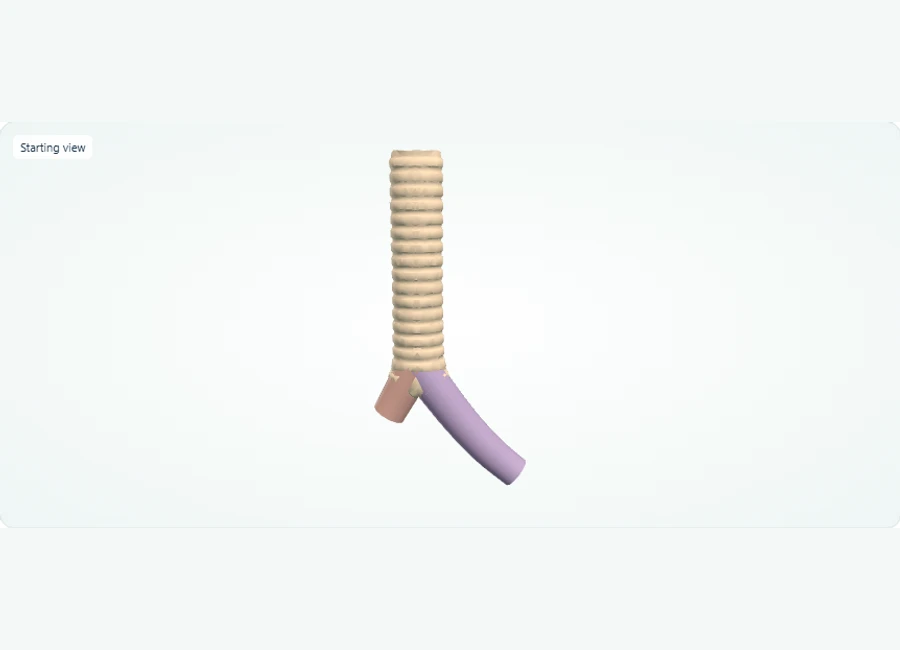
This model shows the trachea and its division into the right and left main bronchi. Only these three airway structures are present: there are no lobar branches, alveoli, or other respiratory structures, and the model shows normal anatomy with no pathology or devices.
Rotate, isolate structures, and test your recall.
Set the view to front and zoom to see the whole model: the trachea is the single central tube, with the right main bronchus and left main bronchus branching from its lower end.
Select each of the three structures in turn (Trachea, Right main bronchus, Left main bronchus), using isolate to view one at a time and show all to restore the full model.
Use Test recall to hide the labels; when a structure is highlighted, name it before pressing Reveal name, then use Return to study to continue.
Practice exercise
Test recall highlights the structure branching from the lower end of the trachea toward the body's left side. Which structure is it?
Show answer
Left main bronchus
In the front view, the trachea runs down the midline and splits into two main bronchi. The branch passing to the viewer's right (the body's left side) is the left main bronchus, while the branch to the body's right side is the right main bronchus.
- The trachea is the central airway that divides into two main bronchi, one for each lung side.
- The right main bronchus and left main bronchus are the first branches off the trachea; this model contains no smaller (lobar) branches or alveoli beyond them.
- Because only three structures are selectable, identification practice here means telling the trachea from the right versus left main bronchus.
Visual anatomy review: Follow the digestive route and accessory organs
Locate the gallbladder and distinguish the organ name from the procedure suffix.
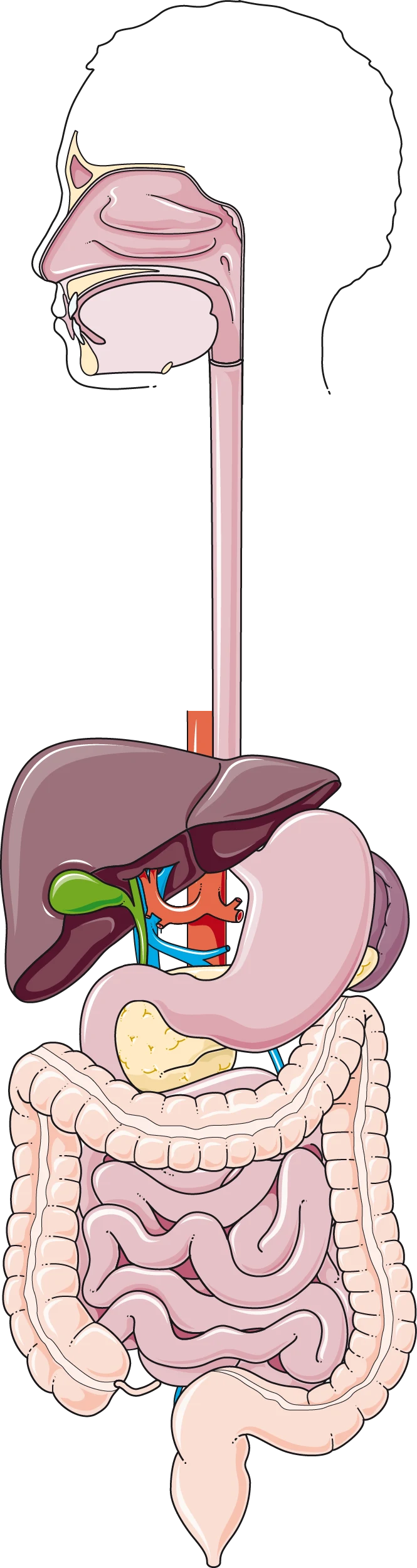
The digestive tract is a continuous passage; the liver, gallbladder and pancreas are accessory organs. Open the full-size illustration for the smaller abdominal structures.
Trace the esophagus into the stomach and then the small intestine. The duodenum comes first, followed by the jejunum and ileum. The gallbladder lies beneath the liver; it is not part of the passage through which food travels.
In Z-Anatomy, locate the stomach, duodenum, liver and gallbladder. Rotate the visceral structures to inspect their relationships, then describe the food passage without including the accessory organs in it.
Practice exercise
An upper endoscope passes through the esophagus and stomach. Which small-intestinal segment does it reach first, and is the gallbladder part of that route?
Show answer
It reaches the duodenum first. The gallbladder is an accessory organ outside that food passage.
Separate the route of access from the target of a procedure. The diagram supports location recall; the actual operative findings and work performed determine the procedure being described.
Applying, fees, and scheduling
The RMA application fee is $150. It is non-refundable and includes the application, the exam, and the first annual fee. You schedule the exam only after AMT approves your application.
Submit a separate application for each certification you pursue. Once your approval notice arrives, scheduling depends on where you test: if your school administers the exam, your instructor provides the date and time; otherwise you book your own appointment at a Pearson VUE testing center.
Because the fee is non-refundable, confirm your documents are complete before you pay. AMT also lists a candidate handbook, practice exam, fundamentals course, and reference materials among its preparation resources on the certification page.
Official sources: Registered Medical Assistant Certification - RMA | AMT — Eligibility routes, application fee, and scheduling sections
The 2026 content outline at a glance
The outline organizes tested content into three work areas and breaks each into task areas and competencies. Items flagged with a # are part of the medical assisting role but are not directly assessed on the exam.
General Medical Assisting covers body systems and disorders, wellness and nutrition, medical terminology including word parts and abbreviations, medical law and ethics with consent, disclosure, and HIPAA applications, and human relations with patients and coworkers.
Administrative Medical Assisting covers insurance terminology, explanation of benefits, HIPAA-mandated coding systems (ICD-10-CM, CPT, HCPCS), prior authorizations and referrals, scheduling, oral and written communication, medical record maintenance, supplies and equipment management, computer applications with privacy and security safeguards, and office safety under OSHA guidelines.
Clinical Medical Assisting, the largest area, spans infection control and aseptic technique, diagnostic instruments, laboratory procedures under CLIA '88 with specimen collection and waived testing, minor surgical procedures and sterile setup, vital signs and patient measurements, physical examinations including specialty exams and 12-lead electrocardiography, clinical pharmacology including injection procedures and dose calculations, therapeutic modalities, and first aid and emergency response with its legal responsibilities.
- Study the competencies under each task area in AMT's own PDF, which is the authoritative and exhaustive list.
- Treat # flagged items, such as mounting ECG readings or alternative therapies, as role knowledge rather than direct exam targets.
- AMT notes the task inventory is dynamic, so tasks may be added, removed, or modified over time.
Official sources: American Medical Technologists RMA examination content outline, 2026 — Competencies and examination specifications summary table; task inventory notes
A weight-aware study order
An editorial recommendation, not an official rule: sequence your preparation as clinical content first, general content second, and administrative content third, mirroring the 31/14/55 weighting.
Start with the clinical work area because it supplies more than half the questions. Within it, give the heaviest task areas, such as laboratory procedures, vital signs, physical examinations, and pharmacology, multiple passes rather than one read-through.
Next, cover General Medical Assisting. The terminology, body systems, and law-and-ethics material also supports your clinical review, so the ordering reinforces itself. Finish with Administrative Medical Assisting, where insurance, coding, scheduling, and records concepts are comparatively self-contained.
A workable weekly rhythm is outlined-topic review followed by practice questions on the same topics, logging every miss against its outline task area. That log, not a feeling of readiness, tells you which task areas need a second pass. Schedule a final week for mixed review across all three areas.
- Clinical (55%): infection control, laboratory, minor surgery, vital signs, physical exams, pharmacology, therapeutics, first aid.
- General (31%): terminology, body systems, law and ethics, human relations.
- Administrative (14%): insurance and coding, clerical and records, computers, office safety.
Official sources: American Medical Technologists RMA examination content outline, 2026 — Competencies and examination specifications summary table; task inventory notes
Practice a dosage conversion
The outline explicitly includes performing calculations for dosages, including conversions, and calculating basic pharmacological doses. Try this original practice problem before reading the answer.
Conversion problems test whether you can move units accurately under time pressure. The skill is arithmetic plus unit discipline, which you can rehearse safely on paper with invented numbers. Set a timer, state your conversion factor, and check the result before revealing the answer.
Practice exercise
Assumption: the conversion factor 1 mg = 1,000 mcg applies, and no other instructions modify the order. A written order calls for 0.75 mg of a medication. The stock on the shelf is tablets labeled 250 mcg each. How many tablets does the order call for?
Show answer
3 tablets.
Convert the ordered dose into the same unit as the stock label: 0.75 mg × 1,000 mcg per mg = 750 mcg. Divide the converted dose by the per-tablet strength: 750 ÷ 250 = 3 tablets. The two common errors are mixing units across the division (dividing 0.75 by 250) and misplacing the decimal during conversion. Writing the conversion factor explicitly before computing prevents both. This is a paper exercise for calculation practice; actual medication handling follows your training, supervising provider's orders, and facility procedure.
Official sources: American Medical Technologists RMA examination content outline, 2026 — Competencies and examination specifications summary table; task inventory notes
Preparation mistakes worth avoiding
Three avoidable errors: spending disproportionate time on # flagged competencies, studying outline headings as full clinical rules, and treating paper review as proof of hands-on skill.
AMT's own task inventory notes flag certain competencies with a # to show they are elements of the role but not directly assessed on the certification examination. Knowing that list keeps your effort pointed at tested content.
The outline lists topics such as consents, subjective versus objective information, and asepsis terminology as competencies to master. Use those headings to structure review with your program materials and AMT's reference list; the outline itself is a topic map, not a textbook, and it does not supply the underlying clinical rules.
Finally, competencies like venipuncture, injection technique, and sterile fields are practical skills. Written preparation builds the decision layer, but it cannot substitute for supervised, in-person training in those procedures.
Official sources: American Medical Technologists RMA examination content outline, 2026 — Competencies and examination specifications summary table; task inventory notes
Final checklist and official documents
Confirm your route and documents, pay the $150 fee once your paperwork is complete, and schedule after AMT approves you. Duration and passing score are not stated in the retrieved sources, so verify them in the AMT candidate handbook.
Before you apply, tick off the items that match your route: transcripts for the Education Route, competency documentation and CPR card for the hybrid route, employment verification, diploma or GED, and CPR card for the experience route, service records for the military route, and teaching and clinical verification for the instructor route.
Two AMT documents anchor your preparation: the RMA examination content outline, which lists every work area, task area, and competency for 2026, and the RMA certification page, which carries the eligibility routes, fee, and scheduling steps. Work from those rather than third-party summaries, and check the handbook for logistics this guide could not verify.
- Route and documentation matched and gathered.
- CPR card valid, where your route requires one.
- Application submitted and approval notice received.
- Study plan weighted toward the clinical work area.
- Practice questions logged by outline task area, with weak areas re-reviewed.
Official sources: American Medical Technologists RMA examination content outline, 2026 — Competencies and examination specifications summary table; task inventory notes; Registered Medical Assistant Certification - RMA | AMT — Eligibility routes, application fee, and scheduling sections
Official sources
Facts checked against AMT's 2026 outline and certification page: