
PLAB 2 assesses whether you can apply clinical knowledge, communication skills, and professional standards in simulated UK-style patient encounters. The productive way to study it is to rehearse the transfer from knowledge to UK-context decisions — structure, safety netting, and ethics spoken aloud — rather than to memorise more content.
The core difficulty: transferring knowledge into a UK-style consultation
The exam's challenge is not recall but translation: each simulated scenario asks you to gather information, reach a management decision, and communicate it as a UK clinician would, within one continuous consultation.
Medical knowledge is necessary but not sufficient here, because a station scores what you do and say in role. Consider a headache scenario: the knowledge version of your answer is a differential list. The consultation version is an opening that puts the patient at ease, a history that screens for red flags, an explanation the patient can follow, a plan the patient agrees to, and a closing safety net. Each of those is a separate, practicable skill, and each can fail independently of your knowledge.
This is why generic OSCE preparation only partially transfers. The scenarios are set in UK practice, so decisions inherit UK norms: primary care as the usual entry point, conservative thresholds for imaging and antibiotics, routine use of patient-centred shared decision making, and explicit safety netting before a patient leaves. When you study a topic, study it twice — once as medicine, once as 'what would a UK GP or SHO actually do and say here'. That second pass is the one this guide trains.
- For every scenario you practise, name the UK setting (GP surgery, emergency department, ward) because it changes the referral options available to you.
- Finish each rehearsal by writing the one decision the scenario hinged on — not the diagnosis, the decision.
- When reading any clinical guideline, extract the communication task attached to it: what must the patient be told, asked, or warned about.
Data gathering: opening, ICE, and red-flag screening as separate moves
Strong data gathering is built from named, practisable components: a structured opening, screening questions, targeted history, the patient's ideas, concerns and expectations (ICE), and a check that you have not missed red flags.
ICE — ideas, concerns, and expectations — is worth studying as a distinct concept because it changes what you do with information. Ideas are the patient's own explanation ('I think it's my thyroid'); concerns are their fears ('my aunt died of something like this'); expectations are what they want from the visit ('can I get a scan?'). A consultation that collects ICE can address the patient's actual agenda; one that skips it risks producing a clinically correct plan the patient silently rejects. Practise eliciting all three in plain sentences rather than reciting the acronym at the patient.
Red-flag screening is the safety-critical half of data gathering and deserves its own checklist per presenting complaint. For a cough, that means haemoptysis, weight loss, night sweats, and smoking history; for a headache, sudden onset, fever, neurological symptoms, and waking-from-sleep pattern. The discipline is writing these lists out per complaint during preparation, then rehearsing them until the phrasing is natural. In the station, an unanswered red flag is a gap in reasoning even if your final diagnosis is right, because the safety of the plan depends on it.
- Opening: introduce yourself, confirm the patient's identity and consent, and ask an open question before narrowing.
- Middle: screened complaints first, then targeted history, then ICE, then impact on daily life.
- Close of data gathering: summarise back to the patient and invite corrections before you move to management.
Explore in 3D: Heart chambers and great vessels
A four-chambered heart viewed from the front. The right ventricle supplies the pulmonary circulation via the pulmonary trunk; the left ventricle supplies the systemic circulation via the ascending aorta. This model shows external chamber surfaces and the visible great vessels only — no internal valves or conduction system.
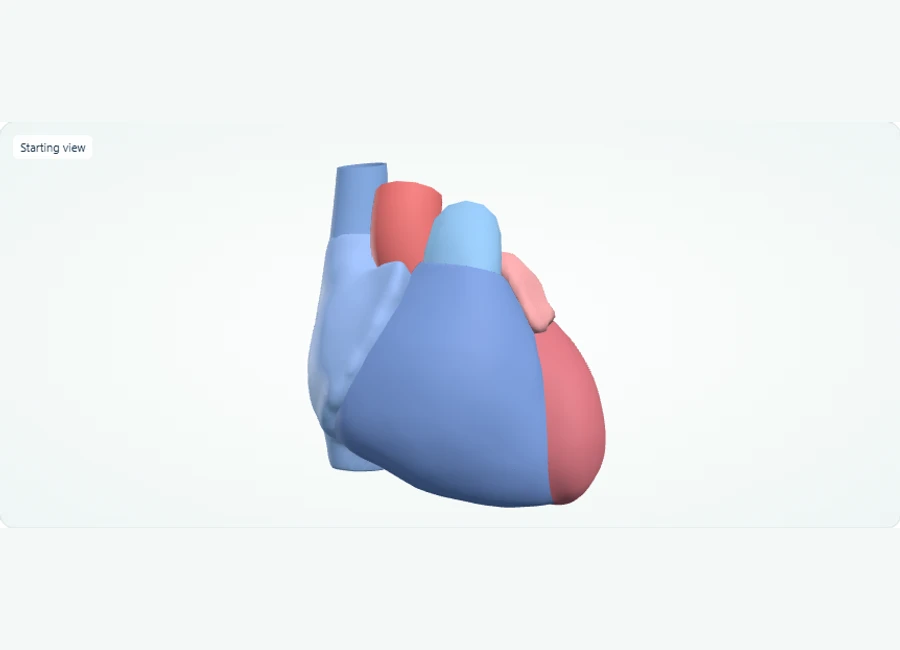
Rotate, isolate structures, and test your recall.
Choose Front and compare the four chambers. The right ventricle forms most of the anterior surface; the left ventricle contributes to the apex.
Select and isolate each chamber in turn, then use Show all to restore its relationship to the surrounding structures.
Select the pulmonary trunk and ascending aorta in turn. Name the circulation supplied by each, then use Test recall to practise identifying the listed structures.
Try it yourself
Which ventricle supplies the pulmonary trunk, and which supplies the ascending aorta?
Show answer and explanation
The right ventricle; it serves the pulmonary circulation.
On the front view, the right ventricle is the anterior-most chamber, and its outflow tract continues as the pulmonary trunk carrying blood to the lungs. The left ventricle instead empties into the ascending aorta for the systemic circulation.
- The right ventricle pumps blood into the pulmonary trunk toward the lungs; the left ventricle pumps into the ascending aorta to the body.
- The superior vena cava returns blood to the right atrium from above the heart.
- The two atria sit superior to the two ventricles; atria receive blood, ventricles eject it.
Explore in 3D: Lung lobes
This model shows the five lung lobes: three on the right (superior, middle, inferior) and two on the left (superior, inferior). The left lung has no middle lobe. Each colored lobe is a distinct selectable structure, separate from segments and bronchial branches. As a normal surface model, it shows healthy anatomy only.
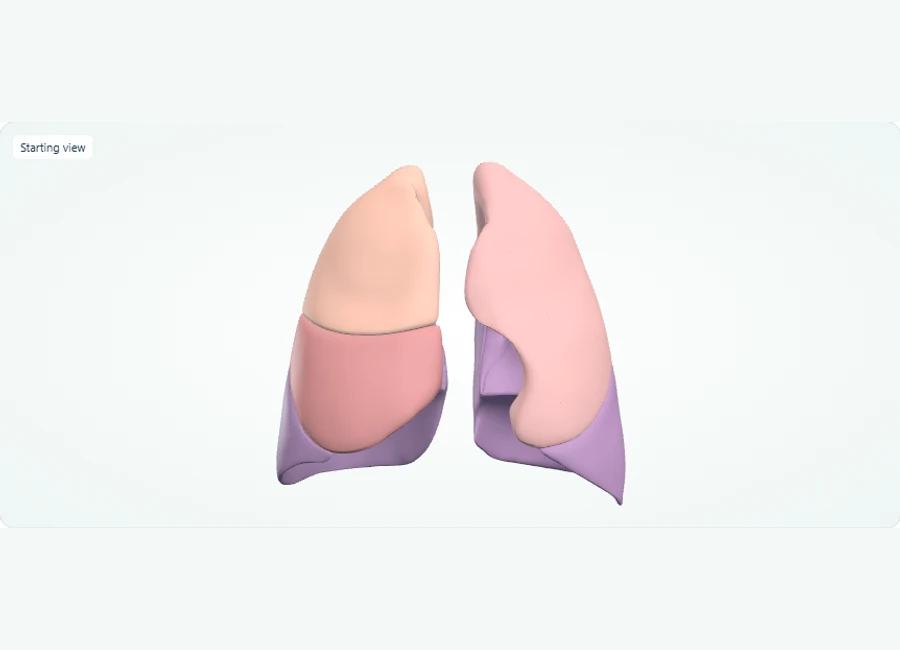
Rotate, isolate structures, and test your recall.
Choose Front. Use the Structure list to select each lobe and count three on the anatomical right and two on the left.
Select and isolate the right middle lobe, then use Show all and Back to inspect how it relates to the other right lung lobes.
Start Test recall, name the highlighted lobe, then select Reveal name to check your answer.
Try it yourself
How many lobes does each lung have, and which lobe name occurs only on the right?
Show answer and explanation
The right lung has superior, middle and inferior lobes. The left lung has superior and inferior lobes, with no middle lobe.
A lobe is a gross anatomical division of a lung. The right lung has three lobes and the left has two. These surface models show lobes, not individual bronchopulmonary segments or surgical margins.
- The right lung has three lobes: superior, middle, and inferior.
- The left lung has only two lobes: superior and inferior; there is no left middle lobe.
- Lobes are distinct from segments and bronchial branches, and a normal model shows no tumors or surgical margins.
Illustrated practice: Otoscopy and the Adult External Auditory Canal
Normal anatomical reference showing the oblique course of the adult external auditory canal to the tympanic membrane, supporting the canal-straightening and speculum-choice reasoning; it is not patient imaging and does not depict this patient's ear.
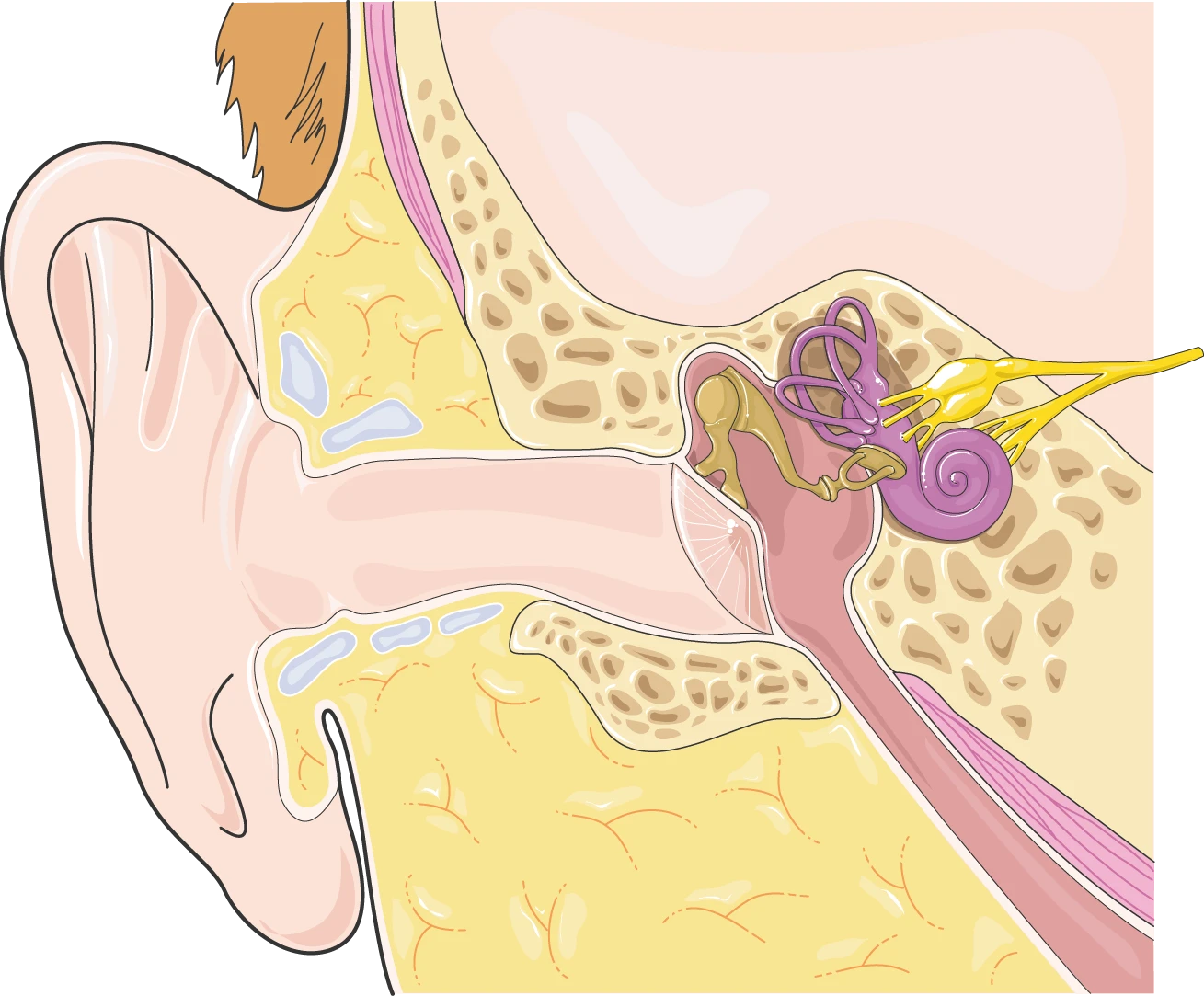
Anatomical study exhibit for the worked question below. Open the full-size view to inspect the structures.
Use the anatomical exhibit to work through the example. Choose an answer before opening the explanation.
Try it yourself
The anatomical illustration shows a normal sectional view of the adult ear, with the external auditory canal leading to the tympanic membrane; it is a normal anatomy reference, not an image of this patient. A 34-year-old man attends with right-sided earache and muffled hearing since yesterday. Otoscopy has not yet been performed. Using the illustrated course of the ear canal as a guide, which technique should you use first to examine his ear canal and tympanic membrane? A. Pull the pinna down and back to straighten the canal before inserting the speculum. B. Pull the pinna up and back to straighten the canal, and insert the largest speculum that fits comfortably. C. Examine the painful right ear first so the patient feels his main concern is being addressed. D. Insert the speculum firmly past any visible wax to ensure the tympanic membrane is seen immediately.
Show answer and explanation
B. Pull the pinna up and back to straighten the canal, and insert the largest speculum that fits comfortably.
The illustration shows that the adult external auditory canal follows a naturally oblique, non-straight course to the tympanic membrane; straightening this visible anatomy is why, in adults, the pinna is pulled up and back, and the largest comfortable speculum gives the best view while minimising discomfort. Down-and-back traction is used in young children, whose canal anatomy differs. Examining the painful ear first risks pain and loss of cooperation, and forcing past wax causes trauma.
Clinical management in a UK setting: thresholds, safety netting, and shared decisions
UK-style management differs from textbook management in three learnable ways: conservative investigation and prescribing thresholds, an explicit safety net, and a plan agreed with the patient rather than issued to them.
Safety netting is a named skill with a specific structure: tell the patient which findings should prompt them to come back or seek urgent care, by what route, and over what timeframe. 'If the pain becomes severe, or you develop a fever or breathlessness, come back immediately or call emergency services; otherwise, if it's no better in a week, book a review.' Compare that with the weaker 'come back if you're worried' — the first is a testable clinical instruction, the second is a pleasantry. Rehearse the full sentence form, because the specifics are what demonstrate safe clinical thinking.
Shared decision making is the second habit to build. In practice this means offering options with their trade-offs, asking about the patient's priorities, and checking understanding before agreeing the plan — teach-back ('just so I know I explained it clearly, can you tell me what you'll do when you get home?') is the standard closing move. Study UK norms for investigation thresholds too: for many undifferentiated complaints the expected answer is watchful waiting with a clear safety net, not immediate imaging or referral. Building a habit of asking 'is the conservative option safe and stated here?' recalibrates instincts formed in more intervention-heavy systems.
- Plan structure: working diagnosis, investigations or treatment chosen and why, what you are deliberately not doing and why, safety net, follow-up.
- Explain in lay terms first, clinical terms second; define every term the patient would not know.
- Check concordance: ask what the patient thinks of the plan and negotiate rather than persuade when they hesitate.
Ethics and professionalism stations: reasoning aloud through confidentiality, capacity, and consent
Ethics scenarios are answered by a sequence, not a slogan: identify the ethical issue, gather the missing facts, weigh the relevant principles, and state a proportionate course of action you would explain to the patient.
Confidentiality is the area where rehearsed structure pays most. The transferable reasoning pattern is: confirm who is asking and what they want; check whether the patient has consented to disclosure; consider whether any recognised exception applies (for example, risk of serious harm to others or a legal requirement); choose the least intrusive option that meets the need; and document the decision. The frequent error is jumping from 'a relative is asking' straight to a yes or no, without the intermediate steps that show judgement. Saying your reasoning aloud, in role, is what distinguishes a considered refusal or disclosure from an arbitrary one.
Capacity and consent questions reward the same visible process. For capacity, the assessment is decision-specific and time-specific: can the patient understand the relevant information, retain it, weigh it to reach a choice, and communicate that choice? A patient can hold strong views, refuse a recommended treatment, or make an unwise choice and still have capacity — the reasoning you show matters more than the conclusion. For consent, the check is whether the patient has been given the information a reasonable person would want, in terms they understand, and whether consent is being sought for the right intervention by the right person.
- Confidentiality template: who is asking → patient's consent → any exception → least intrusive option → document and explain.
- Capacity template: decision in question → the four abilities → presumption of capacity unless shown otherwise → support the patient to decide where possible.
- Never promise absolute secrecy; explain the limits of confidentiality early when sensitive topics arise.
Worked scenario A: chest pain — chasing the diagnosis versus closing the consultation
In an acute undifferentiated chest pain scenario, the decisive skill is a consultation that rules out the dangerous causes, acts on red flags immediately, and closes with a safety net — not an exhaustive differential delivered as a monologue.
Scenario: a middle-aged patient in a GP-style station describes central chest tightness over three days, worse on exertion, relieved by rest, with a history of smoking and hypertension. The plausible mistake is treating the station as a viva: spending nearly all the time interrogating the pain character and listing differentials — muscular, reflux, anxiety — and then ending with 'I'll examine you and arrange some tests' as time runs out. The error is structural, not knowledge-based: no examination findings were requested, no urgent pathway was named, and the consultation had no close, so the plan was never actually made or communicated.
The better decision is to recognise a pattern demanding urgent exclusion and to let that drive the consultation's shape: a focused history confirming the red flags, a direct request for examination and an ECG now, and explicit words such as 'because of your risk factors and the pattern of this pain, I want to rule out a cardiac cause today; I will arrange for you to be assessed urgently'. The reason it matters: in UK-style practice, the management of possible cardiac chest pain is time-critical referral, and a consultation that identifies the risk but leaves it dangling demonstrates unsafe follow-through even with a perfect differential in mind.
Worked scenario B: a relative demands test results — the confidentiality decision made visible
When a relative asks for results, the correct performance is a calm, structured conversation that checks the patient's wishes before any information is shared, explained in plain language and without becoming adversarial.
Scenario: a telephone-style task in which an adult son asks for his mother's blood test results, saying he is her carer and 'you always tell me everything'. The plausible mistake is binary thinking: either blurting out the results because he sounds like a genuine carer, or giving a flat, legalistic refusal that ends the call and destroys rapport. Both skip the reasoning. The first breaches confidentiality on an assumption; the second is technically safe but fails the communication half of the task and ignores a legitimate avenue the scenario may contain.
The better decision runs the template from the ethics section: acknowledge his concern and his caring role; explain that you cannot confirm or deny whether the patient is even registered there or discuss her care without her permission; offer the workable routes — he can attend with her next appointment, or the patient can contact the practice to give consent for him to receive updates; and agree a specific next step before ending the call. It matters because the assessment here is whether the doctor protects confidentiality while remaining helpful and non-judgemental — the two halves are scored together, and the structured answer delivers both where an improvised yes or no delivers neither.
A self-assessed practice drill and an adaptable preparation sequence
Record yourself running full consultations against written scenario prompts, score each against a fixed rubric, and cycle through complaint-specific red-flag lists — the sequence adapts to whatever preparation time you have.
The drill: write or obtain short scenario prompts across the three task types in the table below. For each, speak the whole consultation aloud in real time — opening to safety net — and record it. Then score yourself on the rubric: two points each for a structured opening with consent, complete red-flag screening for the presenting complaint, ICE elicited, a plan stated as a concrete action, a full safety net in specific sentence form, and lay-language explanation with a teach-back check. Twelve is the ceiling; the point of the score is to show you which component is weakest, so your next repetition targets that component rather than restarting the whole consultation.
A preparation sequence you can scale: first, build a one-page red-flag and safety-net sheet for each high-frequency presenting complaint and rehearse those pages aloud. Second, run the recorded drill across all three task types, two scenarios per type per session, scoring every recording. Third, add a dedicated ethics block where you practise the confidentiality and capacity templates on written prompts until the sequences come out without hesitation. Fourth, in the final phase, shorten feedback loops: one scenario, one recording, immediate self-scoring, immediate repeat. Expect early recordings to feel awkward and wordy; the fluency gain from re-recording the same scenario once is where most of the improvement is visible.
- Readiness check 1: you can state the red-flag list for five common complaints from memory in natural spoken sentences.
- Readiness check 2: a recorded management consultation hits the concrete plan, teach-back, and full safety net without prompting.
- Readiness check 3: you can run the confidentiality and capacity templates aloud on an unfamiliar prompt in one take.
- Treat rubric scores as learning milestones showing which skill to repeat next — they are not predictions of any exam outcome.
| Task type | Primary objective | Typical improvised mistake | Closing move that scores |
|---|---|---|---|
| Data gathering | Complete, red-flag-safe history including ICE | Interrogating details without ever summarising back | Summarise to the patient and invite corrections |
| Clinical management | A concrete, UK-appropriate, agreed plan | Naming tests or drugs without a follow-up or safety net | Teach-back plus a specific safety net in full sentences |
| Ethics / professionalism | Visible reasoning through a recognised framework | A bare yes/no on disclosure or capacity | State the weighing, the least intrusive option, and the documentation step |
References and further reading
Use these references to explore the concepts and check the latest information from the relevant organizations.