
Study each drug as a one-line decision profile — what it treats, what changes its dose, what you monitor to a target, and one high-impact interaction with its mechanism — then drill that profile against changing patient scenarios.
Why a drug list is the wrong unit of review: the decision variable
Organize review around decision variables — the facts that change a dose, a choice, or a monitoring plan — instead of around drug names, and store one profile line per drug.
A decision variable is a piece of drug knowledge that, when it changes, changes your answer. Compare two facts about amoxicillin: 'also used for some dental infections' versus 'dose is reduced when creatinine clearance falls below about 30 mL/min because it is renally eliminated.' The first is static context; the second flips a dosing decision when the patient's kidneys change. The distinction matters because review time is finite, and static facts and decision facts compete for the same recall.
To apply this, rewrite your drug notes as one-line profiles with four slots: primary indication, the variable that most often changes the dose (renal function, hepatic status, weight, therapeutic level), the monitoring parameter with its target, and one high-impact interaction with its mechanism. A profile you cannot complete exposes a gap more precisely than a flashcard you get wrong, because it tells you which slot — not just which drug — is weak. Rebuild weak profiles before adding new drugs.
Renal dosing: picking the creatinine clearance estimate before the dose
In paper scenarios, state which CrCl estimate fits the patient before calculating: actual-weight Cockcroft-Gault for typical adults, adjusted body weight in obesity, and no equation when renal function is changing fast.
The Cockcroft-Gault equation estimates creatinine clearance in mL/min using age, weight, serum creatinine, and sex, and it remains the standard anchor for renally adjusted dosing in pharmacy practice teaching. Its near neighbor, the BSA-indexed eGFR reported in mL/min/1.73 m², answers a different question — staged kidney function in a lab report — and cannot be dropped into a weight-based dose without converting or adjusting. Treating these two numbers as interchangeable is the concept-level trap: the units themselves signal whether the estimate is total-body or normalized.
Weight selection is the second trap. In a 130 kg adult, using actual body weight in Cockcroft-Gault can inflate the estimate and push you toward a dose higher than renal function supports, which is why adjusted body weight is used for obese patients in standard practice teaching. And when serum creatinine is rising or falling day to day, the equation lags the kidneys, so no calculated value should be trusted alone — escalate to drug-specific levels and clinical judgment instead. Check the equation and weight choice before you touch the dose.
| Patient situation | Preferred estimate | Caution | Why it matters |
|---|---|---|---|
| Stable adult, typical muscle mass | Cockcroft-Gault with actual body weight | Confirm units are mL/min | Matches how renally adjusted dosing ranges are written |
| Adult with obesity | Cockcroft-Gault with adjusted body weight | Actual weight overestimates clearance | Prevents doses higher than renal function supports |
| Rapidly changing serum creatinine | No equation trusted alone | Calculated value lags true function | Drug levels and clinical judgment drive dosing |
| Low muscle mass or amputation | Cockcroft-Gault with strong caution | Estimate runs high for the same creatinine | Overestimated clearance can mask the need to reduce dose |
Explore in 3D: Kidneys, Ureters and Bladder: The Urine Transport Pathway
This model shows five selectable structures: the right and left kidneys, the right and left ureters, and the urinary bladder. It demonstrates the gross pathway of urine transport from where urine forms (kidneys) to where it is stored (bladder). Note: the urethra and internal renal anatomy are not included in this model, so the pathway ends at the bladder.
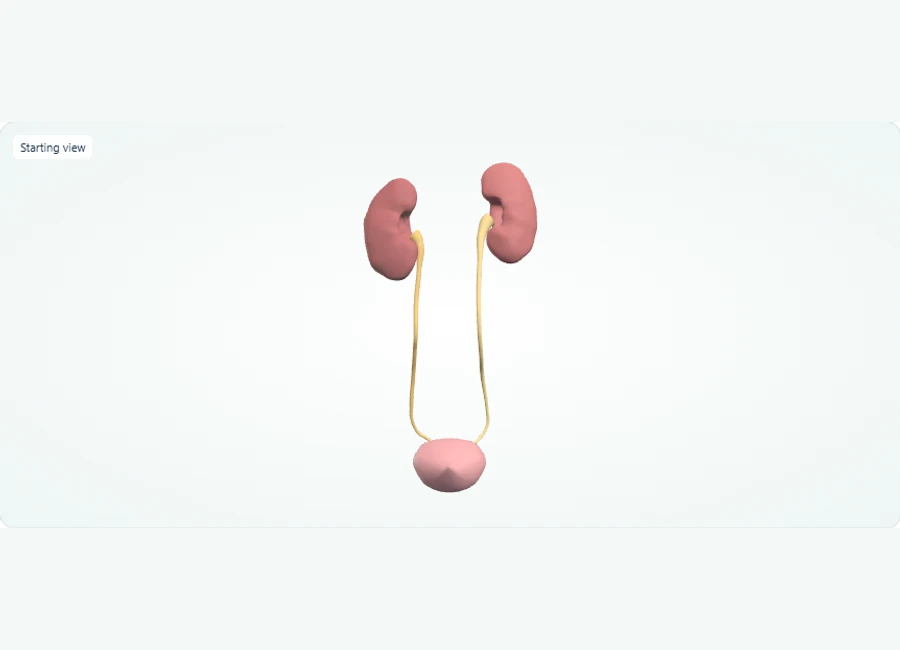
Rotate, isolate structures, and test your recall.
Choose Front. Select the right kidney, then its ureter, and follow the route toward the bladder with all structures visible.
Repeat on the left side. Select and hide each kidney separately if you want a clearer view of the ureters; use Show all to restore them.
Select the urinary bladder. Rotate the model and identify where the paired ureters meet the single bladder.
Try it yourself
Trace the three structures in the right-sided urine transport route shown here. What does the final structure do?
Show answer and explanation
Right kidney, right ureter, urinary bladder. The bladder stores urine until it leaves the body. (The left side follows the same pattern: left kidney and left ureter also deliver urine to the bladder.)
Urine flows from each kidney into its own ureter, which transports it down to the urinary bladder for storage. Both the right and left ureters empty into the single bladder. Because the urethra is absent from this model, the bladder is the terminal structure you can trace.
- Urine is formed in the kidneys; from each kidney, urine drains into that side's ureter (right ureter from right kidney, left ureter from left kidney).
- Each ureter carries urine downward to the urinary bladder, which stores urine until it is expelled; this model shows both ureters joining the bladder.
- This model is a gross transport overview only: the urethra and internal kidney structures are not shown, so urine flow beyond the bladder cannot be traced here.
Worked scenario: vancomycin dosing when renal function moves under you
When a patient's serum creatinine changes between admission and now, recalculate with the current value rather than the one on the chart header, then let drug levels confirm.
Scenario: a 68-year-old man, 80 kg, is started on IV vancomycin for suspected bacteremia. His admission serum creatinine was 1.0 mg/dL; on day 3 it is 1.6 mg/dL and rising. The tempting move is to continue the maintenance dose calculated on day one, because the order is already written. That is the mistake: the day-one calculation used a clearance that no longer exists.
The better decision recalculates with the current value. Cockcroft-Gault for a male: CrCl = (140 − age) × weight / (72 × SCr) = (140 − 68) × 80 / (72 × 1.6) = 5,760 / 115.2 ≈ 50 mL/min. On admission the same patient computed around 80 mL/min, so the maintenance dose a stable-renal-function calculation would support is now markedly lower — roughly cut by a third — and any loading dose already given still counts toward total exposure. It matters because vancomycin accumulates as clearance falls, and accumulation drives nephrotoxicity and ototoxicity risk. The confirming step is a measured trough or an AUC-guided level rather than the equation alone, since the equation assumes stable renal function this patient does not have. The transferable rule: in any dosing scenario, check the date on the creatinine before you check the dose.
Interaction triage: rank by mechanism, not by the severity label
When a medication list shows several interactions, identify the mechanism of each — enzyme inhibition, displacement, additive toxicity — and rank by how strongly that mechanism should change your decision.
Interaction software presents a flat list: every entry gets a severity word. The pharmacy skill underneath is mechanism-first reasoning. Enzyme inhibition (which enzyme, how strong, how fast it acts), protein-binding displacement (usually transient, but matters for narrow-index drugs), and additive toxicity (two drugs hitting the same organ) lead to different actions: substitution, monitoring intensification, or dose change. Two 'moderate' flags can hide one pharmacologically trivial pair and one pair that genuinely matters.
Scenario: a patient stable on warfarin presents with a urinary tract infection, and the prescriber asks whether to use trimethoprim-sulfamethoxazole or an alternative such as cephalexin or nitrofurantoin (if renal function permits). The tempting answer is 'check the interaction checker and flag everything.' The better decision names the mechanism: sulfamethoxazole inhibits CYP2C9, the main warfarin metabolizing pathway, so anticoagulant effect can climb over several days — a plausible mechanism for a rising INR — and sulfonamides can also enhance hypoglycemia with sulfonylureas. Choosing the antibiotic with the smaller enzymatic footprint, or if TMP-SMX is clinically unavoidable, planning intensified INR monitoring, follows directly from the mechanism. The mistake that matters is either stopping warfarin reflexively or treating the flag as background noise; both lose the causal chain the scenario is asking you to reason through.
- Name the mechanism out loud before deciding: inhibition, induction, displacement, or additive organ toxicity.
- For inhibition, ask which enzyme and how strong — CYP2C9 or CYP3A4 inhibition on a narrow-index drug outranks a shared side-effect flag.
- For additive toxicity, identify the shared target organ and the existing monitoring that already covers it.
- For displacement, ask whether the victim drug has a narrow therapeutic index; if not, the clinical effect is usually small.
Calculations and biostatistics: compute, don't recognize
Treat calculations and biostatistics as performance skills: work full paper calculations — weight-based dosing, infusion rates, ARR and NNT — until each takes under two minutes without notes.
Weight-based dosing example: a 22 kg child needs amoxicillin 45 mg/kg/day divided every 12 hours. Total daily dose = 45 × 22 = 990 mg/day; per dose = 495 mg every 12 hours; rounding to available strengths gives 500 mg twice daily. The checkable steps are the division into doses and the rounding to real strengths — skipping either is where a plausible mistake hides. The same structure covers mg/kg/day versus mg/kg/dose stems: read which one the question states before multiplying.
Biostatistics rewards the same hands-on treatment. If a trial reports mortality of 12% with placebo and 9% with drug: absolute risk reduction = 3 percentage points, relative risk reduction = 3/12 = 25%, and number needed to treat = 1/0.03 ≈ 33 patients. The discriminating concept is that RRR inflates small effects while ARR and NNT keep them in scale — a paper can quote the flattering number, and a pharmacy decision should quote the honest one. For study design and result interpretation, rehearse saying what each measure would change in a counseling or formulary decision; that converts the formula into the applied judgment the content is really about.
A practical exercise: the two-minute decision profile drill
Pick twenty drugs from your weakest areas, write each four-slot profile in under two minutes from memory, then score against a rubric — the scoring, not the writing, is the training.
The exercise: after a review session, select twenty drugs you have not written profiles for yet and produce one line each from memory in two minutes or less per drug. Slots: (1) primary indication, (2) the variable that most often changes the dose, (3) the monitoring parameter with a target value, (4) one high-impact interaction and its mechanism. Expected observations: for well-known agents you will complete all four slots quickly; for the middle of your list, slot three — the monitoring target — is usually the blank, because targets are the least glamorous fact and the most decision-loaded.
Self-check rubric: score each drug 0–4, one point per slot. A drug scoring 2 or less goes on the rebuild list; a drug scoring 3 with a vague slot four (an interaction you flagged without a mechanism) counts as 2 until the mechanism is named. Milestone, not prediction: reaching a median of 4 across twenty randomly chosen drugs is a learning marker that your retrieval is decision-shaped. Repeat the drill weekly with a fresh twenty, because the goal is the speed of recall under mild time pressure, which is what a case-style question actually demands.
A preparation sequence you can adapt, and how to know you are ready
Sequence preparation as profile-building, then scenario drilling, then mixed timed sets with an error log sorted by decision type — and verify administrative details with NABP directly.
A realistic sequence: weeks one and two, write decision profiles across your main therapeutic areas and rebuild every drug that scores 2 or below; weeks three and four, drill changing-patient scenarios — a creatinine that moves, an antibiotic added to warfarin, a weight-based pediatric dose — writing your decision and its reason before checking an answer; the final stretch, mixed timed sets covering all six topic areas, logging every miss by decision type (wrong equation, wrong weight, unranked interaction, unrecognized statistic) rather than by drug. An error log sorted by decision type shows you which reasoning step, not which topic, needs work.
Readiness checks before the exam: you can produce a four-slot profile for a randomly chosen drug in two minutes; you can choose the right CrCl equation and weight basis for three different patient descriptions and justify each choice; you can triage a three-interaction list and rank it by mechanism in writing; you can compute ARR and NNT from a two-row results table without notes. Reaching these markers means your knowledge is organized the way case questions ask for it. Note: for current eligibility rules, scheduling, and other administrative details, go directly to NABP, which administers the examination — administrative specifics change and belong to the issuer, not a study guide.
References and further reading
Use these references to explore the concepts and check the latest information from the relevant organizations.