
The RNC-NIC content areas reward a specific habit: when two neonatal conditions share a finding, the correct interpretation usually depends on the infant's gestational age, postnatal timing, and trend over hours rather than on any single value. Build your review around look-alike pairs, work each pair through a written case, and record which feature settled the differential. That discipline turns a broad syllabus into a set of decidable questions you can rehearse.
Separating transient tachypnea from RDS in the first hours
Compare onset and trajectory: transient tachypnea of the newborn peaks early and eases over hours as lung fluid clears, while respiratory distress syndrome from surfactant deficiency typically demands escalating support over the first days.
Name the mechanisms so the findings make sense. TTN reflects delayed absorption of fetal lung fluid, classically after cesarean birth without labor or with maternal diabetes, and produces tachypnea with mild retractions and a chest radiograph showing perihilar streaking and fluid in the fissures. RDS stems from surfactant deficiency in preterm infants, producing grunting, retractions, diffuse ground-glass opacities with air bronchograms, and a rising fraction of inspired oxygen. The trajectory, not the starting respiratory rate, is the discriminating feature.
Worked scenario: a 34-week infant born by unplanned cesarean develops a respiratory rate near 80 and needs an FiO2 climbing from 0.25 to 0.45 across three hours. A plausible mistake is labeling this TTN because the birth was by cesarean and the onset was early. The better reading is a preterm infant with an escalating oxygen requirement, which fits surfactant deficiency, prompting closer monitoring and early notification of the team. The distinction matters because TTN expects tapering support while RDS expects an escalation plan, and choosing the wrong label delays the right response.
Anchor your review with a two-column comparison so the pair is rehearsed as a decision, not two topics.
- When your practice case is early-onset respiratory distress, force yourself to state the expected direction of change over the next 6 to 12 hours before checking the answer explanation.
| Feature | Transient tachypnea (TTN) | Respiratory distress syndrome (RDS) |
|---|---|---|
| Typical population | Term or late-preterm, often after cesarean without labor | Preterm, earlier gestational age |
| Trajectory | Peaks early, improves over hours to a day | Worsens over the first 48-72 hours without treatment |
| Oxygen need | Modest, tapering | Rising FiO2 requirement |
| Radiograph | Perihilar streaking, fluid in fissures | Ground-glass opacities, air bronchograms |
| Core mechanism | Delayed fetal lung fluid absorption | Surfactant deficiency |
Reading jaundice against hour-specific risk, not a single bilirubin value
Interpret bilirubin by the infant's age in hours and risk factors. Jaundice in the first 24 hours, a rapid rise, a raised conjugated fraction, or prolonged elevation each signals a pathologic pattern requiring evaluation.
Contrast the named patterns. Physiologic jaundice appears after the first day, peaks in the first week, and follows the expected course for term and late-preterm infants, moderated by risk factors such as bruising, breastfeeding intake, and family history. Pathologic patterns include onset within the first 24 hours, a rate of rise that outruns the hour-specific nomogram zone, a significant conjugated (direct) fraction suggesting cholestasis, or persistence beyond the expected window. Hemolysis from blood type incompatibility is the classic driver of a rapid unconjugated rise.
Worked scenario: an 18-hour term infant is visibly jaundiced on the face and trunk. A plausible mistake is noting that physiologic jaundice is common and planning to check at the routine next assessment. The better decision is to treat visible jaundice in the first 24 hours as never physiologic: obtain a total serum or transcutaneous bilirubin promptly and evaluate for hemolysis, including maternal and infant blood types and a direct antiglobulin test per protocol. This matters because an immune-mediated hemolytic process can climb quickly, and the timing of measurement determines whether the infant stays in a lower-risk zone.
When drilling practice questions, discipline yourself to state the infant's age in hours before reading the answer choices; make the timing the first filter you apply to every choice, and notice which options it rules out in that specific stem.
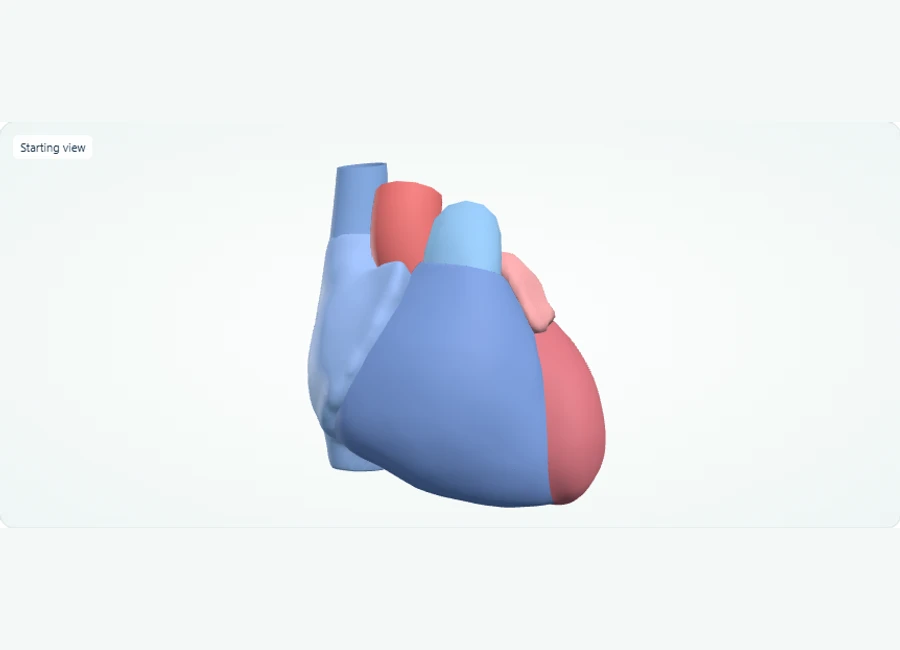
Explore in 3D: Heart chambers and great vessels
A four-chambered heart viewed from the front. The right ventricle supplies the pulmonary circulation via the pulmonary trunk; the left ventricle supplies the systemic circulation via the ascending aorta. This model shows external chamber surfaces and the visible great vessels only — no internal valves or conduction system.
Rotate, isolate structures, and test your recall.
Choose Front and compare the four chambers. The right ventricle forms most of the anterior surface; the left ventricle contributes to the apex.
Select and isolate each chamber in turn, then use Show all to restore its relationship to the surrounding structures.
Select the pulmonary trunk and ascending aorta in turn. Name the circulation supplied by each, then use Test recall to practise identifying the listed structures.
Try it yourself
Which ventricle supplies the pulmonary trunk, and which supplies the ascending aorta?
Show answer and explanation
The right ventricle; it serves the pulmonary circulation.
On the front view, the right ventricle is the anterior-most chamber, and its outflow tract continues as the pulmonary trunk carrying blood to the lungs. The left ventricle instead empties into the ascending aorta for the systemic circulation.
- The right ventricle pumps blood into the pulmonary trunk toward the lungs; the left ventricle pumps into the ascending aorta to the body.
- The superior vena cava returns blood to the right atrium from above the heart.
- The two atria sit superior to the two ventricles; atria receive blood, ventricles eject it.
Weighing apnea and temperature instability as a cluster, not isolated events
Apnea of prematurity is expected in preterm infants and improves with postnatal age. New or worsening apnea in an infant who had been stable, especially with temperature or perfusion change, is a sepsis-style cluster pending evaluation.
The named distinction is context and trend. Apnea of prematurity appears in preterm infants, often in the first weeks, and has no accompanying signs of illness; episodes become less frequent as the infant matures. By contrast, apnea can be a presenting sign of late-onset sepsis when it is new relative to the infant's established baseline or is accompanied by temperature instability, feeding change, poor perfusion, or lethargy. In a case question, the phrase that usually settles the differential is whether the infant had been stable before the episode began.
Scenario for self-testing: a former 28-week infant, now three weeks old and breathing in room air for several days, has two desaturation episodes and a temperature of 36.2 degrees C. A plausible mistake is attributing this to apnea of prematurity because the infant is preterm. The better reading is a new decompensation after a period of stability, which warrants full evaluation, sepsis workup, and empiric antibiotics as directed by the unit pathway. The stakes are that sepsis in this population can progress quickly, so the timing relative to baseline drives the decision more than the diagnosis of prematurity itself.
In your case notes, write one line describing the infant's baseline before the event; questions and real handoffs both hinge on that comparison.
NEC versus simple feeding intolerance: what tips the differential
Distinguish benign gastric residuals from necrotizing enterocolitis using abdominal exam, stool character, and systemic signs. Bilious residuals, distension, tenderness, bloody stool, or systemic instability push evaluation toward NEC.
NEC is classically a disease of preterm infants on enteral feeding, presenting with feeding intolerance plus abdominal findings: increasing or bilious residuals, distension, abdominal wall discoloration or tenderness, guaiac-positive or frankly bloody stool, and often systemic signs such as apnea or temperature instability. Pneumatosis intestinalis on imaging supports the diagnosis. Simple feeding intolerance, by contrast, shows a retained or curdled residual with a soft, nondistended, nontender abdomen, normal stools, and a well-appearing infant whose vitals are unchanged. The discriminating task is checking the abdomen and the stool, not just the volume of the residual.
Worked scenario: a 29-week infant on day 14 has growing residuals that turn bilious, mild distension, and one stool streaked with blood, yet vitals look reassuring. A plausible mistake is holding one feeding and resuming the schedule, treating this as routine intolerance. The better decision is to stop enteral feeds, decompress the stomach, obtain an abdominal imaging study and labs, and perform serial abdominal exams per the unit's NEC pathway, with escalation as findings evolve. This matters because NEC can progress from subtle findings to perforation, and the window for conservative management closes quickly.
Practice stating the two side-by-side: a benign residual comes with a soft abdomen and normal stool; anything bilious, bloody, or tender belongs to the NEC workup column until proven otherwise.
Duct-dependent cardiac presentations and the pre-ductal saturation clue
Compare pre-ductal and post-ductal saturations to localize a problem. A significant post-ductal drop suggests differential cyanosis from a duct-dependent lesion, which responds poorly to oxygen compared with a pulmonary cause.
Teach the anatomy behind the number. The ductus arteriosus joins the pulmonary artery to the descending aorta, so saturations measured pre-ductally (right hand) and post-ductally (a lower limb) can diverge when blood shunts across the duct. Lesions such as critical coarctation or interrupted aortic arch can leave the lower body perfused through the duct, producing lower post-ductal saturations and weak femoral pulses. Transposition physiology can also produce differential cyanosis depending on mixing. A cardiac cause resists oxygen escalation because the problem is circulation, not gas exchange, and a duct-dependent circulation depends on the duct remaining open.
Scenario for practice: a term infant on day 3 has gray spells with feeds, a pre-ductal saturation of 94, a post-ductal saturation of 82, and weak femoral pulses. A plausible mistake is managing this as a respiratory problem and raising inspired oxygen, expecting improvement that does not come. The better reading is a differential cyanosis pattern with poor lower-body perfusion, which raises suspicion for a duct-dependent lesion and prompts urgent provider notification and preparation for transfer, with prostaglandin management per protocol. The reason it matters is that treatment pathways diverge completely: pulmonary causes need support of oxygenation, while duct-dependent cardiac lesions need the duct protected.
For every cyanosis practice case, recite the three-way comparison: pulmonary parenchymal disease, structural cardiac disease, and pulmonary vascular disorders such as persistent pulmonary hypertension, and name the finding that points to each.
Documentation, escalation, and family-centered scenarios in professional standards
Professional-standards scenarios apply principles to concrete NICU situations: timely objective documentation, structured escalation, staying within scope, and supporting families with accurate, team-consistent information.
Documentation questions test whether you can turn an assessment into a defensible record. Strong answers avoid vague terms, record what was observed and when, capture the escalation notification with the provider's response, and use structured handoff frameworks such as SBAR to organize findings. Safety questions reward a nonpunitive reporting posture: near misses and delayed assessments are reported so systems improve, and a colleague's pattern of missed care is escalated through the proper chain rather than quietly absorbed.
Ethics scenarios commonly place you between a family and uncertainty. Suppose parents of a critically preterm infant ask you directly whether their baby will be normal. A plausible mistake is offering a personal prognosis or, at the other extreme, deflecting without any support. The better approach is to share only factual current status within your role, arrange the team discussion where prognosis belongs, ensure interpretation services are used when needed, and document the conversation and follow-up plan. The principle being tested is family-centered care with accurate, consistent information delivered by the right team members.
Rehearse these as short written responses: state the action, the person notified, and the documentation sentence you would chart. Practicing in that concrete three-part structure keeps your reasoning complete and transfers directly to how you handle similar situations at the bedside.
An adaptable preparation sequence and a self-check rubric you can score
Cycle through content review by domain, timed case drills, and error analysis. Measure readiness with a rubric on differential reasoning speed and accuracy, treating scores as learning milestones rather than predictions.
A realistic sequence adapts to your NICU experience. In weeks one to three, review content by domain, converting each topic into a look-alike pair and a one-line discriminator. In weeks three to six, shift to case drills: write short scenarios from your own shifts, then work exam-style questions under time limits, logging every miss with the reason, whether a knowledge gap or a rushed interpretation. In the final stretch, rework only your error log and rebuild the comparison table from memory. Practice resources such as the free practice questions and other study guides on this site fit the drill and review stages.
Exercise and rubric: after each drill session, score yourself on five checks, one point each: (1) you named the differential within a minute of reading the stem; (2) you stated the single discriminating finding; (3) you named the first action, not just the diagnosis; (4) you identified the infant's baseline and trajectory; (5) you correctly said whether the finding was expected for the infant's age. A self-check score is a learning milestone for targeting review, not a passing prediction; a lower score simply tells you which pair to rebuild. Expected observations are that early sessions surface knowledge gaps and later sessions surface interpretation habits, so the log's trend matters more than any single score.
For administrative matters such as eligibility, application windows, fees, and scheduling, the National Certification Corporation is the issuing body and its current candidate guide is the authoritative reference.
- Readiness check 1: you can rebuild the TTN versus RDS table, the physiologic versus pathologic jaundice contrast, and the NEC versus intolerance discriminations from memory.
- Readiness check 2: in timed drills, you name the differential and first action before reading answer choices, then verify against the explanation.
- Readiness check 3: your error log distinguishes knowledge misses from interpretation misses, and interpretation misses are shrinking across sessions.
- Readiness check 4: you can state why trajectory and hour-specific timing settle each look-alike pair without checking notes.
References and further reading
Use these references to explore the concepts and check the latest information from the relevant organizations.