
NPLEX I asks you to work across several biomedical disciplines, and the practical difficulty is moving between them: one condition can surface as a biochemistry question, a physiology question, and a pathology question in the same sitting. This guide organizes preparation around mechanism chains — a molecule's role, the cellular function it supports, the tissue behavior that changes, the signs that result — and then drills the look-alike discrimination that case-style stems demand. The actionable starting point: each week, take one condition from your program's curriculum and trace it through every discipline you can, forward from mechanism to presentation and backward from symptom to cause.
What Criterion-Referenced Scoring Means for Your Study Standard
NPLEX results are scored criterion-referenced: your performance is measured against a standard of knowledge required for safe practice, not against other candidates. Study to a fixed standard of understanding rather than to beat an imagined curve.
NABNE describes NPLEX scoring as criterion-referenced: the passing standard is set through a standard-setting process based on the knowledge, skills, and abilities required for safe and effective practice, and each candidate is evaluated on their own performance rather than ranked against peers. For study purposes this reframes your goal. Instead of asking whether you are ahead of an imagined cohort, define for each topic what safe-practice understanding looks like — you can explain the mechanism, predict the consequence of a change, and recognize when a finding contradicts your working hypothesis.
A second implication is administrative separation: applications, fees, calendars, testing accommodations, and transcript requests are handled by NABNE, so keep those details out of your study plan and confirm them directly at nabne.org when you plan your application. This separation also protects your content time. Build your review around mastery criteria you set yourself — for example, 'I can trace this pathway and state what breaks when enzyme X is deficient' — and treat those criteria as the standard you are measured against, mirroring how the examination itself is constructed.
Linking Biochemistry, Physiology, and Pathology in One Chain
A mechanism chain links a molecule or gene to a cellular function, then to tissue behavior, then to observable signs. Studying conditions as chains lets one hour of review serve biochemistry, physiology, and pathology at once.
Take vitamin B12 deficiency as a chain: reduced B12 impairs methionine synthase and methylmalonyl-CoA mutase, which disrupts DNA synthesis and myelin maintenance, which produces macrocytic anemia and neurological findings. Written this way, the same entry answers biochemistry questions (which enzymes), physiology questions (why these cell systems suffer), and pathology questions (why the blood film looks the way it does). One chain, three disciplines, no duplicated flashcards.
Apply the chain in both directions. Forward practice starts at the molecule and predicts the presentation; backward practice starts at a symptom, such as paresthesia, and asks which upstream steps could produce it. Backward practice is harder because several chains can converge on the same symptom, which is exactly the discrimination work case-style questions demand. Keep each chain on a single page so you can see the branching points where a look-alike condition splits off.
Visual anatomy review: Follow the digestive route and accessory organs
Trace the stomach-to-small-intestine sequence before reviewing fluid balance or obstruction.
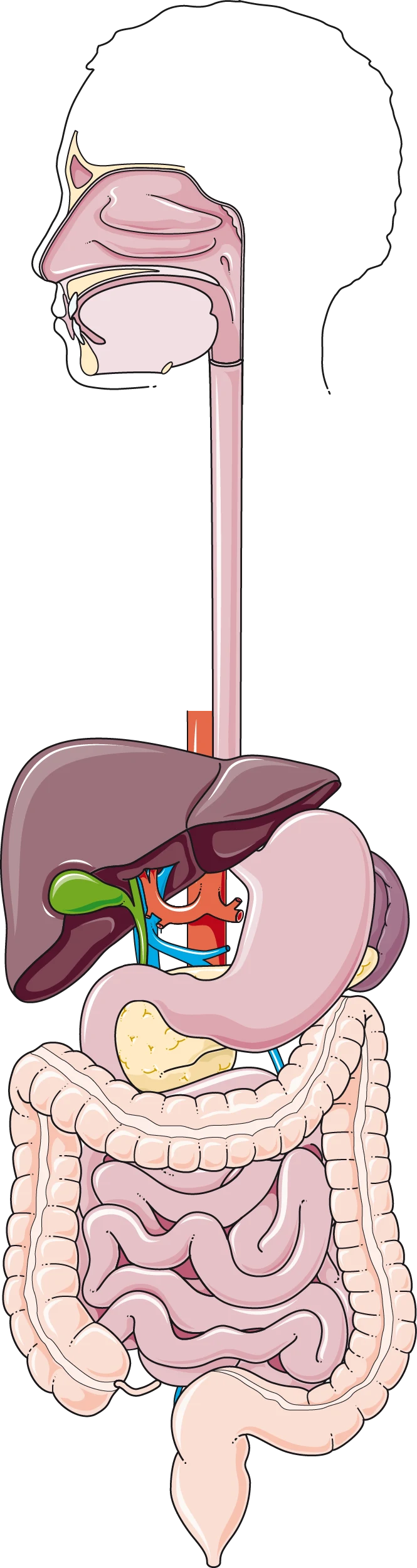
The digestive tract is a continuous passage; the liver, gallbladder and pancreas are accessory organs. Open the full-size illustration for the smaller abdominal structures.
Trace the esophagus into the stomach and then the small intestine. The duodenum comes first, followed by the jejunum and ileum. The gallbladder lies beneath the liver; it is not part of the passage through which food travels.
In Z-Anatomy, locate the stomach, duodenum, liver and gallbladder. Rotate the visceral structures to inspect their relationships, then describe the food passage without including the accessory organs in it.
Try it yourself
An upper endoscope passes through the esophagus and stomach. Which small-intestinal segment does it reach first, and is the gallbladder part of that route?
Show answer and explanation
It reaches the duodenum first. The gallbladder is an accessory organ outside that food passage.
Separate the route of access from the target of a procedure. The diagram supports location recall; the actual operative findings and work performed determine the procedure being described.
Two Anemias, One Complaint: Finding the Discriminating Lab
When two conditions share a presentation, the discriminating observation is the test result or mechanism detail that fits only one chain. Practice naming that single decisive datum before you read any answer options.
Consider a paper case written for study: a 52-year-old reports months of fatigue, and a CBC shows hemoglobin of 10.4 g/dL with MCV 76 fL. The tempting shortcut is to anchor on fatigue plus microcytosis and recommend iron. The better decision is to request iron studies before acting. Ferritin comes back elevated with a low transferrin saturation — a pattern consistent with anemia of chronic inflammation rather than iron deficiency, where ferritin is typically low because stores are genuinely depleted.
The distinction matters because the two chains diverge at the iron-handling step: inflammation raises hepcidin, which traps iron in storage, while true deficiency empties the stores. Adding iron in the inflammatory pattern would not address the underlying process and, depending on the clinical context, is not a benign default. The transferable lesson is procedural: when a presentation fits two chains, name the exact branch point first, then choose the observation that separates them — ferritin and transferrin saturation here — before committing to any intervention.
Thyroid Stems: Locating the Fault Before Acting
Endocrine cases test whether you locate the fault in the axis before responding to the symptom pattern. Serum TSH read together with free T4 tells you whether the problem is thyroidal or upstream, and each calls for different follow-up.
Study case: a 38-year-old describes cold intolerance, weight gain, dry skin, and slowed thinking — a pattern pointing toward reduced thyroid function. The plausible mistake is to treat the symptom cluster as a single condition and stop there. The better decision is to read the labs as a pair: TSH of 12 mIU/L with low free T4 indicates primary thyroid failure, because the pituitary is driving hard against a gland that cannot respond.
Contrast that with a low or inappropriately normal TSH alongside low free T4, which points to a central (pituitary or hypothalamic) cause and changes the follow-up question from the gland to the axis. This is the same discrimination discipline as the anemia scenario: the symptoms define the neighborhood, and the paired labs identify the house. For practice, write three vignettes yourself using different endocrine axes, and force each one to hinge on a two-result interpretation rather than a symptom list.
Turning Lab Facts into a Decision Table
A comparison table turns scattered lab facts into a decision tool. Build one table per look-alike family, pairing each discriminating observation with the mechanism behind it, so interpretation becomes pattern-matching with a reason attached.
The table below is a worked teaching example, not a description of specific exam content. It compresses one anemia family into the features that separate its members. Notice the structure: each row pairs an observation with the mechanism that explains it. When you reproduce this exercise for your own condition families — anemias, thyroid patterns, electrolyte disturbances — insist on the mechanism column. A table without mechanisms is just a longer flashcard; the mechanism is what lets you handle a result the table did not anticipate.
Use the table actively rather than reading it passively. Cover the right-hand columns, read a single observation such as 'elevated ferritin,' and name which condition it supports and why. Then invert the drill: pick a condition and predict every row. If a prediction surprises you, that row marks a gap in your chain, and the fix is to repair the chain rather than re-memorize the row. Fifteen minutes per family is a reasonable starting investment to locate the weak rows.
| Observation | Iron deficiency | Anemia of chronic inflammation | B12 deficiency |
|---|---|---|---|
| MCV | Often low (microcytic) | Normal or mildly low | Typically elevated (macrocytic) |
| Ferritin | Low (depleted stores) | Normal or elevated (acute-phase protein) | Not the discriminating test here |
| Iron studies | Low serum iron, high TIBC | Low serum iron, low TIBC | Not iron-related |
| Key mechanism | Insufficient iron for hemoglobin synthesis | Hepcidin-mediated iron trapping in inflammation | Impaired DNA synthesis and myelin maintenance |
| Discriminating next step | Ferritin and transferrin saturation | Inflammatory markers and clinical context | B12 level; screen for neurologic findings |
The Mechanism-Map Drill and Its Rubric
The mechanism-map drill forces integration under time pressure and gives you observable evidence of readiness. Done weekly, it converts passive review into a repeatable skill you can measure with a short rubric.
Choose one condition per session and hold a 20-minute limit. Draw the chain from molecule to presentation, then invent one plausible look-alike and mark the branch point between them. Write the single observation that best discriminates the two, and generate one exam-style sentence for each direction: a lab clue that should make you think of the condition, and a symptom that should send you back down the chain. Move to a new condition next session rather than polishing the same map repeatedly.
Score each finished map against the rubric below. These milestones measure exercise performance only; they are learning checks, not predictions of any examination result. What you are looking for is consistency: two or three sessions in a row where the map earns most checks without notes is a stronger signal than one polished map produced over an afternoon. Where a check fails, the failure itself is diagnostic — it names the exact link in the chain that needs repair before the next session.
- Chain completeness: every arrow from molecule to presentation can be explained aloud without notes.
- Branch-point accuracy: the look-alike splits at a real mechanistic divergence, not merely at the symptom list.
- Discriminator quality: the chosen observation would plausibly change a decision, and you can say why.
- Bidirectional fluency: you produced both a forward prediction and a backward diagnosis within the time limit.
- Suggested target: at least four of five checks on consecutive sessions before adding a new condition family.
An Adaptable Sequence and Observable Readiness Checks
Sequence preparation in three passes: build chains across disciplines, then drill look-alike discrimination, then practice vignette reading against the clock. Finish with readiness checks you can actually observe, not a feeling of familiarity.
In an adaptable sequence, spend the first stretch building mechanism maps for the major condition families in your program's biomedical curriculum, one family per session. Move next to paired discrimination drills using tables like the anemia example, adding a new family only when the rubric checks hold. Reserve the final stretch for full vignettes: read the stem, list the pertinent positives and negatives, and commit to a discriminating observation before looking at any options. Adjust the proportions to your own weak spots, not to a fixed calendar.
Readiness is observable, and each check below is a behavior you can demonstrate or fail in a single sitting. Treat a failed check as scheduling information, not a verdict: it tells you which family or skill gets the next session. When all four hold on the same day, your review has converged on the criterion-referenced standard described at the start — knowledge organized for decisions — which is a sound position from which to approach a standardized science examination.
- You can explain three mechanism chains in both directions without notes, including one endocrine and one hematologic example.
- You can state the branch point and discriminating observation for three look-alike pairs from memory.
- Given an unfamiliar paper vignette, you can list the pertinent findings and a first discriminating test before reading answer options.
- You have confirmed your own application, scheduling, and accommodation details with NABNE rather than relying on secondhand summaries.
References and further reading
Use these references to explore the concepts and check the latest information from the relevant organizations.