
Study the MCCQE Part I by its blueprint, not by textbook chapters. Tag every practice question with its Dimensions of Care and Physician Activities domain before answering, so you learn to recognize which reasoning style — diagnosis, management, communication, or legal and ethical judgment — each stem is demanding, and rehearse that style deliberately.
Why studying disease-by-disease leaves blueprint cells empty
The MCCQE assesses performance across a two-dimension blueprint: Dimensions of Care (the spectrum of care) and Physician Activities (scope of practice and behaviours), both grounded in the CanMEDS roles. Studying only clinical topics leaves the behavioural, legal, and systems cells unrehearsed.
A specialty-by-specialty review covers the Medical Expert content thoroughly, but the Physician Activities dimension also spans communication and the legal, ethical, and organizational aspects of medicine. Those domains ask how you act with patients, colleagues, and the health system, and they reward a different kind of reasoning than identifying a lesion or selecting a drug. If your notes contain nothing on consent, duty to report, or interprofessional handoffs, entire regions of the grid have never been touched by practice.
The fix is structural. Read the MCC Examination Objectives as a map of behaviours, not a reading list, and draw a two-axis grid: the four Dimensions of Care domains on one axis, the four Physician Activities domains on the other. From that point on, every practice question gets tagged to a cell. Empty cells become visible within days, so you can direct reading toward what you have never practised instead of rereading familiar clinical territory.
Dimensions of Care: what the four care-spectrum domains each demand
Dimensions of Care describes where in the care spectrum a question sits: health promotion and prevention, acute care, chronic care, or psychosocial aspects. Each domain pulls on different content and cues, so each needs its own study pass.
Health promotion and prevention items revolve around screening, vaccination, counselling, and risk reduction, and in the Canadian context they follow Canadian recommendations, which occasionally differ from those learned in other jurisdictions. Chronic care items emphasize ongoing management: titration, monitoring, adherence, complications over years, and coordination among providers. Acute care items compress time — recognition of deterioration, immediate stabilization, escalation — and reward decisive action over further observation. Psychosocial aspects bring culture, finances, housing, family dynamics, and mental health context directly into the stem.
Practically, give each dimension a dedicated review cycle with its own question set. For prevention, drill the screening and immunization frameworks from Canadian sources, checking age and risk criteria each time. For chronic disease, practise multi-visit vignettes where the question asks what to adjust at today's appointment rather than what the disease is. For psychosocial stems, watch for contextual cues — a patient who cannot afford medication, an interpreter in the room, a caregiver at the bedside — because the tested skill is folding that context into the plan rather than overriding it with the narrowly 'medical' option.
Explore in 3D: Heart chambers and great vessels
A four-chambered heart viewed from the front. The right ventricle supplies the pulmonary circulation via the pulmonary trunk; the left ventricle supplies the systemic circulation via the ascending aorta. This model shows external chamber surfaces and the visible great vessels only — no internal valves or conduction system.
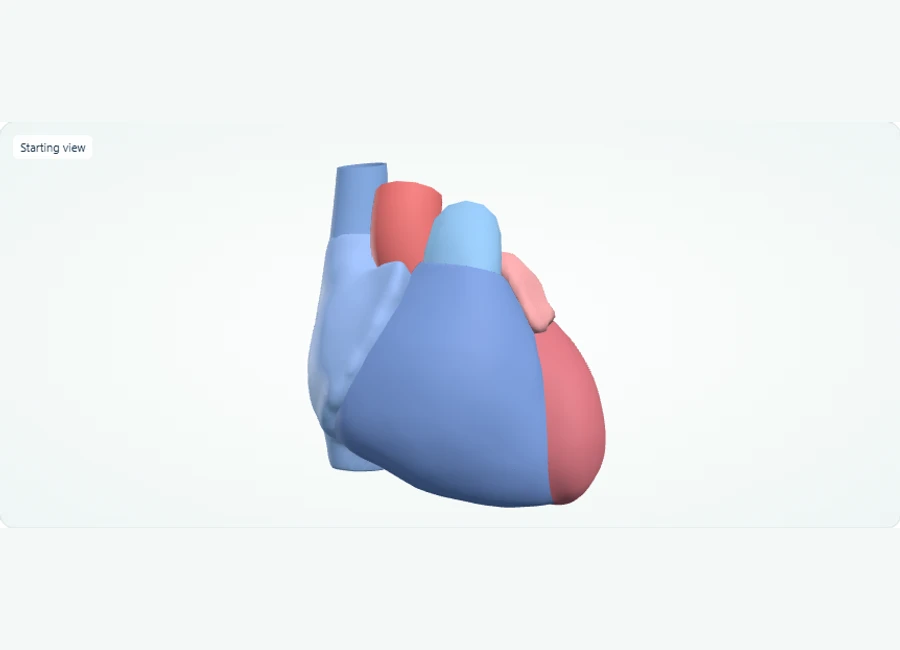
Rotate, isolate structures, and test your recall.
Choose Front and compare the four chambers. The right ventricle forms most of the anterior surface; the left ventricle contributes to the apex.
Select and isolate each chamber in turn, then use Show all to restore its relationship to the surrounding structures.
Select the pulmonary trunk and ascending aorta in turn. Name the circulation supplied by each, then use Test recall to practise identifying the listed structures.
Try it yourself
Which ventricle supplies the pulmonary trunk, and which supplies the ascending aorta?
Show answer and explanation
The right ventricle; it serves the pulmonary circulation.
On the front view, the right ventricle is the anterior-most chamber, and its outflow tract continues as the pulmonary trunk carrying blood to the lungs. The left ventricle instead empties into the ascending aorta for the systemic circulation.
- The right ventricle pumps blood into the pulmonary trunk toward the lungs; the left ventricle pumps into the ascending aorta to the body.
- The superior vena cava returns blood to the right atrium from above the heart.
- The two atria sit superior to the two ventricles; atria receive blood, ventricles eject it.
Physician Activities: telling a diagnosis question apart from a management question
Physician Activities describe what the physician is doing: assessing and diagnosing, managing, communicating, or handling legal, ethical, and organizational matters. Diagnosis items ask what is going on; management items ask what you will do next.
The two domains interfere with each other because the clinical knowledge behind them overlaps: the same disease can anchor either an assessment item or a management item. Diagnosis items signal themselves with cues such as 'most likely explanation,' 'most appropriate initial investigation,' or a request to interpret findings. Management items signal 'most appropriate next step,' 'best initial management,' or a decision point where several actions are plausible and must be ranked. Choosing an investigation when the stem asks for an action — or reflexively treating when the stem asks what the findings represent — is the reasoning error this distinction exists to expose.
Train the distinction explicitly. When reviewing practice questions, write the stem cue at the top of your note — 'diagnosis' or 'management.' For diagnosis items, practise building a ranked differential and knowing which single test best discriminates, rather than which test is most comprehensive. For management items, practise an ordering habit: immediate threats first, then treatment that changes the outcome today, then investigations that only refine the picture. If your first instinct on a management item was an investigation, flag it — that instinct-versus-domain mismatch is exactly what tagged review is designed to catch.
Worked scenario: acute care — when acting beats confirming
In acute care vignettes, the question is typically a management item presented with diagnostic-looking options: the correct move is the immediate intervention, not the test that would document the cause. Trace this example to see how the domain tag drives the decision.
Scenario (paper exercise): a 22-year-old eats a peanut-containing snack and develops diffuse hives, lip swelling, and wheeze; blood pressure is 84/50 and the voice is hoarse. Options include serum tryptase, intramuscular epinephrine, an oral antihistamine, a chest radiograph, and referral for skin-prick testing. A plausible mistake is choosing serum tryptase — it is a real test associated with anaphylaxis, which makes it attractive — but tryptase belongs to the assessment-and-diagnosis domain while the stem presents an unstable patient, which signals the management domain.
The better decision is immediate intramuscular epinephrine: airway involvement plus hypotension shortly after allergen exposure is a life-threatening presentation in which treatment cannot wait for laboratory confirmation; tryptase and allergy testing belong later, once the patient is stable. Why it matters: the domain tag changes the answer even when every option is medically legitimate. Build the reflex of scanning vital signs and time language first — 'now,' 'deteriorating,' 'hypotensive' — and let those cues override the pull of an interesting diagnostic choice.
Worked scenario: the legal and ethical domain is not a communication exercise
Legal, ethical, and organizational items test specific Canadian duties — consent, confidentiality and its limits, mandatory reporting, capacity — not merely empathetic phrasing. Choosing a communication-only response when a statutory duty exists is the error to train against.
Scenario (paper exercise): a 58-year-old had a first unprovoked seizure two weeks ago, has been counselled about the risk, and asks to confirm he can keep driving his delivery route because his job depends on it. Options include counselling him not to drive and documenting the advice, reporting the situation to the provincial licensing authority, contacting his employer directly, and arranging an outpatient EEG. The plausible mistake is the counselling-and-document option: patient-centred in tone, but it answers a communication question when the item tests legal and professional obligations.
In Canadian jurisdictions, physicians are generally under a legal duty to report patients whose conditions create driving risk to the provincial licensing body, with specifics varying by province; the duty is one of the defined circumstances in which confidentiality yields. The better decision is to counsel the patient and report to the authority, while leaving the employer out of it — the reporting obligation runs to the licensing body, not to third parties. Why it matters: this domain is learned from the Objectives' legal and ethical content plus provincial rules, not from general clinical reading, and so it needs an entirely separate study pass.
The blueprint-tagging drill: a self-scored exercise with a rubric
Take ten untimed practice items and tag each with its Dimensions of Care domain and Physician Activities domain before reading the options. Then answer, check the explanation, and score how often your tag and your answer style matched.
Set up the drill: choose ten items you have not seen, and for each write two labels — one dimension, one activity — plus a one-line predicted answer type ('action,' 'investigation,' 'communication response,' 'report/referral'). Only then read the options and commit. When you check the explanation, record three things: whether your dimension tag was right, whether your activity tag was right, and whether your first-instinct answer matched the domain you tagged. Expected observations after ten items: management-style stems cluster in acute and chronic care; psychosocial stems ask you to incorporate context rather than pick a drug; and any mismatch between your tag and your instinct marks a specific habit to fix.
Score yourself against this rubric, as a learning milestone rather than a prediction of any exam result. Eight to ten correct tags with matching instincts: move to timed mixed blocks and keep tagging only the misses. Five to seven: reread the Objectives sections for the cells you mislabeled and repeat the drill with a fresh ten before adding time pressure. Fewer than five: step back and rebuild the grid from the Objectives document itself, writing one example behaviour into each cell before doing further questions. Repeat the cycle weekly; the tags should become near-instant.
An adaptable preparation sequence and concrete readiness checks
Sequence preparation in four phases: map the blueprint and rate your confidence per cell; fill weak cells with content; drill untimed tagging; then integrate under timed, sectioned practice. Stretch or compress phases based on your baseline, not a fixed calendar.
Phase one, map: read the Objectives, draw the dimension-by-activity grid, and rate each cell low, medium, or high based on the questions you have done so far. Phase two, fill: for every low cell, pair one focused content source — Canadian guidelines for clinical cells, the Objectives' own legal, ethical, and organizational content for behavioural cells — with a short block of items from that cell. Phase three, drill: run the ten-item tagging exercise repeatedly until tagging is automatic. Phase four, integrate: take full timed practice tests delivered as consecutive sections with a break between them, mirroring the computer-based format, and practise pacing so you keep a review buffer. One short note: for current format, scheduling, eligibility, and results, rely on the Medical Council of Canada's official MCCQE page rather than summaries.
Readiness checks before you consider phase four complete. First, you can tag an unfamiliar item's dimension and activity within seconds of reading the stem. Second, you can articulate the difference between a diagnosis cue and a management cue and answer each accordingly. Third, you can name a Canadian legal or professional duty relevant to confidentiality, consent, and reporting without looking it up. Fourth, your timed practice leaves enough buffer to revisit flagged items rather than rushing the final stretch. If any check fails, return to the matching phase — the sequence is diagnostic, and each check points back to a specific repair.
| Stem cue you notice | Domain likely being tested | Response strategy |
|---|---|---|
| 'Most likely diagnosis' / 'best initial investigation' | Assessment and diagnosis (Physician Activities) | Build a ranked differential; pick the test that best discriminates, not the most comprehensive one |
| 'Best next step' in an unstable patient | Management, acute care | Act on immediate threats first; defer confirmatory testing until stability |
| Chronic disease follow-up across visits | Management, chronic care | Ask what to adjust today: titration, monitoring, adherence, coordination |
| Screening, vaccination, counselling request | Health promotion and illness prevention | Apply Canadian screening and prevention frameworks; check age and risk criteria |
| Contextual cues: money, culture, family, mood | Psychosocial aspects | Incorporate the context into the plan rather than overriding it |
| Consent, capacity, confidentiality, reporting | Legal, ethical, organizational aspects | Identify the specific Canadian duty; choose the option that fulfils it, not just the empathetic one |
References and further reading
Use these references to explore the concepts and check the latest information from the relevant organizations.