
Readiness checks before you consider your FACRRM case-reasoning preparation on track (learning milestones, not passing predictions): 1. Given any case stem, you can name the setting, resource level, and time-to-definitive-care within 30 seconds of reading. 2. You can state, for five time-critical presentations, why geography makes early escalation the modifiable factor. 3. You can articulate a three-part scope test (training, system support, follow-up) and apply it to a novel scenario. 4. You can write a transfer note containing time-stamped events, interventions, escalation advice, and unanswered questions in under five minutes. 5. In self-written cases, you score at least 4 of 5 on the Section 7 rubric across three consecutive cases. If any check fails, repeat the relevant exercise for that decision type rather than adding new content. For administrative details about the fellowship itself — eligibility, assessment components, and current requirements — rely on ACRRM directly rather than secondary summaries.
Why Metro-Calibrated Reasoning Fails Rural Case Stems
Rural generalist reasoning requires reading each case for its setting before its diagnosis. A correct metro answer that assumes immediate specialist backup, on-site pathology, or rapid follow-up can be the wrong answer in a remote context.
ACRRM describes its fellowship pathway as training rural generalists in a four-year program that is rural from day one, leading toward specialist registration as a Rural Generalist. That framing matters for study: the credential examines medicine practised where the doctor is often the first and most available clinician, with broad scope across primary care, emergencies, and procedural work, rather than medicine practised inside a supported metropolitan department.
Teach yourself one named habit first: constraint-aware triage reading. Before considering differentials in any practice case, extract four data points — location type, available resources, time to definitive care, and follow-up capacity. Practise this on every case you write or review. Trainees who skip this step often produce clinically sound management plans that are simply undeliverable at the stated location, which is the failure mode this guide's scenarios are built to expose.
Manage Locally or Retrieve Early: A Worked Chest Pain Case
For time-critical conditions in remote settings, the retrieval decision competes with the management decision. Geography fixes the definitive-care clock, so early escalation is usually the highest-value action, supported by local guideline-concident care.
Scenario: you are the doctor at a remote clinic. A nurse calls about a 58-year-old with two hours of crushing chest pain; a clinic ECG shows ST elevation, and the nearest cardiology-capable hospital is a long flight away. The tempting reasoning is thoroughness: repeat the ECG, wait for troponins, take more history, and call back. The better decision is to activate the retrieval pathway immediately, start guideline-concordant initial management available at the clinic, and open a telehealth consultation with the receiving or coordinating service while the patient is being prepared.
The concept to name here is the time-critical transfer threshold: when definitive treatment sits behind fixed transport time, delay is the one factor you control. Waiting for results that will not change the retrieval decision consumes the treatment window. Why it matters: in study cases and in practice, the defensible answer is the sequence that starts irreversible-clock events moving first and gathers information in parallel. The table below gives you a reusable structure for these decisions.
| Decision factor | Favours managing locally first | Favours early retrieval or escalation |
|---|---|---|
| Time to definitive care | Definitive care close or condition not time-critical | Long transport time with a time-critical diagnosis |
| Trajectory | Stable or improving with available treatment | Deteriorating, or risk of rapid deterioration |
| Local capability | Equipment, skills, and staffing match the need | Required intervention exceeds clinic capability |
| Escalation support | Telehealth advice available and adequate | Advice received indicates definitive care is needed |
| Transport constraints | Weather or availability make transfer high-risk now | Transfer is feasible and delay narrows the window |
Explore in 3D: Lung lobes
This model shows the five lung lobes: three on the right (superior, middle, inferior) and two on the left (superior, inferior). The left lung has no middle lobe. Each colored lobe is a distinct selectable structure, separate from segments and bronchial branches. As a normal surface model, it shows healthy anatomy only.
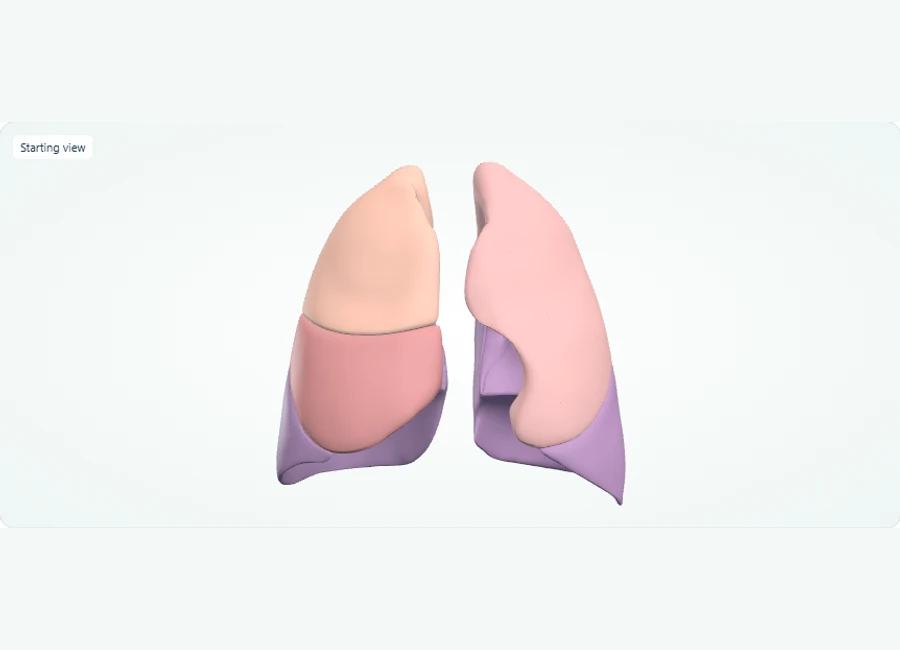
Rotate, isolate structures, and test your recall.
Choose Front. Use the Structure list to select each lobe and count three on the anatomical right and two on the left.
Select and isolate the right middle lobe, then use Show all and Back to inspect how it relates to the other right lung lobes.
Start Test recall, name the highlighted lobe, then select Reveal name to check your answer.
Try it yourself
How many lobes does each lung have, and which lobe name occurs only on the right?
Show answer and explanation
The right lung has superior, middle and inferior lobes. The left lung has superior and inferior lobes, with no middle lobe.
A lobe is a gross anatomical division of a lung. The right lung has three lobes and the left has two. These surface models show lobes, not individual bronchopulmonary segments or surgical margins.
- The right lung has three lobes: superior, middle, and inferior.
- The left lung has only two lobes: superior and inferior; there is no left middle lobe.
- Lobes are distinct from segments and bronchial branches, and a normal model shows no tumors or surgical margins.
Scope Boundaries: When Attempting a Procedure Is the Wrong Call
Scope of practice in rural settings rests on three supports together: your training, the system around you, and follow-up capacity. Confident in one support is not enough; cases test whether you can identify which support is missing.
Scenario: at a small rural hospital overnight, a colleague suggests reducing a displaced forearm fracture under procedural sedation. You have emergency training and past experience, but you are the only clinician present, monitoring equipment is basic, and no theatre or orthopaedic service is nearby if reduction fails. The plausible mistake is proceeding on training alone — treating confidence as scope. The better decision is to recognise the combined gap in monitoring support and fallback capacity, provide immobilisation and analgesia, seek telehealth advice from the on-call service, and arrange timely definitive management.
Apply the three-part scope test: (1) Have I been trained and credentialed for this in comparable conditions? (2) Does the system here — staff, equipment, escalation — support it if something goes wrong? (3) Is there follow-up capacity to detect and manage complications? Why it matters: rural generalism legitimately extends scope, and over-caution has real costs, but extended scope is earned by all three supports, not by willingness. In case analysis, state explicitly which support fails, because that reasoning, not the bare answer, is the examined skill.
Documentation Built for Distance, Handover, and Review
Rural documentation must serve readers who were not present: retrieval crews, receiving hospitals, and reviewing services hours later. Practise notes that carry time-stamped events, interventions, escalation advice, and explicit outstanding questions.
In supported environments, a vague note is often recoverable by asking the author. Across distance it cannot be. When a patient leaves your clinic with a retrieval crew, your record is the handover. Build the habit of structured entries: times of onset, assessment, and interventions; what you administered and when; who you consulted and what they advised; and what remains uncertain. A transfer note that ends with explicit open questions directs the receiving clinician's attention instead of burying it.
Tie this to professionalism in your case practice: documentation is where continuity of care is manufactured in dispersed systems. In scenario work, do not close a case at the transfer decision. Write the accompanying note as an exercise and check it against three tests — could a colleague reconstruct the timeline, repeat your reasoning, and see what you flagged as unresolved? If any test fails, revise before moving on, because the same structure recurs in escalation calls and written communications throughout rural practice.
Aboriginal and Torres Strait Islander Health Context in Case Analysis
Australian rural cases frequently involve Aboriginal and Torres Strait Islander patients and communities. Reasoning must include culturally safe care, local context, disease risks common in remote populations, and realistic follow-up across distance.
One illustrative pattern: a child in a remote community presents with fever and joint pain. A metro-default read may settle on a benign viral illness. In Australian remote Aboriginal and Torres Strait Islander communities, acute rheumatic fever is a recognised risk that changes the threshold for investigation and follow-up, and management depends on engagement with the local health team and structured follow-up rather than a single consultation. The context does not just add a differential — it changes the acceptable level of certainty before discharge.
Study two things together: the clinical epidemiology that is specific to remote Australian populations, and the practice of cultural safety — care shaped by the patient's community, communication needs, and trust in the service. In case analysis, both belong in your stated reasoning. A plan that is technically correct but impossible for the family to complete across distance, or delivered without engaging community health structures, is an incomplete answer at this level.
Remote Emergency Management When Guidelines Assume Faster Backup
Emergency guidelines often presume rapid ambulance and definitive care. Remote practice applies the same principles with delay built in: longer anticipated intervention times, limited drug stock, and telehealth as the bridge until retrieval arrives.
Take anaphylaxis as a paper example. The core management is unchanged, but a remote case adds questions a metro case never asks: how long will the patient remain under your care, what is your biphasic-recurrence plan with no backup overnight, and what will you do if adrenaline supply is limited. Practice cases at this level reward answers that manage the emergency and simultaneously manage the interval — observation planning, escalation timing, and clear communication with the coordinating service.
Convert this into a study method: for each major emergency presentation, write a two-column plan labelled 'first hour' and 'until handover'. The second column is the rural-specific skill. Also rehearse degraded-resource reasoning — what you would do if a standard first-line item were unavailable — using your own clinical reasoning and telehealth advice rather than improvised substitutions. Presenting the interval plan explicitly is what separates a recited guideline from an applied rural decision in written case work.
A Preparation Sequence and a Five-Point Self-Check Rubric
Sequence your preparation: constraint-reading first, then retrieval decisions, scope tests, interval planning, and context. Finish each week by writing one full case yourself and scoring it against the rubric below.
A realistic adaptable sequence: week one, practise constraint-aware reading on any cases you can access, naming location, resources, time to definitive care, and follow-up for each. Week two, work retrieval decisions using the Section 2 table until the factors feel automatic. Week three, apply the three-part scope test to procedural and prescribing scenarios. Week four, add interval planning to emergency cases, then layer in Australian population context. Repeat the cycle, rotating the presentation types you cover.
Practical exercise with expected observations: each cycle, write one complete case from your own experience or imagination, then an answer that names the setting first. Score it 0 or 1 on five points — constraint identification, escalation reasoning, scope justification, interval plan, and documented communication. Expect early attempts to score 2–3; a score of 4 or higher across three consecutive self-written cases is a sound learning milestone that your decision patterns have consolidated. Use the rubric, not your sense of fluency, as the progress signal.
- Cycle 1: constraint-aware reading — extract setting, resources, time, and follow-up from every case before reasoning.
- Cycle 2: retrieval and escalation — rehearse manage-versus-transfer decisions aloud using the five decision factors.
- Cycle 3: scope of practice — justify attempts and referrals with the training–system–follow-up test in writing.
- Cycle 4: interval plans and context — extend emergency cases to 'until handover' and incorporate Australian population context.
- Ongoing: one self-written case per cycle, scored against the five-point rubric, with weak domains targeted next cycle.
References and further reading
Use these references to explore the concepts and check the latest information from the relevant organizations.