
Prepare for Dipl. O.M.-style material by practicing a fixed two-pass case method: first screen for biomedical flags that change or stop treatment, then differentiate an Oriental medicine pattern and choose treatment consistent with both frames. Drill this on written scenarios, self-score with a rubric, and verify administrative requirements directly with NCCAOM.
Why diplomate-level cases require two diagnostic frames at once
A diplomate credential spans acupuncture and herbal medicine, so case material asks you to reason in two registers simultaneously: a biomedical safety screen and an Oriental pattern analysis. Treat them as separate, ordered steps rather than a blended impression.
The two frames answer different questions. The biomedical screen asks: is anything here a red flag for referral, a medication interaction, or a technique contraindication? The pattern frame asks: which differentiation system best organizes this patient's signs, and what treatment follows? Confusing the two produces either a treatment plan that ignores safety or an assessment that has no Oriental medicine reasoning in it at all.
A practical habit for study is annotating every practice case with two columns before touching treatment: column one, frame-check items (symptoms suggesting urgent care, current medications, pregnancy, skin integrity at needling sites); column two, pattern differentiations (tongue, pulse, key symptom qualities). Only after both columns are filled do you select points or formulas. This ordering becomes automatic with repetition and is testable on paper cases.
- Frame one (screen): red-flag symptoms, medications, pregnancy status, local tissue condition, infection-control considerations.
- Frame two (differentiate): eight principles, zang-fu organ patterns, qi-blood-body fluid patterns, channel-level analysis.
- The bridge: choose interventions whose intensity and ingredients fit the pattern and the screen simultaneously.
Telling the eight principles apart from zang-fu patterns
Eight principles (yin/yang, cold/heat, deficiency/excess, interior/exterior) classify a condition's overall character; zang-fu patterns name the organ network involved. Learn them as layers: the principles describe the state, the organ patterns locate it.
The eight principles answer four either/or questions: interior versus exterior locates the depth, cold versus heat describes thermal character, deficiency versus excess describes the strength of the pathogen relative to the body, and yin versus yang summarizes the whole. A single condition gets one position on each axis. Zang-fu patterns instead identify which organ system shows dysfunction, such as Spleen qi deficiency or Liver qi stagnation, and typically come with signature symptom clusters.
In practice the layers combine: Spleen qi deficiency is a zang-fu pattern whose eight-principle profile is interior, cold or neutral, deficiency. Study exercises should make you state both: pick a case, write the four principle positions, then name the organ pattern, then check that the principle profile is consistent with the organ pattern's usual presentation. Where your two answers conflict, you have usually misread one key sign, most often pulse quality or the nature of pain.
- Eight principles: axes of classification, not locations; always four positions, one per axis.
- Zang-fu patterns: location within organ networks, each with a recognizable symptom cluster.
- Consistency check: an organ pattern's textbook cluster should predict the principle profile; mismatches signal a misread sign.
Explore in 3D: Right knee: bony relationships
A right knee shown as four whole bones — femur, tibia, fibula and patella — in anatomical position. This model teaches which bone sits where around the knee, not soft-tissue joint anatomy: no menisci, cartilage, cruciate ligaments or tendons are included.
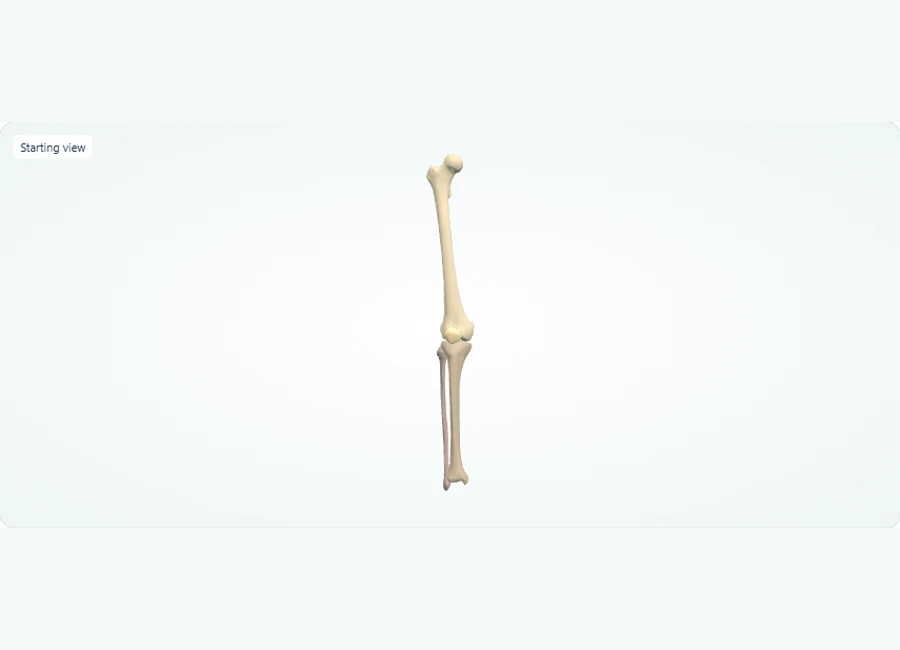
Rotate, isolate structures, and test your recall.
Compare Front, Back and Side views. Whole bones are included, so zoom and pan toward the knee region.
Select and isolate the patella to inspect it. Use Show all, then select and hide the patella to inspect the femur and tibia near the knee.
Use Show all and Test recall. Identify the highlighted bone, using the fibula’s lateral position and patella’s anterior position as clues.
Try it yourself
Which leg bone lies lateral to the tibia, and where is the patella relative to the knee?
Show answer and explanation
The fibula lies lateral to the tibia. The patella lies anterior to the knee.
In anatomical position, the fibula is the slender lateral leg bone, beside the larger tibia. The patella lies in front of the distal femur. These are bony relationships; the model does not include joint cartilage, menisci or ligaments.
- In anatomical position the fibula is the lateral bone of the leg, so it is your orientation landmark for left/right.
- The patella lies anterior to the femur–tibia articulation, so it appears at the front in a front view and overlaps the distal femur in profile.
- The knee region contains four bones here: femur above, tibia and fibula below, patella in front; joint soft tissues are not part of this model.
Comparison of differentiation frameworks and when each fits
Different differentiation systems serve different case shapes. Knowing which framework a written case is built around prevents forcing an organ-pattern answer onto a channel-level problem or vice versa.
Use the table as a routing tool during case practice: read the case, decide which framework the presentation most naturally organizes under, then apply the other frameworks as secondary layers. A knee pain case with fixed, stabbing pain and a purple tongue routes to channel plus qi-blood analysis, with the purple tongue pulling blood stasis into the primary formulation.
The routing habit also protects you in written case questions where two frameworks could both seem plausible. Ask which framework explains the most distinctive findings in the stem; the framework that accounts for the odd or marked findings, rather than the generic ones, is usually the one the case is testing.
| Framework | What it organizes | Fits best when | Common misuse in study |
|---|---|---|---|
| Eight principles | Overall character: depth, thermal state, deficiency/excess, yin/yang | Quick global sorting of any presentation | Treating it as a complete diagnosis instead of a first layer |
| Zang-fu patterns | Organ-network dysfunction with signature symptom clusters | Internal, chronic, or systemic presentations | Forcing an organ label onto clear channel-level pain |
| Channel-level (meridian) analysis | Pathway-based localization of pain and flow problems | Musculoskeletal and local complaints with clear course distribution | Ignoring zang-fu contributors behind a channel problem |
| Qi, blood, body fluids | Substance-level disturbances: stagnation, deficiency, dampness, phlegm | Cases with quality-of-flow findings: fixed pain, masses, damp heaviness | Listing qi stagnation without deciding which organ or channel it belongs to |
Worked scenario 1: blood stasis presentation on anticoagulant therapy
A pattern that clearly reads as blood stasis can still contraindicate an aggressive blood-moving treatment plan when the biomedical screen reveals anticoagulation and possible undiagnosed bleeding. The correct decision coordinates both frames instead of trusting the pattern alone.
Scenario: a written case describes a patient in their sixties with fixed, stabbing lower-back pain, a purple tongue, a wiry-choppy pulse, dark facial complexion, and easy bruising. They also report taking a blood-thinning medication and several weeks of unusual fatigue with pale nail beds. The pattern reading is blood stasis. The plausible mistake is to go straight to a strongly blood-moving herbal strategy plus cupping or deep needling over the stasis signs, treating the pattern as the whole answer.
The better decision runs the screen first: anticoagulant use raises bleeding risk with aggressive needling, cupping, and blood-moving herbs, and the fatigue with pallor is a red flag suggesting possible anemia or ongoing blood loss that warrants medical evaluation before substantial treatment. On paper, the defensible plan is gentle techniques, a modified or deferred blood-moving strategy, documentation of both the flag and the pattern, and clear referral language. The reasoning matters because each frame, used alone, produces a plan that is either clinically risky or diagnostically shallow.
- Pattern frame output: blood stasis, supported by fixed stabbing pain, purple tongue, choppy pulse.
- Screen frame output: anticoagulation (technique and herb caution), fatigue with pallor (referral flag).
- Documented plan: gentle intervention, modified strategy, explicit referral note for the unexplained symptoms.
Worked scenario 2: pregnancy changes the point selection
In pregnancy, several commonly selected points and some techniques are traditionally contraindicated, so a correct pattern analysis must be filtered through the safety frame before any point list is finalized.
Scenario: a first-trimester patient presents with nausea, vomiting, poor appetite, fatigue, and a pale tongue with a slippery pulse. The pattern reading is stomach qi rebelling with Spleen qi deficiency. The plausible mistake is to build a routine from habitual anti-nausea and tonification choices that include He Gu (LI4) and San Yin Jiao (SP6), points traditionally contraindicated in pregnancy, and to add strong stimulation or moxibustion without checking suitability.
The better decision keeps the pattern but re-selects the intervention: Nei Guan (PC6) for nausea, gentle tonification such as Zu San Li (ST36), mild stimulus only, and explicit documentation of pregnancy and the points deliberately avoided. This scenario teaches that point knowledge has two layers: what a point does for a pattern, and what patient states restrict its use. Paper drills should ask for both layers in the same answer, because a plan that is pattern-correct but safety-blind fails the case.
- Learn a short written list of traditionally pregnancy-restricted points (for example LI4, SP6) and the states that trigger other technique restrictions.
- In every pregnancy case, write the avoided points and the rationale next to the final selection.
- Check that the kept points still address the same pattern; a safety filter should not silently change the diagnosis.
Case-analysis exercise with a self-check rubric
Run a timed two-column case drill: read a written patient scenario, fill a screening column and a differentiation column, then write a treatment decision that satisfies both. Score yourself against the rubric below and note which column you consistently fill last.
Set a 20-minute timer per case. Step one, list every screening finding (medications, pregnancy, red-flag symptoms, local tissue issues) and what each changes or stops. Step two, state the primary pattern with three supporting signs and name which differentiation framework you used. Step three, write the intervention with technique intensity and any avoided points or herbs. Expected observation on your first few runs: one column is strong and the other thin, which tells you which frame needs drilling rather than more generic case volume.
Score each completed case out of eight points: two for screening completeness, two for a correctly framed pattern with matched supporting signs, two for a treatment consistent with both columns, and two for documentation quality including avoided items and referral language. A learning milestone, not a pass prediction, is scoring six or more on three consecutive unseen cases before moving on to new content. Keep your scored sheets; the recurring gap in them is your next study target.
- Rubric line 1: two screening findings named, each with its consequence for the plan.
- Rubric line 2: primary pattern named, framework identified, three matched supporting signs.
- Rubric line 3: intervention consistent with both columns; avoided points, herbs, or techniques listed.
- Rubric line 4: documentation wording present, including referral language where flags exist.
A preparation sequence and concrete readiness checks
Sequence your preparation in four passes: core concept separation, framework drills, two-column case sets, then mixed timed sets. Finish by verifying administrative requirements, such as eligibility and current certification structure, directly with NCCAOM rather than relying on secondary summaries.
Pass one, spend early sessions making the concept separations explicit: eight principles versus zang-fu, qi-blood-body fluid versus channel analysis, screening findings versus pattern findings. Write your own one-line definitions and one example per concept. Pass two, drill each framework on its natural case type using the routing table from earlier. Pass three, run the two-column rubric drill across mixed cases including the medication and pregnancy scenarios modeled above. Pass four, simulate exam-style pacing with unseen mixed cases and score them with the same rubric.
Readiness checks before you finish: you can, without notes, (1) state the four eight-principle positions for any organ pattern you name, (2) produce a screening list for a case within one reading, (3) list traditionally pregnancy-restricted points and other technique restrictions you committed to memory, and (4) score six or more on three consecutive unseen cases. For anything administrative, including current credential structure and eligibility, use the issuer's own pages; a short note to NCCAOM's certification pages at nccaom.org covers current requirements without depending on third-party summaries.
- Sequence: concept separation, framework routing drills, two-column rubric cases, mixed timed sets.
- Ready check 1: organ patterns recited with matching principle profiles, no notes.
- Ready check 2: screening list produced on first read of an unseen case.
- Ready check 3: restriction lists (pregnancy, technique cautions) reproduced from memory.
- Ready check 4: rubric score of six-plus on three consecutive unseen cases.
References and further reading
Use these references to explore the concepts and check the latest information from the relevant organizations.