
Weight your preparation to the published blueprint, retrain each topic from rapid field stabilization toward managing an ongoing critical care therapy through a full transport, and close the gaps in the populations and devices your service rarely handles.
Weighing your study hours against the CCP-C blueprint
The candidate handbook's content outline gives each of twelve domains a different share of scored items. Converting those weights into study sessions keeps effort proportional to what is measured instead of to what feels familiar.
The April 2026 candidate handbook content outline assigns roughly these shares: airway, anesthesia, and analgesics about 13 percent; cardiac and trauma/burn near 12 percent each; general medical and respiratory around 10 percent; neurologic and pediatric near 9 percent; maternal/fetal about 8 percent; and transport and safety, toxic/environmental, special populations, and professional considerations each around 5 to 6 percent. Turning those weights into a session count gives you a defensible calendar rather than one driven by personal preference.
Low-weight domains still deserve dedicated blocks. Five percent of a scored bank is a meaningful cluster of questions, and domains such as maternal/fetal medicine and toxic exposure are exactly the ones that may be thin in a ground program's routine caseload. A practical rule: if a domain's blueprint weight exceeds your comfort score on practice questions, that domain moves up in priority regardless of its share.
From stabilize-and-transport to managing an ongoing therapy
The handbook states the exam targets mastery-level practice with patients requiring critical care intervention during transport, not entry-level stabilization. Reframe every case around therapies already running and the decisions spanning the whole transport timeline.
The handbook describes the exam as beyond entry-level field knowledge, measuring the experienced paramedic's skills with patients requiring critical care intervention during ground ambulance, interfacility, marine, and other transport profiles. In practice, this means the material is built around care already in progress: a ventilated patient, an infusing vasopressor, an invasive line, a monitored device. Your assessment must explain why each therapy is running, what it is doing for the patient, and what its failure looks like.
Retrain with a decision-chain drill. For every condition you review, write three decision points: what to confirm at handoff, what to monitor en route, and what changes at arrival. Take a sepsis case: field practice emphasizes recognition and rapid transport, while transport practice adds titrating the running vasopressor against a stated blood pressure target, tracking perfusion markers, and anticipating what happens if the infusion line fails forty minutes from the receiving facility.
Explore in 3D: Trachea and Main Bronchi
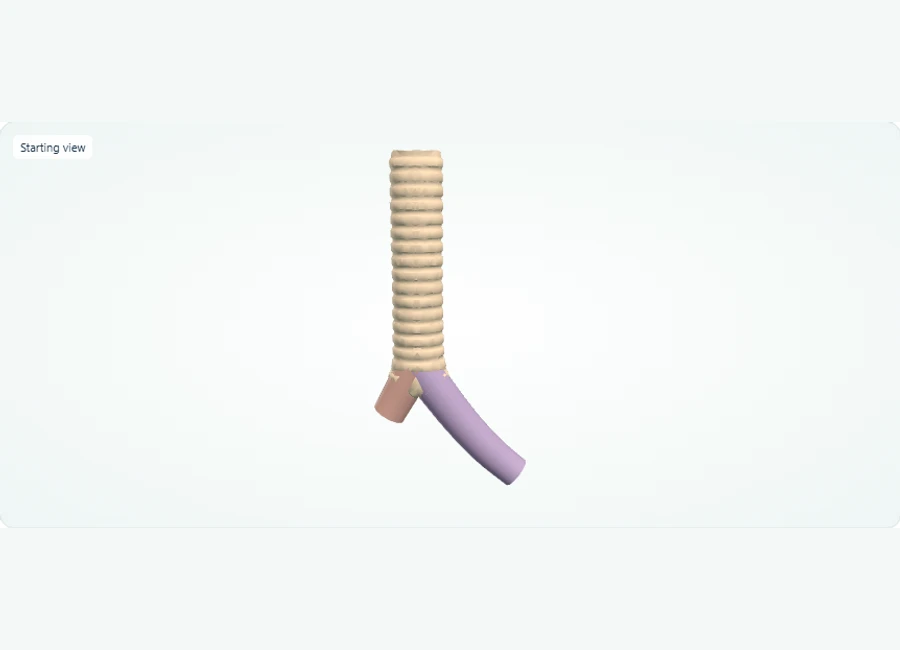
This model shows the trachea and its division into the right and left main bronchi. Only these three airway structures are present: there are no lobar branches, alveoli, or other respiratory structures, and the model shows normal anatomy with no pathology or devices.
Rotate, isolate structures, and test your recall.
Set the view to front and zoom to see the whole model: the trachea is the single central tube, with the right main bronchus and left main bronchus branching from its lower end.
Select each of the three structures in turn (Trachea, Right main bronchus, Left main bronchus), using isolate to view one at a time and show all to restore the full model.
Use Test recall to hide the labels; when a structure is highlighted, name it before pressing Reveal name, then use Return to study to continue.
Try it yourself
Test recall highlights the structure branching from the lower end of the trachea toward the body's left side. Which structure is it?
Show answer and explanation
Left main bronchus
In the front view, the trachea runs down the midline and splits into two main bronchi. The branch passing to the viewer's right (the body's left side) is the left main bronchus, while the branch to the body's right side is the right main bronchus.
- The trachea is the central airway that divides into two main bronchi, one for each lung side.
- The right main bronchus and left main bronchus are the first branches off the trachea; this model contains no smaller (lobar) branches or alveoli beyond them.
- Because only three structures are selectable, identification practice here means telling the trachea from the right versus left main bronchus.
Illustrated practice: Airway Depth and Main Bronchus Anatomy
Shows the tracheal bifurcation and the asymmetric geometry of the two main bronchi so the learner can connect the right-sided auscultation findings to the mechanism of deep tube placement before selecting the corrective depth action.
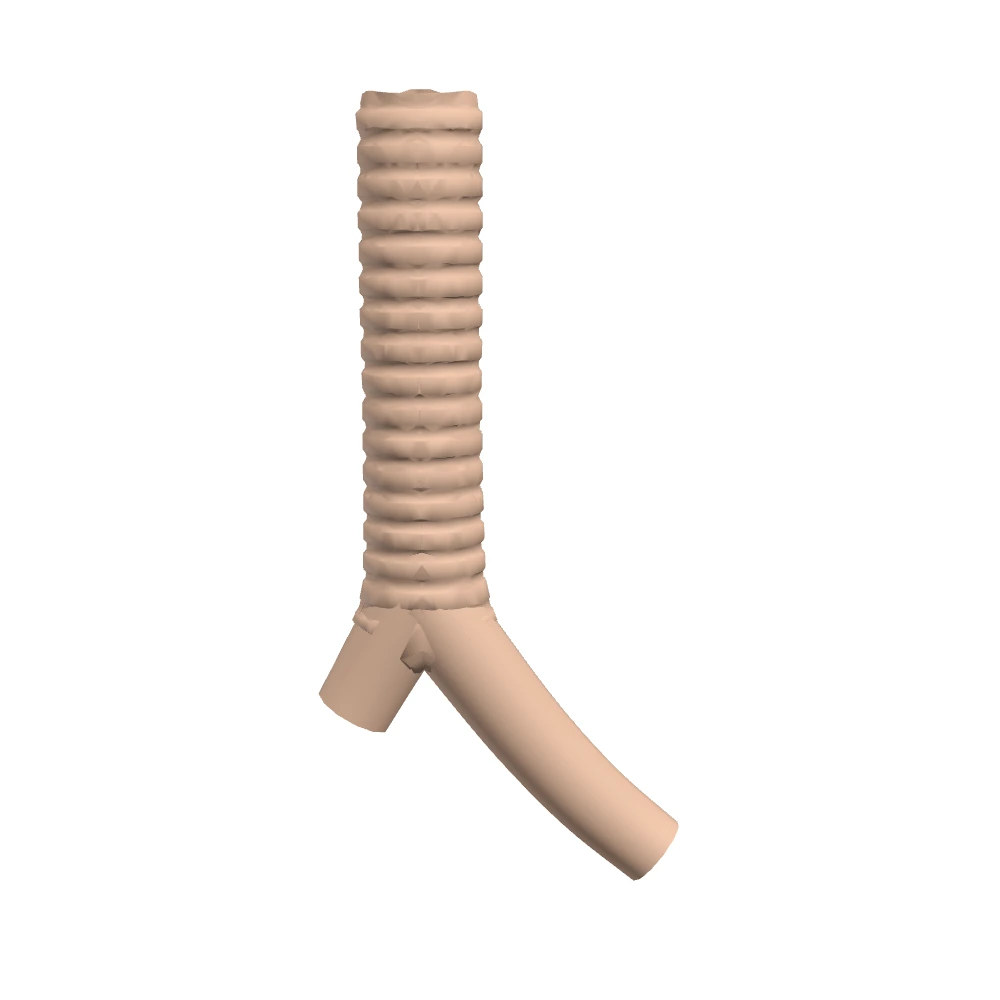
Anatomical study exhibit for the worked question below. Open the full-size view to inspect the structures.
Use the anatomical exhibit to work through the example. Choose an answer before opening the explanation.
Try it yourself
A 165 cm adult female was intubated before an interfacility transfer. The tube is secured at 26 cm at the teeth, and breath sounds are absent on the left with chest rise only on the right. The anatomy exhibit shows an anterior view of a normal adult trachea and main bronchi: the anatomical right main bronchus lies on the viewer's left and is shorter and more vertical than the left. Using the standard adult depth guide of roughly 21 cm for women and 23 cm for men, what is the most appropriate action? A. Add PEEP to improve ventilation on the left and keep the tube at 26 cm B. Withdraw the tube to approximately 21 cm, reconfirm with waveform capnography and bilateral breath sounds, then secure and document the new depth C. Advance the tube slightly to improve left-sided ventilation D. Deflate the cuff and reintubate from scratch without reassessing current depth
Show answer and explanation
B. Withdraw the tube to approximately 21 cm, reconfirm with waveform capnography and bilateral breath sounds, then secure and document the new depth
The exhibit shows why a tube advanced past the carina preferentially enters the right side: the right main bronchus is shorter and more vertical than the left, so it aligns with the tube's path. A depth of 26 cm exceeds the female guide of about 21 cm, so unilateral right-sided findings indicate right mainstem intubation. Withdraw toward the standard depth, then reconfirm objectively with waveform capnography and bilateral sounds before securing and documenting. Advancing deepens the endobronchial placement, PEEP cannot correct malposition, and blind reintubation abandons a functioning airway without addressing the known depth error. The exhibit is a normal anatomical reference, not a depiction of this patient's airway.
Walking a ventilation problem in order instead of reacting to the alarm
Mechanical ventilation material rewards a fixed troubleshooting sequence: patient, tube, machine, circuit. Rehearse that order on paper so an alarm during transport triggers a systematic check rather than a reflexive settings change.
Scenario: you accept an intubated adult on volume ventilation for respiratory failure. Ten minutes into transport, peak airway pressures climb and SpO2 drifts downward. The tempting mistake is to grab the vent and raise the pressure limit or switch straight to hand bagging, an action that can mask the cause, hide a displaced tube, or disrupt recruited lung. The better decision is to pause and run the sequence before touching settings.
First the patient: position, pain, bronchospasm, signs of pneumothorax. Second the tube: depth at the teeth, cuff, displacement. Third the machine: did the mode and settings carry over from the sending unit, and is the device running correctly on transport power? Fourth the circuit: kinks, condensate, leaks. Waveform capnography helps you separate a sudden loss of exhaled CO2, which suggests displacement or a circuit break, from a gradual rise, which suggests worsening ventilation. The fix differs for each branch, and guessing burns transport time.
Telling IABP, Impella, ECMO, and VAD apart before you accept the patient
The cardiac domain explicitly names electrical and mechanical assist devices. Study them as distinct devices with distinct failure modes, and attach one concrete transport question to each rather than a vague sense of support.
Scenario: an IABP-dependent cardiogenic shock patient develops a new tachyarrhythmia en route and the pressures fall. The tempting mistake is to treat this purely as primary deterioration and escalate drips without looking at the balloon console. Intra-aortic balloon timing is triggered from the ECG or a pressure waveform, so a new arrhythmia can degrade augmentation and produce hemodynamic change on its own, separate from the underlying disease.
The better decision: verify the trigger, check augmentation quality, escalate per protocol in parallel, and have rehearsed your failure plan for a console alarm or lost trigger before you reach the receiving facility. This matters because a device-dependent patient can decompensate because the support changed, not because the disease changed, and the two explanations call for different actions. Compare the named devices side by side as you study:
| Device | How it supports the patient | A key transport question to answer before moving |
|---|---|---|
| IABP | Intra-aortic balloon timed to the cardiac cycle via an ECG or pressure trigger | What is the trigger source, and what happens to support if the rhythm changes? |
| Impella | Catheter-based pump that moves blood across the aortic valve | How is device position and flow verified with the monitoring available en route? |
| ECMO | External circuit that oxygenates and circulates blood in VA or VV configurations | What is the configuration, and what is the plan for a circuit problem during transport? |
| VAD | Implanted pump assisting a failing ventricle | How will you assess output and pump status when conventional pulses and cuff pressures may not apply? |
| Invasive pacemaker | Electrical pacing delivered through implanted leads | What are the settings, and how do you confirm capture on your transport monitors? |
Covering the populations your program rarely transports
The handbook is explicit: the exam tests the transport environment, not one program's patient mix. Maternal/fetal, pediatric, toxic/environmental, and special-population coverage must be planned even when daily caseload never touches them.
Study these domains from the transport angle rather than the field angle. For maternal/fetal medicine, that means the physiologic changes of pregnancy as they affect a critical care transport, positioning, and fetal monitoring considerations, not only delivery mechanics. For pediatrics, it means weight-based dosing discipline, airway size selection, and recognizing that a child on a transport ventilator tolerates settings errors within a much narrower margin than an adult.
For toxic and environmental exposures, connect each agent to the specific antidote or supportive therapy it requires and how that therapy behaves during movement. A self-audit makes the gaps concrete: score every blueprint domain for exposure and confidence, then pull the weakest low-exposure domains forward in your calendar. The handbook's stated assumption is broad competency across adult, pediatric, neonatal, maternal, and bariatric populations, so an unevaluated gap is a planned blind spot.
- Score each blueprint domain one to five for exposure and confidence
- Pull the two lowest low-exposure domains into your next two study blocks
- Write one handoff, en-route, and arrival decision chain for each of those domains
- Test yourself with questions only after the decision chains exist
Safety, crew resource management, and documentation in a transport frame
Transport and safety plus professional considerations are their own blueprint domains. Study them as named concepts, including crew resource management, restraint systems, stressors of transport, fatigue, and communication, not as background common sense.
Crew resource management in transport means briefing before you move, closed-loop communication for any medication or setting change, and an agreed escalation phrase when a crew member spots a problem the person managing the device may have missed. Safety and restraint systems are tested concepts because an unsecured device becomes both a projectile and a dislodged therapy in a sudden stop. Radio operations and communication planning belong here too: knowing whom to call, when, and with what report is part of the domain.
The stressors of transport, including vibration, noise, and motion, are worth study because they explain why monitoring choices and patient positioning change en route, and personal wellness appears in the outline as its own topic. Documentation should mirror the decision-chain drill: record the handoff baseline, every titration, and the response, because transport care is a timeline rather than a single scene, and the record a receiving team reads is that timeline.
A case-rewrite exercise, a self-check rubric, and an adaptable sequence
Convert field-style cases into transport-style cases in writing, then score yourself against a rubric. Milestone scores measure study progress, not a predicted exam result, and the sequence below stretches or compresses to your timeline.
Take any case you already know from field practice, such as a chest pain call or a trauma run, and rewrite it as an interfacility transfer with two running therapies, for example a ventilator and a vasopressor infusion. Then write the decision chain: the handoff questions you must answer, the two most likely en-route complications for each therapy, and your response to each. Complete this on paper for at least five cases drawn from different blueprint domains, including at least one population you rarely transport.
Score each rewritten case against a rubric: one point each for a complete handoff list, a correct first troubleshooting step for every running therapy, a named device or drug consideration, and an arrival plan. A milestone worth targeting is four out of four on every case before you attempt full practice sets; lower scores tell you which domain to reopen. Readiness checks before you schedule: recite the ventilation troubleshooting order from memory, state one transport question for each assist device, reproduce the blueprint weightings approximately, and finish a case rewrite without notes.
- Weeks one and two: map the blueprint against your caseload audit and build decision chains for the highest-weight domains
- Weeks three through five: one high-weight domain per week with case rewrites and device-differentiation drills, adding low-exposure populations
- Final stretch: remaining low-weight domains, full case simulations, and rubric scoring under self-imposed time limits
References and further reading
Use these references to explore the concepts and check the latest information from the relevant organizations.