
Prepare for the CRCC exam by treating every practice case as three separate decisions stacked together: an assessment interpretation, a counseling-planning choice, and an ethics check. Name which decision a question is asking about before you answer, because the same vignette can support several plausible-sounding responses while only one fits the concept being tested. Anchor your content review to the specialty itself: work treated as a therapeutic intervention, a strengths-based and self-determination focus, functional assessment tied to vocational planning, and a professional ethics code that governs confidentiality and consent. Build fluency by writing out why the wrong options are wrong, using a rubric, and cycling through ethics, assessment, documentation, and counseling scenarios weekly. For administrative details such as eligibility, application steps, and current exam policies, use the issuer's site directly; this guide focuses on learning the content.
What the CRC credential certifies, and how that should shape your study plan
The CRC certifies competence in rehabilitation counseling: a counseling specialization centered on disability, where employment and independence are treated as outcomes in themselves and clients are approached from a strengths-based, self-determination perspective.
Rehabilitation counseling is not generic counseling with a disability label attached. It is a distinct specialization in which work functions as a therapeutic intervention, and the counselor integrates medical, psychological, social, and vocational information into one plan. When you review content, ask whether each fact helps you connect an impairment, a functional ability, and a life or work goal.
Structure your review around the specialty's own logic rather than around isolated topics. In real cases, a case-services fact, a counseling technique, and an ethics rule surface together in a single situation. Organizing your practice around integrated vignettes mirrors that reality and trains you to move across domains while keeping track of which decision you are making at each step.
Assessment interpretation: separating functional capacity from transferable skills
Assessment-style vignettes require you to distinguish what a client can physically and cognitively do now, which skills carry over to other work, and what the labor market offers. These are three separate lenses; blending them creates plausible-sounding but flawed conclusions.
Functional capacity describes current abilities given an impairment: lifting tolerance, standing tolerance, cognitive endurance, communication modes. Transferable skills analysis starts from work history and asks which skills apply in different occupations. Labor-market information asks whether suitable occupations exist where the client can realistically pursue them. A defensible vocational conclusion needs all three layers, stated separately.
Practice by labeling every assessment fact in a vignette with its lens before answering. A medical report supplies functional data, not a vocational outcome; a skills inventory supplies options, not guarantees; a job posting supplies market evidence, not client fit. Writing the label next to each fact trains you to notice when a scenario silently swaps one lens for another.
Worked scenario 1: A warehouse supervisor in her forties develops a back condition with a restriction to no lifting over 20 pounds occasionally. A plausible mistake is reading the restriction as the vocational answer and concluding she cannot work, because her whole career has been heavy physical labor. The better decision is to run the three lenses in order: the restriction defines functional capacity (medium-to-light demands), her experience supervising crews, scheduling, safety compliance, and equipment tracking are transferable skills, and labor-market information identifies dispatching, inventory control, and safety-coordinator roles as plausible targets. The restriction changes the demand level, not the viability of employment, and the plan that follows is a redirection plan rather than a closure.
| Lens | Question it answers | Typical evidence in a vignette | Common misreading |
|---|---|---|---|
| Functional capacity | What can the client do now, given the impairment? | Medical restrictions, stamina notes, adaptive equipment | Treating a restriction as a job verdict |
| Transferable skills | Which abilities carry into other occupations? | Work history, duties, supervisory or technical experience | Assuming past job title equals skill set |
| Labor-market information | Do suitable openings exist and where? | Local openings, growth fields, wage levels | Treating one posting as proof of a market |
Illustrated practice: Cerebral Lobes on the Lateral Surface and Functional Localization
Supplies the anatomical localization that the stem no longer states verbally: the candidate must recognize the anterior-most colored region of the lateral cerebrum and map it to executive function without the lobe being named in text.
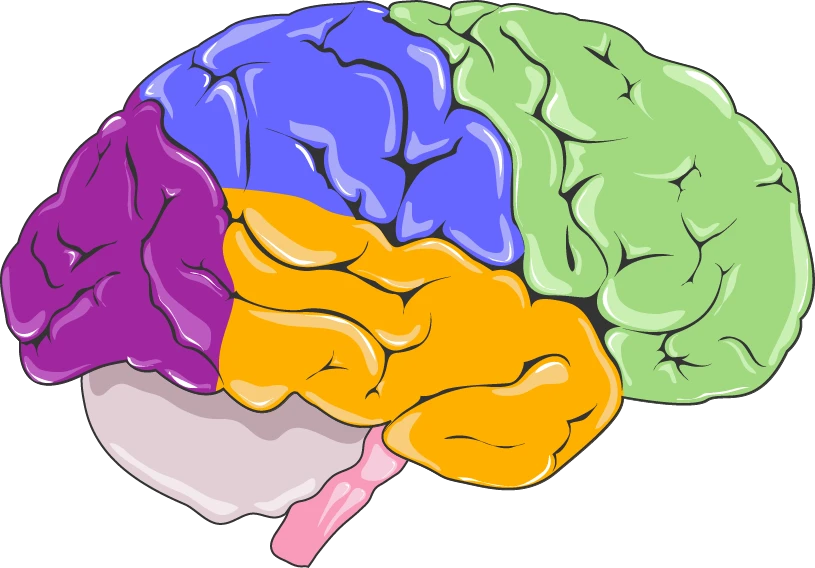
Anatomical study exhibit for the worked question below. Open the full-size view to inspect the structures.
Use the anatomical exhibit to work through the example. Choose an answer before opening the explanation.
Try it yourself
A client hospitalized six months ago following a traumatic brain injury is failing in a data-entry position. Grip strength and endurance are within normal limits, memory scores are average, and a functional capacity evaluation confirms full physical tolerance. Supervisors report missed deadlines and disorganization, not slowed output. The exhibit is a normal anatomical reference illustration of the lateral cerebrum with each lobe shaded a different color; it is NOT the client's imaging and shows no injury. The anterior-most shaded region (green, toward the viewer's right) is the region to which this client's neuropsychological impairment localizes. Which functional interpretation best explains the performance breakdown associated with that region? A. Post-traumatic vestibular impairment that destabilizes the client when navigating the open office. B. Deconditioning from prolonged hospitalization that reduces stamina across the workday. C. Frontal-executive dysfunction, because planning, inhibition, and flexibility deficits disrupt self-directed task sequencing despite intact physical and memory capacity. D. An undiagnosed depressive disorder that has suppressed the client's motivation to complete assignments.
Show answer and explanation
C. Frontal-executive dysfunction, because planning, inhibition, and flexibility deficits disrupt self-directed task sequencing despite intact physical and memory capacity.
On the lateral surface of the cerebrum, the anterior-most colored region corresponds to the frontal lobe, the area subserving planning, cognitive flexibility, and inhibition. Isolated weakness in these executive domains with preserved memory and physical tolerance localizes the functional problem to frontal-executive dysfunction, which explains disorganization and missed deadlines in unstructured work. Deconditioning and vestibular findings conflict with the normal FCE, and depression alone would not produce this circumscribed neuropsychological pattern. The other colored regions displayed (superior, inferior, and posterior on the lateral surface) support different functions and would not account for the self-directed task-sequencing breakdown.
Applied counseling practice: planning with the client, not for the client
Counseling-planning vignettes reward plans built around the client's own goals, choices, and strengths. The contrast to learn is a deficit-focused plan, organized around what the client cannot do, versus a strengths-based plan organized around capacity and self-determination.
A strengths-based approach means the rehabilitation plan starts from what the client wants to achieve and what capacities can get them there, with services selected to support those goals. In practice, this shows up in the order of decision-making: the client's stated objective shapes the services, rather than a pre-set menu of services shaping the objective.
When a vignette shows a client hesitating about a counselor's chosen goal, the concept worth naming is informed choice: the counselor supplies information and options, and the client makes the decision. Compare two drafts of the same plan. Draft one says the client will be placed into a designated training program. Draft two says the client, after reviewing two occupational options and their requirements, selected one. The second version is the defensible one, because it records the client as the decision-maker and the counselor as the informer and facilitator.
- Contrast pair: deficit-focused intake (leads with limitations and closures) versus strengths-based planning (leads with goals and capacities).
- Contrast pair: counselor-directed goal setting versus informed choice, where the counselor presents options and consequences and the client selects.
- Apply both contrasts by rewriting any plan statement until the client's choice is visible in the wording.
Methods, procedures, and documentation: making the record support the decision
Documentation practice asks whether each service in a case record connects to an assessed need, a client goal, and a measurable objective. Learn to audit a case file the way you would audit an argument: every entry should trace back to a reason.
A well-formed case record typically shows a chain: assessment findings establish a need, the client and counselor agree on an objective, services are selected to serve that objective, and progress notes report movement toward it. When you work a next-step scenario, trace this chain in the vignette; the step you defend is the one that repairs the weakest link, such as clarifying an objective before purchasing a service.
Practice with a two-minute audit: take any practice case and, for each service mentioned, write which need it serves and how progress would be observed. Entries that serve no stated need, or objectives with no observable indicator, are the documentation weak points. This habit also trains you for next-step questions, because you learn to derive the required step from the chain itself rather than from whichever action appears most active or helpful on the surface.
Ethics in scenario form: confidentiality, consent, and competing pressures
Ethics practice scenarios present a pressure — a request from an employer, a family member, or a colleague — that tempts a small, well-intentioned disclosure. Learn the pattern: information is shared only within the scope the client has authorized, with informed consent documented.
Build your ethics reasoning around recurring structures rather than memorized rule numbers: confidentiality and its permitted limits, informed consent as an ongoing process, client autonomy, professional boundaries, and the duty to represent your qualifications accurately. For each structure, know what it requires and what evidence of compliance looks like in a case record, such as a written, scope-limited release.
Worked scenario 2: An employer who is co-funding a client's rehabilitation calls the counselor and asks, casually, how the client's treatment is going and whether the client has mentioned the workplace conflict that led to the injury. The plausible mistake is sharing a brief, reassuring update to keep the employer engaged, reasoning that no formal report is being released. The better decision is to acknowledge the professional relationship, explain that specific information can be shared only under the client's informed, written consent defining what may be disclosed, and then discuss with the client what, if anything, to authorize. The distinction matters because consent is defined by its scope: a general authorization to coordinate services is not authorization to narrate clinical details, and the counseling relationship the client relies on would be compromised by a casual disclosure.
- Pressure pattern: a cooperating party requests information beyond the authorized scope; the response limits the disclosure, not the courtesy.
- Consent pattern: consent is specific about what is shared, with whom, and for what purpose; vague consent fails these tests.
- Autonomy pattern: where the client's choice and a third party's preference conflict, the client's informed decision governs within ethical limits.
A self-check rubric for scenario practice
Use a five-point rubric to grade your own answers to practice vignettes. The rubric converts vague familiarity into observable evidence, and repeated scores give you a learning milestone, not a predicted exam result.
For each practice scenario, write your answer, then score it against the rubric below before comparing it to any provided explanation. Scoring first forces you to notice whether your reasoning was complete or merely confident. Keep a running log of which rubric points you miss; the pattern, not any single case, tells you what to review.
A practical exercise: take three vignettes from different domains — one assessment, one counseling plan, one ethics — and apply the rubric to each. Expected observations on a first pass are scores of two or three, usually dropping points on naming the concept and on stating why wrong options fail. After a week of rubric-graded practice, re-run the same three vignettes; improvement shows as consistent four-to-five scores and shorter written justifications, because complete reasoning becomes compact with fluency. Treat these scores as study milestones only.
| Rubric point | What it looks like in your written answer | Score 0 | Score 1 |
|---|---|---|---|
| Named the concept | States which concept the vignette tests (e.g., informed choice, functional capacity) | Answer jumps to an action | Concept named explicitly |
| Applied the concept's rule | Shows the rule's requirements, not just a conclusion | Conclusion only | Rule and conclusion both stated |
| Separated the lenses | Keeps functional, skills, and preference decisions distinct | Lenses merged | Each lens addressed in turn |
| Explained the best wrong option | Says why the most attractive distractor fails | Distractor ignored | Specific reason for rejection given |
| Centered client self-determination | Plan or decision records the client's informed choice | Client passive | Client's choice visible in the answer |
An adaptable preparation sequence and concrete readiness checks
Run a rotating cycle that pairs one content domain with scenario practice and rubric grading, then repeats with tighter time. Readiness is a set of observable checks on your written reasoning, not a feeling of familiarity with the material.
A suggested sequence you can stretch or compress: weeks one and two, assessment interpretation plus the three-lens table, three vignettes weekly; weeks three and four, counseling planning and documentation chains, including the two-minute audit; weeks five and six, ethics patterns and consent scenarios; week seven, mixed practice where you must name the domain first and then answer; week eight, full mixed sets graded by the rubric with a review log. If you have more time, repeat the cycle with new scenarios rather than re-reading notes.
Readiness checks, all observable in writing: you can label every assessment fact in a vignette with its lens in under a minute; you can state the documentation chain for a case without prompting; you can articulate the scope-of-consent reasoning for an employer or family inquiry in two or three sentences; and your rubric scores hold at four or above across mixed domains. If any check fails, return to that domain's section and run three new vignettes before moving on. For application timelines, testing policies, and renewal requirements, rely on the issuer's official site rather than secondhand summaries.
References and further reading
Use these references to explore the concepts and check the latest information from the relevant organizations.