
Study for the CCFP by reorganizing what you already know into the family medicine decision order: patient safety concerns first, likely diagnoses second, then broader differentials and management, with the patient's ideas, concerns, and expectations woven into every plan. Drill this order in timed short-answer practice and recorded oral rehearsal.
Why memorizing the priority topics list is a weaker strategy than learning key features
The CFPC publishes priority topics with key features: the specific critical steps needed to resolve each clinical problem. Studying the topics as content silos misses the reasoning the key features describe.
A key feature is not a fact but a hinge in a case: the moment where you must recognize something, order investigations in a particular sequence, or choose a management step before another. Learning a topic as a chapter gives you breadth; learning its key features gives you the branches where an exam case actually turns.
Trace one example. For a topic like dysuria in a young woman, the content approach reviews microbiology and drug doses. The key-feature approach asks: at what point do you decide this is uncomplicated cystitis versus pyelonephritis, and what single finding changes your disposition? Build study notes around those decision points, and the same note serves both written and oral-style practice.
To do this systematically: pick priority topics from your weak areas, locate the published key features for each, and rewrite them as if-then rules. If fever and flank pain, then consider pyelonephritis and decide on admission. If-then rules are easier to retrieve under time pressure than paragraph summaries.
- Convert each key feature into an if-then decision rule in your own words.
- Flag every key feature that involves a must-not-miss diagnosis or a safety step.
- Group topics by the decision type they test: recognition, investigation ordering, management choice, or follow-up planning.
Ordering differentials under pressure: applying the family medicine priority hierarchy
Family medicine answers are sequenced, not alphabetical. The working order is: patient safety issues first, then the most likely diagnosis, then other differentials and management steps.
Worked scenario one. A case presents a 55-year-old with three weeks of fatigue, exertional breathlessness, and black tarry stools. A list-style answer writes: CBC, anemia, iron studies, endoscopy referral, consider celiac disease. The information is present, but the ordering buries the danger.
The better decision applies the hierarchy explicitly. Lead with suspected upper gastrointestinal bleeding: this is the safety concern, so urgent assessment, hemodynamic status, and expedited endoscopy come first. Then name iron-deficiency anemia as the likely unifying diagnosis, and only afterward list other causes of fatigue. The mistake is not missing the bleed; it is failing to signal that you recognized it as the first priority.
This matters because the hierarchy is the organizing logic of family medicine case analysis: a correct differential with no expressed priorities reads as unfinished reasoning, while a shorter answer with the safety issue named first reads as clinical judgment. Practice writing the safety line as your opening sentence in every answer.
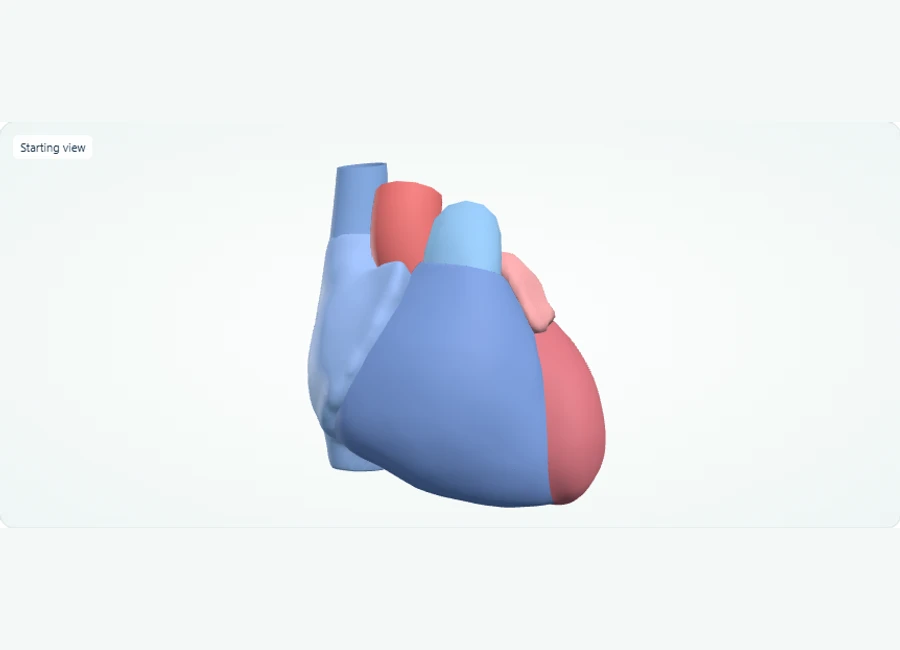
Explore in 3D: Heart chambers and great vessels
A four-chambered heart viewed from the front. The right ventricle supplies the pulmonary circulation via the pulmonary trunk; the left ventricle supplies the systemic circulation via the ascending aorta. This model shows external chamber surfaces and the visible great vessels only — no internal valves or conduction system.
Rotate, isolate structures, and test your recall.
Choose Front and compare the four chambers. The right ventricle forms most of the anterior surface; the left ventricle contributes to the apex.
Select and isolate each chamber in turn, then use Show all to restore its relationship to the surrounding structures.
Select the pulmonary trunk and ascending aorta in turn. Name the circulation supplied by each, then use Test recall to practise identifying the listed structures.
Try it yourself
Which ventricle supplies the pulmonary trunk, and which supplies the ascending aorta?
Show answer and explanation
The right ventricle; it serves the pulmonary circulation.
On the front view, the right ventricle is the anterior-most chamber, and its outflow tract continues as the pulmonary trunk carrying blood to the lungs. The left ventricle instead empties into the ascending aorta for the systemic circulation.
- The right ventricle pumps blood into the pulmonary trunk toward the lungs; the left ventricle pumps into the ascending aorta to the body.
- The superior vena cava returns blood to the right atrium from above the heart.
- The two atria sit superior to the two ventricles; atria receive blood, ventricles eject it.
Turning knowledge into marks: writing concise, structured short-answer responses
Short-answer components reward terse, labeled responses: one idea per line, priorities stated, no narrative padding. The skill is compression, and it is trainable.
Compare two answer styles for the same question. A narrative answer spends sentences explaining pathophysiology before reaching the plan. A marked answer states: Safety: rule out GI bleed first. Likely: iron-deficiency anemia from occult upper GI loss. Next steps: CBC, ferritin, urgent endoscopy referral. Same knowledge, radically different readability for a marker working through many responses.
Build this through a timed drill. Take one priority topic, write answers to three case stems in eight minutes each, then audit your own script: did the safety concern appear in line one, is each line a single action or diagnosis, and did you cut all preamble? Rewrite the weakest answer once. The rewrite, not the first attempt, is where compression habits form.
Keep a personal phrase bank for recurring answer elements: agnostic safety-netting language, investigation bundles, and follow-up intervals. Reusing pre-compressed phrasing saves time and reduces the risk of omitting a patient-centred element when the clock is running.
The oral case rehearsal: eliciting ideas, concerns, and expectations before you advise
In oral-style cases, management plans that ignore the patient's own framework score poorly. Structure your interview to surface ideas, concerns, and expectations, then negotiate rather than deliver.
Worked scenario two. A simulated patient is the parent of a four-year-old with three days of fever, eating and drinking reasonably, asking directly for antibiotics. A knowledge-driven response recites that most childhood fevers are viral and warns against unnecessary antibiotics. Clinically accurate, relationally flat: the parent's fear was never named, so the plan feels imposed.
The better decision runs in sequence. Open with an unhurried question about what worries the parent most; acknowledge the concern before examining the child; perform a targeted exam and say what you are looking for; then negotiate: agree on fever management, what improvement looks like, and explicit return precautions with a clear timeframe. Offer the safety-net rather than a lecture, and check the parent's agreement before closing.
The lesson generalizes: in patient-centred cases the diagnosis is often straightforward, and the assessed skill is whether your plan fits the person in front of you. Practice saying three sentences out loud in every rehearsal: one that surfaces the concern, one that legitimizes it, and one that proposes a shared next step.
Four principles and CanMEDS-FM: two frameworks that answer different questions
The four principles of family medicine describe what the discipline is; the CanMEDS-FM roles describe what a family physician does across a case. Use both as checklists when analyzing scenarios.
The four principles, rooted in Ian McWhinney's articulation of family medicine, are: the family physician as a skilled clinician, community-based care, the doctor-patient relationship as central, and the physician as a resource to a defined population. When a case involves continuity, a family context, or community resources, these principles tell you which management elements an exam answer should include.
CanMEDS-FM adds role lenses: medical expert, communicator, collaborator, leader, health advocate, scholar, professional. A case about a frail elderly patient with conflicting family opinions is not only a medical expert question; the collaborator and communicator roles signal that involving the family, home care, or allied professionals belongs in the answer.
A practical habit: after drafting any case answer, scan it against the two frameworks. If your answer is all investigations and prescriptions, ask which role or principle element is missing, usually advocacy, collaboration, or follow-up. This scan takes seconds and catches whole categories of omitted content.
| Framework | What it answers | Use it when |
|---|---|---|
| Priority hierarchy | What comes first in my answer | Every case; always the ordering rule |
| Four principles of family medicine | What makes this family medicine, not specialty care | Cases involving continuity, family context, or community care |
| CanMEDS-FM roles | Which non-clinical duties the case is testing | Cases involving teams, advocacy, ethics, or system navigation |
| Key features | Which single step the case hinges on | Topic-by-topic preparation and error review |
A two-track preparation sequence: knowledge consolidation plus response rehearsal
Prepare on two parallel tracks. Track one consolidates clinical content by priority topic; track two rehearses producing prioritized answers under time, in writing and out loud.
Track one, adaptable to whatever weeks you have. First, self-assess across the published priority topics and rank your weak areas. Second, work through weak topics in if-then key-feature format. Third, add a daily fifteen-minute review of one topic's safety-critical features. Content work ends when you can state each weak topic's hinge decisions from memory.
Track two runs concurrently. Weekly, produce timed written answers to unfamiliar case stems, then record yourself managing one case aloud using the sequence: open question, safety scan, likely diagnosis, negotiated plan, safety-net. Rotate a partner if possible; otherwise review your recording against a rubric. In the final stretch, alternate written and oral sessions so both response modes stay sharp.
Adapt the proportions, not the structure. If your clinical knowledge is strong, weight the sequence toward rehearsal; if content gaps dominate, extend track one but never drop weekly written practice entirely, because compression is itself a perishable skill.
Readiness checks: a self-audit rubric for written and oral practice
You are approaching readiness when your practice answers reliably satisfy a rubric, not when you feel done. Audit five consecutive practice cases per mode against fixed criteria.
Written rubric, scored per case: safety issue named in the opening line; likely diagnosis stated explicitly; investigations and management ordered by urgency; at least one patient-centred or follow-up element included; no preamble or restatement of the stem. Aim to satisfy all five criteria on five consecutive cases before extending your practice set.
Oral rubric, scored per rehearsal: you asked an open question first; you surfaced and acknowledged the patient's concern before advising; your plan was negotiated, not delivered; you closed with specific return precautions including a timeframe; you stayed within the case's role boundaries and referred where appropriate. Record and re-listen: candidates reliably hear omissions they did not notice while speaking.
These rubric scores are learning milestones for your own tracking, not predictions of exam outcomes. When both rubrics are consistently met, shift remaining time to mixed, timed, unfamiliar cases rather than new content. For administrative details such as current format, scheduling, and eligibility, rely on the CFPC's own examinations page rather than secondary summaries, since logistics change.
References and further reading
Use these references to explore the concepts and check the latest information from the relevant organizations.