
NBCE Part III asks you to reason through patient cases, and its defining difficulty is decision sequencing: the correct option depends on where the vignette stops the case. This guide teaches a two-pass vignette method, a two-tier differential habit, a three-category contraindication classification, and a management-ordering technique, then combines them into a four-week practice sequence with a self-check rubric. Worked scenarios show how ordinary-looking findings change the correct answer. For application windows, fees, and current exam format, confirm details directly with the NBCE.
Why Part III vignettes hinge on decision sequence, not recall
The exam's central difficulty is vignette logic: each case stem sets up a decision point, and the correct option depends on what must happen next, not on naming a fact in isolation.
A case describing a patient with shoulder pain and a handful of examination findings is really asking you to order the work: rule out must-not-miss conditions, then localize the problem, then choose management. Recalling the content of each finding is not enough; you must reconstruct the case timeline and identify exactly where the stem stops. That stopping point defines which option can be correct.
Build a two-pass reading habit. Read the final sentence of the vignette first to identify the question type — next best step, most likely diagnosis, best management plan, or professional standard — and only then scan the stem for findings that change urgency. This order keeps plausible distractors from pulling you into fact-recall mode, because you know what kind of decision you are making before options compete for your attention.
Red-flag screening: choosing urgent referral over routine care
Case stems can embed red flags inside ordinary complaints. The correct option addresses the must-not-miss condition first, even when a common musculoskeletal diagnosis fits the story better.
Worked scenario one: a 58-year-old presents with low back pain after lifting, and the stem also mentions saddle anesthesia, difficulty urinating, and bilateral leg weakness. A plausible mistake is selecting schedule imaging and reevaluate in two weeks because the mechanical onset fits a lumbar strain. The better decision is urgent emergency referral for suspected cauda equina syndrome. The routine features are the distractor; the flag findings carry a narrow time window in which the underlying condition is managed, so the sequencing answer overrides the diagnostic fit.
Turn that pattern into a personal red-flag list per region: for the lumbar spine, cauda equina signs; for the cervical spine, progressive myelopathy markers such as gait change, hand clumsiness, or electric shock sensations with neck flexion; across systems, unexplained weight loss, night pain unrelieved by position, and fever as systemic markers. For each flag, write the specific action it triggers — emergency referral, same-day medical evaluation, or prompt diagnostic workup — not simply the word refer. The action level is what the options will actually test.
Explore in 3D: Heart chambers and great vessels
A four-chambered heart viewed from the front. The right ventricle supplies the pulmonary circulation via the pulmonary trunk; the left ventricle supplies the systemic circulation via the ascending aorta. This model shows external chamber surfaces and the visible great vessels only — no internal valves or conduction system.
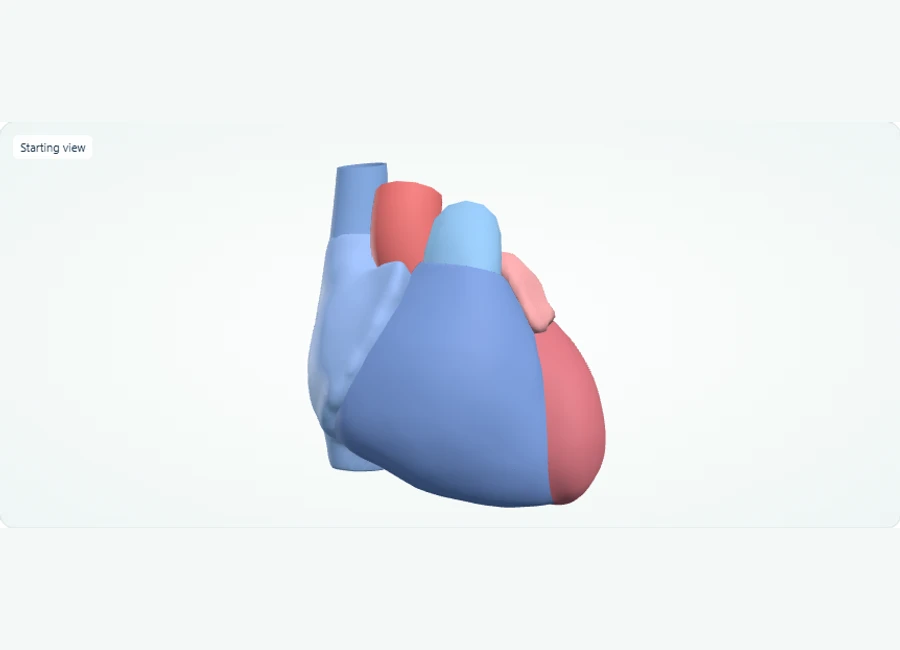
Rotate, isolate structures, and test your recall.
Choose Front and compare the four chambers. The right ventricle forms most of the anterior surface; the left ventricle contributes to the apex.
Select and isolate each chamber in turn, then use Show all to restore its relationship to the surrounding structures.
Select the pulmonary trunk and ascending aorta in turn. Name the circulation supplied by each, then use Test recall to practise identifying the listed structures.
Try it yourself
Which ventricle supplies the pulmonary trunk, and which supplies the ascending aorta?
Show answer and explanation
The right ventricle; it serves the pulmonary circulation.
On the front view, the right ventricle is the anterior-most chamber, and its outflow tract continues as the pulmonary trunk carrying blood to the lungs. The left ventricle instead empties into the ascending aorta for the systemic circulation.
- The right ventricle pumps blood into the pulmonary trunk toward the lungs; the left ventricle pumps into the ascending aorta to the body.
- The superior vena cava returns blood to the right atrium from above the heart.
- The two atria sit superior to the two ventricles; atria receive blood, ventricles eject it.
Differential diagnosis: narrowing a complaint without anchoring
A reliable Part III habit is generating a two-tier differential — a likely tier and a must-not-miss tier — before reading options, so a single plausible distractor cannot anchor your reasoning.
Anchoring means committing early to the diagnosis that best explains the loudest findings. Consider anterior shoulder pain in a 60-year-old: the likely tier holds rotator cuff pathology, but the must-not-miss tier holds cardiac referral. If the stem adds an exertional pattern with sweating and relief at rest, the case is reframed and the detailed shoulder examination findings become noise. Tracing this example shows the mechanism: must-not-miss conditions earn their tier from risk factors and pattern, not from how well they explain the local complaint.
Run a closing exercise for this section: for five chief complaints — chest and shoulder pain, low back pain, neck pain, headache, and knee swelling — write a two-tier differential from memory, then check each against a clinical reference for completeness. Expected observation: your likely tier will be well populated while your must-not-miss tier comes out sparse. That imbalance is precisely the gap to close, because the tier you tend to omit under time pressure is exactly where a sparse list costs you the most when options compete.
Contraindications: absolute versus relative risk in manual therapy options
Vignettes test whether you classify a finding as an absolute contraindication, a relative contraindication requiring modification, or a caution that changes technique — not merely whether treatment is allowed.
Map the three categories to answer strategies. An absolute contraindication supports options that withhold the procedure and pursue referral, imaging, or medical evaluation. A relative contraindication supports options that modify technique, force, or region. A caution supports options that proceed with monitoring. Worked scenario two: a 62-year-old with long-standing rheumatoid arthritis reports new upper neck pain and a sensation of head instability. A plausible mistake is selecting gentle midrange cervical mobilization because rheumatoid arthritis alone is not a universal bar to treatment. The better decision is to recognize that rheumatoid arthritis with suspected upper cervical instability warrants imaging and medical evaluation before any cervical mobilization. The disease label does not decide the answer; the category classification does.
Drill the classification with a written list of findings — reduced bone density on a scan, anticoagulant use, pregnancy, history of malignancy, acute inflammatory joint disease, acute neurological deficit — and for each, write the category and the corresponding option strategy. A useful observation emerges from the drill: the same finding can shift categories depending on what else the stem supplies, such as comorbidities or symptom onset. Classification is conditional, so practice conditional answers rather than memorizing a flat list of forbidden findings.
Case management sequencing: ordering studies, referrals, and care steps
Management vignettes reward the option occupying the correct position in the sequence — triage, then evaluate, then treat, then reassess — rather than the option that sounds most clinically thorough.
The most complete plan is a recurring trap. An option that bundles conservative care with laboratory studies and advanced imaging can be wrong simply because the stem's decision point sits earlier in the sequence, before advanced workup is indicated. Compare two plausible options for a stable mechanical complaint: immediate advanced imaging versus a trial of conservative care with a defined reassessment point. Which one is correct depends on stem cues such as symptom duration, severity, functional impact, and the absence or presence of flags — cues you should note explicitly before reading options.
Use a sequencing habit that makes the trap visible: after reading the stem and before reading options, write your own next three steps for the case. Then match each option to your list. The correct option is usually one of your steps placed at the right position, while distractors are steps that belong earlier or later. Practice this aloud on five vignettes and log every case where the stem's decision point surprised you — those cases reveal which sequencing assumptions you carry that the case evidence did not support.
| Vignette question type | What it is really asking | First move before reading options | Common distractor shape |
|---|---|---|---|
| Next best step | Which action belongs at the stem's current decision point | Write your own next three steps | A later step offered early, or a thorough bundle that skips triage |
| Most likely diagnosis | Which diagnosis the findings support after flags are excluded | Build a two-tier differential | A must-not-miss condition lacking supporting findings, or a likely condition that ignores a flag |
| Contraindication | Whether a finding forbids, modifies, or merely cautions a procedure | Classify findings as absolute, relative, or caution | Treating a relative contraindication as absolute, or the reverse |
| Best management plan | Which plan fits duration, severity, and flag status | Note stem cues on time course and severity | The most aggressive plan when conservative care with reassessment fits |
| Professional standards | What documentation, consent, or scope requires here | Check your standards checklist | A clinically attractive option that omits consent or referral |
Ethics, consent, and documentation traps inside clinical vignettes
Professional-standards content is woven into case stems; the correct option documents findings, obtains informed consent, and respects scope, independent of the clinical decision being tested.
Informed consent follows a recognizable answer pattern: when an option involves a procedure with material risks, the correct sequence includes explaining risks, benefits, and alternatives before proceeding, and recording that explanation. Documentation competes the same way — an option that documents findings and the plan will correctly beat an otherwise identical option that skips the record. Train your eye to notice whether each option preserves or breaks the documentation trail, because a clinically sound decision with a broken trail is not the defensible answer.
Scope and boundaries bring their own logic. When a vignette presents a condition outside conservative management, the professional answer is referral with clear communication, not continued care that delays appropriate treatment — the same sequencing principle from clinical sections, applied to professional duty. Boundary scenarios, such as gifts or overlapping relationships, should be decided against the standard itself rather than the sympathetic reading of the situation. Build a one-page standards checklist covering consent, documentation, scope, referral communication, and boundaries, then test every ethics-flavored option against it before choosing.
A four-week practice sequence with a self-check rubric
Convert content review into vignette fluency with a staged sequence: content mapping, untimed two-pass practice, timed mixed blocks, then full case simulations scored with a rubric rather than a raw percentage.
Week one: build region-by-region one-page maps covering red flags with their required actions, two-tier differentials, and contraindication classifications. Week two: work vignettes untimed, writing a one-sentence rationale for every option, chosen and rejected. Week three: move to timed mixed blocks while keeping the two-pass read. Week four: run full case simulations under exam conditions and log every hesitation. Stretch or compress weeks based on the rubric below rather than the calendar — the sequence is adaptable, and extending the mapping week is the right call if you cannot yet produce the maps from memory.
Score each practiced vignette on four checks: you identified the question type before reading options; you named the must-not-miss tier; your chosen option matched the stem's decision point; and you wrote why each rejected option fails. Expected observations: early sessions run slowly, several minutes per vignette with notes, and that is acceptable; by the timed blocks you should complete the two-pass read in under a minute and produce one-sentence rationales without prompting. Readiness checks before exam day: you can recite regional red flags and their action levels from memory, classify a fresh list of findings into the three contraindication categories, and in a simulated block your hesitations concern content rather than method. Rubric scores are learning milestones that track method adoption, not predictions of your official result.
References and further reading
Use these references to explore the concepts and check the latest information from the relevant organizations.