
This guide teaches CPSN content through case judgment rather than isolated recall. Plastic surgical nursing spans reconstructive care and aesthetic practice, and the same knowledge behaves differently in each context. The actionable approach here: study by contrast (reconstructive versus aesthetic, assessment versus intervention, documentation versus opinion), rehearse two full decision scenarios on paper, and verify readiness with a rubric instead of a vague sense of familiarity. The PSNCB administers the credential and publishes exam specifications and recertification requirements, so administrative details belong to the issuer rather than to any study guide.
Building a domain map before you open a single practice question
Organize study around the specialty's conceptual structure — reconstructive care, aesthetic practice, perioperative assessment, procedures and documentation, and professional standards — so every new fact attaches to a category instead of floating free.
A domain map earns its keep through retrieval practice: when you attach each fact to a category and to the decision it informs, you build a path back to that fact under testing conditions. Start with five columns: core plastic surgery concepts, surgical assessment and interpretation, applied nursing decisions, procedures and documentation, and ethics and safety. As you review any topic, write it into one column and one sentence about how it changes a nursing action. A fact without an attached action is a weak anchor for case-based questions.
Compare this approach with reading a review book front to back. Linear reading produces recognition — the topic looks familiar — while domain mapping produces retrieval paths: you can name which column a topic lives in and what decision it informs. Test yourself by closing your notes and redrawing the map with two topics per column. If a column holds fewer than two entries you can explain in a sentence, that column is your first review priority, not the topics you already enjoy.
Reconstructive versus aesthetic nursing: two mindsets sharing one specialty
Reconstructive plastic surgical nursing centers on restoring form and function after trauma, surgery, or congenital conditions, while aesthetic nursing centers on elective appearance-related care. Same specialty, different risk profiles, patient expectations, and nursing priorities.
Trace the difference through one concept: tissue viability. In a reconstructive context, tissue viability is often time-sensitive and tied to surgical outcomes — a nurse monitors perfusion-related signs and compares them against baseline because delayed recognition can threaten the surgical result. In an aesthetic context, the same tissue concept usually appears as wound healing and complication surveillance after elective procedures, where patient-reported concerns and cosmetic expectations shape the conversation as much as clinical signs.
Apply the contrast when you study any topic by asking two questions: what does this look like in a reconstructive case, and what does it look like in an aesthetic case? Patient education illustrates the split. Post-reconstructive education often focuses on functional recovery and monitoring expectations; post-aesthetic education often focuses on realistic outcomes and staged results. Articulating both versions of a topic builds the dual-context fluency that makes it easier to interpret scenarios confidently, whichever frame a case uses.
- Reconstructive frame: restoring function and form; monitoring often centers on surgical-site status and recovery trajectory.
- Aesthetic frame: elective, appearance-related goals; conversations often center on expectations, staged results, and satisfaction.
- Shared frame: wound care principles, infection prevention, and documentation standards apply in both contexts.
- Study habit: for each topic, write one sentence per frame — if the two sentences are identical, look harder for the contextual difference.
Illustrated practice: Skin layers and dermal appendages at split-thickness donor sites
Provides the layered skin anatomy, especially the dermal appendages, that underlies the reasoning about retained epithelial elements and rapid donor-site re-epithelialization under an undisturbed occlusive dressing.
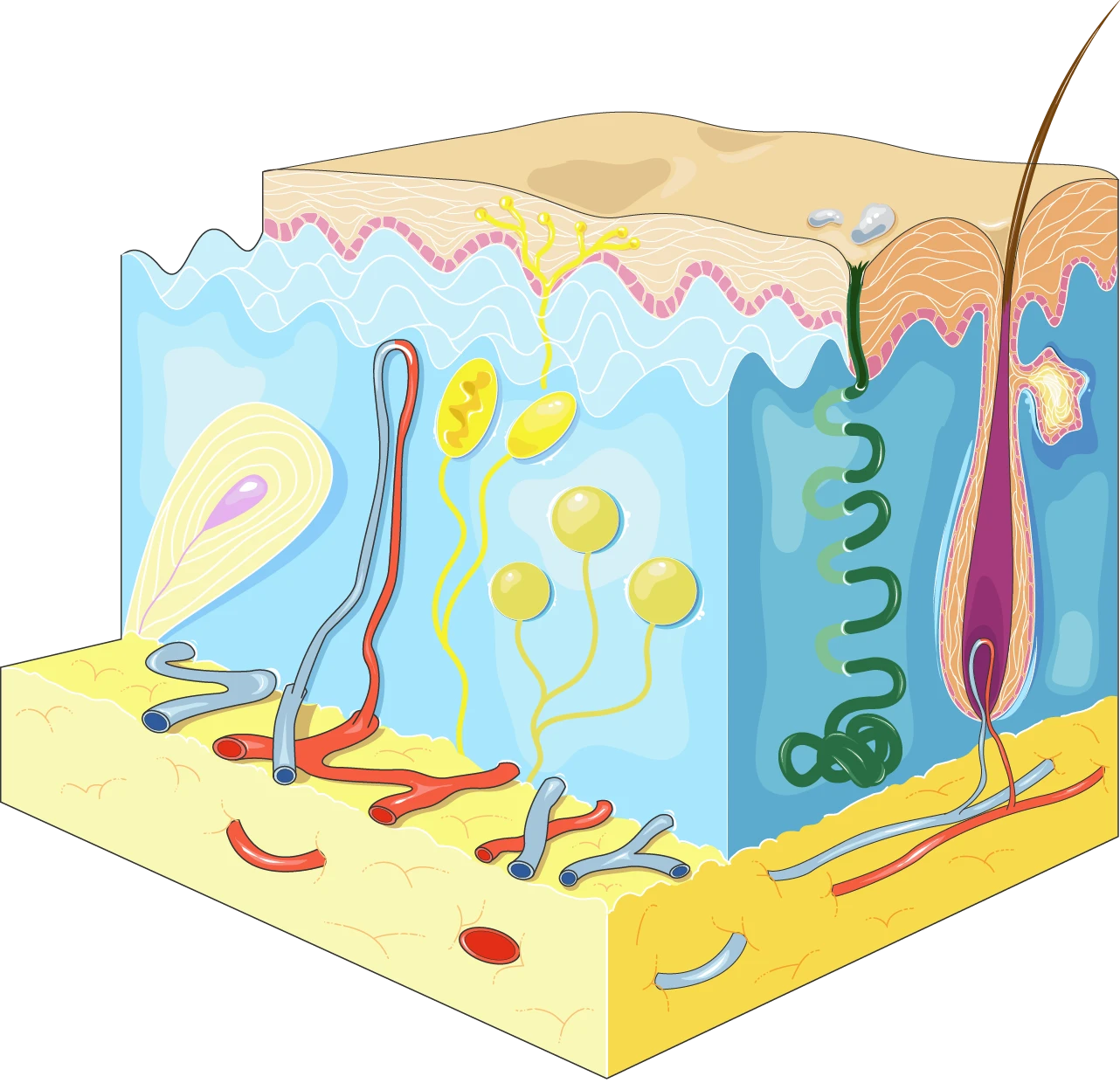
Anatomical study exhibit for the worked question below. Open the full-size view to inspect the structures.
Use the anatomical exhibit to work through the example. Choose an answer before opening the explanation.
Try it yourself
A patient who donated a split-thickness skin graft from the thigh has the donor site covered with an occlusive dressing and asks why it will not be opened for routine inspection and dressing changes. The accompanying illustration shows normal skin in section: epidermis overlying a dermis that contains hair follicles, glands, receptors and blood vessels, with subcutaneous tissue beneath. This is a normal anatomy reference, not a picture of the patient's wound. With this layered anatomy in mind, which explanation by the nurse is most accurate? A. Donor sites re-epithelialize rapidly, and keeping the dressing intact and undisturbed maintains a moist environment that supports healing and reduces pain. B. The dressing must stay sealed so that any developing infection remains contained within the wound bed. C. Donor sites heal best when left open to air so a dry scab can form as quickly as possible. D. The dressing is left intact only because the surgeon is unavailable to change it during the hospital stay.
Show answer and explanation
A. Donor sites re-epithelialize rapidly, and keeping the dressing intact and undisturbed maintains a moist environment that supports healing and reduces pain.
The illustration shows that the dermis contains hair follicles, glands and other epithelial elements. A split-thickness harvest leaves these appendages behind at the donor site, and their retained epithelial cells repave the surface quickly, which is why donor sites re-epithelialize rapidly. Keeping the occlusive dressing intact and undisturbed maintains the moist environment that supports this healing and minimizes pain, so the dressing is generally left in place unless signs of complications require evaluation. Claiming the dressing contains infection misstates its purpose, and exposing the site to air dries the wound and typically increases pain. The practice reflects wound-healing science, not scheduling convenience.
Scenario 1 worked through: a postoperative report that sounds almost normal
A patient on the second postoperative day after a reconstructive procedure reports that the surgical site 'feels tighter than yesterday.' The plausible mistake is treating this as expected healing and documenting reassurance; the stronger response is structured comparison against baseline and protocol-driven escalation.
The mistake in detail: the nurse hears a subjective complaint, matches it to a general expectation that swelling increases in early recovery, reassures the patient, and charts 'patient educated on expected swelling.' Why this is the weaker decision: it converts an assessment prompt into a reassurance task. The complaint is a change from yesterday, and the nursing value lies in comparing it against the documented baseline — appearance, symmetry, drainage, and the patient's own report over time — before deciding it fits the expected course. 'Tighter than yesterday' is data that deserves interpretation, not smoothing over.
The better decision: keep the report in the assessment column. Compare today's findings with yesterday's documented observations, examine the site within the nurse's scope, and escalate through the chain of command when the change cannot be explained by the documented expectations, because vascular and space-occupying problems after reconstructive surgery are time-sensitive and in a real unit follow local protocols and provider orders. Document the findings, the comparison, the notification, and the response. The lesson generalizes as a study habit: whenever a scenario presents a change over time, make baseline comparison your default first decision rather than categorizing the finding in isolation.
Scenario 2 worked through: an aesthetic question that pulls the nurse outside the role
A patient recovering well asks the nurse whether she should also book a related elective procedure 'since you see these all the time.' The plausible mistake is giving a personal recommendation; the better response stays within nursing education and routes the decision to the surgeon and shared decision-making.
The mistake in detail: flattered by the trust, the nurse says the additional procedure 'is very common and most patients are happy.' This crosses from nursing education into what amounts to a recommendation for an elective intervention, exposes the nurse professionally, and bypasses the assessment and consent process that belongs to the treating provider. It also imports someone else's outcomes onto this patient, whose anatomy, goals, and healing capacity the nurse has not evaluated for that procedure.
The better decision: acknowledge the question, provide factual education within the nursing role — what the procedure generally involves, typical recovery considerations, and the importance of individualized assessment — and explain that the decision rests with the patient and the surgeon through a proper consultation. Document the education provided and the patient's questions. In case-analysis terms, watch for answer options that replace referral and informed decision-making with informal endorsement; treat rapport in a scenario as a cue to recheck the assessment-and-consent boundary, not as permission to recommend.
CPSN compared with CANS: picking your target credential deliberately
The PSNCB administers two distinct specialty credentials: the Certified Plastic Surgical Nurse (CPSN) and the Certified Aesthetic Nurse Specialist (CANS). They share a certification board but have separate exam specifications, eligibility materials, and recertification requirements.
Conflating the two credentials is a concrete study risk: preparation built around one credential's emphasis can quietly skew your domain map. The PSNCB site presents CPSN and CANS as separate certification tracks with their own exam development materials and application resources, and lists substantially different numbers of currently certified holders in each — which signals genuinely distinct candidate populations rather than a single specialty with two names. If your study materials blur aesthetic injectables-heavy content into a reconstructive-heavy review (or the reverse), annotate the mismatch explicitly.
Use the table below as a decision aid when you choose materials and when you review: every resource you pick should clearly serve your target credential's scope. The PSNCB has also publicly warned that certain commercially sold CPSN practice-test booklets are not created or endorsed by the board, so verify that a resource's claimed connection to the credential is real before you budget study hours around it.
| Feature | CPSN (Plastic Surgical Nurse) | CANS (Aesthetic Nurse Specialist) |
|---|---|---|
| Issuing board | PSNCB | PSNCB |
| Specialty focus | Plastic surgical nursing across reconstructive and related surgical care | Aesthetic nursing practice |
| Exam materials | Own exam development and test specifications published by PSNCB | Separate exam development and test specifications published by PSNCB |
| Recertification | PSNCB publishes eligibility and recertification requirements | PSNCB publishes eligibility and recertification requirements |
| Common mix-up risk | Absorbing CANS-style aesthetic-only content uncritically | Absorbing CPSN-style surgical content uncritically |
A case-annotation exercise with a self-check rubric you can score honestly
Write one original two-paragraph case (a reconstructive recovery and an aesthetic consult), annotate every nursing decision inside it, then score yourself against a four-item rubric. Target observations: all decisions labeled, scope boundaries marked, documentation points named, and baseline comparisons explicit.
Exercise, about 30 minutes: draft Case A in which a patient three days after a reconstructive procedure reports a change you must interpret, and Case B in which a patient asks the nurse to endorse an elective option. Then annotate: underline every nursing decision, label it assessment, education, escalation, documentation, or scope boundary, and mark where a baseline comparison or a referral would change the outcome. Expected observations when the exercise works: Case A should generate at least two assessment-labeled decisions and one escalation point; Case B should generate at least one education-labeled decision and one clearly marked refusal to recommend.
Score with this rubric, one point each, out of four: (1) every decision is labeled with a category, not just narrated; (2) at least one scope boundary is explicit in each case; (3) each case names what would be documented, in content rather than a vague 'charted per policy'; (4) Case A states what baseline data the comparison uses. Treat three out of four as a working milestone and four as a mastery signal — these are learning benchmarks, not predictions of exam performance. Rerun the exercise after a week with new cases; score stability across fresh cases is the real readiness indicator.
A preparation sequence and concrete readiness checks for exam week
Sequence your review as: domain map first, dual-frame concept work second, scenario drilling third, rubric-scored self-tests fourth, and a final pass organized around your weakest annotated column. Readiness is behavioral — decisions made correctly under self-testing — not page counts.
Adaptable sequence: days one to two, build and memorize the five-column domain map with two explained topics per column; days three to five, run dual-frame analysis (one reconstructive sentence, one aesthetic sentence) across your full topic list; days six to eight, write and annotate four fresh scenarios using the exercise rubric, two reconstructive-framed and two aesthetic-framed; days nine to ten, convert every mistake from the annotations into a one-line contrast statement; final days, close notes and re-derive the map, then work mixed case questions and track decision-category accuracy, not raw totals.
Concrete readiness checks before you sit the exam: you can redraw the domain map from memory with correct placements; you can restate both worked scenarios from this guide — the trigger, the mistake, and the better decision — without notes; your rubric score on fresh, self-written cases holds at four out of four across two separate sittings; and you can name, for any topic on your map, whether it changes assessment, education, escalation, or documentation. For administrative matters — eligibility, application, scheduling, and current recertification requirements — rely on the PSNCB directly, since issuers own those facts and study guides should not.
References and further reading
Use these references to explore the concepts and check the latest information from the relevant organizations.